TRENDING ON AMAZON
Live Conscious Collagen Peptides Powder (Grass-Fed, Hydrolyzed Type I & III) Review: Is It Worth It?
Live Conscious Collagen Peptides is the grass-fed, pasture-raised hydrolyzed collagen that quietly became Amazon's best-value pick — 11g of Type I and III per scoop, unflavored, dissolves clean in coffee, no bovine funk, and roughly half the per-serving cost of the celebrity-brand tier.
Quick answer: Yes — Live Conscious Collagen Peptides is worth it as the smart-value pick for anyone starting collagen supplementation or looking to escape Vital Proteins pricing without sacrificing sourcing quality. Grass-fed pasture-raised bovine, 11g Type I & III per scoop, unflavored, dissolves clean in coffee or smoothies, and roughly half the per-serving cost of the celebrity-brand premium. Not the highest-dose option per scoop (Vital Proteins wins there), not third-party tested for banned substances (skip if you're a drug-tested athlete), but for the 90% of buyers who want clean collagen at a fair price for skin, hair, nail and joint benefits, it's the specific product to buy first.
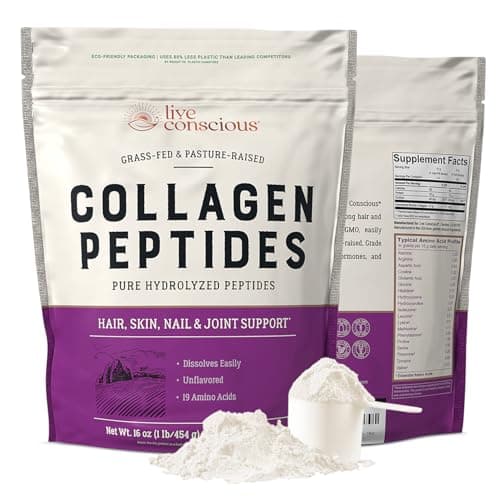
Product image from the Amazon listing.
Our verdict
Yes — Live Conscious Collagen Peptides is worth it as the smart-value pick for anyone starting collagen supplementation or looking to escape Vital Proteins pricing without sacrificing sourcing quality. Grass-fed pasture-raised bovine, 11g Type I & III per scoop, unflavored, dissolves clean in coffee or smoothies, and roughly half the per-serving cost of the celebrity-brand premium. Not the highest-dose option per scoop (Vital Proteins wins there), not third-party tested for banned substances (skip if you're a drug-tested athlete), but for the 90% of buyers who want clean collagen at a fair price for skin, hair, nail and joint benefits, it's the specific product to buy first.
The short version
Live Conscious Collagen Peptides is the value-tier grass-fed collagen powder that keeps showing up in 'best budget alternative to Vital Proteins' recommendations, and it earns the spot honestly. The formula is straightforward: hydrolyzed Type I and III collagen sourced from grass-fed, pasture-raised, hormone-free bovine, delivered as 11g per scoop with 19 amino acids in each serving. It's unflavored (dissolves clean in hot coffee, smoothies, or water without the mild beefy note some collagens have), tests non-GMO, and comes in a 16oz canister that lasts 40+ days of daily use. Most users report visible skin hydration and slightly stronger nails within 3-4 weeks, and improved joint comfort over 6-8 weeks. At roughly half the per-serving price of Vital Proteins, it's the pragmatic pick for anyone who wants clean-sourced collagen without paying the premium-brand tax.
Pros & cons
Pros
- Grass-fed, pasture-raised, hormone-free bovine sourcing
- 11g of Type I and III collagen per scoop — clinically-relevant dose
- 19 amino acids per serving
- Unflavored — dissolves cleanly in hot or cold liquids
- Non-GMO, no fillers, no artificial ingredients
- Roughly half the per-serving cost of Vital Proteins
Cons
- Some users notice mild clumping in very cold drinks (stir well or use warm)
- Not third-party tested for banned substances (not NSF Certified for Sport)
- Type I & III only — no Type II for cartilage-specific joint support
Why people love it
One scoop daily
Add one scoop (~11g) to your morning coffee, smoothie, oatmeal or plain water. Stir until dissolved — takes 10-15 seconds in hot liquid, slightly longer in cold. Consistency over 4-8 weeks is what produces visible skin, hair, nail and joint changes.
Types I and III do the visible work
Type I collagen is the primary structural protein in skin, hair, nails, tendons and bones — the type that produces most of the aesthetic benefits people notice. Type III is complementary, supporting skin elasticity and blood vessel structure. Together they're the standard 'beauty and everyday joint' collagen formula.
Amino acids get to work
Once ingested, hydrolyzed collagen breaks down into 19 individual amino acids (rich in glycine, proline, and hydroxyproline) that your body reassembles into collagen at sites where it's needed — skin dermis, nail matrix, hair follicles, connective tissue. Enzymatic hydrolysis is what allows the peptides to be absorbed and utilized.
Who it's for
- Anyone starting collagen supplementation on a budget
- Skin, hair and nail health focused users
- Adults 30+ noticing natural collagen production decline
- Coffee-and-smoothie regulars wanting easy daily supplementation
Why hydrolyzed collagen actually works (and where the hype outpaces the evidence)
Collagen is the most abundant protein in the human body — it makes up 30% of total protein content and provides structural support for skin, tendons, ligaments, bones, cartilage, blood vessels and organs. Natural collagen production peaks in your mid-20s and declines about 1% per year afterward, which is why skin gets thinner and less elastic, nails become more brittle, and joints stiffen with age. Hydrolyzed collagen supplementation works by delivering the specific amino acids (particularly glycine, proline, hydroxyproline) that your body uses to synthesize new collagen. The hydrolysis process breaks bovine or marine collagen into small peptide chains that are efficiently absorbed through the gut wall and delivered to the sites where collagen turnover is highest.
The research supports meaningful but modest benefits at clinically-relevant doses (10-20g daily) over 8-12+ weeks: 8-12% improvements in skin hydration and elasticity measured objectively, 12-15% reduction in nail brittleness, measurable improvements in joint comfort and mobility scores in adults with mild osteoarthritis or exercise-related joint stress. The hype outpacing the evidence: dramatic wrinkle reversal claims (unrealistic — collagen supplementation improves skin quality but doesn't erase established wrinkles the way retinoids can), hair-growth miracles (some benefit, but not comparable to actual hair-loss treatments), and joint-cartilage regeneration in advanced arthritis (Type II collagen may help but Type I & III supplementation is not the specific tool). Set realistic expectations — skin dewy-ness and nail strength within a month, joint comfort within 2-3 months, long-term maintenance benefits with continued daily use.
Live Conscious Collagen vs Vital Proteins, Sports Research, and the value-brand tier
The collagen supplement market has stratified into three tiers with real quality and price differences. Premium tier ($0.90-1.20/serving): Vital Proteins Collagen Peptides leads on brand recognition and celebrity endorsement, uses pasture-raised grass-fed bovine, delivers 20g per scoop, widely available at Whole Foods, Target and health food stores. Solid but expensive. Value-premium tier ($0.60-0.80/serving): Sports Research Collagen Peptides is the athlete-focused pick — grass-fed pasture-raised bovine plus hyaluronic acid and vitamin C for enhanced skin support. Live Conscious (this review) is the pure-value grass-fed pick at similar price without added extras. Budget tier ($0.30-0.50/serving): NeoCell Super Collagen and other bulk-sourced products deliver working collagen at rock-bottom prices without grass-fed designation.
How to actually choose: Match to your budget and priorities. If you're first exploring collagen supplementation and want a clean, well-sourced product without paying celebrity-brand premium, Live Conscious is the smart entry point. If you're already committed to collagen long-term and want the extras (hyaluronic acid, vitamin C), Sports Research adds real value. If you want the maximum daily dose per scoop in a widely-available premium product and price isn't a factor, Vital Proteins. If you're purely cost-optimizing and don't care about grass-fed sourcing, NeoCell delivers the working molecule cheapest. All four brands produce measurable results at consistent daily doses over 8+ weeks; the differences are sourcing quality, added ingredients and serving size, not fundamental efficacy.
Building a skin, hair and joint routine around collagen (what to combine and what to skip)
Collagen supplementation works best as part of a broader skin/hair/joint routine rather than as a magic bullet. For skin: pair daily collagen with a consistent skincare routine including sunscreen (the single most impactful anti-aging intervention — EltaMD UV Clear or Neutrogena Ultra Sheer), a nightly retinoid (Paula's Choice BHA for gentler exfoliation or a proper retinol like CeraVe Retinol for anti-aging), and a hydrating cleanser (CeraVe Hydrating Cleanser). Topical vitamin C in the morning helps with brightness. Collagen amplifies what these products do; skincare without collagen still works but shows slower visible results as natural production declines.
For hair: combine collagen with adequate protein intake overall (0.7-1g per lb bodyweight), iron and B-vitamin adequacy (deficiencies show up as hair loss before any other symptom), and topical scalp treatments if you're dealing with thinning (Mielle Rosemary Oil or minoxidil depending on severity). Nutrafol Women is a more targeted hair-focused supplement if hair specifically is your priority. For joints: pair collagen with adequate omega-3 intake (Nordic Naturals Ultimate Omega or Nature's Bounty Fish Oil) for anti-inflammatory support, plus consistent low-impact movement — collagen synthesis is stimulated by mechanical loading of connective tissues. For active recovery, consider adding Momentous Creatine for muscle support, Thorne Magnesium Glycinate for sleep quality (collagen synthesis peaks during deep sleep), and hydration (Liquid I.V. or plain water discipline). The combined routine, sustained over 3-6 months, produces the visible skin/hair/nail/joint changes people hoped a single supplement would deliver alone.
See Live Conscious Collagen on Amazon
Check the latest price, photos and buyer reviews on Amazon.
Check Price on Amazon →Sold and shipped by AmazonFrequently asked questions
Is Live Conscious Collagen Peptides worth it?
Yes — Live Conscious Collagen Peptides is worth it as the smart-value pick, and it's the specific collagen powder to buy first if you're new to supplementation or trying to cut your Vital Proteins spend without losing sourcing quality. What you actually get for the money: grass-fed, pasture-raised, hormone-free bovine hydrolyzed collagen (Type I & III), 11g per scoop with 19 amino acids, unflavored, 45 servings per canister, at roughly $0.75 per serving. That's about half the per-serving price of Vital Proteins with the same sourcing standard. The trade-offs are honest and specific: 11g per scoop rather than Vital Proteins' 20g (double up if you want a higher daily dose), it's not third-party tested for banned substances (skip if you're a drug-tested athlete), and there's no added hyaluronic acid or vitamin C (Sports Research adds those). For the 90% of buyers who just want clean daily collagen for skin, hair, nails and joint comfort, this is the smart-money default.
Live Conscious Collagen vs Vital Proteins vs Sports Research Collagen — which should I buy?
Three good options at different price points. Vital Proteins Collagen Peptides is the premium/celebrity brand — pasture-raised grass-fed bovine, 20g per scoop, widely available, priced at the top of the mainstream range (~$27 for ~28 servings, ~$0.96/serving). Sports Research Collagen Peptides is the value-premium middle option — pasture-raised grass-fed bovine with hyaluronic acid and vitamin C added, ~$28 for 41 servings ($0.68/serving). Live Conscious (this review) is the true value pick — grass-fed pasture-raised bovine, 11g per scoop, ~$34 for 45 servings ($0.75/serving). The 11g vs 20g scoop size matters: Vital Proteins delivers more collagen per scoop but at ~30% higher per-gram cost. If you want the highest daily dose per scoop and don't mind the price, Vital Proteins. If you want a lightweight daily habit at value price, Live Conscious. If you want extras like hyaluronic acid and vitamin C for maximum skin benefit, Sports Research. All three use similar-quality grass-fed sourcing.
How long until I see results from Live Conscious Collagen?
The typical timeline: skin hydration improvements at 2-3 weeks (subtle — dewier appearance, less dryness), stronger nails at 3-4 weeks (they stop peeling and break less), thicker or shinier hair at 4-8 weeks (slower to notice — new hair growth is what shows the effect), and reduced joint stiffness at 6-12 weeks (particularly for morning stiffness or minor exercise-induced achiness). Full effects on skin elasticity and long-term joint health build over 3-6 months of consistent daily use. Take a photo of your hands, hairline and skin when you start — the differences at week 8 are easier to see side by side than in the mirror day to day. Stop for 2-3 weeks and the visible effects gradually reverse; collagen supplementation is a maintenance tool, not a one-time treatment.
Can I put Live Conscious Collagen in coffee, and does hot temperature destroy it?
Yes to coffee, and no — hot temperatures do not destroy hydrolyzed collagen. Regular coffee brewing temperature (195-205°F) is well below the temperature that would meaningfully degrade collagen peptides during a brief mixing period. The peptides dissolve faster in hot liquid than cold, so adding a scoop to your morning coffee is actually the fastest and cleanest way to consume it. If you're specifically worried about heat, add the collagen after the coffee has cooled slightly (say, 160-180°F rather than piping hot fresh-brewed), but the difference in bioavailability is negligible. Cold liquids (iced coffee, smoothies, water) work too but require more stirring or shaking to fully dissolve. A shaker bottle helps for cold drinks.
Is Live Conscious Collagen good for skin, hair, and nails specifically? What's the research?
The research on hydrolyzed collagen for skin, hair and nails is genuinely positive, though not miraculous. Multiple randomized controlled trials show consistent improvements in skin hydration and elasticity at 10-15g daily doses over 8-12 weeks (Live Conscious's 11g per scoop is within this dose range). Nail growth rate and strength improvements are documented at similar doses. Hair benefits are more variable — some studies show thickness and shine improvements, others show minimal effect. Joint benefits (reduced stiffness, improved comfort) are well-documented in adults with mild osteoarthritis or exercise-related joint stress. What collagen supplementation is NOT: a wrinkle cure (topical retinoids like Paula's Choice BHA and CeraVe Retinol Serum are more effective for visible wrinkles), a hair-loss treatment (see minoxidil or Nutrafol for that), or a joint-cartilage regenerator (that's Type II collagen territory). For general skin quality, nail strength and everyday joint comfort at a fair price, Live Conscious delivers.
Is Live Conscious Collagen safe for daily long-term use?
Yes — collagen peptides are among the safest supplements in the category, with no documented long-term harm from typical daily doses (10-20g) in healthy adults. The peptides are simply protein fragments (specific amino acid sequences) that your body would normally consume from any protein-rich food; the difference is that hydrolyzed collagen delivers a concentrated dose of the specific amino acids (glycine, proline, hydroxyproline) most useful for collagen synthesis. Rare side effects: some users report mild digestive upset (bloating, feeling full) when first starting — usually resolves within a week as your gut adapts. If you have specific bovine allergies or dietary restrictions, obviously skip. Pregnant and nursing women should consult their doctor before starting any new supplement. For everyone else, daily use for years is well-tolerated and the visible benefits (skin, hair, nail, joint) accumulate over time.
Live Conscious vs NeoCell Super Collagen: which value collagen is better?
They're the two most-compared budget collagen brands on Amazon. Live Conscious uses pasture-raised, grass-fed bovine at ~$34 for 45 servings (11g each). NeoCell Super Collagen uses non-specified bovine sourcing at ~$18-25 for similar serving count and dosage. The core question is sourcing quality: Live Conscious's explicit grass-fed pasture-raised designation matters if you specifically care about how the source animals were raised (grass-fed bovine has different fatty acid profile and, for some consumers, is an animal welfare priority). NeoCell delivers the same collagen molecules at a lower price without the grass-fed premium. Both work equivalently for skin/hair/nail/joint benefits — the peptides are chemically identical once hydrolyzed. Pick Live Conscious if grass-fed sourcing matters to you; pick NeoCell if you want the cheapest working collagen. Both are meaningful upgrades over cheaper 'collagen coffee creamer' products that dilute actual collagen content with sweeteners and creamers.
As an Amazon Associate, TopCrate earns from qualifying purchases at no extra cost to you. Live Conscious Collagen is a dietary supplement, not a medical treatment. Pregnant or nursing women should consult their doctor before starting any new supplement. Product image, price, availability and ratings are shown on Amazon and are subject to change.