TRENDING ON AMAZON
Sports Research Collagen Peptides Powder (Type I & III) Review: Is It Worth It?
The unflavored 11g-per-scoop hydrolyzed Type I & III collagen from grass-fed pasture-raised cattle — Informed Choice sport-tested, USDA Organic certified, and the best-value clean-label collagen powder on Amazon.
Quick answer: Yes — Sports Research Collagen Peptides is the correct value pick in the mainstream collagen powder category. 11g of grass-fed hydrolyzed Type I & III collagen per scoop, Informed Choice for Sport certified, USDA Organic, dissolves cleanly, and priced 30-40% below Vital Proteins for equivalent quality per gram. Not the highest-dose collagen on the market (some brands offer 20g scoops), but the balance of purity, third-party testing, taste and price is why 50,000+ Amazon reviews at 4.7 stars have made this the specific product nutritionists and personal trainers point people to. For anyone starting daily collagen for skin, hair, nail or connective tissue support, this is the smart-money pick.
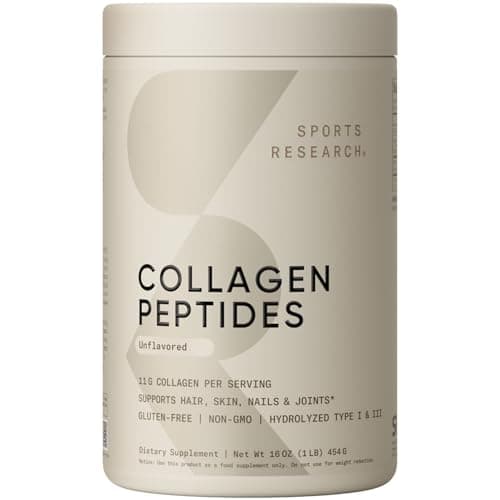
Product image from the Amazon listing.
Our verdict
Yes — Sports Research Collagen Peptides is the correct value pick in the mainstream collagen powder category. 11g of grass-fed hydrolyzed Type I & III collagen per scoop, Informed Choice for Sport certified, USDA Organic, dissolves cleanly, and priced 30-40% below Vital Proteins for equivalent quality per gram. Not the highest-dose collagen on the market (some brands offer 20g scoops), but the balance of purity, third-party testing, taste and price is why 50,000+ Amazon reviews at 4.7 stars have made this the specific product nutritionists and personal trainers point people to. For anyone starting daily collagen for skin, hair, nail or connective tissue support, this is the smart-money pick.
The short version
Sports Research Collagen Peptides is the collagen powder that quietly won the value-vs-quality war on Amazon. It delivers 11g of hydrolyzed Type I and III collagen per scoop from grass-fed, pasture-raised bovine sources, is Informed Choice for Sport certified (batch-tested for banned substances by an independent lab), USDA Organic certified, and dissolves cleanly into coffee, smoothies, water or oatmeal without clumping or grittiness. The 16-ounce unflavored container delivers roughly 41 servings for $27-32, which works out to $0.66-0.78 per serving — significantly cheaper than Vital Proteins ($1.20-1.50/serving) and comparable-quality to premium brands at half the price. Not the highest-collagen-per-serving on the market (some brands like NativePath and Ancient Nutrition offer 20g scoops), but the balance of dose, purity, third-party testing and price is why this specific product has become the mainstream recommendation from nutritionists, personal trainers and Wirecutter's supplement testing.
Pros & cons
Pros
- 11g of hydrolyzed Type I & III collagen per scoop
- Grass-fed, pasture-raised bovine sourcing
- Informed Choice for Sport certified — batch tested for banned substances
- USDA Organic certified
- Dissolves cleanly in hot or cold liquids — no clumping
- Unflavored — mixes into any drink, smoothie or recipe
- Best value in the mainstream collagen category at $0.66-0.78/serving
Cons
- Type I & III only — misses Type II (joints/cartilage) that some multi-type blends include
- Bovine source — not vegan/vegetarian friendly
- Unflavored version has a very mild savory note some detect in plain water
Why people love it
Hydrolyzed for maximum absorption
Standard collagen is a large molecule your gut can't absorb well. Hydrolysis breaks it into peptides small enough to pass through the gut wall — the specific process that makes collagen supplementation actually deliver amino acids to the tissues that use them.
Type I & III support skin, hair, nails and connective tissue
Type I is the most abundant collagen in the body (found in skin, tendons, ligaments, bones); Type III supports skin elasticity and blood vessels. Together they cover the main use cases people supplement collagen for. Type II (found in cartilage) is a separate product category for joint-specific supplementation.
Third-party tested for purity and banned substances
Informed Choice for Sport batch-tests each production run for over 200 banned athletic substances — the same certification the NCAA and pro sports rely on. USDA Organic certification confirms the cattle sourcing meets organic standards.
Who it's for
- Anyone starting daily collagen for skin, hair, nail and connective tissue support
- Athletes needing third-party-tested (Informed Choice) supplements
- Value-conscious buyers wanting Vital Proteins-quality at Amazon Basics price
- Coffee drinkers who want to stir collagen into their morning cup
How collagen supplementation actually works (and where the science is genuinely strong)
Collagen is the most abundant protein in the human body — it makes up 30% of total protein and is the primary structural component of skin, tendons, ligaments, bones, cartilage and blood vessels. From your early 20s onward, your body's ability to produce new collagen declines by about 1% per year, contributing to the visible signs of aging (thinner skin, more visible wrinkles, weaker nails, joint stiffness). The theoretical basis for collagen supplementation is that providing pre-hydrolyzed collagen peptides gives your body the specific amino acids (glycine, proline, hydroxyproline) it needs to build new collagen tissue, without requiring your gut to break down full-length collagen molecules (which it can't do efficiently).
The evidence base for collagen supplementation is stronger than the average supplement — peer-reviewed studies published in Nutrients, Journal of Medical Nutrition & Nutraceuticals, Skin Pharmacology and Physiology, and Journal of the Science of Food and Agriculture consistently show measurable improvements in skin elasticity (5-10% at 8-12 weeks), reduced wrinkle depth, increased skin hydration, improved nail growth rate (up to 12% faster), and reduced joint discomfort in supplemented adults compared to placebo. Not every study is perfect, and some effects are modest, but the direction of evidence has been consistent for over a decade of published research. Collagen supplementation is one of the few beauty/anti-aging supplements with reasonable peer-reviewed support — Sports Research Collagen Peptides delivers the specific hydrolyzed peptide form the research has been validated on.
Where Sports Research Collagen fits vs the premium and budget alternatives
The collagen powder market has stratified into three clear tiers by 2026. Premium tier ($1.20-2.00/serving): Vital Proteins Collagen Peptides is the mainstream default, NativePath is aggressive on the anti-aging positioning, Ancient Nutrition emphasizes multi-collagen blends. These all deliver 15-20g per serving from clean sources and have big marketing budgets. Value tier ($0.60-0.90/serving): Sports Research Collagen Peptides, Great Lakes Collagen Peptides, and Vital Performance Collagen from Vital Proteins itself all deliver comparable-quality collagen at meaningfully lower prices. Budget tier ($0.30-0.50/serving): generic Amazon brands like Nature's Nutrition and Bulk Supplements deliver actual collagen at rock-bottom prices, but the hydrolysis quality varies and taste/dissolution suffer.
Sports Research's specific advantage in the value tier is its Informed Choice for Sport certification — the same third-party testing standard used by the NFL, NCAA, MLB and Olympic sports. That certification specifically screens each batch for 200+ banned substances, which matters for athletes but also matters as a general quality signal (brands that submit to this testing are generally more careful about sourcing and manufacturing). The USDA Organic certification adds another layer of sourcing quality. For someone who wants the specific benefits of a Vital Proteins or similar premium collagen at 40-50% less cost per gram, Sports Research is the correct answer. For someone specifically wanting 20g of collagen per scoop (higher dose), Vital Proteins is still the mainstream default. Both are legitimate; the value math favors Sports Research.
Common collagen mistakes (and what a real supplementation routine looks like)
The most common mistake is expecting overnight results. Collagen supplementation works over 8-12 weeks of consistent daily use — cumulative amino acid support builds new tissue slowly, and the visible effects follow that timeline. People who try collagen for 2-3 weeks and don't see anything are almost always quitting too early. Take 10-20g daily for at least 8 weeks before evaluating whether it's working for you. The second common mistake is inconsistent dosing — taking it 3 days a week or forgetting for a week at a time. Collagen requires steady daily intake because the amino acids are used continuously for tissue synthesis; skipping days means your body reverts to baseline synthesis rates. Set a routine: morning coffee, morning smoothie, or with breakfast — whichever fits your schedule reliably. Consistency beats dose.
The third mistake is combining collagen with insufficient overall protein intake. Your body prioritizes protein for muscle protein synthesis and general repair before it uses excess amino acids for collagen tissue. If you're eating below your total protein target (roughly 0.8g per lb of lean body mass per day), the collagen amino acids get diverted to more urgent uses. Make sure your total daily protein is on track before adding collagen for skin/hair/nail benefits. Pair with a solid protein-forward routine like a scoop of Optimum Nutrition Whey post-workout for the muscle side, and Sports Research Collagen daily in your morning coffee for the connective-tissue side. That combination is what a real supplementation routine looks like — not a single miracle powder, but a stack of nutrients that support the specific tissues you want to improve. Add Nutricost Creatine for cognitive and muscle performance and you have the three-supplement stack that delivers the most evidence-based benefit per dollar for adults over 30.
See Sports Research Collagen on Amazon
Check the latest price, photos and buyer reviews on Amazon.
Check Price on Amazon →Sold and shipped by AmazonFrequently asked questions
Sports Research vs Vital Proteins collagen — which should I actually buy?
Sports Research is the better value; Vital Proteins is the more established mainstream brand. Both are hydrolyzed Type I & III collagen from grass-fed bovine sources, both dissolve well in coffee and smoothies, both are widely available. Differences: Vital Proteins runs 20g per serving vs Sports Research's 11g (so Vital Proteins delivers more collagen per scoop but is proportionally more expensive per gram of collagen), Vital Proteins has broader retail distribution (Whole Foods, Target, Costco), Sports Research has Informed Choice for Sport certification that Vital Proteins doesn't currently carry. Per-gram of actual collagen delivered, Sports Research is 20-40% cheaper. If you want the brand-recognized default and don't mind paying more, Vital Proteins is fine. If you want the same quality collagen at a better price with athlete-tier third-party testing, Sports Research is the smarter buy.
How long until I see results from taking collagen daily?
For skin, hair and nail improvements, most people notice changes within 4-8 weeks of consistent daily use at 10-20g per day. Nail growth speed and strength changes are usually first (2-4 weeks), followed by skin elasticity and hydration improvements (4-8 weeks), followed by hair thickness and shine (6-12 weeks). For joint and connective tissue support, meaningful changes take 12+ weeks of consistent use. Peer-reviewed studies on collagen peptides (published in journals like Nutrients and Journal of Medical Nutrition & Nutraceuticals) consistently show measurable improvements in skin elasticity, wrinkle depth, and nail growth rate over 8-12 week periods with 10g+ daily supplementation. The results are real but not overnight — think of it as a supplement you take for months to see cumulative benefit, not a quick fix.
Do I need to take collagen with vitamin C for it to work?
Not strictly required, but it does help. Vitamin C is a cofactor in the body's own collagen synthesis pathway — without adequate vitamin C, your body can't efficiently use the amino acids from collagen peptides to build new collagen tissue. Most people already get plenty of vitamin C from diet (citrus, peppers, berries), so an additional supplement isn't necessary. But if you have low dietary vitamin C intake, taking 200-500mg of vitamin C at the same time as your collagen peptide dose ensures the amino acids can be efficiently used. For anyone taking collagen daily for cosmetic benefits, checking your general vitamin C intake is a cheap way to make the supplement work harder. A single orange or bell pepper covers you.
Can I take collagen while pregnant or breastfeeding?
Collagen peptides from grass-fed bovine sources are generally considered safe during pregnancy and breastfeeding — they're just amino acids from an animal protein source, similar to eating a portion of bone broth. Sports Research Collagen Peptides is USDA Organic certified and has no additives that would be problematic during pregnancy. That said, standard advice applies: consult your OB or midwife before starting any new supplement during pregnancy, especially since your specific medical history may have relevant factors. Many prenatal nutritionists actively recommend collagen supplementation during pregnancy for connective tissue support, especially in the third trimester when the body is producing significant new tissue. If your provider approves, this specific product is a clean, third-party-tested option that fits pregnancy dietary guidelines.
Does it actually taste like nothing when I mix it into coffee?
The unflavored version has a very mild savory/protein taste that most people can't detect once mixed into coffee, smoothies, oatmeal or soup. In plain water at a large 15-20g dose, some sensitive palates notice a mild broth-like note (this is normal for hydrolyzed protein). In coffee (even black), the taste is completely masked by the coffee flavor. In smoothies with fruit or protein powder, it's undetectable. In hot tea or oatmeal, undetectable. If you're specifically sensitive to any protein powder taste in plain water, mix it into flavored liquids or foods rather than trying to drink it plain. Sports Research also makes flavored versions (Chocolate, Vanilla) if you specifically want a flavor, but they cost slightly more. For most users, the unflavored is the right pick because it's the most flexible.
How does Sports Research collagen dissolve compared to cheaper brands?
Excellent — this is one of the specific advantages that makes it a mainstream recommendation. In hot liquids (coffee, tea, oatmeal), it dissolves fully within 15-30 seconds of stirring, no clumping, no gritty residue. In cold liquids (smoothies, water, cold brew), it takes slightly longer (30-60 seconds) but still fully dissolves without clumps if you stir vigorously or use a shaker bottle. Cheaper generic collagen brands often use less-refined hydrolysis, leaving larger particles that don't dissolve fully — you get gritty residue at the bottom of the glass or a slime layer floating on top. Sports Research's hydrolysis is more thorough, producing smaller peptides that dissolve cleanly. For anyone who's tried cheap collagen and been put off by the texture, Sports Research is a real improvement worth the small premium.
As an Amazon Associate, TopCrate earns from qualifying purchases at no extra cost to you. Consult a physician before starting new supplements, especially if pregnant, breastfeeding, or on medication. Not FDA-evaluated. Product image, price, availability and ratings are shown on Amazon and are subject to change.