HANDS-ON REVIEW
Statik State Semi-Solid-State Power Bank Review: Is It Worth It?
A magnetic, phone-hugging power bank built on semi-solid-state battery chemistry — the fire-resistant next generation of the lithium cell.
Quick answer: Yes — the Statik State power bank is worth $49.99 for MagSafe iPhone owners who fly: a magnetic snap-on charger built on semi-solid-state chemistry, which uses a gel-matrix electrolyte that resists thermal-runaway fires instead of the flammable liquid every other bank ships with. It's what the power bank category should have been building toward: the convenience of magnetic snap-on charging on top of cell chemistry that removes the category's one real hazard. It costs more per mAh than the bargain bin and wireless is never the fastest lane, but as the bank that lives in a bag, a pocket, and a carry-on, safer-and-cooler-running is worth the premium.
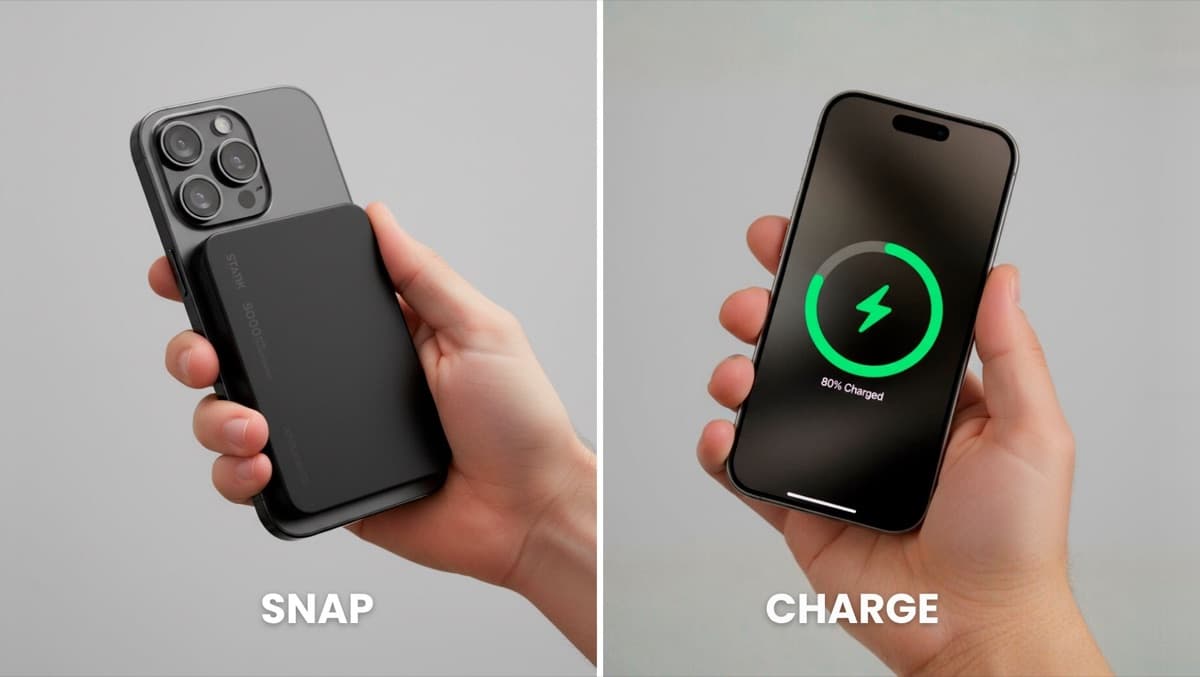
Snap on the back, keep using the phone — no cable between you and the charge. Photo: Statik
Our verdict
Yes — the Statik State power bank is worth $49.99 for MagSafe iPhone owners who fly: a magnetic snap-on charger built on semi-solid-state chemistry, which uses a gel-matrix electrolyte that resists thermal-runaway fires instead of the flammable liquid every other bank ships with. It's what the power bank category should have been building toward: the convenience of magnetic snap-on charging on top of cell chemistry that removes the category's one real hazard. It costs more per mAh than the bargain bin and wireless is never the fastest lane, but as the bank that lives in a bag, a pocket, and a carry-on, safer-and-cooler-running is worth the premium.
The short version
Every power bank you've owned runs on the same liquid-electrolyte lithium cells that airlines keep making announcements about — puncture one, overheat one, and the flammable liquid inside is the problem. Statik State is built on semi-solid-state chemistry instead: the electrolyte is a gel-like matrix that resists catching fire even when damaged, runs cooler, and tolerates more charge cycles before fading. Around that safer core is a clean everyday charger — a slim magnetic slab that snaps onto the back of a MagSafe-era iPhone (or any phone with a magnetic ring) and wirelessly charges while you keep scrolling, with USB-C for wired speed when you want it.
Pros & cons
Pros
- Semi-solid-state cells resist fire even if punctured or damaged
- Magnetic snap-on wireless charging — no cable, keep using the phone
- USB-C in/out for full-speed wired charging too
- Runs cooler and survives more charge cycles than liquid cells
- Slim, pocketable slab — travels flat against the phone
- TSA-friendly capacity for flights
Cons
- Costs more per mAh than commodity liquid-cell banks
- Magnetic wireless charging is slower than plugging in
- Android phones may need a magnetic ring case to snap on
How it works
Snap it on
The magnet array aligns itself to the back of the phone — no cable, no fumbling. Wireless charging starts on contact.
Keep using your phone
The bank rides flush like a slightly thicker case while it charges, so texting, maps and video keep going.
Refill over USB-C
Recharge the bank itself — or wired-charge a device at full speed — through the USB-C port. Pass-through lets one wall plug fill both overnight.
Who it's for
- Travelers who want a bank they trust in a carry-on
- Anyone burned (figuratively or otherwise) by cheap banks
- MagSafe iPhone owners tired of carrying a cable
- Commuters whose phone dies by the ride home
What 'semi-solid-state' actually means
Inside a conventional power bank is a lithium cell whose electrodes swim in liquid electrolyte — an energetic, flammable solvent. Damage the cell (puncture, crush, extreme heat) and that liquid is the fuel for thermal runaway: the fires behind airline battery rules and doorbell-camera footage of glowing backpacks. Solid-state batteries replace the liquid with a stable solid — the holy grail — but they're still hard to mass-produce. Semi-solid-state is the shipping-today middle: a gel/matrix electrolyte with dramatically less flammable liquid, so a damaged cell smolders into failure instead of erupting.
The same chemistry brings quieter wins: less internal resistance means less heat in normal fast-charging, and the cell structure tolerates more charge cycles before capacity fades — a bank that still holds most of its capacity when a commodity cell would be noticeably tired. You're paying a premium per mAh for the cell technology rather than the case design, which is the right place for the premium to be.
The magnetic form factor is the everyday win
Safety chemistry gets the headline, but the snap-on design is what changes daily behavior. A cabled power bank turns your phone into a two-piece appliance — pocket the bank, snake the cable, hold both. A magnetic bank makes charging ambient: snap it on when the battery dips, keep texting, pull it off when done. Because the friction is near zero, you actually use it at 40% instead of performing the low-battery panic at 8%.
It plays the same role on the desk and nightstand — the bank itself refills over USB-C, and pass-through charging means one wall plug tops up phone and bank together overnight, so it leaves the house full. If your charging life is more cables-and-bricks than magnets, a high-wattage wall charger plus a standard bank still wins on raw speed; the Statik's case is built on convenience-plus-chemistry, not maximum watts.
Is Statik State worth $49.99?
Against $25 commodity banks, you're paying roughly double for two things: cells that won't become a news story in your backpack, and the magnetic wireless deck. Against Apple-adjacent magnetic packs — which run the same price or more on ordinary liquid cells — Statik is arguably the value pick, matching the convenience while upgrading the chemistry. There's no configuration in the category that gets you both for less.
Fit notes: MagSafe-era iPhones (12 onward) snap natively; Android and older phones need a magnetic ring or compatible case, a $10 addition worth budgeting. Frequent flyers should note the practical bonus — a bank with fire-resistant chemistry is exactly the thing you want to be carrying when the gate agent eyes your carry-on. For the cable-free pocket loadout, it pairs naturally with a magnetic snap-on charger at home and a slim tracker in the wallet.
Flying with a power bank in 2026 — TSA/FAA rules and why semi-solid-state matters at 35,000 feet
The rules on lithium batteries in the cabin are simple and getting stricter every year, and Statik State is designed for them. TSA and FAA (and equivalents in the EU, UK and most of Asia) require all lithium-ion power banks to travel in carry-on baggage only — never in checked luggage. The reason is thermal runaway: a damaged or defective cell in the cargo hold below 30,000 feet is a cargo fire nobody can respond to; in the cabin, crew can move it, dunk it in a thermal-containment bag (most airlines now carry them), or in the worst case wet it. The watt-hour ceiling matters too: under 100 Wh (roughly a 27,000mAh at 3.7V bank) is fine and unlimited; 100-160 Wh needs airline approval and is limited to two per passenger; over 160 Wh is banned outright in passenger aircraft. Statik State's capacity is well under the 100 Wh threshold, so no paperwork applies — but the trend is toward tighter rules after several 2024-2025 in-cabin battery fires, and Korean Air, Cathay Pacific and Air Asia already require power banks to be visible on your person (not stowed in an overhead bin) throughout the flight starting 2025.
This is the specific context where semi-solid-state chemistry earns its premium. A conventional lithium-ion bank in a compressed carry-on wedged against a laptop for a 12-hour flight is exactly the pressure-plus-heat scenario that pushes marginal cells toward thermal runaway. A gel-electrolyte cell isn't immune, but the chemistry that resists ignition on puncture is the same chemistry that resists ignition on crush and heat — the failure mode becomes 'smolders and dies' instead of 'catches the cabin on fire.' Practical flying protocol regardless of brand: (1) never check a power bank, ever; (2) keep it in a seat-back pocket or under the seat in front of you where you can reach it, not in the overhead bin; (3) unplug it from your phone during landing and taxi (a bank connected to a charging device is doing the highest-thermal-stress work of its cycle); (4) if it ever gets hot to the touch mid-flight, alert cabin crew immediately — do not try to unplug or move it yourself. For anyone who flies more than a few times a year, a bank whose chemistry is designed for the actual worst case is $20 well spent.
Try Statik State for Yourself
Available now for $49.99.
Check Availability & Price →Ships to your doorFrequently asked questions
What makes semi-solid-state safer?
The flammable liquid electrolyte of a normal lithium cell is replaced with a gel-like matrix. With far less liquid fuel inside, a damaged or overheated cell resists the thermal-runaway fires that conventional banks are notorious for.
Will it work with my phone?
MagSafe-era iPhones snap on directly. Android phones and older iPhones work too — wirelessly with a magnetic ring case, or at full speed through the USB-C port with a cable.
Can I use my phone while it charges?
Yes — that's the point of the snap-on design. It rides flush on the back like a thick case while charging wirelessly; there's no cable between you and the screen.
Can I take it on a plane?
Yes — it's within TSA's carry-on limits for power banks (always carry-on, never checked). The fire-resistant chemistry is a bonus the person in seat 14B will never know to thank you for.
How fast does it charge?
Wired over USB-C it fast-charges like a quality bank; magnetic wireless is inherently slower and best treated as top-up-while-you-scroll. Use the cable when you need the fastest fill.
How long will the battery itself last?
Semi-solid-state cells tolerate more charge cycles before fading than liquid cells, so expect it to outlive a commodity bank — typically years of daily use before capacity noticeably drops.
When you buy through links on this page, TopCrate may earn an affiliate commission at no extra cost to you. Specifications reflect the manufacturer's listing. Prices accurate as of publish time.