TRENDING ON AMAZON
Anker Prime 100W GaN Wall Charger (3 Ports) Review: Is It Worth It?
A pocket-sized 100W GaN charger with three ports that replaces the laptop brick, the phone charger and the tablet charger in your bag.
Quick answer: If you carry more than one USB-C device, the Anker Prime 100W is the charger to buy. It replaces the laptop brick, the phone charger and the tablet charger with a single pocket-sized cube that fast-charges all three at once. Best upgrade under $80 for anyone with a bag full of cables. Round out the everyday-carry kit with a battery for the outlet-free hours: a solid [Anker portable power bank](/reviews/anker-power-bank) is the wall-charger's other half, and the two together mean a phone never dies whether or not you can find an outlet.
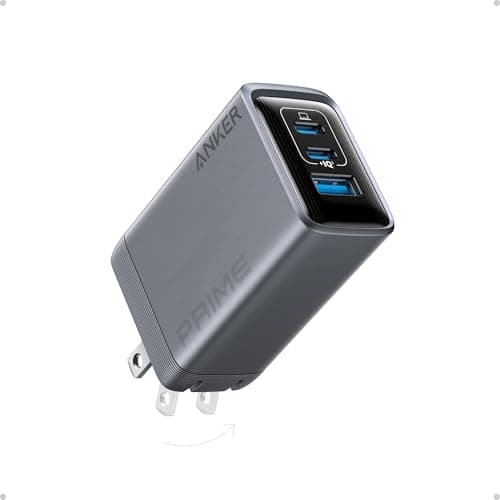
Product image from the Amazon listing.
Our verdict
If you carry more than one USB-C device, the Anker Prime 100W is the charger to buy. It replaces the laptop brick, the phone charger and the tablet charger with a single pocket-sized cube that fast-charges all three at once. Best upgrade under $80 for anyone with a bag full of cables. Round out the everyday-carry kit with a battery for the outlet-free hours: a solid [Anker portable power bank](/reviews/anker-power-bank) is the wall-charger's other half, and the two together mean a phone never dies whether or not you can find an outlet.
The short version
If you carry a laptop and a phone, this is the charger that turns three bricks into one. Anker's Prime 100W uses GaN (gallium nitride) semiconductors to squeeze full laptop-charging power into a genuinely pocket-sized cube, with two USB-C ports and one USB-A. It fast-charges a MacBook Air at full speed on one port, hits a phone at 45W on another, and tops off earbuds on the third — all simultaneously. It has become the default 'one charger to rule them all' for people who travel with more than one device.
Pros & cons
Pros
- 100W total — enough for a MacBook Pro 14 at full speed
- Three ports (2× USB-C, 1× USB-A) charge phone, laptop, tablet at once
- Genuinely small — the GaN internals shrink it to travel-cube size
- Foldable prong tucks flat for a bag
- Handles USB-PD PPS for Samsung and Pixel super-fast charging
- Travel-friendly voltage range works on 100-240V
Cons
- Meaningfully more expensive than a basic 65W charger
- Total power splits when three ports are in use
- No USB-C cable in the box
Why people love it
GaN semiconductors
Gallium nitride handles voltage more efficiently than silicon, letting Anker deliver 100W of power in a fraction of the size of a traditional charger.
Smart port allocation
An internal chip dynamically distributes the 100W between the ports depending on what's plugged in — full 100W to a laptop alone, or split between laptop, phone and earbuds when all three are attached.
Wide USB-PD support
USB-PD 3.0 and PPS mean it fast-charges MacBooks, iPads, iPhones, Samsung Galaxy, Pixel and most modern laptops without needing a specific charger for each.
Who it's for
- Anyone who carries a laptop and a phone through an airport
- Households consolidating a drawer of mismatched chargers
- MacBook, iPad and iPhone users who want one wall plug
- Travelers who want a single charger for hotel-room life
Why a 100W GaN charger like the Anker Prime is worth the upgrade
The move to a GaN multi-port charger like the Anker Prime is one of the highest-return small tech upgrades you can make. A laptop charger, a phone charger and a tablet charger add up to a bulky, tangled mess in a bag and three outlets in a crowded hotel room. Replacing all of them with a single pocket-sized cube isn't a small quality-of-life win — it's a real one, and it doesn't come at the cost of slower charging. USB-PD's negotiation protocol means your MacBook Air pulls 30W, your iPhone pulls 27W and your AirPods pull 5W simultaneously, all through the same brick, without any of them slowing down.
The bigger picture: GaN (gallium nitride) is genuinely better than silicon for switch-mode power supplies. It runs cooler, wastes less energy as heat, and handles higher frequencies — which lets engineers use smaller transformers and inductors, shrinking the whole charger. That's why a 100W GaN cube is now roughly the size of the old 30W MacBook Air brick. If your daily-carry charger is still a plastic silicon block from three years ago, upgrading to a GaN multi-port charger is one of the few objectively better swaps you can make.
Anker Prime vs Apple 140W vs UGREEN Nexode: which multi-port charger should you buy?
Anker Prime, Apple's own USB-C chargers and the UGREEN Nexode line are the three families most people cross-shop. The Apple 140W or 96W chargers are single-port, high-quality and expensive per watt — they only make sense if you charge one device at a time and are fully in the Apple ecosystem. Anker Prime's 100W three-port model is the sweet spot for most laptop-plus-phone users: three simultaneous outputs, USB-PD PPS support for Samsung and Pixel, foldable prongs, and pricing that usually undercuts Apple for more capability.
UGREEN Nexode is the direct competitor and it's very good — it comes in a 100W three-port model, a 100W four-port model, and 140W and 200W versions for people who need to charge a MacBook Pro 16 alongside multiple devices. UGREEN often undercuts Anker on price and adds a fourth port at similar wattage. Anker generally wins on build quality, port allocation intelligence and support. Between them: buy whichever is on sale in the wattage and port count you need — both are genuinely good, and both are dramatically better than the stock chargers your devices came with.
USB-C cables, ports and getting full speed from a 100W charger
Owning a 100W charger and not getting 100W speeds is a common frustration, and the answer almost always sits in the USB-C cable. Not every USB-C cable is rated for 100W — many bundled or bargain cables cap at 60W because they lack the e-marker chip that tells the charger it can safely deliver higher current. If your MacBook Pro is charging slowly on a new Prime, replace the cable before you blame the charger. Look for a cable explicitly rated 100W/5A or 240W/5A. Thunderbolt 3 and Thunderbolt 4 cables are always high-wattage, and Anker's own Bio-Braided 100W cables are cheap and reliable.
Port choice matters too. On a three-port charger, the ports are usually not equal — one port is the 'full power' port and the others share the remainder. Check the wattage table printed on the underside of the charger to see which port delivers the highest single-device wattage; use that one for your laptop. When you plug in a phone or earbuds on the other ports, the laptop port automatically drops to a lower shared wattage, which is fine for most daily use. If you consistently need full 100W plus phone at full speed, step up to a 140W or 200W GaN charger.
See Anker Prime 100W Charger on Amazon
Check the latest price, photos and buyer reviews on Amazon.
Check Price on Amazon →Sold and shipped by AmazonFrequently asked questions
Will the Anker Prime 100W charge my MacBook Pro at full speed?
Yes for the MacBook Air (M-series), MacBook Pro 13, and MacBook Pro 14 M3 base — all charge at full speed on a single 100W USB-C port. The MacBook Pro 16 comes with a 140W adapter and will charge slower on a 100W charger but still fine for daily use. When multiple devices are plugged in, port power drops per port — check the printed wattage table on the charger itself for the exact splits.
Can it fast-charge my iPhone and Samsung Galaxy?
Yes. USB-C on the Prime supports USB-PD 3.0 with PPS, which is what Samsung Super Fast Charging 2.0 (up to 45W on S23 Ultra and newer) and Pixel need. iPhone 15 and newer fast-charge at 20-27W over USB-C. iPhone 14 and older take standard USB-PD fast charge (20W). You need a USB-C to USB-C cable for both — a USB-A to Lightning/USB-C cable won't hit the same speeds.
Is a 100W GaN charger safe? Will it fry my phone?
Yes it's safe. USB-PD negotiates the exact voltage and amperage the device asks for — a 100W charger will happily deliver 5W to your earbuds, 20W to your iPhone, 100W to your laptop. It never pushes more than the device requests. Anker also builds in surge, over-voltage, over-current and thermal protection. There's no downside to over-provisioning wattage.
How is this different from Apple's charger?
Apple's 96W charger has a single USB-C port and no USB-A. The Anker Prime is 100W across three ports (2× USB-C + 1× USB-A), typically costs about the same or less, is noticeably smaller thanks to GaN, and has foldable prongs. If you only ever charge one device at a time and prefer Apple gear, the Apple charger is fine. If you have a phone, laptop and earbuds — the Anker replaces three of Apple's chargers with one.
Does it come with a USB-C cable?
No — Anker sells the charger by itself in most SKUs. Use the cable that came with your laptop or phone, or add a 100W-rated USB-C to USB-C cable to the cart. Not all USB-C cables are rated for 100W — a low-cost cable might cap at 60W and slow your laptop charging. For full 100W to a MacBook, use an e-marker-equipped cable rated 100W/5A.
Can I use it internationally?
Yes — the Prime accepts 100-240V AC, so it works worldwide. You just need a plug shape adapter for the outlet in your destination country. The prongs on the US version are foldable but not swappable, so bring a small international travel adapter to slot it into UK, EU, or AU outlets.
Is the Anker Prime 100W GaN wall charger actually worth it, or is a basic 65W enough?
Worth it for anyone who charges a laptop plus a phone in the same session — which is most people with a modern MacBook, iPad Pro, or Windows ultrabook. A basic 65W USB-C brick will charge a MacBook Air, but it slows dramatically when you plug in a second device, and it can't full-speed a 14-inch MacBook Pro (which asks for 96W). The Prime 100W hits laptop-full-speed and simultaneously fast-charges an iPhone or Samsung on the other ports without slowing either. If you only ever charge one small device and never travel, a 45W charger is fine. If you carry a laptop, phone, and earbuds through a coffee shop, airport or hotel, the 100W Prime is the specific upgrade that turns three chargers into one — and the resale-and-swap math beats buying a 65W now and re-buying next year. Pair it with a matched 100W-rated USB-C cable and one for the Anker Nano 30W as a phone-only backup for a complete travel kit.
As an Amazon Associate, TopCrate earns from qualifying purchases at no extra cost to you. Product image, price, availability and ratings are shown on Amazon and are subject to change.