TRENDING ON AMAZON
Anker Nano 30W USB-C Charger Review: Is It Worth It?
A GaN-based 30W USB-C wall charger the size of a sugar cube — fast-charges an iPhone, an iPad, and a MacBook Air alike, then folds flat for a bag.
Quick answer: Yes — the Anker Nano 30W is worth it, and after tens of thousands of consistent Amazon reviews it's the USB-C fast charger we'd recommend to almost anyone with an iPhone, iPad or MacBook Air. A 1.2-inch cube that weighs about 1.2 oz, delivers a full 30W of USB-C Power Delivery over GaN semiconductors, and typically costs $10-15 less than Apple's larger 30W brick. The single charger that replaces three older bricks in a bag. Step up to the Nano 45W only if you own a Samsung flagship or hammer a MacBook Air with an external monitor — otherwise 30W has all the headroom you need.
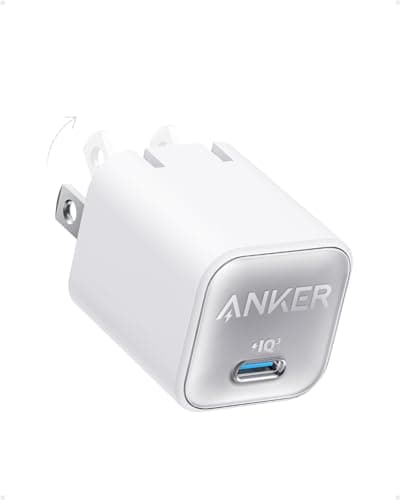
Product image from the Amazon listing.
Our verdict
Yes — the Anker Nano 30W is worth it, and after tens of thousands of consistent Amazon reviews it's the USB-C fast charger we'd recommend to almost anyone with an iPhone, iPad or MacBook Air. A 1.2-inch cube that weighs about 1.2 oz, delivers a full 30W of USB-C Power Delivery over GaN semiconductors, and typically costs $10-15 less than Apple's larger 30W brick. The single charger that replaces three older bricks in a bag. Step up to the Nano 45W only if you own a Samsung flagship or hammer a MacBook Air with an external monitor — otherwise 30W has all the headroom you need.
The short version
Apple's 5W brick made you think chargers were supposed to be small. Then USB-C PD demanded bigger power supplies. Anker's Nano line uses GaN (gallium nitride) semiconductors to bring the physical size back down while pushing 30W of USB-C Power Delivery — enough to fast-charge an iPhone from empty to 50% in about 30 minutes, top up an iPad Pro without waiting an hour, or run a MacBook Air at reasonable speed. It has foldable prongs, comes in white or black, and slips into a coat pocket without a bulge. The single accessory that fixes 'why do I have three different chargers on my desk.'
Pros & cons
Pros
- 30W USB-C PD fast-charges iPhone, iPad and MacBook Air
- GaN semiconductors let it be about half the size of a comparable silicon charger
- Foldable prongs — pocket, purse and suitcase friendly
- Recognized by every USB-C PD device without fiddling
- Widely reported to run cooler than knockoff chargers
- One accessory replaces the iPhone brick and the iPad brick
Cons
- Doesn't include a USB-C cable in most packaging
- Single port — no multi-device charging
- 30W isn't enough for a MacBook Pro under load
Why people love it
Plug into any US outlet
Fold out the prongs and plug in — the compact GaN internals convert AC to fast DC in a much smaller footprint than a traditional charger.
Connect USB-C PD
Any USB-C Power Delivery device negotiates its optimal charging profile automatically — iPhone at up to 20W, iPad at up to 30W, MacBook Air at 30W.
Fast-charge, then travel
When you're done, fold the prongs flat and drop it in a bag. Zero cable clutter beyond the USB-C cable you were already carrying.
Who it's for
- iPhone 15/16 owners wanting real fast-charge
- iPad users tired of the tiny stock brick
- MacBook Air owners who travel
- Anyone consolidating chargers on a desk or in a bag
Why the Anker Nano exists, and what GaN actually solves
The physics is simple but the engineering isn't. A wall charger converts high-voltage AC from your outlet into low-voltage DC for a device. Traditional silicon-based chargers switch that current at moderate frequencies and lose a lot of energy as heat, which means larger transistors, more thermal management and more overall size. Gallium nitride (GaN) semiconductors switch at much higher frequencies with lower losses, which means smaller transformers, smaller heat sinks and a physically tinier charger for the same output.
The practical result: a modern 30W GaN charger like the Anker Nano fits in about the same footprint as Apple's old 5W silicon brick. Anker was one of the first big brands to ship GaN to consumers, refined the design across multiple generations of the Nano line, and put it at a price point where it competes directly with — and usually beats — Apple's first-party equivalent. If you've held an old 30W charger and thought 'why is this the size of a bar of soap,' the Nano is the answer.
Nano 30W vs 45W vs 65W vs 100W: which Anker fast charger do you actually need?
Anker sells GaN chargers at basically every wattage from 20W to 240W. For most people the answer is: 30W for a bag or travel, 65W or 100W for a nightstand or desk. Here's the finer resolution. If you only ever charge a phone and earbuds, 20W-30W is enough. If you charge an iPad Pro or a MacBook Air, 30W is the minimum; 45W-65W is more comfortable. If you charge a MacBook Pro 14, you need at least 67W for full-speed charging, and Anker's 65W Prime or 100W GaN is the right pick. MacBook Pro 16 wants 100W or more.
The other axis is port count. A single-port charger is smaller, simpler and cheaper, which is why the Nano 30W is the ideal travel choice. Multi-port chargers add convenience (charge two or three devices at once) at a bigger footprint and higher price. Many people end up with two: a Nano 30W permanently in a bag and a multi-port GaN at home. If you want just one device that does everything, the Anker Prime 100W three-port is the do-it-all choice for a home base. And when there's no outlet at all — a long flight, a full travel day, a festival — the Nano is only half of the answer; a proper Anker portable power bank is the other half, and the two together are the everyday-carry pair that keeps a phone alive from wheels-up to hotel check-in.
Fast-charging your iPhone and MacBook the right way
To fast-charge an iPhone 15/16 you need three things: a USB-C PD wall charger (Anker Nano 30W qualifies), a USB-C cable — either C-to-C for iPhone 15+ or C-to-Lightning for older iPhones — and enough headroom on the charger side. iPhone tops out around 20W input, so a 30W charger gives it comfortable headroom without heating up the phone. The result: 0 to 50% in about 30 minutes, versus 1-2 hours on the old 5W brick.
MacBook Air (M2/M3) fast-charges via USB-C PD at 30-35W. On the Anker Nano 30W you'll see essentially full-speed charging when the laptop is idle or lightly used; heavy workloads (video editing, external displays) can pull more than 30W and slow the charge down slightly. Not a problem for overnight or workday top-ups; the fix for on-the-road heavy use is to step up to the 65W Anker Nano. For iPad Pro, 30W is enough for a properly fast top-up — dramatically faster than the tiny stock brick Apple includes. In every case, the cable matters as much as the charger — use a USB-C PD-rated cable, since a bargain-bin C-to-C cable can limit charging speed even with a great charger.
See Anker Nano 30W on Amazon
Check the latest price, photos and buyer reviews on Amazon.
Check Price on Amazon →Sold and shipped by AmazonFrequently asked questions
How big and how heavy is the Anker Nano 30W charger, really?
About the size of a sugar cube and lighter than a AA battery. The Nano 30W measures roughly 1.2 × 1.2 × 1.2 inches (30 × 30 × 30 mm) with prongs folded, and weighs approximately 1.16 oz (33 g). For context, that's about half the volume of Apple's 30W silicon brick and around a third of its weight. Folded, it sits flush against a wall outlet with essentially no protrusion into the room; in a bag, it disappears into a pocket you didn't know a charger could fit in. The size and weight are the reason it's such a popular travel and everyday-carry pick — GaN semiconductors let Anker package a full 30W of USB-C Power Delivery into a footprint that used to belong to a 5W charger.
Is the Anker Nano 30W fast enough for a MacBook Air, iPhone and iPad?
Yes for all three, with a nuance. The MacBook Air (M2/M3) charges at up to 30W when the display is dim and background load is light — perfect for overnight or resting charging, and functional but slower under heavy use than the 35W or 65W bricks Apple ships. iPhone 15/16 series fast-charge at ~20W with USB-C PD, so 30W is plenty of headroom. iPad Pro tops up at 30W, faster than the smaller stock brick. For MacBook Pro 14 or 16, step up to Anker's 65W or 100W Nano.
Anker Nano 30W vs 45W: which should I buy?
Both are excellent — the choice comes down to what you'll charge. The Nano 30W is smaller, lighter and cheaper, and it delivers full-speed fast charging for iPhone (which caps at ~20W), iPad Pro (30W), and MacBook Air under normal loads. For that trio, 30W has all the headroom you need. The Nano 45W is a little larger and pricier but pushes 45W of USB-C PD — meaningfully better if you own a MacBook Air M2/M3 you use hard (video calls, external monitor, editing) or a Samsung Galaxy S23+/S24+/S24 Ultra, which negotiates 45W Super Fast Charging 2.0 and charges noticeably faster on the 45W than the 30W. Rule of thumb: iPhone + iPad + light MacBook Air = 30W. Heavy MacBook Air use, a Samsung flagship, or a bag charger you want to future-proof = 45W. Most travelers who own both keep the 30W in a coat pocket and the 45W in the laptop bag.
Anker 30W charger reviews — what do owners actually say after a year?
Long-term Amazon reviews for the Nano 30W are unusually consistent: after 12+ months of daily bag-and-desk use, owners still report the same fast-charge speeds, no swelling, no chirping capacitor noise, and no port wear. Common praise: replaces two or three older Apple bricks, fits in a jeans pocket, foldable prongs don't gouge other items in a bag, and the GaN internals run genuinely cooler than knockoff chargers of the same wattage. Common gripes: no USB-C cable in the box (most Amazon listings ship charger-only), single port only (fine for travel, limiting on a nightstand where a 2- or 3-port GaN makes more sense), and the pass-through white plastic can pick up marks over time. Real complaint rate is very low across tens of thousands of reviews, which is a big part of why it's an Amazon best seller across multiple years.
What is GaN, and why does the Nano matter for chargers?
GaN (gallium nitride) is a newer semiconductor that switches faster and runs cooler than the silicon used in traditional chargers. Faster switching means the same power output in a physically smaller design; cooler running means the charger doesn't need as much thermal mass. For end users, GaN means a 30W-65W wall charger that fits in your palm instead of taking up a whole outlet. Every serious charger brand (Anker, UGREEN, Belkin, RAVPower) now uses GaN for their premium tier.
Does it come with a USB-C cable?
Most current Anker Nano 30W bundles ship without a cable to keep the price and packaging small. If you already have a USB-C to Lightning cable (for older iPhones), a USB-C to USB-C (for iPhone 15+, iPad, MacBook), or a USB-C to Lightning cable, you're set. If you don't, add a braided USB-C to USB-C or C-to-Lightning cable to your cart — Anker's PowerLine III or the Apple cable are both solid.
Can I use it internationally?
The US model has fixed US-style prongs and works on US voltage. For international travel, either buy the region-specific version (EU, UK, AU) or use a passive travel adapter. The charger's internals are already dual-voltage 100-240V, so a plug adapter is enough — no voltage converter needed. For frequent international travelers, Anker also sells a specific travel version with swappable prongs.
Anker Nano 30W vs Apple's 30W USB-C Charger — which should I get?
Anker's Nano 30W is meaningfully smaller (GaN vs Apple's silicon design) and typically cheaper by $10-15. Real-world charging speed on iPhone, iPad and MacBook Air is essentially identical. Apple's version has the Apple support relationship if something goes wrong. For most people the Anker Nano is the smarter buy — same performance, smaller, cheaper, with a strong warranty and Anker's decent customer support. Get Apple's only if you specifically want Apple's returns process, or if you're issued one at work.
Is a 30W single-port charger enough, or should I get a multi-port one?
Depends on the use case. For a bag or travel charger (one device at a time), 30W single-port is perfect — small, cheap, always works. For a nightstand or desk where you charge phone + earbuds + a watch simultaneously, look at Anker's Prime 65W or 100W GaN with 2-3 ports. Many people buy both: a Nano 30W for travel and a multi-port charger for permanent locations. A powerful multi-port travel companion like the Anker Prime 100W GaN charger fits well as the desk anchor while the Nano goes in a bag.
As an Amazon Associate, TopCrate earns from qualifying purchases at no extra cost to you. Product image, price, availability and ratings are shown on Amazon and are subject to change.