HANDS-ON REVIEW
KeySmart SmartLock TSA Travel Lock Review: Is It Worth It?
The first TSA-accepted combination lock with Apple Find My built in — your bag stays locked and your iPhone always knows where it is.
Quick answer: Yes — for iPhone travelers, KeySmart's SmartLock is worth $29.99 because it replaces the TSA-lock-plus-AirTag stack with one device at the price of one of them. The lock does honest TSA-grade zipper duty; the Find My integration turns every checked bag into a dot you can watch instead of a prayer you make at the carousel. Android users should pass (the tracking is Apple-only), but for everyone else this is the new default travel lock. Pair it with a wallet-slim tracker like the [SmartCard](/reviews/smartcard) and your daily-carry gets the same visibility your suitcase just did.
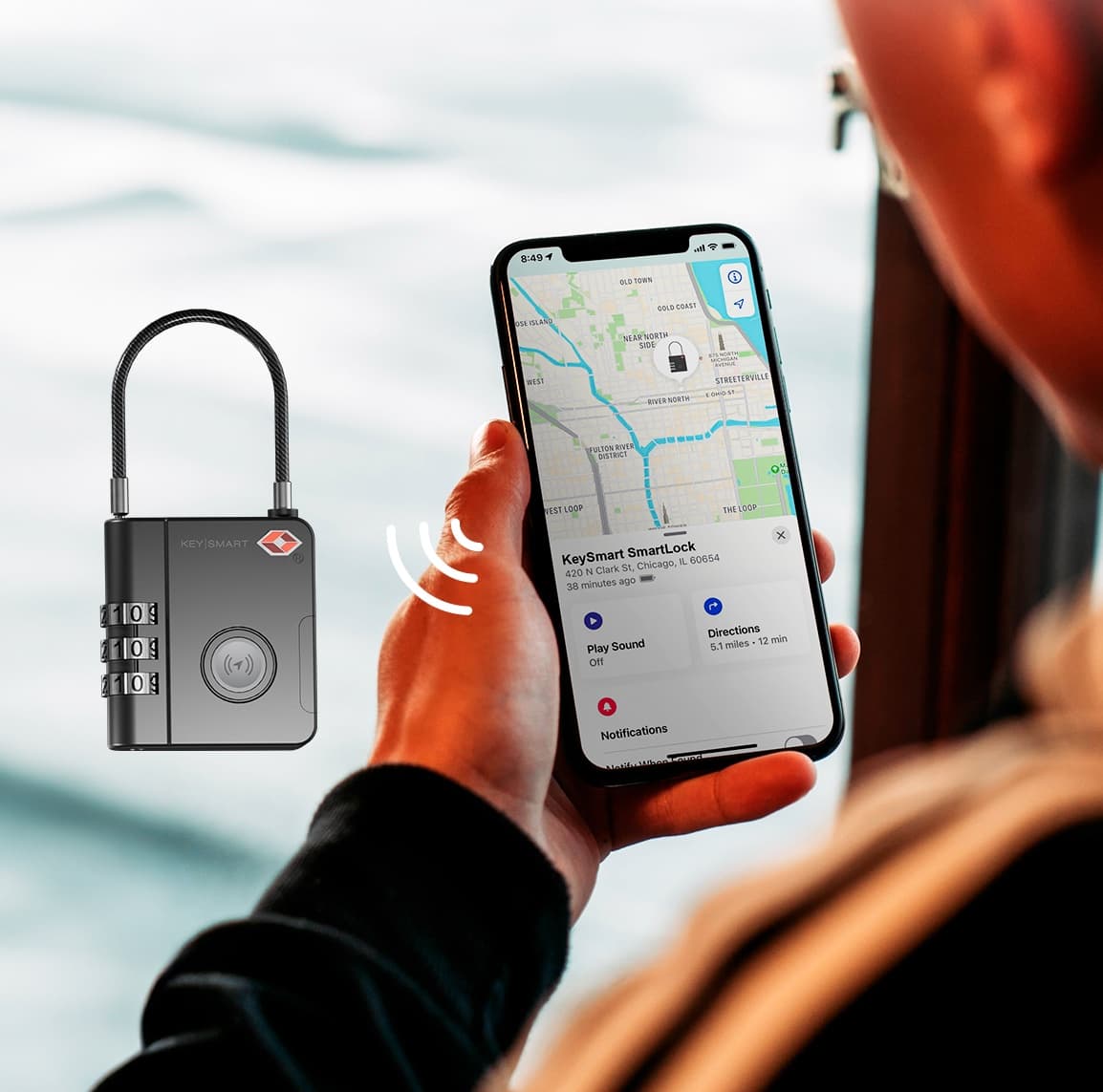
The lock secures the zippers; Find My shows the bag's location live on your iPhone. Photo: KeySmart
Our verdict
Yes — for iPhone travelers, KeySmart's SmartLock is worth $29.99 because it replaces the TSA-lock-plus-AirTag stack with one device at the price of one of them. The lock does honest TSA-grade zipper duty; the Find My integration turns every checked bag into a dot you can watch instead of a prayer you make at the carousel. Android users should pass (the tracking is Apple-only), but for everyone else this is the new default travel lock. Pair it with a wallet-slim tracker like the [SmartCard](/reviews/smartcard) and your daily-carry gets the same visibility your suitcase just did.
The short version
Travelers currently solve two problems with two products: a TSA lock to keep zippers honest, and an AirTag buried inside to find the bag when the airline misplaces it. KeySmart's SmartLock merges them — a hardened TSA-accepted combination lock with Apple Find My tracking built into the body. Lock the zippers, and the world's largest finding network (every iPhone on earth, anonymously) reports your bag's location: on the carousel, in the wrong terminal, or in a city you've never been to. Airlines lose about 25 million bags a year; this is the $30 that turns 'trust the airline' into 'watch the dot.'
Pros & cons
Pros
- TSA-accepted — agents can inspect without cutting the lock
- Apple Find My built in: live bag location on your iPhone
- One device replaces the lock + hidden-AirTag combo
- Hardened combination lock — no keys to lose
- Long battery life; water-resistant for real travel
- Also guards gym lockers, lockboxes and gear cases
Cons
- Find My tracking needs an iPhone — Android users lose the headline feature
- A visible tracker-lock deters differently than a hidden AirTag (grab-and-run thieves can see it)
- Slightly bigger than a plain TSA lock
How it works
Pair with Find My
Add SmartLock to the Find My app like an AirTag — it joins the same network of a billion Apple devices that anonymously report its location.
Set your combo and lock the zippers
Three-dial combination through both zipper pulls. TSA agents can open it with their master key instead of bolt-cutting it.
Watch the dot
From gate to carousel to hotel, your iPhone shows where the bag actually is — including when it doesn't make your connection.
Who it's for
- Anyone who checks a bag more than once a year
- Travelers who've already lived the lost-luggage week
- iPhone owners with an AirTag rattling loose in a pocket
- Gym-goers and commuters locking gear in shared spaces
Why bag tracking stopped being optional
Mishandled-baggage numbers stopped being funny around 2022 and never fully recovered — tens of millions of bags a year delayed, misrouted or lost, with the airline's tracking often knowing less than a $29 tracker. The AirTag-in-the-suitcase trick became standard travel advice precisely because Apple's Find My network out-tracks the industry: every passing iPhone silently reports the tag's position, no subscription, no charging anxiety, global coverage.
SmartLock's move is putting that network inside the security device you were already buying. The lock rides outside the bag on the zippers — which means it reports from where bags actually get stuck (carts, belts, tarmacs) rather than muffled from inside a pile. One battery, one device, both jobs. If you've already got a wallet-sized tracker and an AirTag scattered through your kit, this consolidates the luggage slot.
The TSA part, done right
Any lock on checked luggage must be TSA-accepted or it gets bolt-cut the first time your bag is selected for inspection — agents have master keys for the standard lock cores, and SmartLock uses one. The three-dial combination covers you everywhere else: zippers can't be casually fished open on a train platform, a gym locker gets real security, and there's no tiny key to lose in seat 23C.
Set expectations correctly about what any zipper lock does: it stops opportunistic access, not a determined thief with tools and privacy — that's true of every luggage lock ever made. The tracking is what changes the game, because the dominant failure mode isn't theft, it's misrouting. A thief is rare; a bag sitting in the wrong terminal is Tuesday. The lock handles the rare case adequately and the common case brilliantly.
Is SmartLock worth $29.99?
Price the alternative: a decent TSA combination lock is $12–15, an AirTag is $29 plus a $10 holder, and the pair still leaves the tag rattling inside the bag with a separate battery to think about. SmartLock lands at the price of the AirTag alone while replacing the whole stack — and unlike the buried tag, it's serviceable without unpacking. For a two-bag household, the math gets better again.
It also earns a place beyond the airport: gym lockers, office lockers, tool cases, ski bags, boat storage — anywhere a combination lock already made sense, this one adds a live location. Pair it with packing compression bags and the travel kit starts feeling properly engineered rather than accumulated. Android households should skip it for the tracking (grab a plain TSA lock and a Tile) — this product's magic is specifically the Find My network.
Frequently asked questions
Will TSA cut my lock off?
No — SmartLock is TSA-accepted, meaning agents open it with their standard master key for inspections and re-lock it after. Cutting only happens to non-TSA locks.
Does it need an iPhone?
For tracking, yes — it uses Apple's Find My network, so an iPhone (or iPad/Mac) is required to see its location. The combination lock itself works for anyone.
How is this better than an AirTag inside the bag?
It's one device instead of two, it locks the zippers while it tracks, and it rides outside the bag where it reports cleanly. An AirTag also can't stop a zipper from being fished open.
How long does the battery last?
Months of travel per charge/battery in typical use — Find My beacons sip power. You'll get low-battery notice through the app long before it goes dark.
Can I use it beyond luggage?
Yes — gym and office lockers, gear cases, ski and golf bags, storage units: anywhere a combination padlock fits, with a live location as the bonus.
Does tracking work internationally?
Yes — anywhere iPhones exist, which is effectively everywhere airlines fly. Density matters: an airport in any country reports constantly; a remote trailhead reports when someone walks past.
When you buy through links on this page, TopCrate may earn an affiliate commission at no extra cost to you. Find My tracking requires an Apple device; no lock prevents determined theft — keep valuables in your carry-on. Prices accurate as of publish time.