EVERYDAY CARRY
How to Stop Keys from Jingling in Your Pocket (Every Method, Ranked by How Well It Actually Works)
Loose keys are a hundred-times-a-day annoyance most people never fix because 'it's just keys.' The DIY hacks work in a pinch; a real fix is a five-minute job you do once and stops thinking about.
The keyring is one of the oldest pieces of design in your pocket, and it's also one of the worst. A loose split ring holding four to eight metal teeth that grind against each other every step is going to jingle — that's not a defect, that's the physics of what a bag of loose teeth does when it moves. The jingle telegraphs you down every hallway, the teeth shred pocket linings and scratch phone screens, and finding the right key is a squint-and-rotate ritual you do multiple times a day without noticing you're doing it.
This guide ranks every method — the free DIY hacks from the internet, the mid-tier tape-and-rubber tricks, and the actual one-time fix — by how well they silence the jingle in practice, how long the fix lasts, and how much friction they add. Nine out of ten people can go from noisy pocket to silent pocket in one evening. The tenth is a person with a car fob too fat to fold, and there's a specific solution for that too.
Why keys jingle in the first place (and what a 'fix' actually has to do)
Keys jingle because they can move freely against each other on the ring. Every step swings them, and metal against metal at low mass rings clearly — the same reason a wind chime works. A real fix has to do one of three things: eliminate the space between the keys (so they can't collide), damp the collision (so when they collide they don't ring), or lock them in position (so they don't move at all). Everything below is a variation on one of those three principles.
The reason the free DIY hacks feel inconsistent is that they solve the problem partially — cling film wraps the keys and damps the collision, but the wrap tears within a day. Duct tape damps the collision but leaves adhesive residue and pocket lint everywhere. A rubber band eliminates the space but stretches out fast. Each of these fixes is real for an evening; none of them is real for a year. That's the honest distinction to keep in mind reading the list.
The free DIY methods (real, but temporary)
**Wrapping the keys in cling film or Saran wrap.** Fast, free, silent. Tear a small square of plastic wrap, bundle it around the head of the keys, and press it flat. The plastic damps the metal-on-metal contact and the jingle is gone. Downside: it tears within a day of normal pocket use, so this is an emergency-before-a-meeting fix, not a lifestyle. Worth knowing for that one time you're headed into a quiet event.
**Electrical tape or duct tape around the key heads.** Wrap the top (bow) of each key in a strip of tape. The tape acts as a cushion so keys meeting each other on the ring don't ring. Longer-lasting than cling film — a few weeks — but the tape peels, collects pocket lint, and leaves adhesive residue when you eventually remove it. Also uglier than most people are willing to look at every time they open the front door.
**Rubber O-rings between the keys.** Slip small silicone or rubber O-rings (the kind you can buy in a hardware-store multi-pack for a few dollars) onto each key's bow before threading it onto the ring. The O-rings sit between the keys and create a soft spacer that prevents the collision. This is genuinely durable — many months to a year before the rubber fatigues — and cheap. Downside: still bulky (keys still swing loose on the ring, they just don't ring), and you need to remember the trick each time you add a new key.
**Small neodymium magnets on the key bows.** A cool-sounding solution that pops up on gadget blogs: stick tiny magnets to each key so they cluster together instead of splaying out. Works surprisingly well while it lasts. Downsides: the magnet adhesive fails within weeks and one lost magnet in a pocket is a hazard, and neodymium magnets can wipe magnetic-stripe cards (older hotel keys, some transit cards) if the keys share a pocket with them. Cute; not a real answer.
The middle tier (leather pouches, keyring silencers, carabiners)
**Leather key pouches.** A soft leather sleeve that holds your keys folded inside. It silences the jingle by fully wrapping the keys, and it's the traditional 'nicer than a loose ring' solution. Downsides: keys still swim inside the pouch when you need one — you fish, you rotate, you squint. Retrieval didn't get better, only the noise did. And most pouches don't hold a car fob at all, so you end up with a pouch plus a fob dangling separately — worse than where you started.
**Silicone keyring silencers.** Purpose-made silicone caps or full-key covers that slip over each key's head. They damp the ring cleanly and last a long time. Better version of the tape trick, without the residue. But keys still swing loose on the ring, so the fix is 'silent but still bulky and still hard to find the right one.' Fine as a partial upgrade, not a comprehensive answer.
**Carabiner + belt clip.** Move the whole jingle problem out of the pocket and onto your belt loop or bag strap via a small carabiner. Silent-in-pocket is achieved by not being in the pocket. Works well for people who wear the same jacket or belt daily; falls apart for anyone whose outfit doesn't have a permanent clipping point. It's also just relocating the problem — the keys still jangle, they just do it visibly on your hip.
The actual one-time fix — a folding key organizer
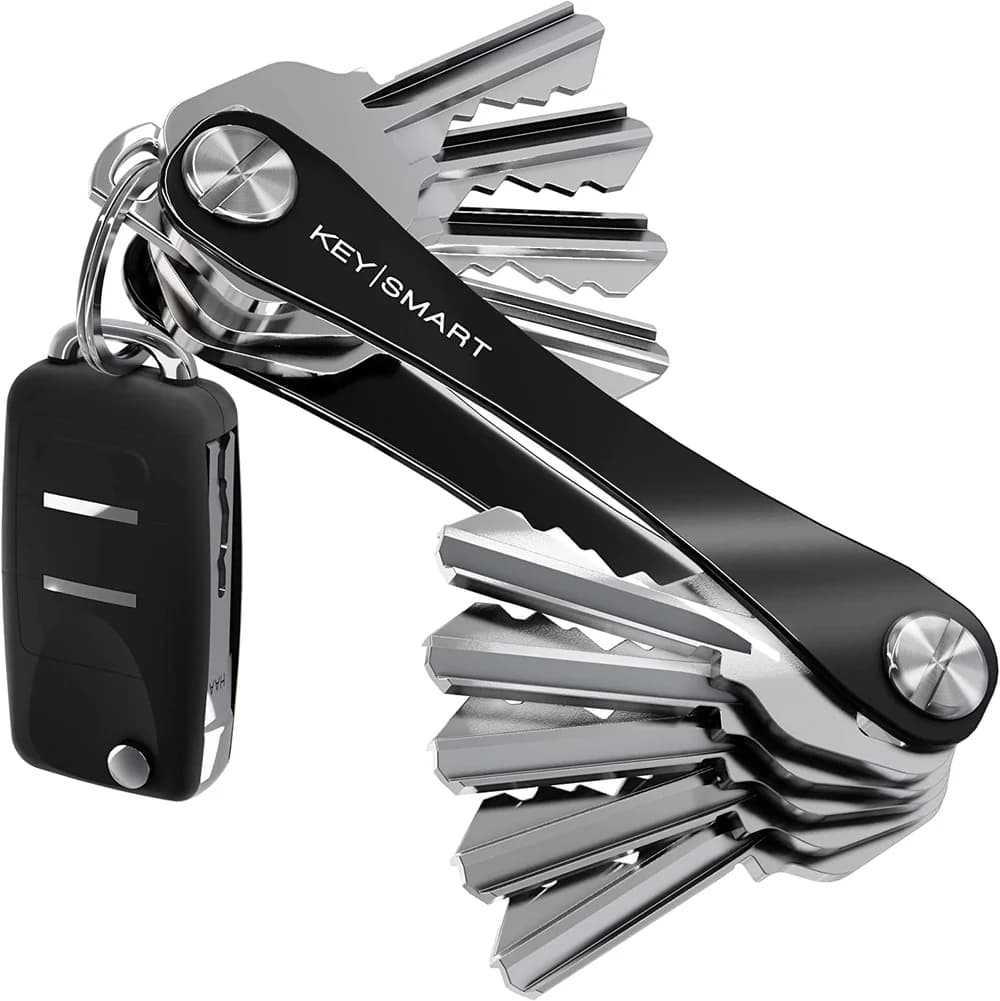
The purpose-built answer to the jingle-and-fumble problem is a pocket-knife-style key organizer: two aluminum plates on adjustable-tension screws, with your keys stacked between them like blades. Keys fold inside the frame when not in use — silent, flat, and armored against pocket wear — and you flip out the specific one you need one-handed, by feel. Because the plates constrain the keys to fixed positions, muscle memory replaces searching within a week: your front door key is at the outside slot, your car key is second, and your thumb finds them without looking.
KeySmart is the specific product in this category most reviewed and most sold — two million-plus carriers, ten-key capacity, aircraft-aluminum build. Setup is about five minutes with the included hardware: thread keys onto the two posts, add spacers to fill unused width, and tighten the screws to the tension where a flipped-out key stays out but doesn't take real effort to open. Do it once and the noisy pocket is a solved problem for as long as your key ring stays the same. It's the same quality-of-life math as organizing cables on a desk — a small, constant friction, removed permanently instead of tolerated forever.
The trade-off worth being honest about: this fixes house keys, office keys, mail keys, and standard car keys. Modern smart car fobs are too fat to fold inside the frame; they attach to a small loop on the outside of the organizer instead. That still beats the fob swinging on a loose ring — it rides flush against the frame — but if your carry is literally one big smart fob and nothing else, an organizer isn't the tool. For everyone whose ring is more than one item, this is the fix.
The 'yes, but' cases (why sometimes the DIY answer is enough)
There are real cases where a $25 organizer is overkill and a $2 rubber O-ring is the right answer. If you carry two keys total — house and apartment mailbox, say — the ring is not really the problem an organizer solves. Put an O-ring between them and you're done. If you're renting for two more months and about to give the keys back, don't invest. If your keys live in a bag or a purse compartment and never in a pocket, the noise is limited and the fumble is limited, and either the rubber-O-ring approach or a silicone silencer sleeve is enough.
The cases where the organizer is unambiguously worth it: four or more keys, daily pocket carry, at least one situation where the jingle is a problem (nurses on quiet floors, teachers walking hallways, realtors at showings, parents with sleeping kids) or where retrieval matters (fumbling for the right key at a dark front door with an armful of groceries). At those thresholds the DIY answers stop scaling — you can't O-ring seven keys and still call them organized. The organizer is a five-minute one-time job that pays back every day for a decade.
What NOT to do (the bad advice you'll find online)
**Don't crazy-glue keys together to stop the ring.** It's suggested on some gadget blogs. It's a permanent commitment to whatever key order you glued, it looks awful, and the glue eventually fails in a mess. **Don't wrap keys in plumber's tape (PTFE).** It slips off within an hour. **Don't file down the edges of keys to reduce metal-on-metal contact.** Even setting aside that most locksmiths consider this key tampering, it doesn't work — the ring is still the source of the noise.
**Don't buy a 'silent keyring' that's just a plastic split ring.** The material of the ring isn't the noise source; the collision of the keys is. Swapping a metal ring for a plastic one at best trades a bright jingle for a duller rattle. **And don't waste money on a soft leather pouch expecting it to fix retrieval — it doesn't.** Pouches solve noise; organizers solve noise and retrieval. If you're going to spend real money once, spend it on the tool that solves both.
The bigger picture: your keys are one of five EDC upgrades worth making
'Everyday carry' as a hobby can spiral into gear collecting, but the underlying principle is real: the objects you touch dozens of times a day are worth optimizing once. Keys are the most obvious one because everyone has them and everyone has a mildly annoying default. The second is your wallet — a card-based slim wallet weighs half of the trifold most people carry. The third is your charging cable situation, addressed in how to organize cables on desk. The fourth is your pocket tool if you're the kind of person who reaches for one — the Kelvin Tools multi-tool is the honest hobbyist-approved answer here. The fifth is your bag or backpack, but that's beyond scope for this article.
The theme across all of them is the same: the small daily frictions of the objects you don't think about are quietly costing you more time and attention than any of them individually seems worth. Once fixed, none of them ever bother you again. Keys are the highest-leverage of the five because you touch them more often and because the fix costs less than a nice lunch. Do it once; enjoy a quieter pocket for a decade.
Read our KeySmart key organizer review
Two aluminum plates, adjustable-tension screws, and up to ten keys folded silent between them — the specific one-time fix most people wish they'd bought years earlier instead of retying rubber O-rings.
Read our KeySmart key organizer reviewFrequently asked questions
What's the fastest way to stop keys from jingling in your pocket?
For an emergency fix before a meeting or quiet event, wrap the head of the keys in a small square of cling film or a piece of electrical tape — both damp the metal-on-metal contact that causes the ring, and both take a minute. Neither lasts (cling film tears within a day; tape peels within weeks), but as a same-evening solution they work. For a real, one-time fix, a folding key organizer like KeySmart stacks the keys between two aluminum plates so they can't move against each other at all — silent, flat, and it takes five minutes to set up.
Do silicone keyring silencers actually work?
Yes, partly. Silicone silencers — small rubber caps or full-key covers that slip over the head of each key — damp the metal-on-metal contact and remove most of the jingle. They last months, unlike tape, and they don't leave residue. What they don't fix is the swing itself: keys still splay out on the ring, they just don't ring when they touch. So you get a silent pocket but not a slim one, and finding the right key is still a fumble. For anyone whose problem is only noise, silencers are a fair mid-tier answer. For anyone whose problem is noise AND bulk AND retrieval, a folding key organizer solves all three at once for about the same money.
Are magnets a good way to keep keys from jingling?
Cute idea, not a real answer. Tiny neodymium magnets glued to key bows do cluster the keys together temporarily, which cuts the jingle. But the adhesive fails within weeks, a loose neodymium magnet in a pocket is a genuine hazard (they pinch skin painfully and are dangerous if swallowed), and the magnets can wipe magnetic-stripe cards (older hotel keys, some transit cards) if the keys share a pocket with them. Blog-post writers love this hack because it sounds clever; anyone who tries it eventually retires it. A folding key organizer solves the same problem mechanically, permanently, and without the card-wiping side effect.
How does KeySmart compare to a leather key pouch?
Both silence the jingle, but they solve different halves of the keyring problem. A leather pouch wraps the keys inside a soft sleeve — quiet in the pocket, but keys still swim loose inside the pouch, so retrieval is a fumble. A folding organizer like KeySmart fixes both halves: keys stack between two aluminum plates in fixed positions, so nothing moves and each key flips out one-handed from a slot your thumb learns. After a week, muscle memory replaces looking. The organizer also handles a modern car fob via an external loop (fobs are too fat to fold), where most pouches don't include the fob at all. Same price range; more of the problem solved.
How many keys can you fit in a folding key organizer?
Most folding organizers handle two to about ten standard house and office keys between the plates, with included spacers to fill any unused width for a rattle-free fit. KeySmart specifically is rated for up to ten keys, and expansion posts exist for bigger stacks. Most pockets are happiest under eight — beyond that the frame gets thick enough to feel like carrying a slim knife. Car key fobs and other oversized items are too thick to fold inside the frame; they attach to a small external loop instead. If you carry more than ten keys daily, you probably have a job with a keyring at your belt anyway (janitors, building maintenance), and a folding organizer isn't the right form factor.
Can I put a smart car fob inside a folding key organizer?
No — modern smart car fobs are too fat to fold between the plates. Almost every folding organizer solves this with a small external loop or ring attachment: the fob clips to the loop so it rides flush against the frame instead of swinging on a loose ring. That still cuts the noise significantly (nothing is jingling because the fob has one thing to hit, the frame, not five other keys), and it keeps everything in one bundle so nothing gets lost. If your car uses a slim valet-blade physical key (some Hondas, some Toyotas), that often does fold inside the frame — check the specific dimensions against the organizer's spec.
Is it worth spending $25 on a key organizer just to stop the jingle?
If you carry four or more keys daily in a pocket, yes — the payback is essentially every day for the life of the tool. Beyond noise, you also solve pocket wear (no more shredded liners), phone-screen scratches, and the daily squint-and-rotate to find the right key. Aircraft-aluminum builds like KeySmart's survive years of pocket abuse, so amortized over a decade of use, the tool costs a few dollars a year for a permanently quieter and more organized pocket. If you carry two keys, or if your keys never leave a bag, a $2 rubber O-ring between them is enough and an organizer is overkill. Match the tool to the actual daily annoyance.
TopCrate is reader-supported. When you buy through links on our site we may earn an affiliate commission, at no extra cost to you. Content is for general information and isn't a substitute for professional advice.