AUTO REPAIR
How to Remove a Car Door Dent Without Damaging the Paint (Every DIY Method, Honestly Ranked)
Body shops start at $200-400 for a small ding. Most parking-lot dents can be pulled at home for under $50 — but only the specific dent shapes that DIY tools can actually handle. Here's how to tell.
Someone opens a car door into your car in a parking lot. There's a shallow, roundish dent in your driver's side door, paint completely intact, and the body shop's minimum quote is $250. That gap — between the tiny ding and the not-tiny bill — is where the entire DIY-dent-repair category lives. The tools exist, the techniques work, and for a specific narrow class of dents you can genuinely pull them at home for under $50 without touching the paint. For a different class of dents, no consumer tool will fix them and trying can make things worse. Knowing which dent you have before you try anything is the whole game.
This guide walks through the honest categorization of dents (what DIY tools can and can't fix), the five methods worth actually trying — hot water, hair dryer plus cold air, plunger, boil-and-punch, and the pull-kit approach — ranked by which dent they suit, what NOT to do (there's more of it than the internet admits, particularly around dry ice), and when to just accept the body-shop bill because the dent is beyond the DIY category. No paint respray required for any of the methods below; if your dent needs paint work, it needs a shop, full stop.
Before you try anything: which category of dent do you actually have?
Every DIY dent method works on some dents and fails on others, and the failure mode is often making the dent worse. So the first step is not picking a tool — it's honestly identifying which of four categories your dent belongs to. **Category 1: shallow, round, gradual dent on a flexible panel with intact paint.** This is the door-ding sweet spot: the metal is pushed in but not stretched or creased, the paint isn't cracked, and the panel around the dent has some flex to it. This is the category DIY methods can actually fix, and the whole rest of this article is really about this dent. Doors, quarter panels, and hoods on modern cars usually qualify.
**Category 2: sharp creased dent.** If you can see a distinct line or angle in the metal — a fold rather than a curve — the metal has been stretched past its elastic limit and it will not spring back with any DIY pull method. Pulling it hard enough to flatten the crease usually leaves a raised high spot next to the crease, so now you have two problems. **Category 3: deep dent, or damage on a body line, or damage on a rigid section** (the pillar between windows, the reinforced sections around the fuel door, the frame). Consumer tools can't reach the back of the panel to push these out, and pulling from the front braces against damaged metal. **Category 4: dent with paint damage** — cracks, chipping, or scraped-off clear coat. Any dent removal risks worsening the paint damage, and the fix here has to include paint work regardless. Categories 2, 3, and 4 need a professional; save yourself the frustration.
Method 1 — Hot water (the free one for plastic bumpers)
For a shallow round dent on a **plastic bumper cover** (not metal — this doesn't work on doors or fenders), the simplest DIY method costs zero: pour a kettle of boiling water over the dent, then push the dent out from behind with a gloved hand or reach through the wheel well. Plastic gets pliable at hot-water temperatures and will often pop back to its original shape as it cools; the reason it works on plastic and not steel is that plastic has 'memory' — heat softens it enough to remember the shape it was molded in. Two minutes, a kettle, and a good chance of success on qualifying plastic dents.
Two honest cautions. First, hot water on cold paint on a cold day can shock the clear coat and cause micro-cracks; do this on a mild day, or at least let the car warm up first. Second, it only works on plastic. A steel door will happily ignore the water and give you a wet dent. Confirm the panel is plastic (rap it — plastic sounds hollow and dull, steel rings brightly) before you commit.
Method 2 — Hair dryer + cold air (the thermal-shock method)
A slightly more controlled version of the hot-water method, and one that works marginally on the shallowest steel dents too: heat the dent with a hair dryer on high heat for 60-90 seconds until the panel is warm to the touch, then immediately spray it with a can of compressed air held UPSIDE DOWN — inverted, so the liquid propellant sprays out and instantly cools the metal to well below freezing. The rapid contraction can sometimes pop a shallow dent outward; the physics is real and the effect is documented, though on steel doors the success rate is honestly maybe 30-40% and often only partial.
The safety notes matter here. Compressed-air propellant sprayed at skin causes cold burns instantly — wear gloves, don't spray your hand. The propellant itself is highly flammable; no open flames nearby, no cigarette. Don't use a heat gun in place of a hair dryer, because a heat gun runs hot enough to blister the paint at the temperatures needed for the metal to move. Hair dryer on high is enough. And **absolutely do not use dry ice** as the cold source, despite the popular internet suggestion: dry ice at -109°F causes severe cold burns on skin contact in seconds, releases CO2 that displaces oxygen in enclosed spaces (working in a garage with the door closed is a real asphyxiation risk), and requires PPE most home DIYers don't have. Compressed-air inversion gives you the same thermal effect with a manageable safety profile.
Method 3 — Plunger (the underrated one)
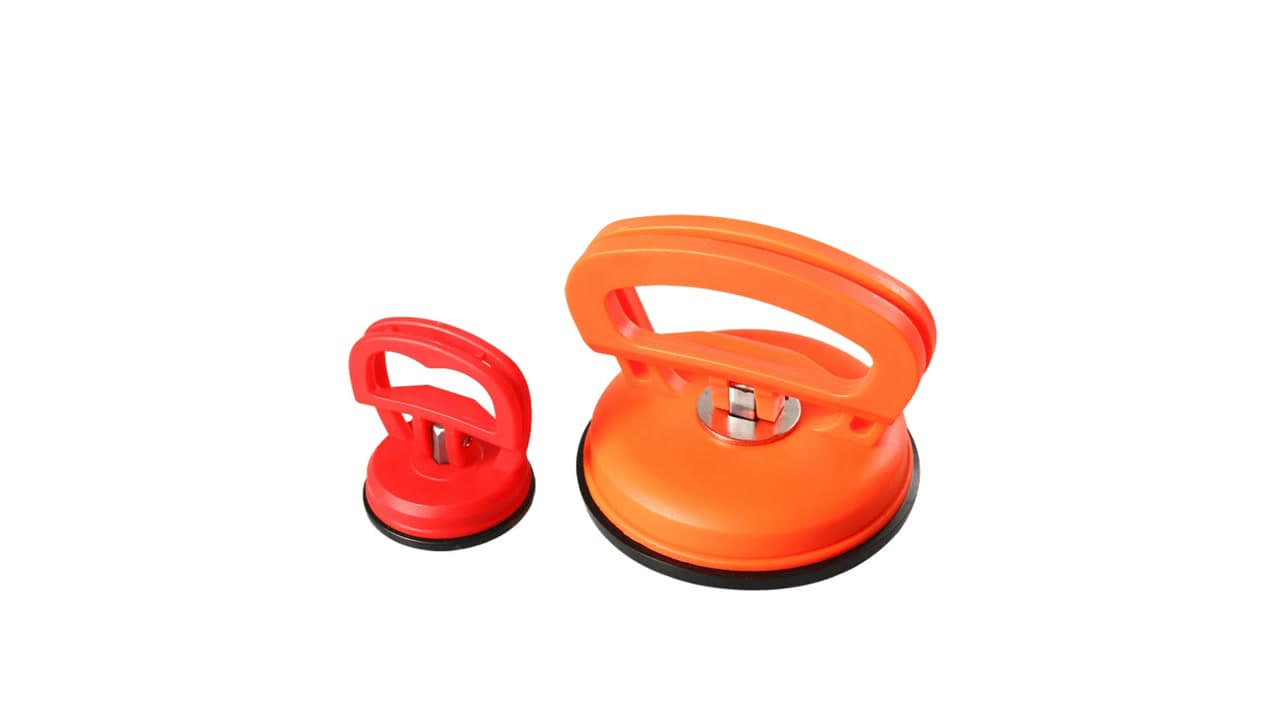
A standard cup-style toilet plunger (the flat one, not the flanged bell) presses against a shallow, roundish dent on a flat panel and pulls a low-cost vacuum when you jerk it outward. It's the same physics as any suction-pull tool: atmospheric pressure inside pushes the dent outward when the plunger removes the air outside. Wet the plunger rim and the panel with soapy water for a better seal, press firmly to expel air, then pull sharply. On the right dent it works surprisingly well; on the wrong dent it either won't seal or won't move the metal.
Right dent: shallow, gradual, on a flat area of a flexible door or quarter panel, larger than the plunger's cup diameter. Wrong dent: anything sharp, small, on a curved section, or crossing a body line. Cost: whatever you already own. Success rate on qualifying dents: genuinely worth trying before spending money on a kit. Don't over-pull — a hard yank can leave a raised spot in the middle where the plunger's cup was strongest, which looks worse than the original dent.
Method 4 — Pull kit with glue tabs and lifter bridge (the DIY-tool tier)
The dedicated DIY paintless-dent-repair (PDR) kit is the next tier up in tool investment and results. A typical kit includes a hot-glue gun, an assortment of plastic pull tabs sized to different dent shapes, and a metal 'bridge' lifter with a screw handle. You heat a tab, glue it to the exact center of the dent, wait for the glue to set (2-3 minutes), then either use the bridge to screw the tab outward against the surrounding panel or hook a slide-hammer through the tab for a controlled pull. Working in small increments and releasing between pulls (a heat gun or hair dryer melts the glue to detach the tab), you gradually coax the metal back toward flush. When the dent is out, you scrape the residual glue off the paint with the plastic scraper the kit includes plus a dab of rubbing alcohol.
The Cumuul dent puller kit is the specific product in this category most reviewed and most sold — a golden lifter bridge with a screw handle, a glue gun, and a range of tabs, at around $50. The honest math: on the shallow-round-flexible-panel dent category, a kit like this genuinely does the job for a fraction of the body-shop minimum, and it's reusable for the next parking-lot ding a decade from now. The kit's real limitation is what all pull kits share: no touch. Professional PDR technicians read metal with years of practice; a $50 kit hands you the pulling force without the touch. The result on qualifying dents is 'meaningfully better' rather than 'showroom invisible,' which is more than fair value if you calibrate expectations that way. Skip the kit entirely for creased dents, deep dents, or body-line damage — no pull tool at this price will fix them, and the marketing on cheap kits often implies otherwise.
Method 5 — Boil-and-push, and why it works for plastic only
For plastic bumper covers that dented from a low-speed impact — the classic 'backed into the hedge' bumper wrinkle — the simplest method is to boil the affected area (pot of water over the dent from a jug, kettle poured over it, or removal of the bumper cover and dunking it if you're ambitious), then reach behind and push the deformation back into shape while the plastic is soft. Cold water rinse to lock the shape, and often that's the whole repair. It works because plastic's memory of its molded shape returns when heat softens the polymer chains.
This is the one method where a genuinely bad dent — a big deformation that looks scary — can pop out to nearly invisible, because plastic can recover deformations that metal simply can't. If your dent is on a plastic bumper cover and the paint is intact, spend ten minutes and a kettle before spending any money on any tool. If the bumper cover has a crack or the plastic tore, you're outside the DIY category and into replacement territory ($200-800 depending on car and paint match), which is still cheaper than a metal-panel body-shop repair.
What NOT to do — the internet suggestions that make dents worse
Every 'dent removal hack' compilation on the internet contains three or four suggestions that range from useless to dangerous. **Do not use dry ice as a cold source.** It's dangerous (severe cold burns, CO2 asphyxiation risk in a closed garage), requires PPE most people don't have, and works no better than inverted compressed air for the thermal-shock method. **Do not use a heat gun instead of a hair dryer.** Heat guns run at 400-1000°F and will blister the paint in seconds. Hair dryer on high (typically 130-180°F) is warm enough for the panel to move, cool enough not to burn the clear coat. **Do not hit the panel from behind with a mallet or hammer** as some YouTube videos suggest — you'll overshoot flat into a raised bump, and on modern high-strength steels you can crease the metal permanently.
**Do not use suction cups intended for holding glass** (bathroom hooks, phone holders) as improvised pull tools; they don't seal properly on curved panels and slip off mid-pull, often ripping paint on the way. **Do not apply solvents or acetone to loosen the glue from a pull-kit tab** — those solvents strip clear coat immediately. The kit-included plastic scraper plus rubbing alcohol is what's designed to remove PDR glue safely. And **do not attempt DIY on a leased car** unless you're absolutely confident in the result; a botched DIY dent that a body shop then has to redo often costs more than the shop would have charged in the first place, and the lease company will notice at return time.
When to give up and just go to a body shop
The dent categories that need a professional aren't a rounding error; for most collision-scale damage, the shop is the right and cheapest-in-the-long-run answer. Any dent with paint damage (cracks, chips, scraped clear coat) is a shop job because a paint respray and blend is beyond consumer capability and a dent with untreated paint damage will rust from the inside. Any creased dent — with a visible fold rather than a curve — needs a professional PDR technician who can massage metal from behind. Any body-line damage. Any dent on a hood pressed into the underlying reinforcement. Anything on a rigid section like the C-pillar. And any collision damage beyond a single-point ding.
The tiered cost picture, honestly: professional paintless dent repair (PDR) on a qualifying dent, done at a shop that specializes in it (not a general body shop) runs $75-150 for a small ding and $150-300 for something larger — often much cheaper than a body-shop paint job and worth calling around for before assuming the $500 minimum. Full body-shop repair with paint work starts around $250-500 for a small area and climbs from there. Compare those numbers to your insurance deductible before filing a claim; small dents are almost always cheaper to pay for out of pocket than to bring a comprehensive claim into your loss history. For the shallow ding a pull kit like the Cumuul genuinely handles, that's the cheapest of all — but for anything else, the pro is the answer, and it's cheaper than you'd expect if you call three specialist PDR shops rather than defaulting to the dealership.
The other automotive fix worth learning the same way
The pattern in dent repair — 'know what category your problem is in before picking a tool' — is the exact right frame for the other under-$100 auto DIY worth knowing. Our guide to why your check engine light is on walks through the same triage: some codes are cheap fixes you can do in a driveway with a $20 scanner, some codes are 'go to the shop today, do not defer,' and the whole point is knowing which you're looking at before you commit money or effort in the wrong direction. And for the pre-drive vigilance that keeps damage from happening in the first place, how to check your tire pressure covers the two-minute weekly habit that prevents more curb-rash and blowout damage than any repair tool ever fixes.
Read our Cumuul dent puller kit review
The paintless dent repair kit most home mechanics land on for shallow door dings — a golden lifter bridge, glue gun, and range of pull tabs that saves you a body-shop bill on the specific dent shapes it's designed for. Honest about what it can and can't fix.
Read our Cumuul dent puller kit reviewFrequently asked questions
Can I really remove a car door dent without damaging the paint?
For the specific category of dent that DIY methods can handle — a shallow, gradual, rounded ding on a flexible panel with intact paint — yes, and without touching the paint at all. The paintless dent repair (PDR) methods work by pulling from the front (glue tabs and a lifter bridge, like a Cumuul pull kit) or pushing from the back (accessible dents), never grinding or refinishing. For creased dents, deep dents, dents crossing a body line, or dents with paint damage, no DIY method will preserve the paint and the honest answer is a professional PDR technician or a body shop.
Does the boiling water trick actually work on car dents?
On plastic bumper covers, yes — plastic has 'memory' of its molded shape and returns to it when heated. Pour boiling water over a dented plastic bumper, then push the dent out from behind with a gloved hand. Success rate is high on qualifying plastic dents. On steel panels (doors, fenders, quarter panels) the trick does not work; steel doesn't have the same memory and the water just gets you a wet dent. Rap the panel first — plastic sounds hollow and dull, steel rings brightly — and only try the boiling-water method on confirmed plastic.
Is dry ice safe for removing dents?
No — this is one of the internet suggestions that should stay off the list. Dry ice is -109°F and causes severe cold burns on skin contact in under a second. Working with it in a closed garage releases CO2 that can displace oxygen and cause asphyxiation. And it requires cryogenic gloves and eye protection most home DIYers don't own. The safer version of the thermal-shock method uses a hair dryer on high heat followed by a can of compressed air held UPSIDE DOWN, which sprays the liquid propellant out and cools the metal well below freezing — same physics, manageable safety profile.
How much does a professional dent repair actually cost?
A specialist paintless dent repair (PDR) shop — not a general body shop — typically charges $75-150 for a small door ding and $150-300 for something larger. Full body-shop repair with paint work starts around $250-500 for a small area and climbs. Compare either number to your insurance deductible before filing a claim; small dents are almost always cheaper to pay for out of pocket than to bring into your loss history. Call three specialist PDR shops in your area for quotes rather than defaulting to the dealership — the price spread is often 2-3x.
What kinds of dents can a DIY pull kit not fix?
Four categories are beyond any consumer pull kit: sharp creased dents (metal stretched past its elastic limit — pulling makes a raised high spot next to the crease), deep dents where the metal is significantly deformed, any damage on or across a body line, and dents on rigid or reinforced sections of the car (pillars, frame, hood over the underlying support). Also: any dent with paint damage needs paint work regardless, which is beyond DIY. For the shallow round ding on a flexible panel with intact paint, a kit like the Cumuul dent puller genuinely works and saves you a body-shop bill.
Will a DIY dent repair void my car warranty?
Almost never for the manufacturer's powertrain warranty — a dent-repair attempt on the exterior body doesn't touch drivetrain components. Body-panel warranties (paint and corrosion) are the specific concern: if your attempt cracks or chips the paint or exposes bare metal, you may have created a rust starting point that voids the corrosion warranty on that panel. On a leased car, the leasing company inspects the vehicle at return and may charge you for a poor DIY repair that a shop then has to redo — often more than the shop would have charged you upfront. If the car is under lease or extended warranty, a specialist PDR shop is the safer answer.
Can I fix a dent with a plunger?
For a shallow, gradual, round dent on a flat flexible panel — surprisingly, yes. A cup-style toilet plunger (not the flanged bell type) wetted with soapy water pressed firmly and then jerked outward creates a suction pull. It works on the same physics as any dedicated suction pull tool. Success is limited to dents larger than the plunger cup, on flat panels, in the shallow-rounded category — but for that specific dent, it's a legitimate first attempt before spending any money. Don't over-pull; a hard yank can leave a raised bump where the plunger's suction was strongest.
TopCrate is reader-supported. When you buy through links on our site we may earn an affiliate commission, at no extra cost to you. Content is for general information and isn't a substitute for professional advice.