CAR CARE 101
How to Check Tire Pressure (and the PSI Your Tires Should Actually Be)
The right number is on your door jamb, not your tire — here's how to check pressure correctly, what the TPMS light really means, and why the first cold morning of fall sets it off.
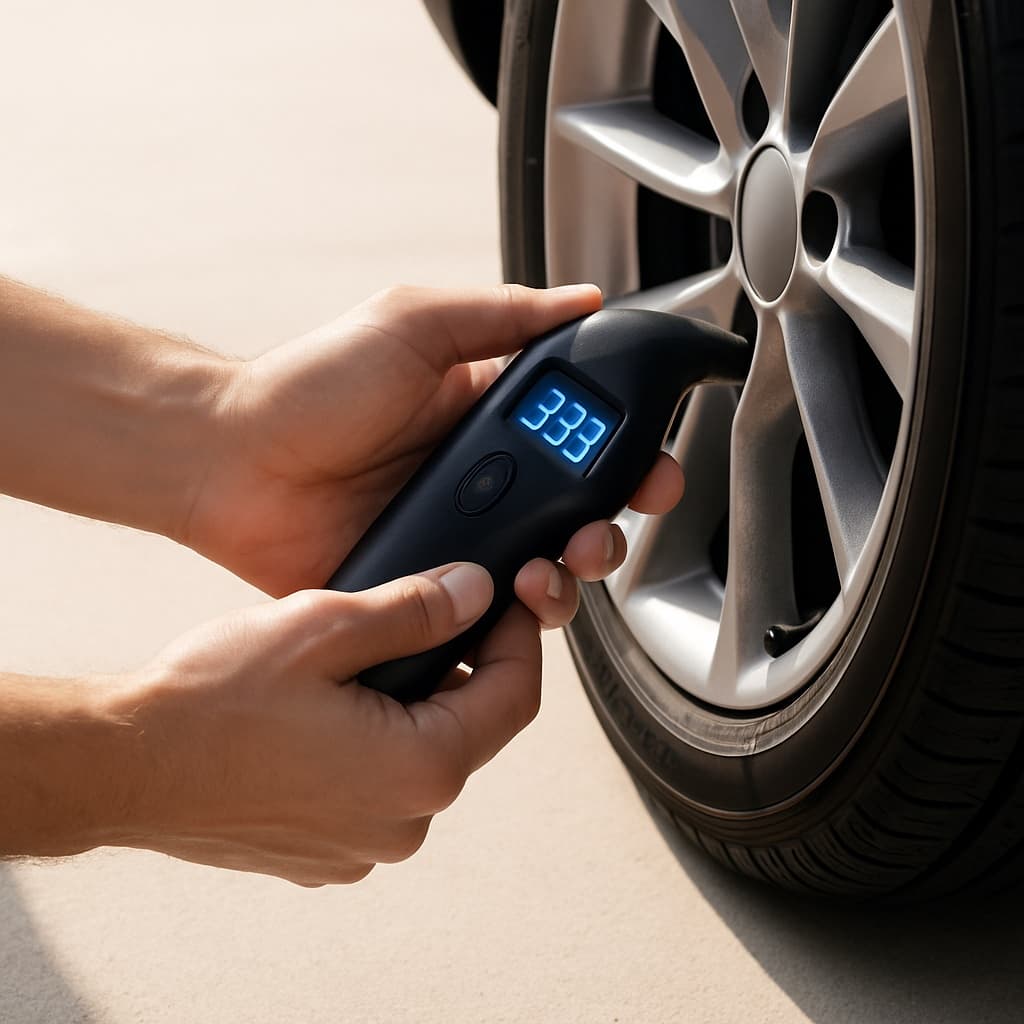
Checking tire pressure is a two-minute job that most drivers do rarely, and a surprising number do wrong — usually because they're inflating to the number printed on the tire, which was never the right number. Meanwhile, tire pressure quietly decides your gas mileage, how evenly your tires wear, and how well the car stops and steers.
This guide covers the one sticker that actually tells you your correct psi, how to take a reading that isn't lying to you, what the tire pressure light on the dash really means, and how to add air without hunting for quarters at a gas station.
The Door-Jamb Sticker vs. the Sidewall Number
This is the single most important thing in this article: the big psi number molded into your tire's sidewall is the tire's maximum pressure — the most it's rated to hold — not the pressure your car wants. The correct pressure for your vehicle is on a sticker inside the driver's-side door jamb (sometimes in the fuel door or the owner's manual), set by the automaker for your specific car's weight, handling, and ride.
Mixing these up is the most common tire pressure mistake there is. Inflate to the sidewall max — often 44 psi or more — when your door sticker says 33, and you're riding around badly overinflated. Open the driver's door, read the placard, and use that number for every tire. Note that some vehicles specify different pressures front and rear; the sticker will say so.
What PSI Should My Tires Be?
Whatever your door-jamb placard says — that's the real answer, and it beats any generic figure. That said, the typical range is narrower than people expect: most passenger cars, crossovers, and small SUVs call for somewhere between 32 and 35 psi, cold. Trucks and heavily loaded vehicles often run higher, especially in the rear, and some placards list a separate pressure for towing or a full load of passengers.
One more wrinkle: those placard numbers are cold pressures. Air expands as it heats, so a tire that reads 35 psi after an hour on the highway may well be a 32 psi tire that warmed up. That's expected — never bleed air out of a hot tire to chase the cold number. Which brings us to when you should actually take the reading.
How to Check Tire Pressure, Step by Step
Check when the tires are cold — meaning the car has sat for a few hours or been driven less than a mile or two. Driving heats the air inside and can raise the reading by several psi, making a low tire look fine. First thing in the morning, in your driveway, is ideal. Unscrew the valve stem cap, press the gauge straight onto the stem until the hissing stops, and read the number. Compare it to the placard, add air if it's low, and recheck. Repeat for all four tires, then screw the caps back on.
On gauges: the pencil-style stick gauge is cheap and glovebox-friendly but easiest to misread; a dial gauge is more precise; a digital gauge is the easiest to read and accurate within a fraction of a psi — any of them beats the eyeball test, because a modern radial tire can be dangerously low and still look normal. If you remember one rule, make it this: cold tires, door-sticker number, all four corners.
What the TPMS Light Means (and Why It's a Late Warning)
That amber horseshoe with an exclamation point is your tire pressure monitoring system, and federal rules only require it to warn you when a tire is about 25 percent below the recommended pressure. On a 33 psi placard, that's a tire down around 25 psi — well past the point where fuel economy, wear, and grip have all degraded. Treat TPMS as a smoke alarm, not a thermostat: it tells you something is already wrong, and it's no substitute for a monthly check with an actual gauge.
TPMS is also one of the friendlier dash lights, all things considered. If the symbol glowing at you is an amber engine outline instead, that's a different diagnosis entirely — why is my check engine light on is its own rabbit hole, and we wrote a full guide for it.
Underinflation, Overinflation, and the Cold-Morning Effect
Underinflation is the expensive direction. Soft tires flex more, which scrubs off their shoulders, shortens tire life, and drags down fuel economy — the Department of Energy says keeping tires properly inflated can improve gas mileage by up to about 3 percent in some cases. It's also the dangerous direction: NHTSA research has found that vehicles driving on significantly underinflated tires are about three times more likely to be involved in a tire-related crash, and heat buildup in a badly underinflated tire is the classic recipe for a blowout. Overinflation is a milder sin — a harsher ride, a bit less grip, and faster wear down the center of the tread — but it's still a reason not to pump to the sidewall max.
And here's why the tire light loves the first cold morning of fall: air contracts as it cools, and the rule of thumb is that tires lose roughly 1 psi for every 10 degree Fahrenheit drop in temperature. A tire set to 33 psi on a warm September afternoon can wake up at 29 on the first frosty morning — enough, on a tire already a little low, to trip the TPMS light. Nothing is leaking; physics just sent you a reminder to top up.
How to Add Air (and the Habit That Makes This Easy)
Gas station compressors work fine: park close, set or watch the target pressure, fill each low tire, and recheck with your own gauge, since station gauges live a hard life. The upgrade move is a portable tire inflator like TireHero — it lives in the trunk, runs off the car's 12V socket or a battery, and shuts off automatically at the psi you set, which ends the quarters-at-the-gas-station ritual and turns a slow leak on a road trip from a crisis into a five-minute pause.
Make it a habit: check all four tires once a month, before any long road trip, and whenever the temperature swings hard. And check the spare once in a while too — it loses air sitting in the trunk just like the others, and the moment you need it is the worst possible time to find it flat.
Read our TireHero review
We tested the trunk-sized inflator that sets itself to the right psi and shuts off automatically — here's how it performed.
Read our TireHero reviewFrequently asked questions
What psi should my tires be?
Whatever the placard inside your driver's-side door jamb says — typically 32 to 35 psi for most passenger cars, measured cold. Never use the number on the tire's sidewall; that's the tire's maximum, not your car's recommended pressure.
Should I inflate tires to the psi on the sidewall?
No. The sidewall number is the maximum pressure the tire can safely hold, not a recommendation. Your car's correct pressure is on the driver's door-jamb sticker, and it's usually 8 to 10 psi lower than the sidewall max.
Why did my tire pressure light come on when it got cold?
Air contracts as it cools — tires lose roughly 1 psi per 10 degree Fahrenheit drop. A cold snap can pull an already-lowish tire under the TPMS warning threshold overnight without any leak. Top up to the placard pressure and the light should clear after a short drive.
How often should I check my tire pressure?
Once a month, before any road trip, and after a big temperature swing. Tires naturally lose about 1 psi a month, and the TPMS light won't come on until a tire is roughly 25 percent low — so monthly gauge checks catch problems it can't.
Can I drive with the TPMS light on?
Briefly and gently, yes — to somewhere you can add air. But a tire triggering the light is around 25 percent underinflated, which means degraded braking, worse fuel economy, and elevated blowout risk. Check it with a gauge as soon as you can; if the tire is visibly flat or losing air fast, stop.
Do I need to check the spare tire too?
Yes — spares lose air sitting in the trunk, and compact spares often require much higher pressure than regular tires (frequently 60 psi, printed on the spare itself). Check it a few times a year so it's actually usable when you need it.
TopCrate is reader-supported. When you buy through links on our site we may earn an affiliate commission, at no extra cost to you. Content is for general information and isn't a substitute for professional advice.