HANDS-ON REVIEW
TireHero Smart Cordless Tire Inflator Review: Is It Worth It?
A palm-sized cordless air pump with a digital gauge: dial in the PSI, press start, and it fills the tire and shuts off by itself.
Quick answer: Yes — TireHero turns the most-ignored maintenance light in driving into a two-minute driveway fix, and the auto-stop preset makes correct inflation the default instead of a skill. It won't plug a nail hole and full fills take minutes, but as the always-in-the-glovebox answer to low tires, soft bike wheels and flat basketballs, it pays for itself in skipped gas-station stops and better fuel mileage alone. Bundle it with a compact multi-tool like the [Kelvin 17-in-1](/reviews/kelvin-tools) — screwdriver bits, pliers, LED — in the same glovebox pouch and you've covered both halves of the roadside problem: the tire that's soft and the panel that needs a screwdriver you don't have.
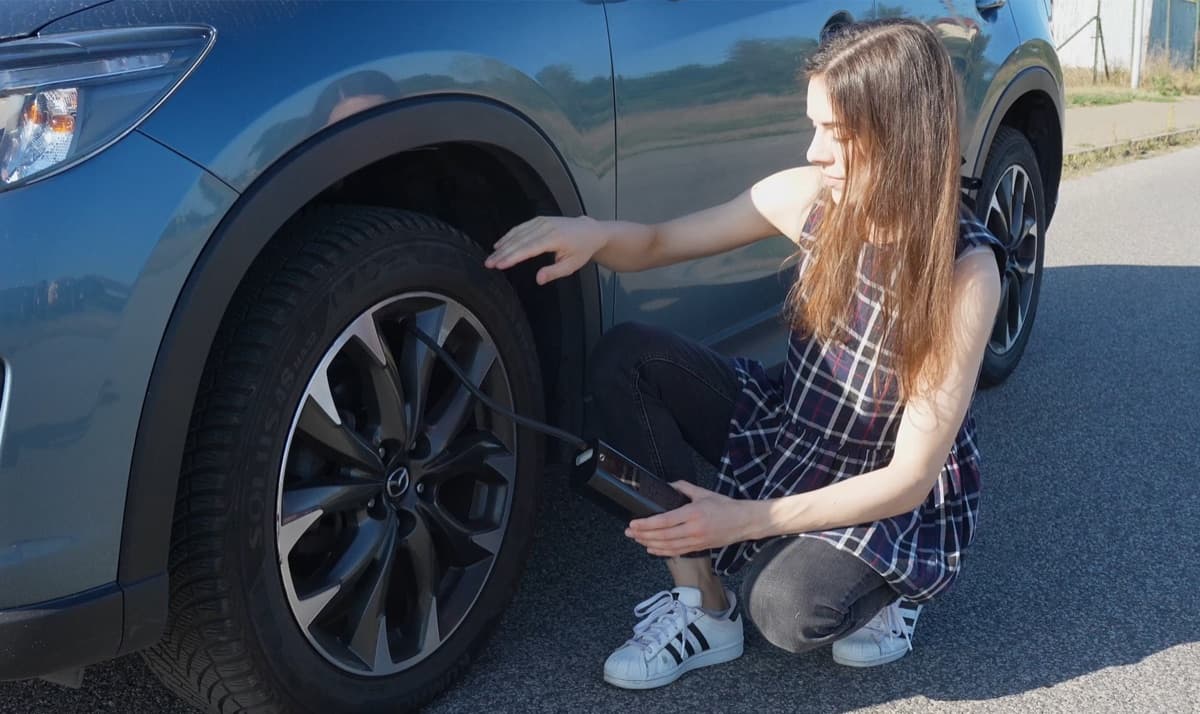
Low tire, no gas station: TireHero tops up a car tire right in the driveway. Photo: TireHero
Our verdict
Yes — TireHero turns the most-ignored maintenance light in driving into a two-minute driveway fix, and the auto-stop preset makes correct inflation the default instead of a skill. It won't plug a nail hole and full fills take minutes, but as the always-in-the-glovebox answer to low tires, soft bike wheels and flat basketballs, it pays for itself in skipped gas-station stops and better fuel mileage alone. Bundle it with a compact multi-tool like the [Kelvin 17-in-1](/reviews/kelvin-tools) — screwdriver bits, pliers, LED — in the same glovebox pouch and you've covered both halves of the roadside problem: the tire that's soft and the panel that needs a screwdriver you don't have.
The short version
The low-tire-pressure light is the most procrastinated warning in driving — because fixing it means hunting for a gas station with a working air machine, quarters, and a gauge you half trust. TireHero moves the whole job to your glovebox: a rechargeable, palm-sized pump with a screw-on hose, a backlit digital gauge, and a set-and-forget mode — punch in the target PSI, press go, and it inflates to exactly that number and stops on its own. Car tires, bike tires, motorcycle, balls, inflatables; presets for each. It's the difference between a two-minute driveway fix and a chore you postpone until the tire is dangerous.
Pros & cons
Pros
- Auto-stop at your target PSI — no over/under-inflating
- Cordless and palm-sized; lives in the glovebox
- Digital gauge doubles as an accurate pressure checker
- Built-in light for roadside and nighttime top-ups
- Modes for car, bike, motorcycle and sports balls
- USB-rechargeable — no 12V cord snaking out the window
Cons
- Tops up and fills tires — it won't fix a puncture (carry a plug kit)
- Full fills from flat take minutes, not seconds
- Like all compact pumps, it gets warm on long runs
How it works
Screw on, read the truth
Thread the hose onto the valve stem and the digital gauge shows your real current pressure — usually the first accurate reading that tire has had in months.
Set your PSI
Dial in the target from the sticker inside your driver's door (not the tire sidewall) and press start.
Walk away, it stops itself
The pump runs to the exact target and shuts off automatically — no squeezing a gauge every 20 seconds, no guessing.
Who it's for
- Anyone who's driven a week on the TPMS light
- Households with bikes, balls and inflatables to feed
- Parents putting a safety net in a new driver's car
- Road-trippers and cold-climate drivers (PSI drops with temperature)
Why tire pressure is the most neglected safety item
Underinflated tires brake longer, hydroplane easier, blow out more often, and quietly cost real money — soft tires drag, and drag burns fuel, upwards of $100 a year of it for a typical commuter. Yet pressure care is universally neglected for one reason: friction. The gas-station air machine is out of order, costs $2.50, and its gauge has been dropped four hundred times. Every step between 'light comes on' and 'problem fixed' is why the light stays on.
A glovebox inflator deletes all of it. The check happens in your driveway because the pump is the gauge; the fix happens in the same two minutes because the pump is also the compressor. Cold snaps — which drop pressure roughly 1 PSI per 10°F — stop meaning a gas-station pilgrimage. The behavioral change is the product: people with a pump in the car simply have correctly inflated tires, the way people with a jump-starter kit simply don't fear a dead battery.
Auto-stop is the killer feature
Manual inflation is a two-hands-three-eyes job: hold the chuck, watch the gauge, stop, re-check, overshoot, bleed air, re-check. TireHero's preset mode replaces the whole dance — set 35 PSI, press start, and walk around checking the other tires while it works. It stops at 35. Overinflation (harsh ride, uneven wear, reduced grip) and underinflation both disappear, because a microcontroller is holding the gauge instead of a cold thumb.
The digital gauge earns its keep even when you're not filling: pencil gauges and station dials routinely read 3–5 PSI off, which is the entire margin between correct and underinflated. One number to know: your car's target PSI lives on the driver's door-jamb sticker — the number molded into the tire sidewall is the tire's maximum, not the target, and inflating to it is a classic mistake the preset mode makes impossible to repeat.
Is TireHero worth $69.99?
The comparison set: 12V plug-in compressors are cheaper but tether you to the cigarette lighter with a cord across the fender — fine in a driveway, miserable on a shoulder. Gas-station air is $1.50–2.50 a visit and requires the visit. A single roadside-assistance call-out for a 'flat' that was actually just low costs more than the pump. As a cordless do-everything inflator with auto-stop, TireHero sits at the price of a tank of gas and change.
It also covers the non-car inventory that ambient households constantly re-buy hand pumps for: bike tires before every ride, footballs and basketballs mid-season, pool floats in June. Glovebox placement is the pro move — next to the emergency multi-tool and whatever else lives in your car readiness kit — because a pump at home fixes driveway problems, but a pump in the car fixes trip problems.
Frequently asked questions
Will TireHero inflate a completely flat car tire?
Yes, if the tire holds air (a bead-seated tubeless tire) — expect several minutes from flat rather than the quick 30-second top-up. What it can't do is repair a puncture; pair it with a plug kit for that.
How many tires can it do per charge?
Comfortably a full car's worth of top-ups with charge to spare — typical compact inflators handle multiple tires from low and recharge over USB between uses. Top it up seasonally like any glovebox battery.
Is the digital gauge accurate?
Far more consistent than pencil gauges and gas-station dials, and precise enough to hold the exact preset it fills to — which matters, since 3–4 PSI is the whole gap between correct and underinflated.
What PSI should I set?
The number on the sticker inside your driver's door jamb — typically 32–36 PSI for passenger cars. Not the number on the tire sidewall; that's the tire's maximum, not the recommendation.
Does it work on bikes and balls?
Yes — it includes modes and adapters for Presta/Schrader bike valves, sports balls and inflatables, replacing the drawer of dedicated hand pumps most households accumulate.
Is it loud?
It sounds like a small compressor — noticeable for a minute or two per tire, quieter than a gas-station machine, and nothing your neighbors will remember.
TireHero vs Xiaomi 1S vs Ryobi 18V vs a $25 12V plug-in — which cordless inflator wins?
TireHero is priced and specced between the popular options. A $25 12V plug-in compressor from Amazon works but ties you to the cigarette-lighter port with a cord you have to snake around the door — fine at home, awful on a shoulder in traffic. Xiaomi's 1S is the closest direct comparable at a similar price: also cordless, also auto-stop, slightly older interface, weaker sports-ball performance. Ryobi's 18V One+ inflator (if you already own Ryobi cordless tools) is faster and stronger but only makes sense as part of that battery ecosystem — a bare inflator plus a battery and charger costs 3-4× TireHero for a first-time buyer. For a driver who just wants a self-contained cordless glovebox pump with auto-stop and multi-purpose modes, TireHero is the right lane. If you own a Ryobi cordless system already, buy that; if you want the cheapest possible, buy the $25 12V and live with the cord.
Cold weather just dropped my tire pressure warning — should I inflate right now or wait?
Inflate now, and inflate to your door-jamb PSI number (not more). Tire pressure drops roughly 1 PSI per 10°F fall in ambient temperature — a car that read 35 PSI at 70°F reads about 32 PSI at 40°F, which is enough to trip the TPMS light on most modern vehicles. The tires themselves are not damaged; they lost apparent pressure. Top them back to the door-jamb spec (typically 32-36 PSI) with TireHero in the driveway, and the light clears within a few miles as the sensors re-poll. The mistake most drivers make is over-inflating to compensate — 'I'll pump to 38 so the light stays off through winter' — which is worse: overinflated tires ride harshly, wear the center of the tread out faster, and grip less on cold roads. Set the door-jamb number, no higher, and re-check every 4-6 weeks through winter.
When you buy through links on this page, TopCrate may earn an affiliate commission at no extra cost to you. An inflator restores pressure but does not repair tire damage — have punctures inspected professionally. Prices accurate as of publish time.