HANDS-ON REVIEW
Cobra First Response Fire Blanket Review: Is It Worth It?
A flame-resistant fiberglass blanket that smothers small kitchen fires in seconds — no pin, no aim, no chemical cloud over everything you own.
Quick answer: Yes — the Cobra Fire Blanket is the highest-value $30 in home safety: a first-response tool that works under panic, never expires on a schedule, and saves the kitchen twice — once from the fire, once from the extinguisher powder. It has honest limits (small, contained fires; alarms and 911 still run the show), but within them it turns the most common home-fire scenario into a fifteen-second non-event.
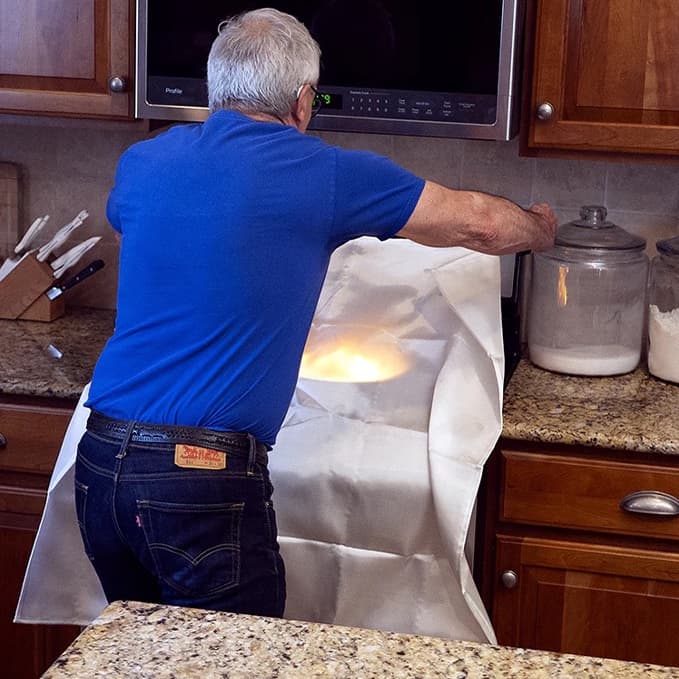
Smothering a stovetop fire: lay the blanket over the flames and cut off their oxygen. Photo: Cobra
Our verdict
Yes — the Cobra Fire Blanket is the highest-value $30 in home safety: a first-response tool that works under panic, never expires on a schedule, and saves the kitchen twice — once from the fire, once from the extinguisher powder. It has honest limits (small, contained fires; alarms and 911 still run the show), but within them it turns the most common home-fire scenario into a fifteen-second non-event.
The short version
Most kitchen fires start small — a grease flare, a forgotten pan — and the standard response tool is a pressurized extinguisher that many people have never test-fired, that expires quietly, and that buries the kitchen in corrosive powder when used. A fire blanket is the older, simpler answer: a woven fiberglass sheet that you pull from its pouch by two hanging tabs and lay over the flames, cutting off oxygen instantly. No pin sequence to remember at 2 a.m., no aiming, no cleanup beyond the pan itself, and nothing to recharge or replace on a schedule. Cobra's version comes in a quick-release wall pouch sized for the kitchen, garage, grill and car.
Pros & cons
Pros
- Smothers small grease and stovetop fires without chemicals
- Grab-and-pull tabs — usable under panic, no training needed
- No pressure gauge, expiry date, or recharge schedule
- No toxic powder cleanup — the kitchen survives the save
- Also wraps around a person whose clothing has caught
- Mounts by the stove, grill, garage, RV or fireplace
Cons
- For small, contained fires only — spreading fires need 911, not bravado
- Single-use in a real fire event; replace after deployment
- Doesn't replace smoke alarms or a home extinguisher entirely
How it works
Pull the tabs
Yank the two hanging tabs and the blanket releases from its wall pouch instantly — the folded design deploys as you pull.
Lay, don't throw
Hold the blanket in front of you (hands tucked behind the top corners) and lay it over the fire — pan, toaster, small appliance — covering it completely.
Leave it and kill the heat
Turn off the burner if you safely can and leave the blanket in place until everything is fully cool. Oxygen starved, the fire dies under it.
Who it's for
- Every kitchen — grease fires are the #1 home-fire start
- Grill masters, garage tinkerers, and RV owners
- Households that never test their extinguisher (most)
- Gift-buyers outfitting a kid's first apartment or dorm
Why a blanket beats an extinguisher for grease fires
Grease fires punish every instinct: water makes them explode outward, and even an extinguisher blast can splash burning oil across the kitchen if aimed carelessly. A blanket has no failure mode of that kind — laying it over the pan starves the flame of oxygen without moving the fuel anywhere. That's why fire blankets have hung in commercial kitchens and welding shops for a century; the physics are idiot-proof in exactly the moment you'll be an idiot.
The comparison isn't blanket-or-nothing, it's about first response. An extinguisher remains the right tool for fires you can't cover — but it demands maintenance (pressure checks, 10–12 year replacement) and a four-step operating sequence under adrenaline. The blanket's entire manual is 'pull, lay, leave.' In the 15 seconds that decide whether a flare-up becomes a house fire, simplicity is the feature.
Where to mount it (and how to actually use it)
Placement rule: near the hazard, not over it. Beside the kitchen doorway or on the pantry wall beats directly above the stove — you don't want to reach through flames to get your fire tool. One by the kitchen, one in the garage or by the grill, one in the RV or car covers the realistic fire map of a household; at $29.99 each, multi-point coverage costs less than one extinguisher service.
Technique details that matter: tuck your hands behind the folded top edge so they're shielded as you lay it down; cover the burning object completely — a gap feeds the fire; kill the burner; then do nothing for a long time. The most common blanket mistake is peeking early — reintroducing oxygen to a hot pan can reignite it. If the fire is bigger than the blanket or spreading, skip the hero act: get out and call 911. The blanket buys seconds; it is not a firefighting career.
Fire blanket vs. extinguisher vs. both
The honest answer for a well-prepared home is both, in different roles: blanket as the instant, zero-thought first response for contained cooking fires (plus the unique ability to wrap a person whose clothes have caught), extinguisher as the bigger gun for fires beyond a pan. What the blanket replaces isn't the extinguisher — it's the frozen ten seconds of 'what do I do' that lets a flare-up grow, and the wrecked kitchen when powder settles into every appliance after a save.
It slots into the same readiness tier as the rest of the prep basics — working smoke alarms first, a grab-and-go document box for the worst case, a car emergency tool in the glovebox. None of it is glamorous; all of it is the $30 category where being wrong once costs a thousand times the price. The blanket is the piece most homes are missing.
Try Cobra Fire Blanket for Yourself
Available now for $29.99.
Check Availability & Price →Ships to your doorFrequently asked questions
What fires can a fire blanket put out?
Class F cooking-oil fires (grease, deep fryers, cooking pans) and small Class A fires — a stovetop flare-up, a pan of hot oil, a toaster, a small trash bin — anything the blanket can fully cover with edge to spare. Cobra is rated for temperatures over 900°F. It is not designed for electrical panel fires still under live power, spreading fires larger than the 47" × 47" blanket, or lithium-battery fires (those need a Class D-approved response). Anything beyond a contained flare — evacuate and call 911 immediately.
How do I use it without burning my hands?
Pull the two tabs to release it from the pouch, then fold or roll the top edge over your hands like oven mitts so the fiberglass shields your skin, and lay — never throw — the blanket over the flames from the front, working away from you. Then turn off the burner if you can reach it and leave the blanket in place for at least 15 minutes until the pan is fully cool to the touch. Lifting early re-introduces oxygen and can reignite hot grease instantly.
Is it reusable?
Treat it as single-use: after smothering a real fire, the fabric may be compromised, so replace it. Undeployed, it keeps indefinitely — no pressure checks or expiry swaps like an extinguisher.
Does it replace a fire extinguisher?
It replaces the extinguisher for the most common kitchen scenario and beats it on speed, simplicity and cleanup — but a full-coverage home still wants working smoke alarms and an extinguisher for fires a blanket can't cover.
Can it protect a person?
Yes — wrapping a blanket around someone whose clothing has caught fire smothers the flames, which is something no extinguisher does gracefully. It's also the classic stop-drop-and-wrap tool.
Where should I keep it?
Mounted visibly near — not above — the cooking area, plus the garage, grill, fireplace, RV or car. The wall pouch releases with one pull, so mount it where you can grab it without crossing the fire.
When you buy through links on this page, TopCrate may earn an affiliate commission at no extra cost to you. A fire blanket is for small, contained fires only — always evacuate and call 911 for any fire that is spreading or larger than the blanket, and keep working smoke alarms. Prices accurate as of publish time.