HANDS-ON REVIEW
Kelvin 8 Car Emergency Multi-Tool Review: Is It Worth It?
A glovebox-sized 8-in-1: window breaker, seatbelt cutter, flashlight, beacon, siren, hand-crank power and a phone-charging battery.
Quick answer: The Kelvin 8 is the glovebox tool we'd actually spec for a family car: it covers the mundane emergencies that definitely happen and the terrifying ones that probably won't, and the hand crank means a forgotten battery never becomes the reason it fails. Forty dollars for eight jobs done properly is easy math. Pair it with the palm-sized [Kelvin 17-in-1 multi-tool](/reviews/kelvin-tools) in the toolbox at home and you've covered the two places every household hits an emergency — the car on the shoulder and the drawer at 10pm when a screwdriver is missing.
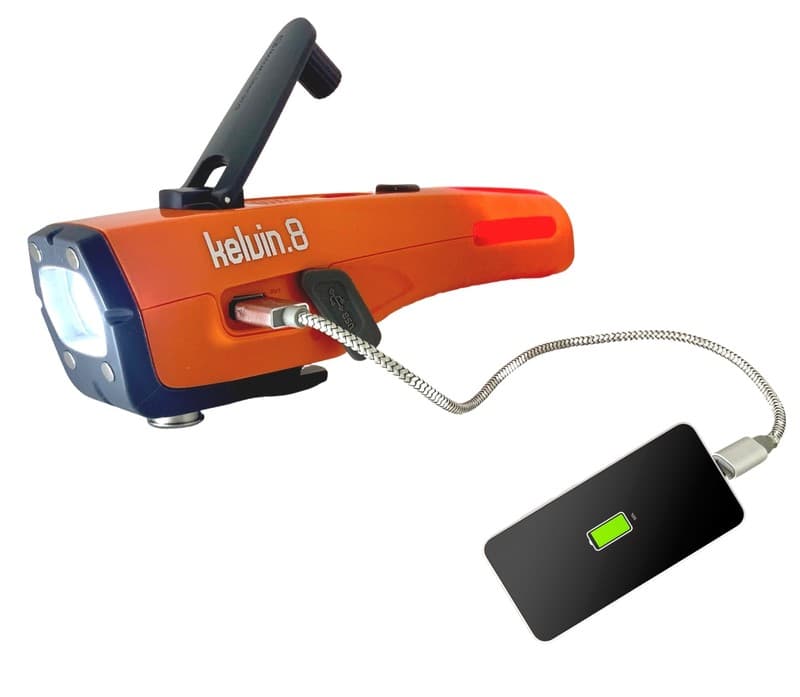
Flashlight, crank and USB charging in one grab — the Kelvin 8 mid-demo. Photo: Kelvin
Our verdict
The Kelvin 8 is the glovebox tool we'd actually spec for a family car: it covers the mundane emergencies that definitely happen and the terrifying ones that probably won't, and the hand crank means a forgotten battery never becomes the reason it fails. Forty dollars for eight jobs done properly is easy math. Pair it with the palm-sized [Kelvin 17-in-1 multi-tool](/reviews/kelvin-tools) in the toolbox at home and you've covered the two places every household hits an emergency — the car on the shoulder and the drawer at 10pm when a screwdriver is missing.
The short version
Most roadside 'emergencies' are boring — a dead phone, a flat at night, a breakdown on the shoulder. A few are life-or-death — a jammed seatbelt, a window that won't open. The Kelvin 8 packs answers to both into one bright-orange, flashlight-shaped tool: LED flashlight, red warning beacon, siren, seatbelt cutter, steel window breaker, a USB power bank for your phone, a hand-crank dynamo so it can recharge itself with no power anywhere, and USB/12V recharging. It stows in the glovebox in its pouch and waits.
Pros & cons
Pros
- 8 real functions — from phone charging to window breaking
- Hand-crank dynamo works even when everything's dead
- USB-out power bank tops up your phone on the roadside
- Steel-tip window breaker and belt cutter for worst-case exits
- Red beacon + siren make you visible and audible to traffic
- High-vis orange, glovebox-sized, includes carry pouch
Cons
- Bigger than a plug-in tool — it lives in the glovebox, not the socket
- Crank charging is for emergencies, not everyday top-ups
- You have to remember it's there (keep it in the door or glovebox)
How it works
Stow it within reach
Keep the Kelvin 8 in the glovebox or door pocket — orange body, so it's easy to spot in a hurry.
Handle the common stuff
Dead phone? USB-out charges it. Dark shoulder? Flashlight, red beacon and siren keep you seen and heard.
Escape the rare stuff
Seatbelt jammed or window stuck: the recessed cutter slices the belt and the steel tip shatters tempered side glass.
Who it's for
- Anyone who drives long distances or rural roads
- Parents who want one tool covering every car scenario
- Winter drivers where a dead battery means a cold wait
- Glovebox preppers who'd rather have it and not need it
Eight tools, one grab: what's actually in the Kelvin 8
The count is real, not padded: (1) an LED flashlight for flats and engine bays, (2) a red flashing warning light so traffic sees you on the shoulder, (3) a siren to draw attention, (4) a seatbelt cutter recessed so it can't cut you, (5) a steel-tip window breaker for tempered side glass, (6) a USB-out power bank that charges your phone, (7) a hand-crank dynamo that generates power from nothing, and (8) rechargeability from USB or the 12V socket between uses.
The combination matters more than any single tool. The scenarios stack in real life — a night breakdown is simultaneously a light problem, a visibility problem and a dead-phone problem. One object in the glovebox that answers all three beats a drawer of single-purpose gadgets you didn't bring.
The hand crank is the killer feature
Every battery-powered emergency tool shares a failure mode: the night you need it is the night it's been sitting discharged for a year. The Kelvin 8's fold-out dynamo crank removes that failure mode entirely — a few minutes of cranking generates enough charge to run the flashlight and put minutes of talk time on a phone, with no wall, no car power, no sun required.
That's the difference between an emergency tool and a gadget: the crank guarantees function at zero percent. Top it up over USB every few months like you should, but if you forget — and everyone forgets — the crank is the backstop that makes forgetting survivable.
Kelvin 8 vs a socket tool like React — which belongs in your car?
They solve reach differently. A 12V-socket tool like the React by ChargeHub 7-in-1 car emergency tool is always at your fingertips and always charged, but its size limits it to the essentials. The Kelvin 8 is the fuller kit — bigger light, beacon plus siren, crank power, more battery — at the cost of living a glovebox away instead of in the console.
For a worst-case exit (belt cutter + glass breaker), closer is better, which favors the socket tool. For everything else that actually happens — breakdowns, dead phones, dark roadsides, being seen — the Kelvin 8's extra capability wins. The belt-and-suspenders answer for a family car is honestly both; if you're choosing one, pick based on whether your nightmare is the crash or the breakdown.
The escape-tool physics: why a steel-tip breaker works on side glass but not the windshield
The moment when you actually need a window breaker is worth understanding, because using it wrong wastes precious seconds. Passenger-vehicle side and rear windows are made of tempered glass — heat-treated to be several times stronger than regular glass and, critically, to shatter into small dice-shaped fragments rather than dagger-shaped shards when the surface tension is broken. A steel or ceramic point concentrates enough pressure at a single spot to break that surface tension, and the entire window falls into thousands of small pieces almost instantly. The Kelvin 8's steel tip is engineered for exactly that mechanism: strike a corner of the side window firmly (corners work better than the center — the edge is under more tension), and the whole pane comes down in one hit. It doesn't require exceptional strength; the point does the work.
The windshield is a completely different problem. Modern windshields are laminated glass — two sheets of glass sandwiched around a plastic PVB (polyvinyl butyral) interlayer that holds the whole thing together even when both glass layers crack. This is a safety feature (it prevents ejection in crashes and keeps roof integrity), and it means no handheld breaker in the world will punch through a windshield in a hurry — the plastic layer just deforms and holds the glass in place. In an underwater or fire scenario, the escape route is always a side or rear window, never the windshield. The rear windshield on newer vehicles is also increasingly laminated, so the front-side and rear-side windows are your reliable exits. This is why the Kelvin 8 lives in the glovebox or door pocket where the front-seat occupants can reach it — the tool is only useful if you can get to the specific window you're trying to break in the specific direction it needs to be struck.
The specific breakdown-scenario playbook — how eight tools actually stack in real emergencies
The Kelvin 8's value isn't in any single feature — it's in how the features cover the specific sequence of a real roadside emergency. **Night breakdown on a rural shoulder** (the most common serious scenario): first move is visibility — the red flashing beacon goes on the roof or dash pointing back at traffic, drops the odds you'll be rear-ended dramatically. Second move is light — the LED flashlight lets you inspect a flat, read a fuse box, or wave at approaching help without holding your phone (which is dying). Third move is comms — USB-out charges your dying phone enough to call for a tow. That's three of the eight tools working in a specific sequence in the specific scenario they were designed for.
**Winter dead-battery scenario**: the crank is the specific tool here — a car battery that won't start the engine also won't run your phone hotspot or your interior lights, and a plug-in power bank you forgot to charge is useless. Two minutes of cranking generates enough for a phone call or a text with your location. **Post-crash trapped-in-vehicle scenario** (the terrifying one): seatbelt cutter first (the recessed blade is designed so you can slice the belt across your chest without cutting yourself in the panic motion), then window breaker on the nearest side window if the doors are jammed or you're upside-down. **Being seen after a shoulder walkaway**: the siren is the tool most families overlook — if you've walked away from the car to check something and need to be heard, the siren works when a flashlight in daylight doesn't. The Kelvin 8's value is that all four of those scenarios are handled by one tool you actually grabbed instead of four gadgets you didn't bring. Round out the household emergency kit with the palm-sized Kelvin 17-in-1 multi-tool in the toolbox, a ChillWell portable air cooler for summer breakdowns in unforgiving heat, and a car with the small habit that saves lives: keeping the fuel tank above a quarter and topping up the Kelvin 8's battery every quarter — the crank covers you when you forget, but a topped-up bank means you never have to crank in the first place.
Frequently asked questions
What are the Kelvin 8's eight functions?
LED flashlight, red flashing warning beacon, siren, seatbelt cutter, steel-tip window breaker, USB-out power bank for charging a phone, a hand-crank dynamo for generating power with no source available, and USB/12V rechargeability. The count is real, not padded — each function targets a specific roadside scenario, and the combination means one tool in the glovebox covers what would otherwise be four separate gadgets you probably didn't remember to bring.
Can it really charge my phone?
Yes — it has a rechargeable internal battery with a USB output. Fully charged, it delivers roughly 30-45 minutes of talk time or an ~30% top-up on a modern smartphone (the exact number varies by phone battery size). Charge the Kelvin 8 at home or in the car every couple of months, and it tops up your phone on the roadside. In a pinch, the hand crank generates enough for emergency call time — two minutes of cranking is enough for a call or a location text.
How does the hand crank work?
A fold-out handle spins an internal dynamo that generates electrical current to charge the tool's battery. A few minutes of cranking powers the flashlight for several minutes and adds emergency minutes to a phone — it works with zero external power, which is the whole point. Real-world calibration: one minute of steady cranking (~120 turns) yields roughly 30 seconds of flashlight or 1-2 minutes of standby phone battery. It's meant as a backstop for a dead unit, not a primary charging method — top the bank up over USB when you can.
Will the window breaker work on my car?
The steel tip is designed for tempered side windows — strike a corner of the glass firmly (corners work better than the center) and the entire pane shatters into small dice-shaped fragments almost instantly. It won't break laminated windshields (front and increasingly rear windshields on newer vehicles), because the plastic interlayer inside a laminated windshield holds the glass together even when cracked. In an emergency exit scenario, always target a side window — front-passenger or rear-side windows are your reliable exits.
How should I store it?
In the glovebox or driver's door pocket, in its pouch, where you can reach it without leaving the seat. If you have a family car, the door pocket beats the glovebox for reach — in a rollover or fire, you may not be able to open the glovebox door. Top up its battery over USB every few months — and the crank covers you if you forget. The pouch also keeps small parts (the belt cutter cover, the pouch strap) organized.
Is it hard to use in the dark?
It's high-visibility orange, flashlight-shaped so your hand knows the grip, and one button gets you light. The cutter is recessed (safe to fumble) and the breaker tip fires with a firm press. Practice once when you first buy it — three minutes with the tool in daylight to feel where every function lives means you can operate it correctly the one time you have to.
How does the Kelvin 8 compare to a Life Hammer, ResQMe, or dedicated escape tool?
A dedicated escape tool like a Life Hammer or ResQMe is smaller and cheaper (~$10-20), does one job (window break + seatbelt cut), and can hang from a keychain or lanyard so it's always within reach. That's a legitimate approach — for someone who ONLY worries about the crash scenario, a ResQMe on the keys is arguably the right buy. The Kelvin 8 is the broader kit: it does the escape job with the same steel-tip mechanism, plus adds the flashlight, beacon, siren, phone charging, and hand crank that address the far more common non-crash emergencies (breakdowns, dead phones, dark shoulders, winter dead batteries). Many families run both — a keychain escape tool for immediate reach in the crash scenario, and a Kelvin 8 in the glovebox for the breakdown scenarios that actually happen every year.
When you buy through links on this page, TopCrate may earn an affiliate commission at no extra cost to you. The Kelvin 8 is an emergency aid; no tool guarantees escape in every scenario — drive safely. Prices accurate as of publish time.