SECURITY
How Do Card Skimmers Actually Work? (And What Actually Blocks Them in 2026)
Wireless card skimming is the drive-by cousin of the gas-pump reader — it works at inches, not across a room, and one $20 card in the wallet you already own is the fix that beats every RFID wallet by a wide margin.
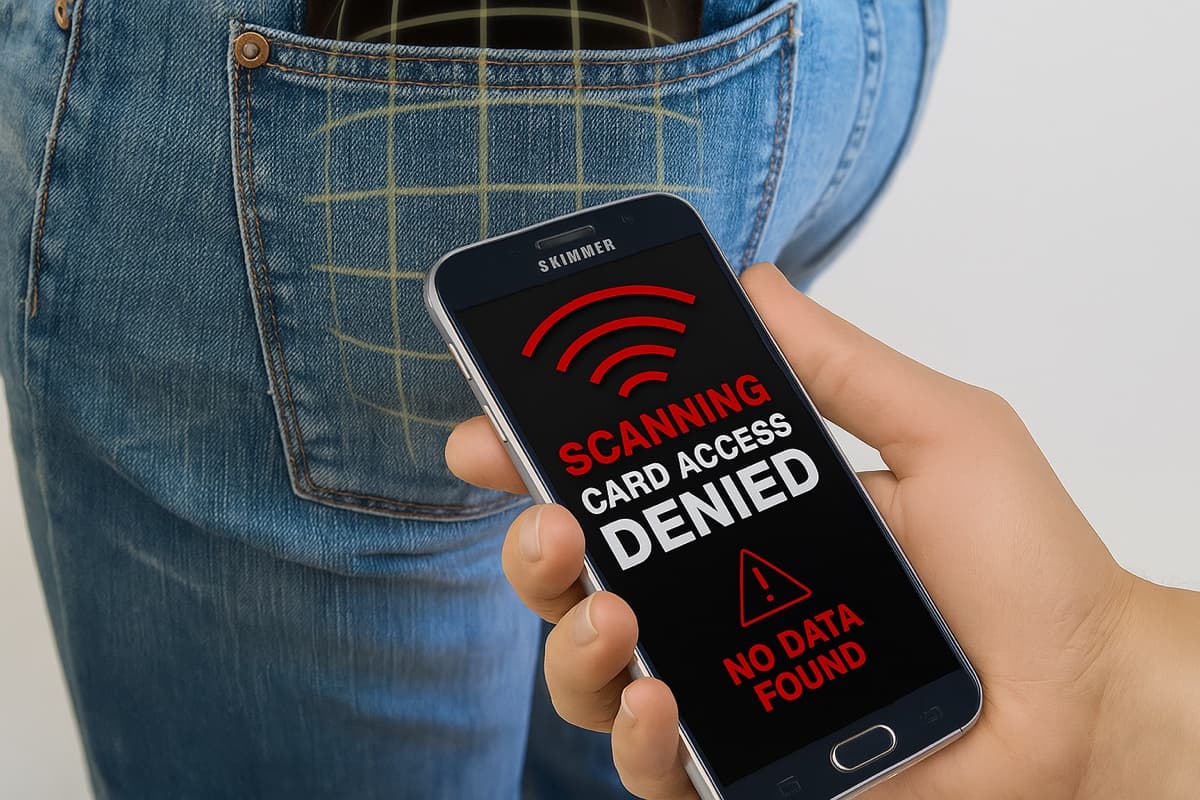
Every tap-to-pay card in your wallet is, physically speaking, a tiny radio antenna wrapped around a chip that answers whoever calls it. That is not a scandal — it is exactly how the tap-to-pay experience at the coffee counter works. The chip has no battery of its own; the payment terminal produces a 13.56 MHz radio field, the field powers the chip for a few hundred milliseconds, the chip broadcasts the payment token, and the transaction is done. What people mean by a 'card skimmer' is a device that produces that same field on somebody else's schedule, with the same card doing exactly what it is designed to do — but in an alley, on a train, or in a crowded line where you never meant to tap anything.
The internet has done a bad job explaining the honest shape of this threat. YouTube tutorials show fictional readers extracting data 'from across the room' that would need a suitcase-sized antenna and a legal problem to actually build; consumer blogs sell $80 wallets with a claim they never quite back up; and card issuers wave the whole thing away because their tokenization catches most fraud at the transaction stage. The truth is in between: wireless skimming is a real attack with a narrow, cheap fix, most people massively over-buy the fix, and the cheapest sound option is a single card-thin jammer that stays in the wallet you already own. This guide walks through how the attack actually works, what data can and cannot be captured, the real-world range and prevalence, and the three real countermeasures ranked by cost and behavior change.
The one-page explanation of how contactless payment actually works
Every credit card issued in the last decade with a small wave-symbol next to the chip contains a passive NFC (Near Field Communication) transponder — an antenna coil of thin copper embedded around the perimeter of the card and a tiny secure element chip in the middle. 'Passive' is the load-bearing word: the card has no battery, no processor running on its own power, and no ability to transmit anything until an external radio field wakes it up. When the payment terminal at the register generates its 13.56 MHz field, the field induces a small current in the card's antenna coil (the same physics as a phone's wireless charging pad, just at higher frequency and lower power). The current briefly powers the secure element chip, the chip runs its authentication routine, and it modulates its answer back onto the same field the terminal is emitting. That answer includes a payment token — a one-time cryptographic proof that the card is legitimate — plus, on some card designs, the primary account number (PAN) and the expiration date.
Which cards do this. All modern Visa payWave, Mastercard PayPass, American Express ExpressPay and Discover Zip cards, most US bank debit cards issued after roughly 2020, transit cards (MTA OMNY, Metro TAP, Boston CharlieCard variants), hotel keycards, employee access badges, US passports issued after 2007 (RFID at 13.56 MHz for the biometric chip), and 'smart' driver's licenses in a growing list of states. Any card with the wave icon or with 'contactless' printed on it is in the same physics category. Which is not — the older magnetic-stripe cards without an NFC chip cannot be wirelessly read at any distance; they need to be swiped through a physical read head. That distinction matters because the classic mall-parking-lot 'card skimmer' most people picture is a hardware overlay on a gas pump or ATM that captures the magnetic stripe as you insert the card. That is a completely different attack from wireless skimming, targets a different technology, and RFID blocking does nothing against it. Both attacks exist; they don't compete for the same fix.
What a wireless card skimmer physically is (and why the 'across the room' videos are lying)
A working wireless card skimmer is not exotic hardware. It is a standard NFC reader — the same category of device your phone contains, the same category the payment terminal at Starbucks contains — combined with a battery pack, some data storage, and either a very quiet 'this happened' beep or no feedback at all. Off-the-shelf NFC development boards from any electronics supplier cost $20-40, run on a phone battery, and can be programmed with about a hundred lines of code to log every card that responds to their field. Someone determined to build one is not stopped by scarcity; they are stopped only by the physics of read range and the legal risk of getting caught with it.
The read range on any reasonable-sized skimmer is far shorter than the videos suggest. The theoretical maximum range for a 13.56 MHz card-terminal transaction is about 10 cm (4 inches); ISO 14443, the standard that governs contactless payment, deliberately caps the field strength to that range for security reasons. Real-world skimming with a coat-pocket-sized reader effectively works at 1-3 inches — reader touching wallet, or reader-in-hand and wallet-in-back-pocket. Long-range reader builds do exist (the security research community has published designs that read at 10-20 inches using amplified antennas and shielded environments) but they require a briefcase-sized backpack, careful antenna alignment, and are essentially unbuildable in the kind of casual crowd where you'd want to use one. The genuine, cheap, easy-to-deploy attack is short-range: the reader is inches from the wallet. That means the honest threat model is 'someone brushes past you in a crowd' or 'someone leaves a reader in a chair back at a café,' not 'a van across the parking lot silently harvests your card.'
What data actually gets captured (and what card networks have done about it)
The data available to a successful wireless skim varies by card generation. Older US-issued contactless cards from roughly 2007-2015 broadcast the full primary account number (PAN), the expiration date, and the cardholder name in plaintext as part of their contactless response — because the original spec was designed for terminals, not attackers, and privacy was retrofitted. A skimmer capturing one of those cards has enough data to clone the card's magnetic-stripe track and use it at a legacy swipe-only terminal, or to make a card-not-present online purchase where the CVV isn't required (a shrinking category as e-commerce hardens). This is the version the 'RFID paranoia' era of 2010-2018 was actually about, and it was a real problem.
Modern contactless cards — every Visa, Mastercard, Amex and Discover contactless issued after roughly 2016 — no longer broadcast the static PAN in the clear. Instead the card broadcasts a one-time cryptographic token generated by the secure element, valid for a single transaction, useless to replay elsewhere. A skimmer capturing that token gets a receipt for a transaction that never happened. Which is why card networks argue publicly that wireless skimming is a solved problem: their fraud-detection systems reject the replayed token, the cardholder is not liable, and life goes on. Their argument is broadly correct for wireless skimming of modern payment cards specifically — the tokenization is genuinely strong. It is not correct for the other RFID/NFC data on your body: an older card issued by a smaller bank that never upgraded, an RFID-chipped US passport with biographical data readable within a few inches, a hotel keycard with a room number, an office access badge that unlocks a building, a transit card with stored value. Those attack surfaces are the honest reason someone might still want to shield a wallet in 2026 — not the fully-tokenized credit card, but the collection of other radios that ride with it. This is also why our review of the Wallet Defender frames the value as protecting the whole card stack, not any single card.
How often does this actually happen? The prevalence question
The prevalence of successful wireless card skimming is genuinely hard to measure — victims often don't know they were skimmed if the tokenization defeated the attack, and card issuers do not publish granular breakdowns of fraud by attack vector. What we do know: the FTC and FBI receive relatively few reports specifically citing contactless skimming compared to online card-not-present fraud, phishing, and physical gas-pump skimmers, which collectively dominate reported card fraud. Contactless skimming is a small slice, and modern tokenization has shrunk it further.
That said, the specific scenarios where the attack still pays off cluster around a few habitats: dense urban transit (the reader-in-the-backpack in a packed subway car), high-tourist areas with concentrated wallet radios (RFID passports at customs lines, hotel key cards in lobbies), and long TSA-style queue lines where wallets sit patiently at pocket-brush distance. Travelers in particular carry an unusual concentration of shielding-worthy radios — passport, hotel keycard, home cards, plus maybe an office badge for a work trip — in one bag through unfamiliar crowds. That's the threat profile where a $20 mitigation buys the most peace of mind for the least behavior change. A commuter riding the same train every day gets slightly less absolute risk reduction but pays the same $20, which is still a fine deal — nobody insures against fires by calculating expected annual loss.
What blocks a wireless card skimmer — three approaches, honest tradeoffs
There are only three physical mechanisms that stop a wireless skim, and consumer products are all variations on them. The first is Faraday shielding: wrap the cards in a conductive metal layer (aluminum foil, a metal-mesh sleeve, an aluminum wallet body) and the reader's 13.56 MHz field is absorbed and reflected before it reaches the card's antenna coil. Simple, cheap, and effective, but it means the whole wallet has to be built around the shield — you can't just add a Faraday layer to an existing leather bifold and expect it to work, because the shield has to fully enclose each card. Ridge-style aluminum wallets and dedicated RFID-blocking leather wallets ($40-90) work this way. The tradeoff: you're replacing the wallet you already own, and enforcing a form factor you may not want.
The second is per-card sleeves: individual foil-lined sleeves that each card sits inside. Effective and cheap ($10 for a pack of five), disastrous for behavior. You have to sheath and unsheath the card at every register, at every ATM, every time. Nobody sustains this for more than a week. Nice in theory, dead on arrival in practice.
The third is active jamming: a card-thin device that sits in the wallet and generates its own local disruption of the 13.56 MHz field whenever a reader tries to energize the surrounding cards. The reader's field induces current in the jammer's coil, which resonantly disrupts the field before the surrounding cards can respond cleanly. It's the same basic physics that a Faraday layer uses, packaged as one card that fits any wallet. The Wallet Defender is the specific implementation most people mean when they talk about this category: card-sized, no battery (powered by the reader's field the same way a payment card is), works in any leather bifold, aluminum minimalist wallet, passport case, or purse. The tradeoff is that the jamming is indiscriminate — it blocks skimmers and legitimate terminals equally — so you pull cards out to tap. Which for most people is arguably a feature: your card is only ever readable in the two seconds you deliberately expose it.
Which countermeasure is right for you — a two-minute self-diagnosis
If you love your current wallet and don't want to replace it: a jammer card wins by a wide margin. It's the only option in the category that requires zero form-factor change — you keep the leather bifold your partner gave you for Christmas, and one card added to the stack does the job. Same logic if you carry a wallet and a passport case; a defender card in each is $40 total and covers both. This is the recommendation for the majority of readers and the reason the category exists.
If you want a slimmer wallet anyway and were already going to replace: buy an RFID-blocking minimalist wallet and skip the jammer card. Two of the same job done twice is money spent for no additional protection. The Ridge Wallet and similar aluminum bifolds are the mainstream option; leather-and-mesh hybrids from Bellroy, Serman Brands and similar cover the 'still looks like a wallet' aesthetic.
If you're a frequent international traveler: run both, plus a Faraday sleeve for the passport specifically. Passports carry the highest-value RFID data (biographical, biometric) and the RFID passport sleeve is $8 and weighs nothing. Overkill in one direction is cheaper than a single successful skim in the other. And while we're on travel: our guide to how to sleep on a plane and tech gear travelers actually keep round out the same category of low-cost, high-payoff travel upgrades.
What no RFID product will ever stop (and why that matters)
The single most important sentence in this guide is this one: RFID blocking is a mitigation for wireless skimming, and wireless skimming is a small percentage of card fraud. The dominant slices of the card-fraud pie are online data breaches (a merchant's database is breached, and your saved card is bulk-sold on a dark-web market), phishing (you type your card into a fake page), and physical gas-pump/ATM skimmers that read the magnetic stripe as you insert or swipe. No RFID product touches any of those attacks. Buying a Faraday wallet and thinking you're covered against card fraud in general is like buying a smoke detector and thinking you're covered against theft.
The right way to think about it is layered defense. RFID blocking closes the wireless door, cheaply and permanently. Card-network tokenization and fraud detection close the replay-a-stolen-token door, which is why your online purchase from a breached merchant usually gets caught before it clears. Physical card handling (don't leave cards in car glove boxes, cover the PIN pad when you type it, look at gas-pump card readers for obvious overlays) closes the physical-skimmer door. Password managers and unique passwords per merchant close the credential-stuffing door. Each layer is cheap and each layer stops a different attack; none of them individually is 'card security.' Wallet Defender's fair claim is that it's the cheapest reliable way to close one specific door. That's not marketing hype — it's an accurate scope of what the physics can and cannot do for you.
Read our Wallet Defender review
The single card-thin jammer that sits in the wallet you already own and disrupts a skimmer's 13.56 MHz field before the surrounding cards can respond — no battery, no wallet replacement, protection resumes automatically the moment the card is back in the stack.
Read our Wallet Defender reviewFrequently asked questions
How do card skimmers actually work?
Two very different attacks share the name. Physical skimmers are hardware overlays installed on gas pumps or ATMs that read the magnetic stripe as your card slides through — a completely different technology from RFID and not stopped by any wallet product. Wireless skimmers are portable NFC readers that produce a 13.56 MHz radio field, the same field a payment terminal uses; when your contactless card is close enough (typically 1-3 inches with a coat-pocket-sized reader), the field powers your card's chip and the chip broadcasts a response. What data the reader captures depends on your card's generation: older cards broadcast the account number in the clear; modern tokenized cards broadcast a one-time cryptographic token that fraud detection catches. The wallet-defense category — Faraday-shielded wallets and card-thin jammers like the Wallet Defender — closes the wireless door specifically. It does nothing against physical skimmers, phishing, or online breaches.
How far away can a skimmer read my credit card?
The ISO 14443 standard that governs contactless payment caps the effective field strength for a 10 cm (4-inch) read range. In practice, a portable coat-pocket-sized skimmer works at 1-3 inches — the attacker's device essentially has to touch or brush your wallet. Long-range reader builds exist in the security-research community (10-20 inches with an amplified antenna) but require a briefcase-sized backpack and careful antenna alignment; they are not the casual crowd threat. The 'across the room' skimmer videos on YouTube are dramatizations, not working attacks. The honest threat model is 'someone brushed past you' or 'a reader was hidden in the back of a chair at a café,' not 'a van across the parking lot.'
Do modern credit cards still broadcast my card number wirelessly?
Not the static account number, on modern tokenized cards. Every Visa, Mastercard, Amex and Discover contactless card issued in the US after roughly 2016 broadcasts a one-time cryptographic token instead of the primary account number — the token is valid for one transaction and useless to replay. A skimmer capturing that token gets a receipt for a transaction that never happened. Older cards issued from 2007-2015 did broadcast the account number in the clear, and were the actual reason the RFID paranoia of that era existed. What still matters to shield in 2026: RFID-chipped US passports (biographical data readable within a few inches), hotel keycards, office access badges, transit cards, and any older card still in use from a bank that never upgraded. That's why a jammer card in the wallet protects the whole stack, not any single tokenized credit card.
Are RFID blocking wallets actually necessary in 2026?
For most people carrying only modern tokenized credit cards, the wireless skimming risk on the credit cards specifically is small — the tokenization does most of the work. The genuine case for RFID blocking today is the other radios in your wallet: RFID passport, older bank card, hotel keycard, office badge, transit card, smart driver's license. Travelers get the most value because they concentrate the most shielding-worthy radios in one bag through unfamiliar crowds. Commuters and city dwellers get a smaller but still real benefit from closing the drive-by read entirely. The right sizing question is behavior change: if you love your wallet, one $20 jammer card like the Wallet Defender is the right buy; if you want a slimmer wallet anyway, buy the Ridge Wallet or an equivalent RFID-blocking bifold and skip the jammer card.
Does aluminum foil actually block RFID?
Yes — it's crude Faraday shielding. A card wrapped in aluminum foil is genuinely shielded from a 13.56 MHz reader field, and a foil pouch works as a functional (if clunky) RFID sleeve. The problem is the same problem all per-card sleeves have: you have to unwrap and rewrap every card at every register, every ATM, every time you tap. Nobody sustains it. The reason dedicated products exist is durability and behavior — a Faraday-lined wallet or a card-thin jammer does the shielding once and holds up to daily use. Foil is a fine emergency measure (if you're going to be in a crowd for a day and want same-day protection); it is not the long-term answer.
Can a card skimmer steal my chip credit card PIN?
No. The PIN is never transmitted to a contactless reader in a way that a wireless skimmer can capture — contactless transactions under a certain threshold ($100 in the US, higher in Europe) don't require a PIN at all, and transactions that do require a PIN send the PIN encrypted to the payment terminal's PIN pad, not to the card's contactless chip. What can capture a PIN is a physical skimmer with a hidden camera aimed at the PIN pad, which is a specific attack you defend against by covering the pad with your other hand when you type. Two different attacks with two different fixes.
What's the cheapest reliable way to protect a wallet from skimmers?
A single card-thin jammer added to the wallet you already carry — that's the specific $20 point on the price/effectiveness/behavior-change curve where the value is highest for the largest number of people. The mechanism is straightforward: the jammer sits in the middle of the card stack, and when any reader tries to energize the surrounding cards, the jammer's coil resonantly disrupts the field before the cards respond cleanly. The Wallet Defender is the specific implementation this guide points to: card-sized, no battery ever (powered by the reader's field the same way a contactless card is), works in any leather bifold, aluminum minimalist wallet, passport case or purse. It requires no behavior change other than pulling cards out to tap — which many security-minded people consider an upgrade rather than a downside, since your card is now only readable in the two seconds you deliberately expose it.
TopCrate is reader-supported. When you buy through links on our site we may earn an affiliate commission, at no extra cost to you. Content is for general information and isn't a substitute for professional advice.