TRENDING ON AMAZON
Samsung The Frame QLED 4K Smart TV Review: Is It Worth It?
The QLED TV that hangs flush on the wall and looks like framed artwork when it's off — no black rectangle in your living room.
Quick answer: Yes — the Samsung Frame (Art) TV is worth it if a black rectangle on your wall bothers you the 90% of the time nobody's watching, and no competitor does what it does. Matte anti-glare panel that reads as canvas, real Art Mode with 2,000+ works and your own photos, and the flush No Gap wall mount included in the box. Picture quality is good QLED rather than flagship — pick a QN90 or LG OLED if dark-room movie performance is the priority — but for design-conscious living rooms, above the mantel, or any wall you look at all day, this is the buy.
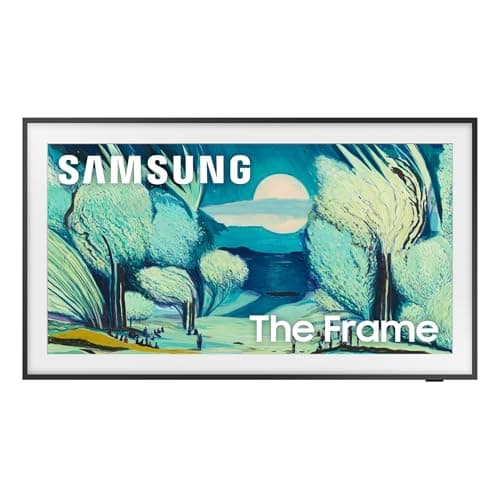
Product image from the Amazon listing.
Our verdict
Yes — the Samsung Frame (Art) TV is worth it if a black rectangle on your wall bothers you the 90% of the time nobody's watching, and no competitor does what it does. Matte anti-glare panel that reads as canvas, real Art Mode with 2,000+ works and your own photos, and the flush No Gap wall mount included in the box. Picture quality is good QLED rather than flagship — pick a QN90 or LG OLED if dark-room movie performance is the priority — but for design-conscious living rooms, above the mantel, or any wall you look at all day, this is the buy.
The short version
Samsung's Frame is the only mainstream TV designed to be looked at when it's off. A matte anti-glare panel plus Art Mode display over 2,000 licensed paintings, photos and your own images at reduced brightness, while a customizable snap-on bezel and near-flush wall mount make it read as a real framed picture instead of a dead black screen. Underneath the art-mode veneer it's still a legitimate 4K QLED — great in bright rooms, decent HDR, gaming-ready with 120Hz on the larger sizes — but it's not the flagship picture in Samsung's lineup, and you're paying a real premium for the design. If a black rectangle on the wall bothers you, nothing else on Amazon does what this does.
Pros & cons
Pros
- Matte anti-glare finish reads as paper, not glass
- Art Mode with 2,000+ licensed works + your own uploads
- Near-flush No Gap wall mount included
- Swappable magnetic bezels (teak, walnut, white, black)
- Solid 4K QLED picture and 120Hz on 55"+ sizes
- One Invisible Connection cable keeps the wall clean
Cons
- Not Samsung's brightest or best-contrast panel for the price
- Anti-glare matte softens fine detail slightly vs glossy QLEDs
- Bezels and premium mounts cost extra
Why people love it
QLED panel with matte anti-glare
A Quantum Dot QLED panel handles color and brightness; a matte anti-glare coating on top diffuses reflections so it reads as a canvas or photo print instead of a mirror.
Art Mode with a motion sensor
When you're not watching, the TV switches to Art Mode: it displays artwork at reduced brightness and matches ambient light with a color/lux sensor, then dims further when the room is empty.
No Gap wall mount + One Connect box
The included flush mount sits the panel millimeters from the wall, and a single thin optical cable runs to a separate One Connect box that houses power and HDMI inputs — the TV itself has no visible cable clutter.
Who it's for
- Design-conscious living rooms and open kitchens
- People who hate a black rectangle above the fireplace
- Renters and homeowners who want a clean, cable-free wall
- Anyone who mainly watches in bright rooms
Is the Samsung Frame TV really worth the premium over a normal QLED?
The honest question with the Frame isn't whether it's a good TV — it's whether the design premium is worth the picture-quality gap versus Samsung's own QN90 QLED. On paper the QN90 is meaningfully brighter, has better local dimming and higher contrast; in a dark room watching movies it will visibly out-perform the Frame. The Frame's matte anti-glare panel, while brilliant for reducing reflections, also slightly softens fine detail — Samsung's own comparison images acknowledge this. If a shopper looks only at picture-per-dollar, the QN90 wins.
But that framing misses what the Frame is actually solving. Most modern TVs are 55-85 inch black rectangles that dominate a room even when nobody is watching. Above a mantel, on a shared wall in an open-plan kitchen, in a bedroom you spend hours in — a dark screen is visually oppressive. The Frame is the one TV designed to be looked at 24/7, and it succeeds: matte finish, near-flush mount, magnetic bezel and Art Mode combine to genuinely fool guests into thinking it's a framed piece. If that matters to you — and for a lot of design-conscious buyers it does — the picture trade-off is worth it. If you spend most of your TV time in a dark room chasing HDR highlights, buy the QN90.
Samsung Frame TV vs LG G-Series OLED vs Hisense Canvas TV
The 'lifestyle TV' category Samsung created with the Frame now has direct competitors, and they occupy different niches. LG's G-series OLED is the picture-quality pick: reference-grade OLED contrast, gallery mount that sits flush like the Frame, and much better dark-room performance. But it doesn't have Art Mode, doesn't have swappable bezels, and looks like a mirror-finish TV when off. If you want the flattest, best-picture wall-mounted TV and don't care about a beautiful off-state, the G-series is the answer.
Hisense's Canvas TV is the price-first alternative: a matte anti-glare panel, an Art Mode, and Samsung Frame-style aesthetics for significantly less money. The trade is a less-refined Art Store, a smaller ecosystem, and picture processing that's a step behind Samsung's. If budget is tight and you want 80% of the Frame concept, the Canvas is a legitimate pick. Otherwise Samsung's ecosystem, artwork catalog and mount quality are still the reference. TCL and other brands are launching similar lifestyle TVs; expect the category to keep growing, but the Frame remains the mature default.
How to make the Frame actually look like art (bezels, art selection and setup)
The default Frame out of the box comes with a thin black bezel that reads as a modern TV. The magnetic snap-on bezels — teak, walnut, white, brown, beveled — are what push it from 'nice TV' to 'framed print,' and they're worth the extra $50-100. Match to your other picture frames or the room's wood tones; walnut suits mid-century interiors, white suits modern or bright rooms, teak suits Scandinavian and coastal styles. On the wall, use the included No Gap mount rather than a third-party mount — the millimeter-gap flush look is a huge part of the effect and any regular VESA mount leaves the TV floating off the wall.
For art, the free bundled works from Samsung are fine but limited; the paid Art Store subscription unlocks 2,000+ licensed pieces from the Louvre, MoMA, Van Gogh Museum and others, and lets you build curated playlists that shuffle throughout the day. If you don't want to pay monthly, uploading your own high-resolution photos and prints is free and often looks better than generic stock — family portraits printed as canvas, high-res museum scans (many are legally free from The Met, Rijksmuseum, and the National Gallery), and personal travel photography all land as personal 'art' that a subscription can't match. The catch is finding the good family photos scattered across phones, laptops and old drives; a physical archive like ThePhotoStick Omni is a one-click way to consolidate every image in one place so you can pick the strongest ones for Art Mode without hunting through six devices. Set Art Mode brightness and color temperature to match room ambient — Samsung's auto-brightness is usually right, but tuning it down another notch in the evening looks even more paper-like.
See Samsung The Frame TV on Amazon
Check the latest price, photos and buyer reviews on Amazon.
Check Price on Amazon →Sold and shipped by AmazonFrequently asked questions
Is the Samsung Frame TV worth it as a real TV, or is it just for looks?
It's a genuine 4K QLED with good but not flagship performance. Picture quality in a bright room is very good — QLED brightness and vibrant color handle daytime viewing well. In dark-room movie viewing it's a step behind Samsung's own QN90 series and LG's OLEDs: contrast is lower, black levels aren't inky, and the matte finish slightly softens sharpness. If you split time between watching and letting the room look nice, the trade is worth it. If picture quality is your top priority and design doesn't matter, a QN90 or LG OLED will look better for less.
How does Art Mode actually work and does it look like real art?
When you turn the TV 'off', it stays on in Art Mode showing your chosen artwork. A built-in ambient light sensor drops brightness dramatically and matches the room's warmth, so it looks like a lit print rather than a glowing screen, and a motion sensor turns the panel off entirely when nobody's home. From more than a few feet away — and thanks to the matte anti-glare finish — most guests genuinely mistake it for a framed poster. Up close you can tell it's a screen. Samsung includes some free art and offers 2,000+ licensed works through a paid Art Store subscription; you can also upload your own JPEGs and photos for free.
Does Art Mode burn extra electricity and shorten the panel's life?
It's more efficient than most people assume. In Art Mode, brightness is far below movie-watching levels, and the motion sensor blanks the screen when the room is empty, so 24/7 use draws about the same power as a standard fridge over a month. QLED panels are also LCD-based, so they aren't susceptible to the burn-in that affects OLEDs when static content sits on them. There's no meaningful lifespan penalty from leaving Art Mode on — the LED backlight will wear at roughly the same rate as any TV in daily use.
Does the Samsung Art TV come with a wall mount?
Yes — the Samsung Frame (the 'Art TV') ships with Samsung's Slim Fit No Gap wall mount included in almost every retail bundle, and that mount is the specific reason the Frame reads as a framed picture instead of a floating TV. A standard VESA mount leaves a two-inch gap that kills the flush illusion; the No Gap mount seats the panel millimeters from the drywall, which is the whole point of buying this TV instead of a QN90 QLED. The included tabletop stand and easel-style Studio Stand are sold separately when you want a floor-standing setup instead. What's NOT included is the mount hardware for a stud-free wall (drywall anchors rated for the panel's weight) — for 55"+ sizes you want to hit studs, and for the leveling and pilot-hole work a compact driver with a built-in bubble level like the Kelvin 17 all-in-one multi-tool turns a two-person, two-trip-to-the-toolbox job into a solo hour.
Do I need the No Gap wall mount, and does it work above a fireplace?
The Slim Fit No Gap mount is included in most bundles and is the reason the Frame looks flush — a normal mount leaves a couple of inches of gap and ruins the framed-picture illusion. Above a fireplace, be careful about heat: many mantels get warm enough that Samsung and every TV maker warns against mounting there. Measure the temperature of the wall above the mantel after a couple of hours of a fire; if it stays under about 100°F, you're fine. If it climbs higher, mount elsewhere. A mantel that's mostly decorative is fine; a working, high-heat fireplace often isn't.
Samsung Frame vs LG G-series OLED vs standard Samsung QN90: which one should I buy?
They target different priorities. The Frame is the design-first pick — the only mainstream TV that looks intentional when off, at the cost of some picture quality. LG's G-series OLED (the gallery-mount OLED) also mounts near-flush and delivers reference-grade picture but doesn't have Art Mode and looks like a black rectangle when off. Samsung's own QN90 QLED beats the Frame on brightness, contrast and gaming for less money but looks like a normal TV on the wall. Pick the Frame if a beautiful off-state matters more than best-in-class picture; pick the G-series if you want the best picture in a flush mount; pick the QN90 if picture-per-dollar is all that matters.
What sizes does the Frame come in and which is right for most living rooms?
The Frame comes in 32", 43", 50", 55", 65", 75" and 85". The 55" is the mainstream default for a normal living room where you sit 8-10 feet from the wall; 65" is the sweet spot for open-plan spaces or if the TV shares a wall with a fireplace and needs to feel proportional; 75" and 85" work in large great-rooms. For a bedroom or a kitchen accent, the 32" or 43" is genuinely useful because it reads as a real framed print rather than a big TV. Note the 120Hz gaming panel is only on 55" and larger — smaller sizes are 60Hz, which is fine for TV but not ideal for PS5/Xbox Series X gaming.
How much does the Samsung Frame TV cost in 2026, and how often does it actually go on sale?
MSRP tiers in 2026 sit roughly where Samsung has kept them since the current generation: 32" around $600, 43" around $1,000, 50" around $1,300, 55" around $1,500, 65" around $2,000, 75" around $2,800, and 85" around $4,300. What matters more than MSRP is that the Frame is one of the most-discounted TVs Samsung sells — expect meaningful drops (often 20-30% off the 55", 65" and 75" sizes) during Prime Day in July, Labor Day, Samsung Discover events, Black Friday and the pre-Super Bowl window. Retail-holiday pricing is when most buyers actually pull the trigger. Magnetic bezels ($100-200 depending on finish) and the optional Studio Stand ($200-300) are the two accessories worth budgeting for separately; the No Gap wall mount is included in most retail bundles. If you're patient enough to wait for a real sale, expect to pay 20-30% less than the sticker on the two mainstream sizes.
As an Amazon Associate, TopCrate earns from qualifying purchases at no extra cost to you. Product image, price, availability and ratings are shown on Amazon and are subject to change.