TRENDING ON AMAZON
Double Wood Supplements Magnesium Glycinate 400mg (180 Capsules) Review: Is It Worth It?
Double Wood's third-party-tested magnesium bisglycinate at 400mg per capsule — 60mg elemental magnesium in the gentle, well-absorbed form, 180 capsules for around $14, and a US-owned brand that has quietly become one of Amazon's most trusted supplement labels.
Quick answer: Yes — Double Wood Supplements Magnesium Glycinate 400mg is worth it, and it's the specific magnesium to buy first if you want real third-party-tested magnesium bisglycinate without the Thorne markup. Third-party ISO/IEC 17025 testing verifies identity, potency, heavy metals and microbial safety; every batch has a public COA. Bisglycinate form means real absorption and no laxative effect. 60mg elemental magnesium per capsule at 180 capsules per bottle works out to three to six months per bottle at ~$14 — one of the highest-ROI supplements available for the money. Not NSF Certified for Sport (skip if you're a drug-tested athlete), and the two-capsule serving can confuse people used to '1-a-day' dosing, but for the 95% of adults who want a genuine magnesium supplement that works, Double Wood is the smart-money default in 2026.
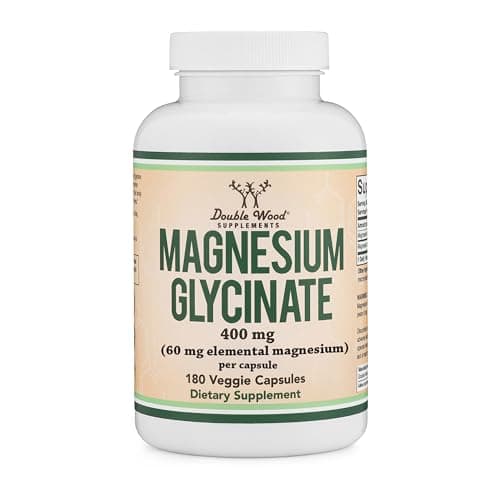
Product image from the Amazon listing.
Our verdict
Yes — Double Wood Supplements Magnesium Glycinate 400mg is worth it, and it's the specific magnesium to buy first if you want real third-party-tested magnesium bisglycinate without the Thorne markup. Third-party ISO/IEC 17025 testing verifies identity, potency, heavy metals and microbial safety; every batch has a public COA. Bisglycinate form means real absorption and no laxative effect. 60mg elemental magnesium per capsule at 180 capsules per bottle works out to three to six months per bottle at ~$14 — one of the highest-ROI supplements available for the money. Not NSF Certified for Sport (skip if you're a drug-tested athlete), and the two-capsule serving can confuse people used to '1-a-day' dosing, but for the 95% of adults who want a genuine magnesium supplement that works, Double Wood is the smart-money default in 2026.
The short version
Double Wood Supplements Magnesium Glycinate 400mg is the value-tier magnesium that keeps ending up in 'best magnesium under $20' recommendations, and it earns the spot because Double Wood does the two things that matter most in the supplements aisle: they use magnesium bisglycinate (the fully chelated form, best absorbed, no laxative effect) rather than the cheaper magnesium oxide most drugstore brands hide behind, and every batch is third-party tested by an ISO/IEC 17025-accredited lab for identity, potency, heavy metals and microbial safety. Each capsule delivers 400mg of magnesium bisglycinate providing 60mg elemental magnesium, so a typical two-capsule daily serving lands at 120mg elemental — right in the sweet spot for sleep, muscle recovery and everyday relaxation. 180 capsules works out to about six months for a single-cap-per-day user or three months at the two-cap dose. Vegan, gluten-free, non-GMO, made in a US cGMP facility. It's not the flagship-priced Thorne bottle, but the label and the third-party testing paperwork are functionally equivalent for a fraction of the money.
Pros & cons
Pros
- Magnesium bisglycinate — best-absorbed, gentle on stomach
- Third-party tested (ISO/IEC 17025) for identity, potency, heavy metals
- 400mg total / 60mg elemental Mg per capsule
- 180 capsules ≈ 3-6 month supply
- Vegan, gluten-free, non-GMO, dye-free
- US-owned brand, made in cGMP facility
- Roughly one-third the price per serving of Thorne
Cons
- Two-capsule serving needed for full 120mg elemental dose
- Not NSF Certified for Sport — skip if drug-tested
- Bottle labeling can confuse '400mg' (compound) vs '60mg' (elemental)
Why people love it
Take 1-2 capsules with food
Most users take one capsule with dinner for maintenance or two capsules 30-60 minutes before bed for sleep and muscle-relaxation support. Taking with food improves absorption and reduces any minor GI upset.
Bisglycinate = gentle absorption
Magnesium bound to two glycine molecules (bisglycinate) is absorbed intact through the small intestine, bypasses the laxative effect of cheap magnesium oxide, and delivers the mineral where your body actually uses it — nerves, muscles, sleep pathways.
Build over 2-4 weeks
Magnesium works cumulatively. Most users notice better sleep depth and less muscle twitching within the first 7-14 days, with fuller effects on daytime calm and stress resilience by week 3-4 of consistent daily use.
Who it's for
- Anyone with restless sleep or racing-mind bedtime
- Athletes with post-workout muscle cramping
- People with high stress or anxiety-adjacent symptoms
- Adults on the standard American diet (chronically Mg-deficient)
Why magnesium glycinate specifically (and why cheap magnesium oxide is worse than useless)
Magnesium is a cofactor in over 300 enzyme reactions and is required for nerve conduction, muscle contraction, energy production, sleep regulation, and blood pressure regulation. Chronic mild deficiency is common — the standard American diet delivers about 200-250mg daily against a recommended 300-400mg — and shows up as poor sleep, muscle twitches, cramps, anxiety-adjacent symptoms, restless legs, and fatigue. Supplementation works, but which form of magnesium you take matters more than most people realize. Magnesium bisglycinate (also called magnesium glycinate) is magnesium bound to two glycine molecules — a form your body absorbs intact through the small intestine, delivering the mineral to tissue with minimal loss. Bisglycinate is the form doctors and researchers reach for when they actually want the magnesium to do something.
Magnesium oxide is the form 90% of drugstore magnesium supplements use because it's dirt cheap to manufacture, but its bioavailability is estimated at 4-10% vs bisglycinate's 40-80%. What that means practically: a 400mg magnesium oxide capsule delivers roughly 20mg of usable magnesium; a 400mg magnesium bisglycinate capsule delivers roughly 60mg of usable magnesium. Worse, unabsorbed magnesium oxide draws water into the colon and causes diarrhea — which is why Milk of Magnesia (magnesium hydroxide, similar behavior) is sold as a laxative, and why so many people say 'I tried magnesium and it made me sick.' They didn't try magnesium; they tried the wrong form of magnesium. Double Wood's decision to use pure bisglycinate — not oxide, not a blend hiding oxide as a filler — is the specific reason it's worth choosing over the $5 drugstore bottle.
Third-party testing is the supplement industry's honesty check — here's why it matters
The FDA regulates dietary supplements under a much looser framework than pharmaceuticals. There's no pre-market approval, no requirement that supplements contain what the label says, and only reactive enforcement — meaning the FDA typically only investigates a brand after consumer harm is reported. Multiple independent studies (ConsumerLab, LabDoor, University of Guelph DNA barcoding studies) have found that 20-40% of tested supplements are mislabeled: wrong dose, wrong ingredient, undeclared contaminants including heavy metals, or in some cases none of the labeled ingredient at all. This is the specific problem third-party testing solves. Independent, ISO/IEC 17025-accredited labs test finished-batch product for identity (is it what the label says?), potency (does it contain the labeled amount?), heavy metals (below FDA safety thresholds?), and microbial contamination.
Double Wood's Certificate of Analysis process — where they publish batch-level COAs from an accredited third-party lab — is the specific consumer protection you're paying for. When you buy Double Wood, you're not trusting the manufacturer's word; you're trusting an independent lab whose accreditation would be revoked if they falsified results. This puts Double Wood in the same testing tier as Thorne, Pure Encapsulations and other premium brands, at a fraction of the price. The next tier up is NSF Certified for Sport, which adds athletic doping-substance testing on top of standard purity testing — Thorne carries this, Double Wood does not. If you're a drug-tested athlete, use Thorne. For everyone else, Double Wood's third-party testing is the meaningful quality signal at this price point. If you want additional recovery layers on top, magnesium pairs naturally with Thorne Creatine for muscle support and a warm Dr. Teal's Epsom salt soak for post-workout tension.
Building a real magnesium-plus-sleep routine (and why one supplement isn't enough)
Magnesium supplementation is one component of a proper sleep and recovery routine, not a silver bullet. The complete evidence-based sleep intervention that actually moves the needle for most adults: (1) Magnesium glycinate 120-200mg elemental at dinner or 60 minutes before bed — Double Wood covers this. (2) Consistent sleep-wake schedule (same times seven days a week, within 30 minutes) — this is often the single highest-leverage sleep intervention. (3) Cool bedroom (65-68°F) — body temperature naturally drops during sleep and a cool room supports this. (4) Complete darkness — pair a Manta blackout sleep mask with room-blocking curtains. (5) Steady background sound — a Yogasleep Dohm or similar fan-based white noise machine masks disruptive noises. (6) No screens in the last 60-90 minutes before bed — blue light suppresses melatonin and the cognitive stimulation delays sleep onset. (7) No caffeine after noon and no alcohol within 3 hours of bed — both fragment sleep architecture even when you 'fall asleep fine.'
Layered together, these interventions produce dramatic sleep quality improvements within 2-4 weeks. Magnesium alone in an otherwise-broken sleep environment produces modest improvements. Magnesium plus 3-4 of the other interventions produces near-clinical-grade sleep quality. For persistent sleep-onset issues that magnesium doesn't touch, add Thorne Magnesium Glycinate at slightly higher dose or consider Life Extension Neuro-Mag (magnesium L-threonate, the brain-permeable form specifically studied for cognitive-anxiety sleep problems). For anxious-thinker bedtime racing minds where the issue is mental rather than physiological, a drug-free breathing tool like the Dodow guided-breathing light gives your brain a rhythmic focus to sync to. The combined stack — magnesium + darkness + sound + breathing + schedule — is the specific set of interventions most sleep clinicians recommend before considering prescription sleep aids.
See Double Wood Magnesium Glycinate on Amazon
Check the latest price, photos and buyer reviews on Amazon.
Check Price on Amazon →Sold and shipped by AmazonFrequently asked questions
Is Double Wood Magnesium Glycinate legit — and how does third-party testing actually work?
Yes, Double Wood is legit and it's one of the more transparent supplement brands on Amazon. Every batch of Double Wood Magnesium Glycinate is sent to an ISO/IEC 17025-accredited third-party lab that verifies four things: (1) identity — that the powder in the capsules is actually magnesium bisglycinate, not oxide or citrate or a filler swap; (2) potency — that each capsule contains the labeled 400mg of magnesium bisglycinate / 60mg elemental magnesium; (3) heavy metals — that lead, arsenic, cadmium and mercury are below FDA safety thresholds; (4) microbial safety — no bacterial, yeast or mold contamination. Double Wood publishes the Certificate of Analysis (COA) for every batch on their website. Most drugstore magnesium brands don't do independent testing at all — they rely on manufacturer specs, which is why the FDA-published spot checks of supplement quality routinely find drugstore brands off-label. For under $15 you're getting a testing-verified product; the only tier above this is NSF Certified for Sport (the athletic-doping-tested certification), which Thorne carries and Double Wood does not.
Double Wood vs Thorne vs Nature's Bounty vs BioEmblem — which magnesium glycinate is best?
Four tiers with real differences. Premium tier ($30-45/bottle): Thorne Magnesium Glycinate is the athlete-and-clinician gold standard — NSF Certified for Sport (drug-tested athletes can use it), pharmaceutical-grade sourcing, chelated at higher purity, but 3-4x the per-serving cost. Value-premium tier ($15-25/bottle): Double Wood (this review) and BioEmblem Magnesium both hit the sweet spot — third-party tested, magnesium bisglycinate (not oxide), transparent COAs, gentle on stomach. Double Wood ships 180 capsules per bottle at ~$14; BioEmblem ships 90 at ~$20 (higher per-capsule elemental dose but shorter supply). Drugstore tier ($10-15/bottle): Nature's Bounty Magnesium Glycinate is fine and cheap, but doesn't publish independent COAs at the batch level. Budget/avoid tier: unlabeled magnesium oxide products at $5 — cheap but poorly absorbed and causes GI issues. Pick Thorne if you're a drug-tested athlete or want the absolute top tier. Pick Double Wood if you want the value sweet spot with real third-party testing. Pick BioEmblem if you specifically want a higher elemental dose per serving. Skip magnesium oxide entirely.
How much magnesium glycinate should I take per day, and when?
The general adult recommendation is 300-400mg of elemental magnesium daily from all sources (food + supplement). Most Americans get about 200-250mg from food alone, so a supplement of 100-200mg elemental magnesium fills the gap. On Double Wood, that's one to two capsules per day (60-120mg elemental). Timing depends on your goal: for sleep and muscle relaxation, take with dinner or 30-60 minutes before bed — magnesium's calming effect peaks 60-90 minutes after ingestion. For daytime calm and stress resilience, morning dose works fine. For post-workout recovery, take within an hour of training. Split the dose (one AM, one PM) if you want steady levels rather than a peak. Taking with food improves absorption slightly and reduces the small chance of GI upset. Don't exceed 350mg elemental magnesium from supplements without a doctor's guidance — the FDA's tolerable upper limit for supplemental Mg is 350mg/day to avoid diarrhea and other symptoms.
How long does Double Wood Magnesium Glycinate take to work for sleep and anxiety?
The consistent user pattern: sleep depth improvements at 3-7 days (subjective — fewer wake-ups, deeper feel to sleep), less muscle twitching and restless-legs symptoms at 7-14 days, better next-day calm and stress resilience at 3-4 weeks, and cumulative anxiety-adjacent benefits (less bedtime rumination, better morning mood) at 4-8 weeks. Magnesium is a cofactor for over 300 enzyme reactions in the body — the effects build gradually as tissue magnesium stores refill rather than as an acute drug-like hit. If you feel nothing after 4 weeks of consistent daily dosing, either you're already magnesium-replete (rare in adults) or you have an absorption issue. For a stronger sleep-onset effect on stubborn nights, pair with a Manta blackout sleep mask, a Yogasleep Dohm white noise machine, and a phone-free wind-down — the combination of magnesium + darkness + steady sound + reduced cognitive stimulation is genuinely the highest-leverage sleep intervention most adults can do without medication.
Is 400mg the total capsule weight or 400mg of elemental magnesium?
400mg is the weight of the magnesium bisglycinate compound in each capsule, which contains 60mg of elemental magnesium (the biologically active mineral). This is a common source of consumer confusion because supplement labels aren't consistent — some brands label 'X mg magnesium bisglycinate' (the compound), others label 'X mg elemental magnesium.' Double Wood labels both clearly on the bottle. What matters for dosing is the elemental amount: 60mg per capsule from Double Wood, so a two-capsule serving gives 120mg elemental magnesium. Comparing brands: BioEmblem's 300mg-labeled capsules provide 150mg elemental per two-capsule serving; Thorne's 135mg-labeled capsules provide 45mg elemental. Always convert to elemental milligrams to compare apples to apples — it's the number your body actually cares about.
Is Double Wood Magnesium Glycinate worth it if I already eat a healthy diet?
Yes, for most adults, and the reason is that even 'healthy' modern diets typically fall short of the 300-400mg daily magnesium recommendation. Magnesium is highest in dark leafy greens, nuts (especially almonds and pumpkin seeds), whole grains, avocados and dark chocolate. Even a diet with several servings of these foods daily typically provides 200-280mg — below the RDA. Farming practices, soil depletion and food processing have all reduced magnesium content in common foods vs 50 years ago. Groups most likely to benefit from supplementation: adults over 40 (absorption declines with age), athletes and heavy sweaters (magnesium is lost in sweat), high-stress lifestyles (stress depletes magnesium faster), heavy coffee or alcohol consumers (both increase magnesium excretion), people on certain medications (diuretics, PPIs, some diabetes drugs reduce magnesium). At ~$14 for six months of one-capsule-daily supply, it's one of the highest-ROI supplements available for the money. Pair with a proper diet (magnesium-rich foods like Dr. Teal's baths are non-competing sit next to it as a wellness routine), not as a replacement.
As an Amazon Associate, TopCrate earns from qualifying purchases at no extra cost to you. Double Wood Magnesium Glycinate is a dietary supplement, not a medical treatment. Consult your doctor before starting if you take prescription medications, have kidney disease, or are pregnant or nursing. Product image, price, availability and ratings are shown on Amazon and are subject to change.