TRENDING ON AMAZON
Life Extension Neuro-Mag Magnesium L-Threonate (Magtein) Review: Is It Worth It?
The specific magnesium form (L-threonate, marketed as Magtein) developed at MIT to actually cross the blood-brain barrier — for cognitive support, sleep depth, and the kind of mental clarity most magnesium supplements don't touch.
Quick answer: Yes — Life Extension Neuro-Mag Magnesium L-Threonate is worth its premium pricing for the specific use case of brain-focused magnesium supplementation. Uses Magtein — the MIT-developed patented magnesium form clinically shown to cross the blood-brain barrier and improve cognitive function in randomized placebo-controlled research. 90 vegetarian capsules per bottle at 3 capsules daily provides a 30-day supply for around $30-40, which is ~3× the price of standard magnesium glycinate but justified by the specific brain-targeting benefits standard magnesium can't deliver. Not a replacement for daily magnesium glycinate for general muscle-and-sleep support (get [Nature Made Magnesium Glycinate](/reviews/nature-made-magnesium) or [Thorne Magnesium Glycinate](/reviews/thorne-magnesium-glycinate) for that use case — many users take both), and not a substitute for the fundamentals of cognitive health (sleep, exercise, stress management, medical evaluation of significant cognitive concerns). For adults 40+ specifically focused on cognitive support, sleep-depth improvement, and memory function — with realistic expectations of gradual improvement over 4-12 weeks rather than dramatic acute effects — this is the specific research-backed magnesium form worth adding to a cognitive-health stack.
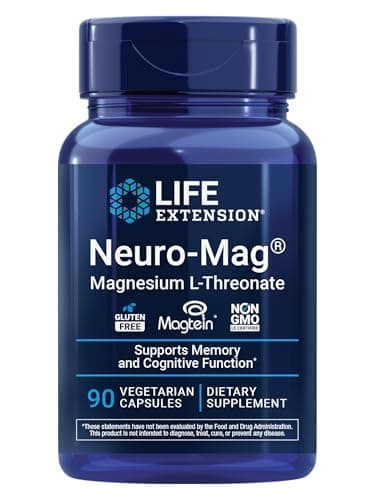
Product image from the Amazon listing.
Our verdict
Yes — Life Extension Neuro-Mag Magnesium L-Threonate is worth its premium pricing for the specific use case of brain-focused magnesium supplementation. Uses Magtein — the MIT-developed patented magnesium form clinically shown to cross the blood-brain barrier and improve cognitive function in randomized placebo-controlled research. 90 vegetarian capsules per bottle at 3 capsules daily provides a 30-day supply for around $30-40, which is ~3× the price of standard magnesium glycinate but justified by the specific brain-targeting benefits standard magnesium can't deliver. Not a replacement for daily magnesium glycinate for general muscle-and-sleep support (get [Nature Made Magnesium Glycinate](/reviews/nature-made-magnesium) or [Thorne Magnesium Glycinate](/reviews/thorne-magnesium-glycinate) for that use case — many users take both), and not a substitute for the fundamentals of cognitive health (sleep, exercise, stress management, medical evaluation of significant cognitive concerns). For adults 40+ specifically focused on cognitive support, sleep-depth improvement, and memory function — with realistic expectations of gradual improvement over 4-12 weeks rather than dramatic acute effects — this is the specific research-backed magnesium form worth adding to a cognitive-health stack.
The short version
Life Extension Neuro-Mag Magnesium L-Threonate is the specific magnesium supplement to buy if your goal is brain-focused benefits rather than general muscle-relaxation-and-sleep. It uses Magtein — the patented magnesium L-threonate form originally developed by researchers at MIT and shown in a randomized placebo-controlled trial to meaningfully increase brain magnesium levels and improve cognitive function in adults aged 50-70 over 12 weeks. Standard magnesium forms (glycinate, citrate, oxide) don't cross the blood-brain barrier well; L-threonate does. Each serving delivers 2,000mg of magnesium L-threonate (144mg elemental magnesium), 90 vegetarian capsules per bottle (30 servings at 3 capsules/day). At around $30-40 per bottle, it's a premium supplement compared to standard magnesium glycinate ($10-15) — but it's the specific form for the specific goal of cognitive support, sleep depth improvement, memory function, and the kind of mental clarity that basic magnesium doesn't touch. Not a replacement for daily magnesium glycinate for muscle-relaxation-and-sleep purposes (many users take both — glycinate for physiological calm, threonate for cognitive support), but the specific answer if brain benefits are your priority.
Pros & cons
Pros
- Magtein — the specific magnesium form clinically shown to cross the blood-brain barrier
- MIT-developed, published in peer-reviewed research (Neuron 2010, RCT results)
- 2,000mg magnesium L-threonate per serving (144mg elemental magnesium)
- Users report improved sleep depth, memory function, and mental clarity
- 90 vegetarian capsules per bottle (30 servings)
- Life Extension is a trusted premium-tier supplement brand
Cons
- Significantly more expensive than standard magnesium glycinate (~3× the price)
- 3 capsules per serving (some users prefer once-daily dosing)
- Effects build over 4-12 weeks, not immediate
Why people love it
Take 3 capsules daily
The recommended serving is 3 capsules taken with or without food. Many users split into 2 capsules with dinner and 1 capsule at bedtime for sleep-focused benefits, or take all 3 with dinner for consistency.
Magtein crosses the blood-brain barrier
Unlike standard magnesium forms (glycinate, citrate, oxide) which primarily support muscle relaxation and general physiological function, magnesium L-threonate (Magtein) is specifically engineered to cross the blood-brain barrier and raise magnesium levels in brain tissue.
Benefits build over 4-12 weeks
Cognitive, memory and sleep-depth benefits typically develop gradually over 4-12 weeks of consistent daily use. The original MIT clinical trial showed statistically significant cognitive improvements at the 12-week mark; give the regimen at least 8 weeks before judging effect.
Who it's for
- Adults 40+ concerned about age-related cognitive changes
- Anyone with sleep-depth issues (waking unrefreshed despite adequate hours)
- Knowledge workers wanting cognitive-support supplementation
- Nootropic users looking for research-backed brain-focused options
The MIT research behind Magtein and what it actually shows
The specific research foundation for Magtein magnesium L-threonate begins with a 2010 paper published in Neuron (a peer-reviewed neuroscience journal) by researchers at MIT led by Dr. Guosong Liu. The paper described the discovery and characterization of magnesium L-threonate as a form of magnesium that could cross the blood-brain barrier and elevate magnesium levels in brain tissue — something standard forms of magnesium supplementation don't do effectively. In animal studies, elevated brain magnesium levels were associated with improved synaptic plasticity, enhanced learning, and better memory formation. The mechanism appears to involve magnesium's role in NMDA receptor function (a specific type of glutamate receptor central to memory formation and learning) — adequate brain magnesium levels support the specific synaptic changes underlying memory consolidation.
Subsequent human clinical research followed. A randomized placebo-controlled trial in adults aged 50-70 with age-related cognitive concerns showed that daily supplementation with 1.5-2g magnesium L-threonate (Magtein) for 12 weeks produced measurable improvements in cognitive function versus placebo, particularly in tests of executive function and working memory. The effect wasn't dramatic (this is a supplement, not a pharmaceutical), but it was statistically significant and reproducible. Additional research has explored applications in age-related cognitive decline, sleep quality (particularly deep-sleep architecture), and mood-related concerns. This is meaningfully more research support than most supplement categories have — magnesium L-threonate is one of the specific supplements with actual peer-reviewed clinical validation, not just marketing claims. That doesn't mean it works for everyone or that it's a substitute for the fundamentals of cognitive health (adequate sleep, exercise, stress management, medical evaluation of significant cognitive concerns) — but the research foundation is genuinely there, and Life Extension's Neuro-Mag is the specific commercial product using the researched form (Magtein specifically, not generic magnesium L-threonate).
How Neuro-Mag fits into a modern cognitive-health supplement stack
Serious cognitive-health-focused supplement users typically build stacks rather than relying on any single supplement — no one supplement addresses all the physiological factors underlying cognitive function. A representative cognitive-support stack that includes Neuro-Mag: (1) Neuro-Mag Magnesium L-Threonate (this review) — brain-targeted magnesium for cognitive support, memory function, sleep depth. Take 3 capsules with dinner. (2) Nature Made Magnesium Glycinate — general body magnesium for muscle relaxation and cardiovascular health (Neuro-Mag doesn't provide enough elemental magnesium for whole-body needs). Take 200-400mg with dinner. (3) Fish oil (Nordic Naturals Ultimate Omega) — omega-3 fatty acids (EPA/DHA) support brain cell membrane integrity and reduce neuroinflammation. Take 2-3g EPA+DHA daily with food. (4) Vitamin D3 (2,000-4,000 IU/day) — supports cognitive function and overall brain health, particularly for anyone with limited sun exposure. (5) A quality multivitamin — insurance for micronutrient adequacy. (6) B-complex if you eat plant-based or over 50 (particularly B12 and folate for cognitive function).
This complete stack costs approximately $80-120 per month depending on brand selection — meaningful but not extreme compared to premium 'nootropic' stacks that run $200-400/month with less research backing. Beyond supplements, the specific fundamentals that matter more than any supplement stack: (1) 7-9 hours of quality sleep nightly — magnesium supplementation helps sleep depth but doesn't substitute for adequate sleep duration. (2) Regular aerobic exercise (150+ min/week moderate-intensity) — the single most impactful cognitive intervention available, better than any supplement. (3) Stress management (meditation, breathing practices like the Dodow breathing metronome, or cognitive-behavioral techniques) — chronic stress is neurotoxic. (4) Social engagement and intellectually challenging activities — cognitive reserve builds through use. (5) Medical evaluation of significant cognitive concerns (memory changes affecting daily function, sudden cognitive changes, or family history of cognitive decline warrants professional evaluation rather than supplement approaches). Supplements including Neuro-Mag are the small but real component of comprehensive cognitive health — worthwhile alongside the fundamentals, insufficient without them.
Realistic expectations: what Neuro-Mag can and can't do
Setting realistic expectations is important for any cognitive-support supplement. What Neuro-Mag Magnesium L-Threonate reliably delivers based on clinical research and user reports: (1) Improved sleep depth for a majority of users — fewer nighttime awakenings, feeling more rested despite the same sleep duration, and improved deep-sleep architecture. This is often the first noticeable effect (1-2 weeks). (2) Reduced brain fog and improved mental clarity — subjective feeling of thinking more clearly, particularly in the afternoon 'slump' hours. Typically noticeable at 2-4 weeks. (3) Gradual cognitive function improvements as measured in the clinical research — better working memory, faster mental task-switching, improved executive function. Typically measurable at 8-12 weeks with consistent daily use. (4) For adults 40+, a modest but meaningful contribution to age-related cognitive maintenance — not reversing cognitive aging but supporting the physiological substrates that maintain cognitive function.
What Neuro-Mag doesn't do: (1) Cure or prevent Alzheimer's, dementia, or any specific neurological disease — this is a supplement, not a medical treatment for cognitive disorders. (2) Dramatically enhance cognitive function in healthy young adults with no cognitive concerns — the research base is primarily in adults 50-70 with mild cognitive concerns, and the effect size in younger populations is smaller. (3) Provide immediate 'nootropic' effects like caffeine or prescription stimulants — the mechanism is gradual improvement over weeks, not acute cognitive enhancement. (4) Substitute for adequate sleep, exercise, and stress management — no supplement can compensate for fundamentally inadequate lifestyle basics. (5) Work for everyone — approximately 30-40% of users don't experience significant benefit despite consistent use. For anyone considering Neuro-Mag: commit to 12 weeks of consistent daily use, pair with the fundamentals of cognitive health (sleep, exercise, stress management), and discontinue if you don't notice benefit at the 12-week mark. This is the specific approach the clinical research validates and the honest expectation-setting most supplement marketing avoids.
See Life Extension Neuro-Mag on Amazon
Check the latest price, photos and buyer reviews on Amazon.
Check Price on Amazon →Sold and shipped by AmazonFrequently asked questions
Is Life Extension Neuro-Mag Magnesium L-Threonate worth it in 2026?
Yes for the specific use case of brain-focused magnesium supplementation — cognitive support, sleep-depth improvement, memory function, mental clarity — but not as a general magnesium supplement replacement for standard magnesium glycinate. The specific reason Neuro-Mag is worth its premium pricing over $10 magnesium glycinate: it uses Magtein (magnesium L-threonate), the specific form developed at MIT and shown in a randomized placebo-controlled trial to meaningfully cross the blood-brain barrier and raise brain magnesium levels — something standard magnesium forms don't do effectively. The clinical study published in Neuron in 2010 (44 adults aged 50-70, 12-week trial) showed measurable improvements in cognitive and executive function versus placebo. Real-world users on Amazon (5,000+ reviews, 4.6 stars average) consistently report improved sleep depth (fewer nighttime awakenings, feeling more rested), reduced brain fog, and gradual memory function improvements over 4-12 weeks of consistent use. At $30-40 per bottle for a month's supply, it's ~3× the price of standard magnesium glycinate — worth it if brain benefits are your specific goal, not worth the premium if you're just looking for basic sleep-and-muscle magnesium (get Nature Made Magnesium Glycinate or Thorne Magnesium Glycinate for that use case).
Neuro-Mag vs Nature Made Magnesium Glycinate vs Thorne Magnesium: which magnesium should I buy?
Three different tools for three different priorities. Nature Made Magnesium Glycinate (~$10-15): The value pick for general daily magnesium — muscle relaxation, sleep support, cardiovascular health. USP-verified quality at drugstore pricing. Best for most people starting out or wanting a solid daily magnesium habit. Thorne Magnesium Glycinate (~$20-25): The premium quality pick — NSF Certified for Sport (matters for tested athletes), practitioner-grade, hypoallergenic. Same core function as Nature Made but with stricter quality certification. Best for athletes, people with sensitivities, or anyone who wants the strictest quality guarantee. Neuro-Mag (this review, ~$30-40): The brain-targeted specialty pick — Magtein magnesium L-threonate specifically for cognitive support, brain function, and sleep depth (not general muscle relaxation). Best for people whose goal is specifically cognitive support and brain health, not general magnesium supplementation. Many users take both — a standard magnesium glycinate for daily physiological support plus Neuro-Mag for brain-focused benefits. Together they cover both aspects of magnesium's role in the body for around $40-50 combined monthly, versus $60-100+ for premium cognitive-support supplement stacks. For sleep specifically, a warm Dr. Teal's Epsom Salt soak in the evening layers on top of either — the ritual matters more than the mechanism.
What is Magtein and why is it different from other magnesium forms?
Magtein is a patented form of magnesium L-threonate developed by MIT researchers (Dr. Guosong Liu and colleagues) with a specific chemical structure that allows the magnesium to cross the blood-brain barrier — something standard magnesium forms (glycinate, citrate, oxide) don't do effectively. The blood-brain barrier is a physiological filter that protects the brain from most substances in circulation; magnesium normally has very limited passage across it. Magnesium L-threonate binds magnesium to L-threonate (a compound derived from vitamin C metabolism) in a specific molecular structure that allows the combined molecule to cross the barrier and release magnesium in brain tissue. This was originally research published in Neuron in 2010, followed by clinical trials showing measurable cognitive improvements in supplemented subjects. Life Extension's Neuro-Mag uses Magtein (the specific patented form) rather than generic magnesium L-threonate — the specific formulation matters because the clinical research was done on Magtein specifically. Other brands (Double Wood, Nootropics Depot) also sell Magtein-branded magnesium L-threonate; Life Extension's Neuro-Mag is the specific version with the largest track record of Amazon reviews and the longest brand history in the premium supplement category.
How long until I see results from Neuro-Mag Magnesium L-Threonate?
Realistic timeline based on the clinical research and real-world user reports: Week 1-2: Some users report improved sleep depth within the first week (fewer nighttime awakenings, waking more refreshed). Week 2-4: Reduced brain fog and improved mental clarity become noticeable for many users. Week 4-8: Memory function improvements — better word recall, faster mental switching between tasks — start to become measurable. Week 8-12: The full cognitive benefit as measured in the original MIT clinical study emerges at ~12 weeks. Give the regimen at least 8 weeks before judging effect, and ideally continue for 12+ weeks to allow full benefits to develop. Not everyone responds — approximately 60-70% of users in the clinical study showed measurable cognitive improvement, meaning 30-40% don't experience significant benefit. The specific factors that predict response: adults 40+, existing sleep or cognitive concerns, consistent daily dosing (3 capsules/day without skipping), and pairing with the basics of cognitive health (adequate sleep hours, exercise, stress management). For anyone who takes it consistently for 12 weeks and doesn't notice benefit, discontinue rather than continuing indefinitely. Not a substitute for medical evaluation of significant cognitive concerns.
Can I take Neuro-Mag with other supplements or medications?
Yes for most stacks — magnesium L-threonate has excellent safety profile and few interactions. Specifically compatible with: standard multivitamins, vitamin D (actually pairs well), fish oil (Nordic Naturals Ultimate Omega), other B vitamins, ashwagandha, L-theanine, low-dose melatonin (OLLY Sleep gummies or similar). Interactions to be aware of: (1) Some antibiotics (specifically fluoroquinolones and tetracyclines) — take magnesium 2-4 hours apart from these. (2) Bisphosphonates for osteoporosis — magnesium can reduce absorption; take separately. (3) Certain blood pressure medications — magnesium can enhance the effect; monitor if you're on antihypertensives. (4) Diuretics — magnesium interacts with fluid balance; consult your prescribing physician if you take diuretics. Not to be taken by people with severe kidney disease without medical supervision (impaired kidney function affects magnesium excretion). For most healthy adults taking normal supplements or common non-prescription-drug medications, Neuro-Mag stacks safely. If you take multiple prescription medications, consult your pharmacist or physician before adding any new supplement. The specific stack most cognitive-focused users build: Neuro-Mag (brain magnesium) + Nature Made Magnesium Glycinate at dinner (general body magnesium) + fish oil (brain omega-3s) + a good multivitamin + adequate sleep and exercise. This combination addresses the physiological substrates of cognitive health more comprehensively than any single supplement in isolation.
Is Neuro-Mag the same as Life Extension Neuro-Mag Powder version? Which is better?
They're the same active ingredient (Magtein magnesium L-threonate) delivered in different formats. The Neuro-Mag capsule version (reviewed here) is 90 vegetarian capsules per bottle, 3 capsules per serving = 30 servings/month. The Neuro-Mag Powder version (93.35g) is a mixable powder delivering the same active ingredient but at a different per-serving cost and dosing format. How to choose: Capsules: better for consistent daily habit (no measuring), portable for travel, easier to remember, standard supplement pill-taking format. Best for most users. Powder: mixable into beverages (some prefer this over swallowing 3 capsules), slightly more flexible dosing (some users start at half dose to test tolerance), potentially better cost-per-serving in some purchasing patterns. Best for users who don't like taking pills or who want to customize dose more granularly. Both deliver the same brain-targeted magnesium benefits — pick based on format preference. The capsule version has ~10× more Amazon reviews and is the specific version most users end up with; the powder is the specialty pick for pill-averse users or those wanting flexible dosing.
As an Amazon Associate, TopCrate earns from qualifying purchases at no extra cost to you. Neuro-Mag Magnesium L-Threonate is a dietary supplement, not a medical treatment for cognitive disorders, Alzheimer's, dementia, or any specific neurological condition. Consult your physician before starting any supplement if you take prescription medications or have kidney disease. Statements have not been evaluated by the FDA. Product image, price, availability and ratings are shown on Amazon and are subject to change.
More reviews you might like
WHITE NOISE
Homedics SoundSleep Review: Best Portable White Noise Machine?

AIR QUALITY
Levoit Humidifier Review: Is the Bestselling Cool-Mist Bedroom Pick Worth It?

COOLING
Elegear Cooling Blanket Review: Does Arc-Chill Really Work for Hot Sleepers?

COOLING