TRENDING ON AMAZON
DJI Osmo Pocket 3 Handheld Gimbal Camera Review: Is It Worth It?
The pocket-sized 3-axis gimbal camera with a real 1-inch sensor and 4K/120fps — smoother, sharper vlogs than a phone, without the shake.
Quick answer: The DJI Osmo Pocket 3 is the best pocket video camera on the market and the clearest upgrade path from phone shooting. Real 1-inch sensor, real 3-axis gimbal, rotating screen, and small enough to always have with you. If you make video content — for work, YouTube, TikTok or your family — this is the camera that will make you shoot more, and shoot better.
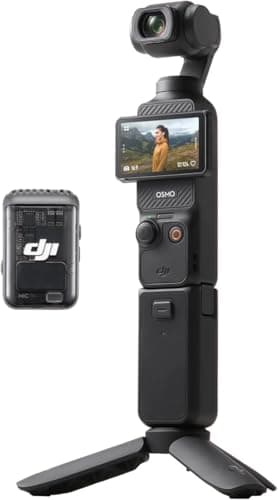
Product image from the Amazon listing.
Our verdict
The DJI Osmo Pocket 3 is the best pocket video camera on the market and the clearest upgrade path from phone shooting. Real 1-inch sensor, real 3-axis gimbal, rotating screen, and small enough to always have with you. If you make video content — for work, YouTube, TikTok or your family — this is the camera that will make you shoot more, and shoot better.
The short version
The Osmo Pocket 3 is what happens when a full-blown motorized gimbal, a real 1-inch sensor and a rotating touchscreen get shrunk to something that fits in your palm. It shoots gorgeously stable 4K video at up to 120fps, has a much larger sensor than any phone (which is what makes low-light and indoor video look pro), and rotates the screen from vertical for TikTok/Reels to horizontal for YouTube with one twist. For creators, travelers and parents who want cinematic footage without carrying a full camera rig, it's the clear best-in-class.
Pros & cons
Pros
- Real 1-inch CMOS sensor — massive low-light and detail leap over a phone
- 3-axis motorized gimbal gives buttery, jitter-free video walking or running
- Rotating touchscreen switches from vertical to horizontal for TikTok or YouTube
- 4K at up to 120fps and 10-bit D-Log M for pro color grading
- Face and object tracking that actually keeps you centered
- Compact enough to live in a jacket pocket
Cons
- Battery life is limited (~2 hours record) — plan on carrying a spare
- Ecosystem accessories (mic, wide lens, ND filters) push the total price up
- No true weather sealing — treat it like a camera, not a phone
Why people love it
Twist the screen, start shooting
Rotate the built-in screen from horizontal to vertical to switch shooting orientation — the gimbal reorients automatically, and the camera's ready in about a second from off.
3-axis gimbal + big sensor
Three motors keep the camera steady on pitch, roll and yaw as you walk, run, or hand it off, and the 1-inch sensor gathers dramatically more light than a phone camera can.
Track, follow, film
Tap a subject and the gimbal follows their face or body automatically — hands-free vlog to camera, or stationary tripod-cam that tracks a kid across a soccer field.
Who it's for
- Vloggers, travel creators, and content creators
- Parents wanting cinematic family videos without a rig
- Business owners who need stable phone-quality-plus video for social
- Anyone graduating from phone shooting to real camera quality
Is the DJI Osmo Pocket 3 worth $520 in 2026?
The Pocket 3 is expensive relative to a GoPro, but genuinely cheap relative to what it replaces. What it replaces: a real camera body ($1,500+), a gimbal stabilizer ($400), and the awkwardness of carrying both plus a bag. What you get in the Pocket 3 is a 1-inch sensor (previously only in cameras costing $1,000+ new), 4K/120fps, 3-axis stabilization, a rotating screen, and it fits in a jacket pocket. For a specific type of creator — vloggers, travel filmmakers, YouTube parents, restaurant reviewers, real-estate shooters — the value is exceptional.
Where it's not worth it: if you don't publish video content, if you only ever shoot in bright daylight (a phone is nearly as good), or if you want a rugged sports camera (buy a GoPro). The Pocket 3 also doesn't replace a phone for photos — it's a video-first tool. For its niche, it's the best product on the market and has been out of stock repeatedly since launch because demand outpaces supply. Buy it if the use case fits — you'll shoot more video, and better video, because you'll actually carry it.
DJI Osmo Pocket 3 vs Insta360 X4 vs Sony ZV-1F: pocket vlog camera showdown
Three excellent pocket vlogging cameras with three very different strengths. Osmo Pocket 3 is the smoothest, most cinematic option — best 1-inch sensor, best 3-axis gimbal, best for talking-head and travel vlogs. Not waterproof, weaker for 360° or action. Insta360 X4 is a 360° camera — you can shoot everything around you and reframe later in post, and it's waterproof to 33ft. Best for skiing, biking, POV, action content. Steeper learning curve for editing.
Sony ZV-1F is a small point-and-shoot camera with a 1-inch sensor, no gimbal, no rotating screen, but excellent still photos and video with real Sony color science. Best for creators who want stills and video from one camera, and don't need motorized stabilization. Overall: pick Pocket 3 for smooth handheld vlog, X4 for action/adventure, ZV-1F for stills-plus-video hybrid work. Many creators own two of them for different scenarios.
How to get pro-looking footage from a DJI Osmo Pocket 3
Settings that matter: shoot in 4K/60fps for a beautiful balance of sharpness and slow-motion flexibility. Turn on D-Log M color profile if you'll color-grade later (dramatically more flexibility in post), or leave it on Normal if you want ready-to-post footage. Use the Face Auto Focus + tracking mode for talking-head vlogs so you stay sharp when moving. Lock exposure and white balance manually for consistent color across a clip — auto exposure shifts mid-shot are the biggest amateur giveaway.
Composition and technique tips: use the ActiveTrack subject tracking to keep yourself framed while walking and talking (no need for a friend behind the camera). Shoot at 1/50 shutter for 24fps or 1/120 for 60fps to get the natural motion blur of cinema. Use the Wireless Mic — internal audio always sounds thin, and clean audio is the single biggest quality upgrade over a phone. And practice slow, deliberate movement: the gimbal smooths shakes, but it can't fix jerky pans. Move like you're pouring water. One last workflow tip: microSD cards fill up fast at 4K/120, and a year of Pocket 3 footage can end up scattered across cards, laptops and phones — a physical archive like ThePhotoStick Omni is the easiest way to sweep every clip into one place before something gets lost.
See DJI Osmo Pocket 3 on Amazon
Check the latest price, photos and buyer reviews on Amazon.
Check Price on Amazon →Sold and shipped by AmazonFrequently asked questions
DJI Osmo Pocket 3 vs GoPro Hero 12 vs a phone: which should I buy for vlogging?
They win on different priorities. Osmo Pocket 3 has the biggest sensor of the three, best low-light and indoor performance, and true 3-axis gimbal stabilization — best for travel vlogging, restaurant/indoor scenes, and any handheld camera-facing content. GoPro Hero 12 is waterproof to 33ft, more rugged, better for action sports and hands-free helmet/chest mount work, but has a smaller sensor and no rotating screen. A modern phone (iPhone 15 Pro / Pixel 8 / Galaxy S24) is more convenient but has smaller sensors, worse low-light, no true optical stabilization, and worse audio inputs. Buy Osmo for vlogs and travel. Buy GoPro for water and action. Buy neither if you only ever film in bright light and don't want to carry an extra device.
Do I need the Creator Combo, or is the standard version fine?
Depends on if you'll do talking-head vlogging. The standard version includes the Pocket 3, protective cover and USB-C cable. The Creator Combo (~$150 more) adds the wireless mic transmitter and receiver, a wind-muff, an extension rod that also charges the camera, and a carrying bag. If you'll ever film yourself talking outdoors, the wireless mic alone justifies the Combo — built-in mics never sound good in wind. Buy standard for silent B-roll and family video. Buy Combo for content creators, YouTubers, or anyone who talks to the camera.
How long does the Osmo Pocket 3 battery last?
About 2 hours of 4K/24fps recording, or shorter (~90 min) if you're using 4K/60fps or the screen at high brightness outdoors. For a full day of shooting, plan on a USB-C power bank (any decent portable battery recharges the Pocket in about 30 min via USB-C PD), or buy the DJI extension rod, which doubles as an extra battery. Sleep mode preserves battery well — leave it on standby between shots rather than powering fully off.
Can I use the Osmo Pocket 3 as a webcam or livestream camera?
Yes, and this is one of the underrated features. Connect the Pocket 3 to a laptop via USB-C and it appears as a UVC webcam — dramatically better video quality than any laptop webcam, and it can gimbal-track your face during a Zoom call. It also livestreams directly via the DJI Mimo app to Instagram, YouTube, TikTok, and RTMP-supporting platforms. Many creators use it as a permanent desk webcam.
Is the Osmo Pocket 3 weather-sealed?
No. Unlike a GoPro, it's not waterproof or officially rain-resistant. Light drizzle is survivable if you wipe it off promptly, but don't shoot in real rain, don't dunk it, and don't take it in the shower. If you want a similar camera for water, snorkeling or heavy weather, buy an Insta360 X4, GoPro Hero 12, or DJI's own Osmo Action cameras instead.
What accessories do I actually need with the Osmo Pocket 3?
The most useful additions in order: (1) a fast microSD card — a UHS-II V60 or better card is required for the highest bitrate 4K recording. (2) A spare battery or the DJI Multifunctional Battery Handle for all-day shooting. (3) The Wireless Mic 2 transmitter (or the Creator Combo bundle) for good audio outdoors. (4) A wide-angle lens attachment if you want more of the scene in the frame for indoor vlogs. Skip: gimbal tripods (the built-in stability is enough), extra ND filters (unless you shoot bright outdoor cinematic), and third-party grips (the extension rod is worth the premium).
As an Amazon Associate, TopCrate earns from qualifying purchases at no extra cost to you. Product image, price, availability and ratings are shown on Amazon and are subject to change.