TRENDING ON AMAZON
Beauty of Joseon Relief Sun: Rice + Probiotics SPF 50+ PA++++ Review: Is It Worth It?
The viral $18 Korean chemical sunscreen — SPF 50+ PA++++, no white cast, glow finish, and rice extract plus probiotics that treat it more like skincare than sunscreen.
Quick answer: Yes — Beauty of Joseon Relief Sun: Rice + Probiotics is worth the viral hype, and it is the specific K-beauty chemical sunscreen most people who try it don't switch off. SPF 50+ PA++++ (top-tier UVA + UVB protection), no white cast on medium or deeper skin tones, dewy glow finish that layers under makeup like a serum, and $18 for 50 ml — cheap enough to actually reapply during the day. The 40,000+ Amazon reviews average 4.6 stars, and every major independent K-beauty reviewer converges on the same verdict: this is the daily face SPF that solved the compliance problem. Skip it if you're very oily (grab the Aqua Fresh version instead for a drier finish) or if you have documented chemical-filter sensitivity ([Blue Lizard Sensitive Sunscreen](/reviews/blue-lizard-sunscreen) is the mineral pick then). For everyone else — the vast majority of daily-face-SPF buyers — this is the reference K-beauty sunscreen for 2026.
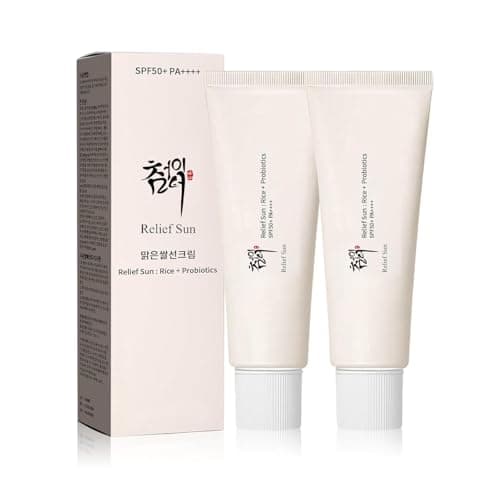
Product image from the Amazon listing.
Our verdict
Yes — Beauty of Joseon Relief Sun: Rice + Probiotics is worth the viral hype, and it is the specific K-beauty chemical sunscreen most people who try it don't switch off. SPF 50+ PA++++ (top-tier UVA + UVB protection), no white cast on medium or deeper skin tones, dewy glow finish that layers under makeup like a serum, and $18 for 50 ml — cheap enough to actually reapply during the day. The 40,000+ Amazon reviews average 4.6 stars, and every major independent K-beauty reviewer converges on the same verdict: this is the daily face SPF that solved the compliance problem. Skip it if you're very oily (grab the Aqua Fresh version instead for a drier finish) or if you have documented chemical-filter sensitivity ([Blue Lizard Sensitive Sunscreen](/reviews/blue-lizard-sunscreen) is the mineral pick then). For everyone else — the vast majority of daily-face-SPF buyers — this is the reference K-beauty sunscreen for 2026.
The short version
Beauty of Joseon Relief Sun: Rice + Probiotics is the specific K-beauty sunscreen that reached mainstream Western beauty aisles by way of TikTok and Reddit. It's a lightweight chemical SPF 50+ PA++++ (Asia's ratings both go higher than US labeling for UVA and UVB) with a rice-extract-and-probiotics base that treats the formula more like a skincare essence than a traditional sunscreen. No white cast even on medium skin tones, a subtle dewy glow finish that many people prefer to matte or greasy Western SPFs, fragrance-free, alcohol-free, and packed with calming ingredients — the formula is the reason it hit 4.6 stars across 40,000+ Amazon reviews and became a fixture on every skincare girlie's TikTok For You page. At around $18 for 50 ml (about 6-8 weeks of daily face use), it's the specific daily face sunscreen most people who've tried it don't switch off.
Pros & cons
Pros
- SPF 50+ PA++++ — top-tier UVA + UVB protection
- No white cast — invisible on medium and lighter deep skin tones
- Lightweight dewy glow finish (skincare-like, not tacky)
- Fragrance-free and alcohol-free
- Rice extract and probiotics soothe and hydrate
- Around $18 for 50 ml — cheap for daily face wear
- Layers cleanly under makeup
Cons
- Dewy finish can feel too shiny for very oily skin (try Aqua Fresh version)
- Contains chemical filters — not the pick for very reactive skin
- Requires reapplication every 2 hours like all chemical sunscreens
Why people love it
Apply 1/4 teaspoon to clean skin
Dispense a rough quarter-teaspoon to the palm (the correct dose for full-face sun protection — most people under-apply and cut their real SPF in half) and press evenly over face and neck 15 minutes before sun exposure.
Chemical filters absorb UV
The formula uses modern Asian-market chemical filters that absorb UVA and UVB across the whole spectrum — earning both the SPF 50+ (UVB) and PA++++ (UVA) ratings, the highest available on Asian labeling.
Reapply every 2 hours
Reapply every 2 hours in direct sun and immediately after heavy sweating or swimming. For makeup-covered faces, a mineral setting powder or a re-applicable SPF stick is the easiest top-up.
Who it's for
- Anyone wanting daily facial sunscreen that layers under makeup
- Medium to deep skin tones tired of white-cast mineral sunscreens
- Fans of Korean or Japanese skincare textures
- Dry, combination or normal skin — even sensitive skin tolerates it
Why Korean sunscreens took over the daily-face-SPF conversation
Sunscreen has one specific problem that dermatologists have been trying to fix for decades: people don't actually wear it. Not because they don't know they should, but because the sunscreens available in the US market — for a mix of FDA approval, formulation and marketing reasons — have historically been unpleasant. Chalky mineral sunscreens leave a white cast that reads badly on medium and darker skin. Traditional Western chemical sunscreens have thick, oil-suspended textures that pill under makeup and leave a greasy or tacky finish. The result: for 30+ years, most people who knew they should wear daily facial sunscreen didn't, because the products were unpleasant enough to skip.
Korean and Japanese sunscreens fixed this by combining three specific advantages the US market doesn't have. First, access to newer chemical UV filters — Uvinul A Plus, Tinosorb S, DHHB — that the FDA hasn't yet approved for the US market despite decades of use in Asia and Europe with strong safety records. These filters absorb UVA and UVB more effectively than the older US-approved filters and blend into skin more elegantly. Second, PA rating scales that push UVA protection to PA++++ (the highest Asian rating), meaningfully deeper than most US SPFs, which typically don't specify UVA protection at all. Third, skincare-adjacent formulations that treat the sunscreen base as an essence with hydrating and calming ingredients rather than a heavy chemical suspension. Beauty of Joseon Relief Sun combines all three in one $18 tube. The result is a sunscreen most people actually wear daily — and the daily wearability, more than any lab-tested peak SPF number, is what actually prevents photoaging and skin cancer risk over decades. The Korean sunscreen category solved the compliance problem the US market never did.
Beauty of Joseon Relief Sun vs Supergoop vs EltaMD vs La Roche-Posay Anthelios
The daily-face-SPF market has consolidated around a handful of premium picks and each fills a slight niche. Beauty of Joseon Relief Sun (~$18): dewy glow finish, no white cast, PA++++ UVA depth, skincare-adjacent formula, cheapest of the tier. Best for normal-to-dry skin wanting an invisible daily SPF that layers under makeup. Supergoop! Unseen Sunscreen (~$38): primer-like clear gel finish that some prefer under matte foundations, PA+++ (one step below Beauty of Joseon's UVA depth), higher price. Best for oily skin wanting a completely matte finish under long-wear makeup. EltaMD UV Clear (~$41): dermatologist favorite hybrid chemical/mineral with niacinamide, specifically formulated for rosacea and acne-prone skin, no white cast, non-comedogenic. Best for reactive or acne-prone skin where niacinamide is a wanted actives layer. La Roche-Posay Anthelios (~$36): European-style formula with Mexoryl (advanced UVA filter not in most US SPFs), skincare-friendly texture, well-tolerated by sensitive skin. Best for sensitive-skin adults wanting a pharmacy-priced daily face SPF.
For most people trying to build a daily-face-SPF habit that actually sticks, Beauty of Joseon Relief Sun is the correct starting point in 2026 — invisible finish, top-tier UVA + UVB protection, elegant enough to wear under any makeup, and cheap enough to reapply during the day. Step up to Supergoop! Unseen if you're specifically oily and need a matte finish. Step to EltaMD UV Clear if you have rosacea, acne, or specifically want niacinamide. Step to La Roche-Posay Anthelios if you have well-documented sensitive skin. Combine any of these with a strong antioxidant routine — vitamin C serum in the morning, retinol like CeraVe Retinol at night — and a solid moisturizer like CeraVe Hydrating Cleanser followed by a ceramide moisturizer, and you have the complete photodamage-prevention stack dermatologists actually recommend.
How to actually use Beauty of Joseon Relief Sun for daily photodamage prevention
Owning the sunscreen is only half the battle; using it correctly is the other half. The single biggest predictor of real-world protection is dose. Most people apply about half of the sunscreen amount that the SPF rating was tested with, which cuts effective SPF roughly in half. For face and neck coverage, the correct dose is about 1/4 teaspoon (or 'two-finger lengths' along your index and middle fingers). Dispense this into your palm, warm briefly between fingertips (warm sunscreen spreads more evenly than cold), and press into face and neck in overlapping sections. Don't rub aggressively; press. This delivers the labeled SPF 50+ protection rather than a real-world SPF 15-20 from under-application.
Layer position in the AM routine: cleanser (a gentle option like Cetaphil Gentle Skin Cleanser), any water-based serums (vitamin C, hyaluronic acid), moisturizer, then sunscreen last as the final barrier. Wait 5-10 minutes between moisturizer and sunscreen, and 5-10 minutes between sunscreen and makeup — this gives each layer time to set and prevents pilling. For reapplication during the day: mineral SPF setting powder (Colorescience Sunforgettable or Supergoop! Invincible Setting Powder) every 2 hours, or in low-UV indoor days, at least at lunch. Add sun-avoidance habits — shade during 10 AM to 4 PM peak UV, UPF-rated clothing on beach days, a wide-brim hat and quality sunglasses. Beauty of Joseon Relief Sun is the sunscreen half of the routine that actually works long-term because you'll wear it daily; the compliance was the missing piece.
See Beauty of Joseon Relief Sun on Amazon
Check the latest price, photos and buyer reviews on Amazon.
Check Price on Amazon →Sold and shipped by AmazonFrequently asked questions
Is Beauty of Joseon Relief Sun worth the hype in 2026?
Yes — Beauty of Joseon Relief Sun is genuinely worth the viral hype, and it's the specific daily face sunscreen most people who try it don't switch off. The reasons: no white cast even on medium and lighter deep skin tones (the biggest complaint about most mineral and even many Western chemical SPFs), a dewy glow finish that reads as skincare rather than sunscreen, a real SPF 50+ PA++++ rating (top-tier UVA + UVB protection on both US and Asian scales), and around $18 for 50 ml — cheap enough to actually reapply during the day. The 40,000+ Amazon reviews average 4.6 stars, and reviewer coverage from Refinery29, Dr Rachel Ho, The Handbook and dozens of independent skincare sites all converge on the same verdict: this is the one that made daily SPF pleasant enough to actually wear. The caveats are minor: the dewy finish can feel too shiny on oily skin (the Aqua Fresh version is the drier-finish alternative), and like all chemical sunscreens it needs reapplication every 2 hours.
Beauty of Joseon Relief Sun vs Aqua Fresh vs Ganpanul vs the original: which one should I buy?
Beauty of Joseon has expanded the Relief Sun line into several variants that are all worth understanding. Relief Sun: Rice + Probiotics (this review) is the flagship — dewy glow finish, best for normal, dry and combination skin. Relief Sun: Aqua Fresh is the same SPF 50+ PA++++ protection with a lighter, water-fluid texture and a much drier finish — the correct pick for oily and very combination skin who find the original too shiny by afternoon. Relief Sun: Ganpanul is the fermented ginseng variant with a slight tint that neutralizes redness on lighter skin tones. For most first-time buyers, start with the Rice + Probiotics if your skin runs normal-to-dry or you like a dewy glow, or start with Aqua Fresh if you're oily and want a matte finish. Skin-type match matters more than any other decision here.
Does Beauty of Joseon Relief Sun leave a white cast on darker skin tones?
No white cast at all on lighter skin, and dramatically less than most Western sunscreens on medium-to-deep tones. Where a mineral zinc-oxide sunscreen leaves a visible chalky layer that reads as gray or ashy on medium and deeper skin, Beauty of Joseon's chemical filter blend absorbs into the skin without leaving pigment behind. For very deep skin (Fitzpatrick VI), some reviewers do notice a subtle initial tint that dissipates within a couple of minutes as the formula sets — the standard rule is to give any sunscreen 5-10 minutes before judging the finish. For medium tones through deep-medium (Fitzpatrick III-V), no cast at all. It's the specific reason the Korean sunscreen category has taken over the daily face-SPF conversation in the last few years — the finish problem got solved.
Can you wear Beauty of Joseon Relief Sun under makeup?
Yes — layering under makeup is one of its strongest use cases. Apply the sunscreen 5-10 minutes before makeup so the SPF has time to set into a smooth base. It works well with most primer-and-foundation combinations, and the mild dewy finish adds a subtle glow that many people prefer over a matte primer. For very long-wear or matte foundations, apply a light dusting of translucent powder over the sunscreen before foundation to avoid slip. For reapplication over makeup during the day, use a mineral SPF setting powder (Colorescience Sunforgettable or Supergoop's Invincible Setting Powder) rather than trying to apply liquid sunscreen over full makeup.
How is Beauty of Joseon Relief Sun different from a Western chemical sunscreen like Neutrogena Ultra Sheer?
Two specific differences that matter for daily use. First, the chemical filters. Beauty of Joseon uses newer Asian-market UV filters (Uvinul A Plus, Tinosorb S, DHHB) that offer broader UVA protection and more elegant textures than the older filters (avobenzone, homosalate, octisalate) that US-market sunscreens are limited to by FDA approval. The result is a formula that spreads more like a moisturizer and delivers higher UVA (PA++++) protection than most US-labeled sunscreens legally can. Second, the skincare-adjacent formulation — rice extract, probiotics, hyaluronic acid — treats the base like an essence rather than a heavy oil-suspended chemical. It's why Beauty of Joseon feels closer to serum than to sunscreen. Neutrogena Ultra Sheer is a legitimate high-SPF workhorse (up to SPF 100+, matte finish, cheap), but it lacks the skin-comfort and UVA depth of the Korean formula. For daily face use, most people who try both prefer the Beauty of Joseon; for maximum SPF number and pure body use, Neutrogena Ultra Sheer is fine.
Is Beauty of Joseon Relief Sun safe for sensitive or acne-prone skin?
Yes, and it's specifically a pick recommended by K-beauty-focused dermatologists for reactive skin because it's fragrance-free, alcohol-free, and uses gentle filter blends. It's non-comedogenic — the formula is designed not to clog pores — and the rice-extract-plus-probiotics base has calming properties that many acne-prone users find noticeably less irritating than heavier Western chemical SPFs. Where to be cautious: any specific chemical filter can cause reaction in a small subset of users, so patch-test on the inner arm for 2-3 days before full-face use if you have known filter sensitivities. For very reactive skin or a documented allergy to chemical filters, stick with a 100% mineral sunscreen like Blue Lizard Sensitive Sunscreen. For the much larger group of people whose skin tolerates chemical sunscreens but wants an elegant texture, Beauty of Joseon is the specific K-beauty pick.
As an Amazon Associate, TopCrate earns from qualifying purchases at no extra cost to you. Illustrative image — see Amazon for the actual product. Sunscreen supports sun protection but does not eliminate skin-cancer risk — combine with shade, protective clothing and regular skin checks. Product image, price, availability and ratings are shown on Amazon and are subject to change.