COMPARISON
Liftly vs Akusoli: Contoured Arch Support or Magnetic Acupressure? (2026)
Both are $20–$30 aftermarket insoles pitched at tired feet, standing all day and plantar fasciitis, and they solve the problem with completely different ideas. Here's how they compare on mechanics, price, guarantees and what the science actually supports.
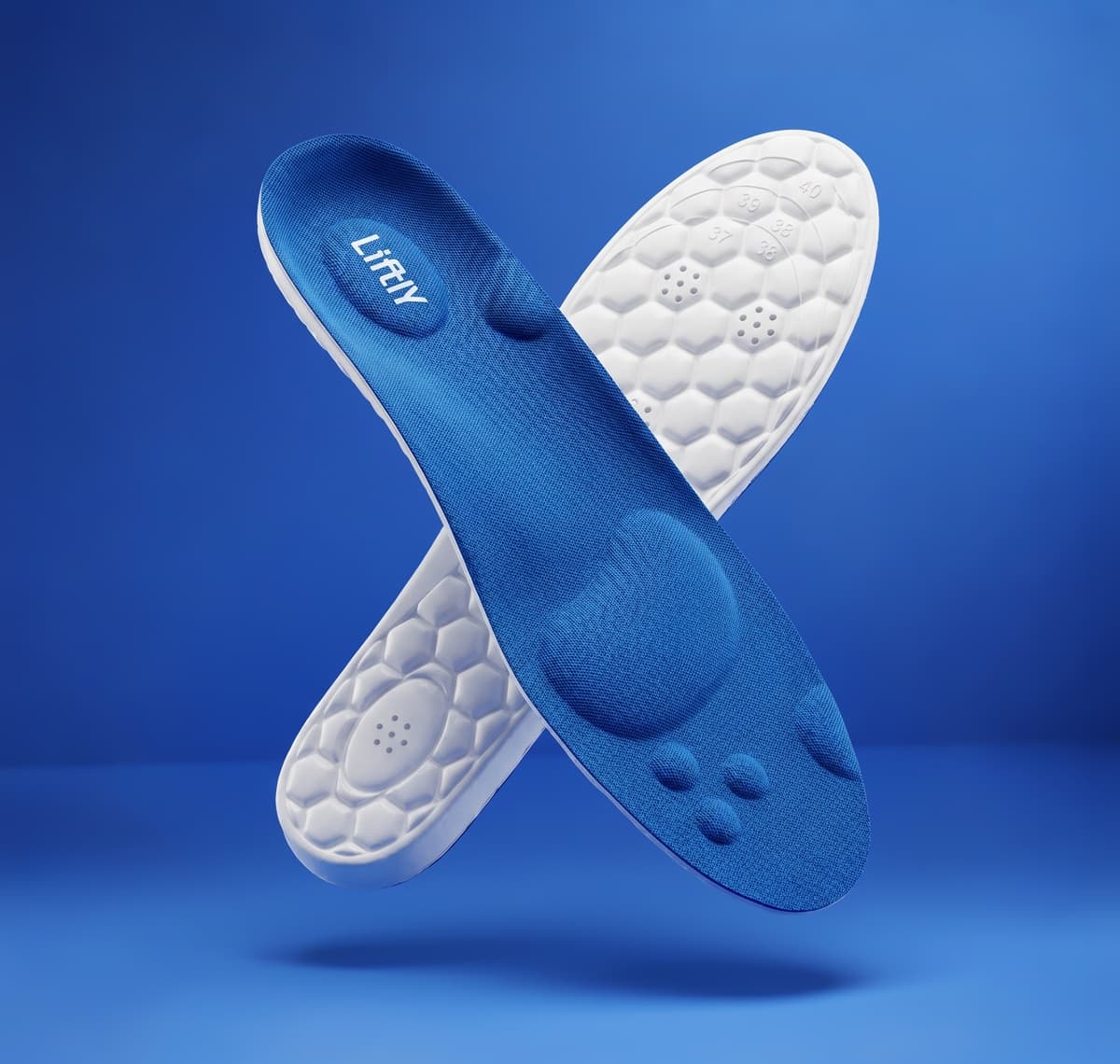
Liftly and Akusoli are both aftermarket insoles you'll see pushed hard on the same tired-feet and standing-all-day searches, and both cost about the same as a fast-food dinner. Beyond the price point, they belong to two different categories. Liftly is a trim-to-fit contoured cushioning insole from the direct-to-consumer brand of the same name — a rubber-plus-foam sandwich with a genuine arch dome, a deep heel cup and a honeycomb cushioning pad, designed to replace the flat factory liner in your existing shoes. Akusoli is a magnetic acupressure insole with silver-coated nodes, a lower profile and a much lower ask — it stacks on top of your existing insole and pitches itself as pressure-point stimulation rather than structural support.
Which one you want depends on what you actually think is wrong. If your arches feel dead, your heels ache by evening and the foam that came in your sneakers is packed flat, the honest fix is a structured insole with a proper arch and a real heel cup — Liftly's territory. If your interest is a low-profile pressure-point insert you can slip into shoes that already have a decent liner, and you're comfortable that the strongest evidence for magnetic therapy is a placebo effect, Akusoli is cheaper.
Below: what each product actually is, what the research says about magnetic insoles, how the two compare on fit, price and guarantee, and our honest verdict on who each one wins. One name-related note before we start: "Akusoli" and "Akusooli" are the same brand name across two spellings you'll see on official sites, and any listing with a similar look-alike name on Amazon or eBay outside those official channels is usually a reseller rather than the manufacturer — a pattern the brand itself flags on its site.
Liftly vs Akusoli at a glance
What it is: Liftly is a trim-to-fit contoured cushioning insole with an arch dome, a deep heel cup and honeycomb cushioning. Akusoli is a magnetic acupressure insole with silver-coated nodes and a lower-profile arch.
Price: Liftly is $29.99 for one pair through the affiliate checkout, with the direct-to-consumer brand's typical multi-pack discounting on top. Akusoli's official site prices single pairs around $20–$40 depending on the current promotion, with two- and three-pair bundles that drop the per-pair cost.
Sizing: Liftly ships trim-to-fit — one physical size that you cut down to your shoe with printed size lines. Akusoli sells in discrete size buckets (roughly Women 5–10 / Men 5.5–8 and Women 10.5–12 / Men 8.5–13).
Where you buy it: Both are primarily direct-to-consumer. Liftly ships through its own funnel and TopCrate is a paid affiliate for it. Akusoli sells through its own sites (akusooli.com and en-akusoli.us are two of them) and warns that third-party Amazon and eBay listings may be resellers outside the manufacturer's guarantee.
Guarantee: Liftly follows the direct-to-consumer brand's stated satisfaction guarantee at checkout. Akusoli's stated window varies by page — the official site lists a 30-day money-back guarantee, and coverage of its policy has quoted a 60-day return window on eligible returns initiated through customer support. Read whichever page you check out on before you pay.
What Liftly actually is
Liftly is a full-length aftermarket insole built around a specific idea: the flat foam liner your shoes shipped with is the weak point, and the right fix is to yank it out and replace it. The insole has a genuine contoured arch dome under the midfoot, a structured heel cup that cradles the fat pad and keeps each landing aligned, and a honeycomb cushioning layer at the heel and forefoot that meters impact without going pillow-soft. It's trim-to-fit — one physical pair, printed size lines along the toe, and about thirty seconds with a pair of scissors to match any shoe you own.
In everyday use that means one pair upgrades whichever sneakers, boots or work shoes you're wearing today, and it migrates between pairs — pull the factory liner out, drop Liftly in, re-lace and go. The specific complaints it targets are the ones a factory foam liner can't touch: arches that ache by evening on concrete, heel-strike pain that travels up to knees and hips, and the standing-all-day fatigue that isn't a diagnosable condition but is very real. Our full Liftly review covers the trim-to-fit workflow, the honeycomb cushioning under the strike zones, and the honest lifespan of about 6 to 12 months of daily wear before the cushioning packs down.
It's a comfort product, not a medical device. Liftly does not diagnose or treat pathology and does not claim to. For diagnosed plantar fasciitis, sharp first-step-in-the-morning heel pain, or foot pain worsening for weeks, a podiatrist and possibly custom orthotics are the right answer. Our best insoles for work boots explainer walks through the tiers so you know where custom orthotics start and Liftly's comfort tier ends.
What Akusoli actually is
Akusoli is a magnetic acupressure insole with a raised pattern of silver-coated nodes on its top surface, a low-profile contour and a set of embedded magnets. Its marketing describes a "4-tech" system — magnetic stimulation, acupressure nodes, an antibacterial silver coating and arch support — and the brand positions it primarily around magnetic and acupressure benefits rather than structural mechanics. It ships in size buckets (small/medium and large/XL, spanning men's and women's ranges) and slots into shoes you're already wearing.
The idea behind acupressure insoles is that the raised nodes press on specific pressure points on the sole while you walk and that this stimulation reduces foot pain and fatigue. Some users find the sensation genuinely pleasant, especially in the arch and forefoot, and adjust to it within a few days. Others find it uncomfortable — the exact reason acupressure insoles are typically sold with a break-in period recommendation.
The magnetic piece is the claim we need to be careful about. Multiple randomized, double-blind, placebo-controlled trials — including a Mayo Clinic-led study published in the Mayo Clinic Proceedings — have compared magnetic insoles against identical-looking sham (non-magnetic) insoles for non-specific foot pain and for plantar heel pain. Across those trials, magnetic and non-magnetic insoles produced roughly the same amount of pain relief, and the authors concluded that the effect people report is most likely the cushioning of the insole itself and the placebo effect rather than the magnets. That doesn't mean nobody feels better wearing them; it means the magnets themselves aren't the reason.
The support mechanics: contoured structure vs pressure nodes
This is where the two products diverge most. A contoured insole like Liftly changes how load is distributed across the sole of your foot. A proper arch dome recruits the midfoot into carrying part of the load your heel and forefoot would otherwise absorb alone; a deep heel cup holds the natural fat pad in place under the heel bone; cushioning under the strike zones meters heel-strike impact so less of it travels up to knees and back. None of that is exotic — it's the same set of mechanics you find in $50-a-pair replacement insoles at running stores or in prescription orthotics, just at a comfort-tier price point.
Akusoli's mechanic is different. Its arch profile is present but lower, so its structural contribution is closer to a mild pressure map than an arch dome that actually holds up a low-arched foot. The main thing you're paying for is the node pattern and the magnets — the pressure-point stimulation while you walk. Whether that helps you comes down to a bet on acupressure and a bet on magnetic therapy. Acupressure has a plausible if modest sensory story to tell, and some people genuinely enjoy walking on it. Magnetic therapy for foot pain does not have that evidence base — the sham-controlled trials keep landing on placebo.
The honest way to read this: if the problem you're trying to solve is mechanical (flat factory foam, aching arches, sore heels after long standing), the product that actually changes mechanics is the better tool. If the problem is subjective and comfort-driven and you just want a different sensory experience under your foot, Akusoli's node pattern may suit you. Neither product replaces a podiatrist visit for pain that's sharp, worsening or lasting past a couple of weeks.
Price and value
On a single-pair basis, both are within a rounding error at their promoted prices — around $30 each. Akusoli's official sites lean on aggressive multi-pair bundles (2 for around $70, 3 for around $100) with a rotating "70% off" banner, so its per-pair math falls fast if you're buying multiple size buckets or one for every shoe in the closet. Liftly's math is trim-to-fit: one pair covers every shoe you own with a removable liner. If the plan is to upgrade the whole closet from a single pair, Liftly's format concentrates the value; if the plan is to have several fixed-size pairs on rotation, Akusoli's bundle math is the more direct route.
The other side of value is what you actually get for the money. Liftly's per-shoe upgrade is a structured arch, a heel cup and honeycomb cushioning — the mechanics of a running-store replacement insole at a fraction of the price. Akusoli's per-shoe upgrade is pressure nodes, magnets and a lower arch — comfort features whose evidence base is thinner. Both are cheaper than the $300-plus tier of custom orthotics through a podiatrist, and neither is a substitute for that tier when a diagnosed condition calls for it.
Prices, tiers and promotional discounts change frequently on both brands' sites; the checkout page is the source of truth. If a landing page promises a specific discount that doesn't apply at checkout, close the tab and start again rather than paying the higher figure.
Fit and format inside the shoe
Liftly's trim-to-fit format means one physical pair adapts to whatever removable liner your shoe currently has. Pull the factory insole out, lay it on top of the Liftly, trace along the printed size lines with a pen and cut conservatively — you can always trim more; you cannot trim less. The full-length format takes up interior volume, which is the one squeeze case: very tight-volume dress shoes may not have room for a full replacement insole, in which case a smaller stick-under-the-arch orthotic like Soul Insole is the more direct answer for that specific pair, and Liftly stays in the daily sneakers and work boots where 10,000 steps a day actually happen. Our insoles for standing all day guide walks the fit workflow in more depth.
Akusoli's size-bucket format ships in discrete sizes and typically expects to sit on top of your existing insole rather than replace it. That makes it lower-friction to install (no scissors) but also means it doesn't fix the underlying problem of a packed-flat factory liner — you're stacking a lower-profile pad on top of foam that has already died. The trade-off: Akusoli is less disruptive to shoes with a well-liked existing insole, but on the standard commodity foam that ships in most sneakers it's addressing symptoms rather than the cause.
Break-in for both products is real. Contoured arch support you're not used to feels present for the first few days; acupressure nodes feel firm for the first few days. Wear either in short 2–4 hour stints for the first week rather than a 12-hour shift on day one, and the awareness fades. Real pain is different from break-in awareness — if either product hurts sharply or your foot is going numb, take them out.
Guarantees and where you're buying
Liftly is sold direct through its checkout with the brand's own stated satisfaction guarantee at the time of purchase. TopCrate is a paid affiliate; we earn a commission when readers buy through our link, and that fact doesn't change the honest advice on this page. If your priority is a comfort-tier structured insole with a real arch and heel cup, buy from the brand's own funnel rather than a marketplace reseller, both to keep the guarantee intact and to avoid the counterfeit risk that follows most viral direct-to-consumer products onto Amazon.
Akusoli sells through more than one official domain (akusooli.com and en-akusoli.us are the two you'll see most often) and warns on its own site that Amazon and eBay listings under the Akusoli name may be resellers outside its manufacturer guarantee. Its guarantee window is described differently across those pages — most official-site copy quotes a 30-day money-back guarantee, while third-party coverage of the brand's policy has quoted a 60-day return window from delivery for eligible returns initiated through customer support with an RMA requirement. If the guarantee is part of why you're comfortable buying, read whichever page's checkout you actually use, keep the packaging, and note the deadline the day the order arrives.
Either way, both products are cosmetic-comfort footwear inserts, not medical devices. Their guarantees are your consumer protection if the product doesn't suit you; they don't promise a specific medical outcome, and any page that implies a diagnosed condition will be cured by an insole is a page to be more cautious about, not less.
Which one should you buy?
Choose Liftly if the problem you want to solve is mechanical: dead factory foam, aching arches on concrete, sore heels by evening, standing-all-day fatigue that doesn't feel like a diagnosable condition. A trim-to-fit contoured insole with a real arch dome, a deep heel cup and honeycomb cushioning is the more direct tool for that job, and one pair migrates between every shoe in your closet with a removable liner. Our full Liftly review covers what to expect.
Choose Akusoli if you specifically want a low-profile pressure-node insert you can lay on top of an existing insole without cutting, you're comfortable that the strongest evidence for magnetic therapy in foot pain is a placebo effect, and the sensation of walking on textured nodes appeals to you. The bundle math also favors Akusoli if you already know you want several fixed-size pairs for a household rather than one trim-to-fit pair for one person.
Choose neither if what you actually have is diagnosed plantar fasciitis, sharp first-step-in-the-morning heel pain that's worsening for weeks, or significant structural asymmetry between your feet. Those are podiatrist and possibly custom-orthotic conversations. Our best insoles for work boots explainer covers where the comfort tier ends and the medical tier begins.
Our verdict
For the standing-fatigue-and-tired-arch problem the packaging on both products targets, Liftly is our pick. It changes mechanics — a real arch dome, a real heel cup, honeycomb cushioning under the strike zones — where Akusoli mostly changes sensation, and the mechanical fix is the one that keeps working after the novelty of walking on nodes wears off. On price, the two are close enough at a single pair that the deciding factor is what you want the insole to do; on trim-to-fit convenience, Liftly wins the closet-upgrade case; on multi-pair bundles for a household, Akusoli's math is more aggressive if you can accept the size-bucket fit and don't need the magnetic story to be true.
Neither product cures anything, and neither is a substitute for a podiatrist when the pain is sharp, morning-first-step, worsening or coming with numbness. But for the everyday problem most people arrive here with — feet that are done by evening and shoes whose factory foam has packed flat — the honest answer is a structured contoured insole rather than a magnetic pad on top of tired foam. Liftly is the direct answer.
A short disclosure: TopCrate earns a commission when readers buy Liftly through our links, and it doesn't earn anything from Akusoli. We'd rather you buy the product that fits your problem than the one that pays us; the case above is our best honest read of the two.
Read our full Liftly insoles review
Our verdict on the trim-to-fit contoured insole — real arch dome, deep heel cup, honeycomb cushioning, and whether it's worth $29.99 for retrofitting the whole closet.
Read our full Liftly insoles review →Frequently asked questions
Is Liftly better than Akusoli?
For the mechanical version of tired feet — flat factory foam, aching arches, sore heels after long standing — yes, Liftly is the more direct tool. Its contoured arch, heel cup and honeycomb cushioning change how load is distributed under your foot. Akusoli's magnetic and acupressure design changes sensation more than mechanics, and multiple sham-controlled trials of magnetic insoles have found the effect is closer to placebo. Our full Liftly review covers what to expect.
Do Akusoli's magnets actually do anything?
The best available evidence says no. Two randomized, double-blind, placebo-controlled trials — including a Mayo Clinic-led study — compared magnetic insoles to identical-looking sham insoles for non-specific foot pain and plantar heel pain, and both found no advantage for the magnetic pair. The authors concluded that any perceived benefit is most likely the cushioning of the insole itself and the placebo effect. That's not the same as saying nobody feels better wearing Akusoli; it's saying the magnets aren't the reason.
How much does each one cost?
Liftly is $29.99 for one pair through the affiliate checkout, with multi-pack discounting available. Akusoli's official sites price single pairs around $20–$40 with rotating promotions, and 2- and 3-pair bundles that drop the per-pair cost. On a single-pair basis they're within a few dollars of each other; the format decides the value case (one trim-to-fit pair versus several fixed-size pairs).
Which fits more shoes?
Liftly, because it's trim-to-fit — one physical pair covers every shoe in your closet with a removable factory liner. Follow the printed size lines with scissors to match each pair and swap it in. Akusoli ships in fixed size buckets and sits on top of your existing insole, so a single pair covers a single shoe.
Do either of these help with plantar fasciitis?
Neither is a treatment. Supportive insoles like Liftly can ease the strain pattern behind everyday heel and arch ache, and the cushioning in any decent insole helps a little. But sharp first-step-in-the-morning heel pain that's persistent or worsening is a see-a-podiatrist signal, not an insole shopping trigger — you want a diagnosis before you spend on either product.
Where should I buy Akusoli if I go that route?
Directly from the brand's own site rather than through Amazon or eBay listings. Akusoli specifically warns on its own pages that third-party marketplace listings may be resellers outside its manufacturer guarantee, and the brand runs more than one official domain (akusooli.com and en-akusoli.us are the two you'll see most often). Whichever page you check out on, read that page's specific guarantee terms before you pay — the stated return window has been quoted differently across pages.
TopCrate is reader-supported. When you buy through links on our site we may earn an affiliate commission, at no extra cost to you. Content is for general information and isn't a substitute for professional advice.