SKINCARE
At-Home Microdermabrasion: What It Actually Does, How Often to Do It, and When to Skip the Spa
Microdermabrasion resurfaces the top layer of skin with mechanical exfoliation and vacuum suction — and the honest answer on whether at-home devices match a $150 spa treatment is more nuanced than either side wants you to believe.
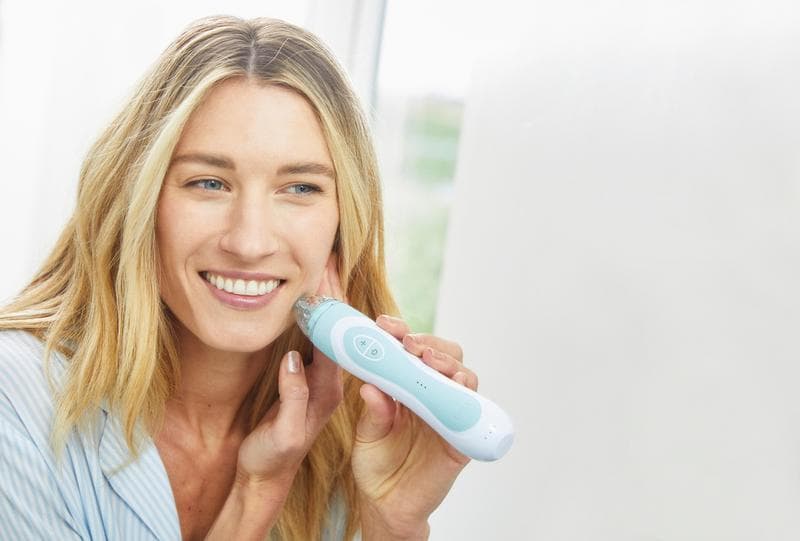
Microdermabrasion has been a spa-menu regular for two decades — a 30-minute treatment where a technician runs a handheld wand across your face that combines mechanical exfoliation (either a spray of crystals or a rotating diamond or crystal tip) with calibrated vacuum suction that lifts dead skin cells away from the surface. The result is smoother texture, brighter tone, less visible pore appearance, and better absorption of serums for a few days afterward. The catch is the price and the frequency: $100-200 per session at a spa, and to keep the results you're supposed to go back every 4-6 weeks.
At-home microdermabrasion devices have quietly reshaped that calculus. A serious home device — not a $30 face brush from the drugstore, but a real motorized wand with genuine suction and calibrated exfoliation discs — runs $150-200 as a one-time buy and pays back within one to two spa visits. This guide covers what microdermabrasion actually does at the skin level, whether the at-home versions really match spa treatments, how often to do it safely, the specific mistakes that turn a resurfacing treatment into skin damage, and which at-home device is worth the money.
What microdermabrasion actually does at the skin level
The technical description: microdermabrasion is a superficial mechanical resurfacing treatment that removes the stratum corneum — the outermost layer of dead skin cells sitting on your face — using two combined mechanisms. The first is mechanical exfoliation, either from a spray of fine aluminum-oxide crystals blown against the skin (crystal microdermabrasion) or from a rotating diamond-tipped or crystal-tipped disc dragged across it (crystal-tip or diamond-tip microdermabrasion). The second is vacuum suction, which simultaneously lifts the loosened dead cells away, increases blood flow to the treated area, and gently stretches skin briefly enough to allow deeper exfoliation than mechanical alone could achieve without irritation.
The visible results people notice within 24-72 hours: smoother surface texture (fine lines from dryness are less visible), brighter tone (dead skin was dulling the reflection), less prominent pore appearance (the pore openings look cleaner without dead-cell rims around them), and dramatically better serum absorption for the next few days (nothing to block penetration). What it doesn't do: reach deep wrinkles, treat active acne, fade set-in hyperpigmentation from years of sun damage, or produce dramatic long-term change without repeated sessions. It's a maintenance treatment that keeps skin at its best baseline — not a transformation treatment that changes the underlying skin.
At-home vs spa: what the honest comparison looks like
Professional spa microdermabrasion runs at a higher intensity than home devices — stronger suction (spa units generate 60-70 kPa of vacuum vs home units at 20-40 kPa), coarser crystal tips or higher-grit diamond discs, and a trained aesthetician who can safely push the parameters harder on tolerant skin. A single spa session removes more dead skin per pass and produces slightly more dramatic 24-hour glow than a single home session. If you're doing microdermabrasion once a quarter as an event-prep treatment, the spa version delivers more per visit and is worth the money for that use case.
The at-home advantage is frequency and cost, and both matter more than the per-session intensity difference. A home device let's you treat weekly (which is where the compounding results come from) at zero marginal cost, so the total skin improvement after three months of weekly home treatments meaningfully exceeds one or two spa treatments in the same period. The PMD Personal Microderm is the specific home device that most closely replicates the spa mechanism — spinning crystal exfoliation discs plus calibrated suction, with color-coded discs at different grit levels so you can start gentle and work up as your skin tolerates it. For most people whose goal is genuinely brighter, smoother skin as a maintained baseline, the at-home route wins over occasional spa visits by a comfortable margin.
For a completely different approach to routine skin renewal — layered gentle actives (bakuchiol plus vitamin C plus peptides) rather than mechanical exfoliation — see our comparison in bakuchiol vs retinol. Microdermabrasion and topical actives aren't either/or; the smartest routines use both, spaced out.
How often should you actually do microdermabrasion at home?
The standard schedule for most skin types: once a week for the first month, then once every 1-2 weeks for maintenance thereafter. The 'once a week for a month' phase is what produces the visible cumulative change (smoother texture, brighter tone, more even pigment); the every-1-2-weeks maintenance is what preserves it. Going more often than weekly is the classic mistake that turns a resurfacing treatment into skin damage — the stratum corneum needs time to regenerate between treatments, and micro-exfoliating skin that hasn't fully recovered thins the barrier, causes persistent redness, and can trigger post-inflammatory hyperpigmentation on darker skin tones.
Sensitive skin should start at once every 2 weeks and work up to weekly only if the skin tolerates it well. Skin actively breaking out (acne, rosacea flare, recent sunburn) should skip microdermabrasion entirely until it calms down — dragging suction and exfoliation over inflamed skin makes it worse, not better. And anyone using a strong retinoid (prescription tretinoin, adapalene) should pause the retinoid for 3-4 days before and after microdermabrasion; the two treatments together are far too much for the skin barrier.
The pre-treatment and after-care protocol that separates 'works well' from 'skin damaged'
Before the treatment: cleanse with a gentle non-abrasive cleanser (skip anything with beads, salicylic acid, or a physical scrub) and pat dry — the skin needs to be clean but not stripped. Pull hair back completely. Skip any actives (retinol, AHA/BHA acids, benzoyl peroxide) for at least 24 hours before treatment. Have your after-care products ready before you start.
The treatment itself: work in straight lines across each area of the face (never small circles, which can concentrate suction in one spot and cause capillary damage), keep the device moving continuously (never let it sit in one place), and avoid the delicate under-eye area entirely — the skin there is too thin for microdermabrasion's mechanical action, which is why every clinical protocol excludes it. One pass over each treatment area is enough; multiple passes concentrate irritation without adding benefit. Total treatment time is 5-10 minutes across the whole face.
After-care is where most home users go wrong. Immediately after treatment: apply a hydrating serum (hyaluronic acid is the safe default), then a barrier-repair moisturizer (ceramides, panthenol, niacinamide — no actives, no fragrance). Skip retinoids and acids for the next 3-4 days. Use broad-spectrum SPF 30+ daily and reapply — freshly exfoliated skin is dramatically more UV-sensitive than baseline skin, and skipping SPF after microdermabrasion is exactly how a treatment meant to improve tone ends up causing hyperpigmentation. The Blue Lizard Australian sunscreen or an equivalent mineral SPF is the specific after-care sunscreen most dermatologists recommend post-treatment; skip chemical filters for the first few days as they can sting on freshly exfoliated skin.
Who should skip microdermabrasion entirely
Not every skin type is a candidate. Active inflammatory acne (cystic acne, painful whiteheads) should not be treated with microdermabrasion — the vacuum action can spread bacteria and worsen breakouts. Rosacea sufferers should generally skip it or consult a dermatologist first; the mechanical action tends to trigger the exact flushing and capillary sensitivity rosacea is defined by. Anyone on isotretinoin (Accutane) or who has finished a course within the past 6 months should absolutely not use microdermabrasion — the drug thins skin dramatically and any mechanical resurfacing can cause serious damage.
Also: skin with active eczema, psoriasis, or dermatitis in the treatment area; anyone with a recent (within 2 weeks) sunburn or peeling sun damage; anyone with a bleeding disorder or on blood thinners (the suction can cause bruising); pregnancy and breastfeeding (not because microdermabrasion is contraindicated but because insurance in most states doesn't cover treatment of pregnancy complications, and the treatment is skippable). And a general caution for very dark skin tones (Fitzpatrick V-VI): microdermabrasion can trigger post-inflammatory hyperpigmentation if treatment is too aggressive or if after-care SPF is skipped — start with the gentlest disc, keep sessions short, and see a dermatologist familiar with darker skin before starting.
How microdermabrasion fits into a full skincare routine (and what it replaces)
Microdermabrasion is a mechanical exfoliation treatment. Any other exfoliation you're already doing needs to be reduced or paused when you add it. If you're using a chemical exfoliant (AHA glycolic or lactic acid, BHA salicylic acid) 2-3 times a week, cut it to once a week (on a non-microdermabrasion day) once you start weekly microdermabrasion — otherwise you'll over-exfoliate and damage your barrier. Skip physical scrubs entirely; you don't need them anymore, and their beads can irritate freshly resurfaced skin.
The complementary parts of the routine work harder after microdermabrasion because absorption improves for a few days: a good vitamin C serum in the morning, a peptide moisturizer at night, and a barrier-repair moisturizer as the base layer any time skin feels tight. Retinoids fit well in the same routine as microdermabrasion but should be spaced: use retinol on the nights you don't microdermabrade, and pause retinol for 3-4 days before and after treatment. For someone doing weekly microdermabrasion, a workable schedule is: retinol Monday and Thursday nights, microdermabrasion Saturday morning, hyaluronic acid plus ceramide moisturizer every night, SPF every morning. This puts the treatments on different days so no single day is stacking too much on the skin, and the barrier-repair products run continuously in the background.
What to look for in an at-home microdermabrasion device (and what to avoid)
The category has three tiers, and the quality gap is real. Bottom tier ($20-60): battery-powered facial exfoliating brushes with small rotating heads marketed as 'microdermabrasion' but with no suction and only mild bristle exfoliation — these are face brushes, not microdermabrasion, and won't produce the treatment's actual results. Skip. Middle tier ($60-120): motorized devices with small diamond-tip heads and mild suction — these do produce some genuine microdermabrasion effect but at intensity too low to match a spa treatment, and the disc-replacement cost adds up. Better than nothing but not the ceiling.
Top tier ($150-200): serious motorized devices with real vacuum suction, replaceable exfoliation discs at multiple grit levels, and enough power to genuinely replicate the mechanism a spa uses. The PMD Personal Microderm is the specific device most reviewers and dermatologists point to at this tier — spinning aluminum-oxide crystal discs plus calibrated suction, color-coded discs from gentle white (for sensitive skin) through blue and green (medium) to red (advanced), with clear guidance on which to start with. It pays back within one to two spa visits and delivers weekly treatments for years. If you're going to buy an at-home microdermabrasion device at all, this is the tier worth spending at — the cheap devices don't do what microdermabrasion is supposed to do, so they're money spent on a category name rather than the treatment.
Read our PMD Personal Microderm review
The at-home microdermabrasion wand that spins genuine aluminum-oxide crystal discs plus calibrated suction — the specific device that replicates the spa mechanism at consumer prices, with color-coded discs to start gentle and work up as your skin tolerates.
Read our PMD Personal Microderm reviewFrequently asked questions
Does at-home microdermabrasion actually work as well as a spa treatment?
Per single session, no — spa units run at higher suction pressure (60-70 kPa vs home devices at 20-40 kPa) and use coarser tips, so a spa treatment removes more dead skin per pass and produces slightly more dramatic 24-hour glow. Per three-month program, home wins by a comfortable margin — because weekly at-home treatments (which is where the compounding results come from) at zero marginal cost meaningfully exceed one or two spa treatments in the same period. If your goal is a one-off event-prep treatment, spa. If your goal is genuinely brighter, smoother skin as a maintained baseline over months, at-home. The PMD Personal Microderm is the specific home device that most closely replicates the spa mechanism at consumer prices.
How often should I do microdermabrasion at home?
Once a week for the first month to build cumulative results (smoother texture, brighter tone, more even pigment), then once every 1-2 weeks for maintenance. Sensitive skin should start at once every 2 weeks and work up to weekly only if it tolerates well. Going more often than weekly is the classic mistake that turns resurfacing into damage — the stratum corneum needs time to regenerate between treatments, and treating skin that hasn't fully recovered thins the barrier, causes persistent redness, and can trigger post-inflammatory hyperpigmentation on darker skin tones. Skip entirely on active acne flares, sunburn, or recent isotretinoin use.
How long do the results of microdermabrasion actually last?
The immediate glow (smoother texture, brighter tone, better serum absorption) lasts about 5-10 days after a single treatment, as the skin cell turnover cycle brings a fresh dead-cell layer to the surface. Cumulative results from weekly treatments (visibly smaller-looking pores, evener tone, softer surface texture over the whole face) build over 4-8 weeks of consistent use and persist as long as you maintain the every-1-2-week schedule. Stop treating for 4-6 weeks and the skin drifts back to its untreated baseline — this is a maintenance treatment, not a permanent change. Which is exactly why cost-per-treatment matters so much for anyone doing it long-term.
Can I use microdermabrasion under my eyes?
No — every clinical protocol explicitly excludes the under-eye area, and reputable home devices tell you the same. The skin under the eye is dramatically thinner than the rest of the face (about 0.5mm vs 2mm on cheeks), the mechanical action of microdermabrasion can cause capillary damage, and the suction can cause immediate visible bruising. For under-eye concerns (dark circles, fine lines, puffiness), the right tools are targeted serums, peptide creams, or dedicated devices like microcurrent — never microdermabrasion. Keep at least a fingertip's width away from the orbital bone during treatment.
What should I put on my skin after microdermabrasion?
Immediately: a hydrating serum (hyaluronic acid is the safe default), then a barrier-repair moisturizer (ceramides, panthenol, niacinamide — no actives, no fragrance). Skip retinoids and acids for the next 3-4 days as the barrier reconstitutes. Broad-spectrum SPF 30+ daily and reapply — freshly exfoliated skin is dramatically more UV-sensitive than baseline skin, and skipping SPF post-treatment is exactly how microdermabrasion ends up causing hyperpigmentation instead of preventing it. A mineral sunscreen like Blue Lizard Australian sunscreen is the safer choice for the first few days; chemical filters can sting on freshly resurfaced skin.
Is microdermabrasion safe for dark skin?
It can be, but with caveats. Fitzpatrick V-VI skin tones are more prone to post-inflammatory hyperpigmentation from any mechanical or chemical exfoliation, and aggressive microdermabrasion can trigger dark patches that take months to fade. The safe protocol: start with the gentlest disc, keep sessions short (5 minutes maximum), space treatments to every 2 weeks initially, and use SPF religiously afterward. See a dermatologist familiar with darker skin before starting, especially if you have any history of hyperpigmentation. Chemical exfoliation with mandelic or lactic acid is often a better first-line option for darker skin tones than mechanical microdermabrasion, and combines well with occasional spa or home treatments as an occasional deeper reset.
Can I do microdermabrasion and use retinol in the same routine?
Yes, but they need to be spaced. Both are exfoliating treatments in different ways — retinol accelerates cell turnover, microdermabrasion mechanically removes the top layer — and stacking them on the same day over-exfoliates the barrier. A workable weekly schedule for someone using both: retinol Monday and Thursday nights, microdermabrasion Saturday morning, hyaluronic acid plus ceramide moisturizer every night, SPF every morning. Pause the retinol for 3-4 days before and after microdermabrasion treatments to give the barrier a real recovery window. For a full retinol ramp-up guide, see how to use retinol.
TopCrate is reader-supported. When you buy through links on our site we may earn an affiliate commission, at no extra cost to you. Content is for general information and isn't a substitute for professional advice.