HANDS-ON REVIEW
Zithion-X USB-C Rechargeable AA Batteries (4-Pack) Review: Is It Worth It?
Lithium AA batteries with a USB-C port in the top — recharge them like a phone, reuse them for years, and quit the disposable-battery treadmill.
Quick answer: Yes — Zithion-X USB-C AA batteries are worth $29.99 because a single 4-pack replaces on the order of a thousand disposable alkalines while outperforming them: full lithium voltage held steady until empty, no leak chemistry, and charging from the same USB-C cable that fills your phone. Smoke detectors keep their specified cells and you'll need a 90-minute charging habit — small prices for never buying AAs again. Add a [pocket power bank](/reviews/statik-state) and even a blackout doesn't stop the charging cycle.
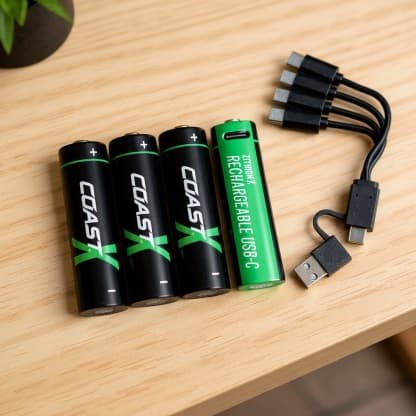
The USB-C port lives in the battery itself — one included cable recharges four at once. Photo: Coast
Our verdict
Yes — Zithion-X USB-C AA batteries are worth $29.99 because a single 4-pack replaces on the order of a thousand disposable alkalines while outperforming them: full lithium voltage held steady until empty, no leak chemistry, and charging from the same USB-C cable that fills your phone. Smoke detectors keep their specified cells and you'll need a 90-minute charging habit — small prices for never buying AAs again. Add a [pocket power bank](/reviews/statik-state) and even a blackout doesn't stop the charging cycle.
The short version
Every battery drawer tells the same story: a jumble of maybe-dead alkalines, a device that eats a fresh pair monthly, and a shopping-list line item that never leaves. Zithion-X ends it with a neat trick — lithium AA cells with a USB-C port built into the top. Plug in the included 4-way cable and they recharge like earbuds; rated for 1,000+ cycles, one 4-pack replaces a literal thousand disposables. Being lithium, they hold a steady voltage until empty (no dim-flashlight fade), work in the cold, and don't leak corrosive gunk into your good gear the way forgotten alkalines do.
Pros & cons
Pros
- USB-C port in the battery — no separate charging dock
- 1,000+ recharge cycles: one pack replaces years of disposables
- Steady lithium voltage — devices run strong until empty, no fade
- No alkaline leakage destroying remotes and flashlights
- 4-way charging cable included; ready in about 1.5 hours
- Drop-in AA replacement for remotes, mice, lights, toys and gear
Cons
- Higher upfront cost than a disposable multipack
- Charging takes planning — dead means plugged-in, not swapped
- A few high-drain or odd-voltage devices prefer specific chemistries — check the manual
How it works
Use them like any AA
Drop them into remotes, mice, flashlights, toys — anything that takes a standard AA. Lithium cells deliver full, steady power.
Recharge over USB-C
When they run down, flip open the top port and plug in the included 4-way cable — any USB charger fills all four in about 90 minutes.
Repeat for years
Rated for over a thousand cycles, each cell replaces roughly a thousand throwaways. The battery aisle stops being your problem.
Who it's for
- Households feeding remotes, controllers and toys weekly
- Anyone who's lost a device to a leaked alkaline
- Camping and blackout kits that need cold-weather reliability
- The sustainability-minded doing the easy math on e-waste
Why lithium USB-C cells beat both alkalines and old rechargeables
Disposable alkalines have two dirty secrets: their voltage sags as they drain (that's your flashlight dimming and your controller drifting weeks before 'dead'), and they leak — the white crust that's quietly killed more remotes than any drop ever did. The old rechargeable answer, NiMH, fixed the waste but ran at a lower voltage that some devices read as half-empty, and demanded a dedicated dock charger that always lived in the wrong drawer.
Lithium cells with onboard USB-C thread the needle: full 1.5V held steady until empty, no leak chemistry, and charging that borrows the cable ecosystem you already own. The port-in-the-battery design is the practical breakthrough — no dock to find, no proprietary anything; the same charger that fills your phone fills your batteries. Coast rates them at 1,000+ cycles, which puts the per-use cost within pennies of free by year two.
The honest math on a $29.99 4-pack
Run the numbers on any battery-hungry household: a wireless mouse, two remotes, a game controller and some toys chew through 40–80 alkalines a year — $30–60 annually, forever. The 4-pack pays for itself inside the first year and then just keeps working; heavier households should size up to the 8-pack tier since the per-cell price drops. Add the un-invoiced savings: no more dead-battery hardware store runs, and no more writing off a $60 motion-sensor light or gaming controller to alkaline leakage.
Where disposables still earn a slot: smoke detectors (most manufacturers specify non-rechargeable cells — follow the manual), and anything you store untouched for years, where a lithium primary's shelf life wins. For everything you actually use weekly — the smart-home gadgets, the kids' inventory, the junk-drawer flashlight — rechargeable is simply the correct default in 2026.
Living with them: charging rhythm and battery discipline
The one behavioral shift: dead batteries now mean 'plug in for 90 minutes,' not 'swap and toss.' The households that love these keep a simple rotation — charge the spent set while the fresh set works, exactly like camera batteries. The included 4-way cable makes it a single-outlet job, and the cells charge from any USB port: wall brick, laptop, even a power bank during an outage.
Longevity practice is minimal but real: store them charged, top them up every few months if unused (lithium prefers not to sit empty), and keep them out of hot cars. The LED on each cell tells you charging state at a glance. Treat them with the mild respect you give any lithium device and the thousand-cycle rating is genuinely reachable — these are the same cells, chemistry-wise, as the rest of your rechargeable life.
Frequently asked questions
How do Zithion-X batteries charge?
Each AA has a USB-C port under a flip cover in its top. The included 4-way cable charges four at once from any USB charger — wall brick, laptop or power bank — in roughly 90 minutes.
How long does a charge last in a device?
Comparable to a quality alkaline in the same device — but with steady full voltage the whole way, so performance doesn't fade as they drain. In low-drain gear like remotes, that's months per charge.
How many times can I recharge them?
Rated for over 1,000 cycles. In practice one 4-pack stands in for on the order of a thousand disposable AAs — years of normal household use.
Will they work in all my AA devices?
They're drop-in replacements for standard AAs — remotes, mice, controllers, flashlights, toys, lights. Exceptions: smoke detectors and a few devices whose manuals specify a particular battery chemistry.
Do they leak like alkalines?
No — lithium cells don't produce the corrosive potassium-hydroxide leakage that crusts up and destroys electronics. That alone has paid for a set for many buyers.
Are they safe to charge?
Yes — each cell has onboard charge-management circuitry, the same protection approach as any USB-charged gadget. Charge them on a normal USB port and standard lithium care applies: no hot cars, store charged.
When you buy through links on this page, TopCrate may earn an affiliate commission at no extra cost to you. Follow device manufacturers' battery guidance (e.g., smoke detectors). Prices accurate as of publish time.