TRENDING ON AMAZON
Meta Quest 3 VR Headset Review: Is It Worth It?
Standalone, no-PC virtual reality with full-color passthrough — the first headset that delivers real mixed reality at a sane price.
Quick answer: Yes — the Meta Quest 3 is the best VR headset for most people in 2026, and the one to buy if you're picking a single standalone system. No PC or cables required, sharp pancake lenses, full-color mixed reality, and the deepest game and fitness library in VR. The rare tech product where the mass-market pick and the enthusiast pick are the same headset — buy the 512GB if you'll play a lot, add an Elite Strap and prescription lens inserts, and you're set for years.
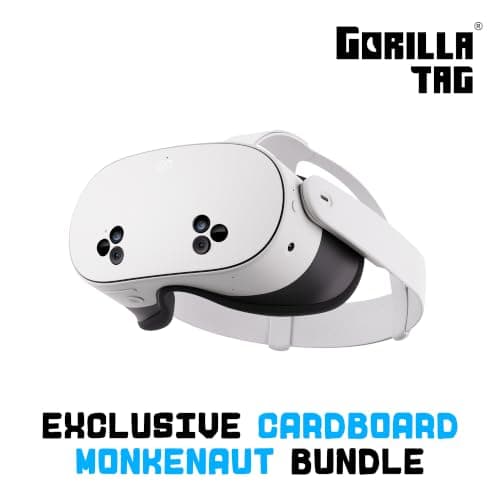
Product image from the Amazon listing.
Our verdict
Yes — the Meta Quest 3 is the best VR headset for most people in 2026, and the one to buy if you're picking a single standalone system. No PC or cables required, sharp pancake lenses, full-color mixed reality, and the deepest game and fitness library in VR. The rare tech product where the mass-market pick and the enthusiast pick are the same headset — buy the 512GB if you'll play a lot, add an Elite Strap and prescription lens inserts, and you're set for years.
The short version
The Quest 3 is the headset that finally makes VR easy: no PC, no base stations, no cables — just charge it, put it on, and you're in. The leap from the Quest 2 is the headline feature most reviews skip past: high-resolution full-color passthrough means you can see your real room and have virtual objects layered into it, which turns the Quest 3 into a genuine mixed-reality device, not just a VR one. The pancake lenses are sharper edge-to-edge than the older Fresnel optics, the Snapdragon XR2 Gen 2 chip runs newer games smoothly, and the library — Beat Saber, Asgard's Wrath 2, Resident Evil 4 VR, fitness apps, immersive video — is the deepest in standalone VR.
Pros & cons
Pros
- Standalone — no PC, phone or base stations needed
- Full-color passthrough enables real mixed reality
- Sharper pancake lenses with edge-to-edge clarity
- Massive content library (games, fitness, social, video)
- Wireless PC VR streaming via Air Link or Steam Link
- Comfortable enough for hour-long sessions out of the box
Cons
- Stock strap is just OK — many add an Elite Strap
- Battery life is about 2 hours per charge
- Higher storage tier is worth it for serious users
Why people love it
Put it on and play
Charge, draw a play boundary once, and you're in — no console, PC or external sensors required.
Mixed reality in color
Front cameras blend the real room into the view, so virtual objects can sit on your real coffee table or wall.
Plays everything
Run thousands of native Quest games, or stream PC VR titles wirelessly from a gaming PC over Wi-Fi.
Who it's for
- First-time VR buyers and gift recipients
- Fitness fans (Supernatural, Beat Saber, FitXR)
- Sim and PC VR players who want a wireless headset
- Anyone who wants to try mixed reality without spending Apple Vision Pro money
Is the Meta Quest 3 worth it in 2026?
The Quest 3 sits in a sweet spot the rest of the VR market hasn't matched. Apple's Vision Pro is several times the price and aimed at productivity, the PSVR2 requires a PlayStation 5 and a cable, and PC VR headsets like the Valve Index need a high-end gaming PC plus base stations. The Quest 3 is the only headset you charge, put on and use — and it still plays nearly every major VR game. For the vast majority of people, that all-in-one simplicity is what makes VR finally stick instead of gathering dust in a closet after a week.
Where the Quest 3 genuinely justifies its price over the cheaper Quest 3S is the optics and passthrough. The pancake lenses are noticeably sharper and have a wider clear area, which makes long sessions less fatiguing and text easier to read in apps and browsers. The full-color passthrough cameras are the headline difference from the Quest 2: mixed-reality apps that drop a virtual chessboard onto your real table or a fitness coach into your living room only work because of those cameras. If you'll wear it more than a couple of times a month, those upgrades pay for themselves in comfort and capability.
Meta Quest 3 vs PSVR2 vs Apple Vision Pro
The PSVR2 has gorgeous OLED displays and excellent controllers, but it's tethered to a PS5 and the game library is much smaller. If you already own a PS5 and primarily want a few flagship titles like Horizon Call of the Mountain or Resident Evil 4 VR, it's a strong choice — but you're locked into that ecosystem. The Quest 3 plays Resident Evil 4 VR natively, runs without a console, and has an order of magnitude more games and apps to grow into.
The Apple Vision Pro is a different category — a premium spatial-computing device aimed at productivity, immersive video and developers, at multiple times the Quest 3's price. The visuals are jaw-dropping but the gaming and fitness ecosystem is small, the battery is external on a wire, and the weight is significant. For gaming, fitness, social VR and casual mixed-reality fun, the Quest 3 is the better and far cheaper buy. For experimental computing, the Vision Pro is the one — but that's a tiny audience versus the Quest 3's mass market.
How to set up the Quest 3 and what accessories actually matter
Setup takes about 15 minutes: charge the headset, install the Meta Horizon app on your phone, create or log into a Meta account, follow the in-app pairing, then put the headset on and walk through the room-boundary setup so the system knows where your walls and furniture are. The headset uses inside-out tracking, so there are no base stations to mount on the wall — just clear a roughly 2-by-2 meter area for room-scale games and you're done. Wi-Fi 6 is recommended if you'll stream PC VR; the headset supports it natively.
Skip most accessories at first and only add what you need. The two upgrades nearly every regular user eventually buys are an Elite Strap (or a third-party halo strap with a built-in battery) for long-session comfort, and a silicone face cover that's easier to wipe down for shared use or sweaty sessions like Beat Saber. Prescription lens inserts are essential if you wear glasses daily — they're a major comfort upgrade. Charging carrying cases, link cables and controller grips are nice-to-haves; the stock controllers and included strap are good enough to start.
See Meta Quest 3 on Amazon
Check the latest price, photos and buyer reviews on Amazon.
Check Price on Amazon →Sold and shipped by AmazonFrequently asked questions
Do I need a PC, phone or console to use it?
No — the Quest 3 is fully standalone. You set it up once with the Meta Horizon app on your phone, then everything runs on the headset itself.
Should I get the 128GB or 512GB version?
128GB is fine for casual play; 512GB is the better buy if you'll install many games, especially big titles like Asgard's Wrath 2 or Resident Evil 4 VR that take double-digit gigabytes each.
Can it play Steam VR / PC VR games?
Yes — over Wi-Fi via Air Link or Steam Link, or wired via a USB-C cable. You need a VR-capable gaming PC, but you get the full Steam VR library at high quality wirelessly.
How long is the battery life?
About 2 to 2.5 hours of mixed use, less for the most demanding games. A USB-C power bank in your pocket or a battery-strap accessory extends sessions indefinitely.
Is the Quest 3 comfortable for glasses wearers?
Yes — it ships with a glasses spacer that creates extra clearance for most frames. Prescription lens inserts from third parties (or Meta's official option) are popular for daily wearers because they're more comfortable than glasses inside the headset.
Quest 3 vs Quest 3S: which one should I buy?
The Quest 3 has the newer pancake lenses for sharper, more comfortable visuals and slightly better passthrough cameras; the Quest 3S uses the older Fresnel lenses to hit a lower price. Both run the same games on the same chip. If you'll wear it often or value clarity, the Quest 3 is the better long-term buy; the 3S is the smart pick for a casual or gift purchase.
Is Quest 3 the best VR headset in 2026?
For most people, yes. Nothing else in the standalone class matches the Quest 3's combination of sharp pancake lenses, full-color mixed-reality passthrough, and a game library that includes basically every major VR title. The PSVR2 has slightly better OLED contrast but requires a PS5 and a cable, and its game library is a fraction of the Quest ecosystem. The Apple Vision Pro is a beautiful spatial computer but costs 6-8× more and has almost no games or fitness apps. High-end PC VR headsets like the Valve Index or Bigscreen Beyond can beat the Quest 3 on visuals if you already own a serious gaming PC and base stations. For gaming, fitness, mixed reality and social VR without a PC or console, the Quest 3 is the best-value 'buy this one' VR headset in 2026 — full stop.
What is Meta Quest 3 VR used for — is it just games?
Games are the anchor, but the Quest 3 has grown into a much broader device. Fitness is huge — Supernatural, Beat Saber, FitXR and Les Mills Bodycombat replace a gym membership for a lot of owners. Immersive video (YouTube VR, Meta TV, Netflix VR) turns any room into a giant private cinema. Meditation and productivity apps like Immersed use the color passthrough for a multi-monitor workstation without physical hardware. Social platforms (VRChat, Rec Room, Horizon Worlds) let friends hang out in virtual spaces. And mixed-reality apps let virtual objects sit on your real furniture — a chess set on your coffee table, a fitness coach in your living room. If you thought VR was just gaming, the Quest 3 is where that stops being true.
As an Amazon Associate, TopCrate earns from qualifying purchases at no extra cost to you. Product image, price, availability and ratings are shown on Amazon and are subject to change.