TRENDING ON AMAZON
Apple Watch Ultra 2 (49mm Titanium) Review: Is It Worth It?
The big, bright, 72-hour-battery Apple Watch built for hiking, diving and marathons — the flagship smartwatch for anyone who lives outdoors.
Quick answer: Yes, the Apple Watch Ultra 2 is worth it if you actually leave the house — the 49mm titanium case, 72-hour Low Power battery, 3,000-nit screen and dual-frequency GPS make the Ultra 2 the flagship rugged smartwatch, and it fully replaces a mid-range Garmin for hikers, divers and marathoners. If your watch mostly lives at a desk, save $400 and get the [Apple Watch SE](/reviews/apple-watch-se) or the standard Series 10 — you won't miss the extras.
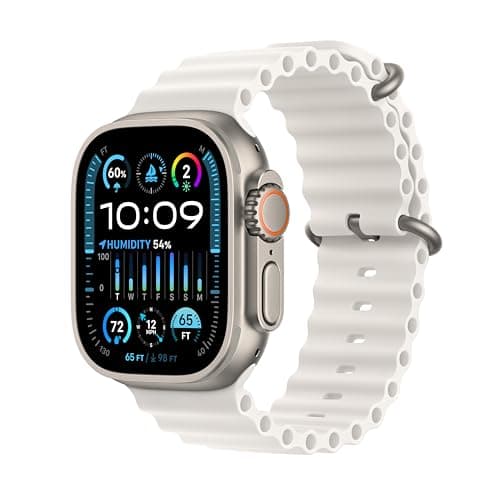
Product image from the Amazon listing.
Our verdict
Yes, the Apple Watch Ultra 2 is worth it if you actually leave the house — the 49mm titanium case, 72-hour Low Power battery, 3,000-nit screen and dual-frequency GPS make the Ultra 2 the flagship rugged smartwatch, and it fully replaces a mid-range Garmin for hikers, divers and marathoners. If your watch mostly lives at a desk, save $400 and get the [Apple Watch SE](/reviews/apple-watch-se) or the standard Series 10 — you won't miss the extras.
The short version
The Apple Watch Ultra 2 is the version of Apple Watch built for people who actually go outside. A 49mm aerospace-grade titanium case houses the brightest display Apple has ever shipped (3,000 nits — readable in direct sun and underwater), dual-frequency L1+L5 GPS for accuracy that beats most dedicated running watches, dive computer certification to 40m, and a battery that runs 36 hours normally or 72 hours in Low Power Mode. Add the customizable Action Button, an 86dB emergency siren, and the same watchOS, Fitness+ and full iPhone integration as any Apple Watch, and it's the only smartwatch that legitimately replaces a Garmin, dive computer and Apple Watch in one device. If you hike, dive, run ultras or need a Watch that lasts a weekend, this is it.
Pros & cons
Pros
- Titanium case rated to MIL-STD-810H — genuinely rugged
- 3,000-nit display — readable in bright sun and underwater
- Dual-frequency L1+L5 GPS beats most running watches for accuracy
- 36-hour battery, 72 hours in Low Power Mode
- Certified dive computer to 40 meters (with Oceanic+ app)
- Programmable Action Button + 86dB siren + precision compass
Cons
- Only fits wrists 130-200mm — not for small wrists
- $400 premium over Series 10 with same core watchOS
- Battery still shorter than Garmin Fenix for multi-day expeditions
Why people love it
Titanium case + sapphire crystal
An aerospace-grade titanium case (49mm) with a raised sapphire crystal edge protects the display from impacts, IP6X dust rating, WR100 water resistance to 100m and EN13319 dive computer certification.
Dual-frequency L1 + L5 GPS
The Ultra 2 receives both L1 (traditional GPS) and L5 (newer, higher-precision) satellite signals simultaneously and picks the strongest, delivering positional accuracy that rivals dedicated running watches in urban canyons and dense forest.
S9 chip with on-device Siri and Neural Engine
Apple's dual-core S9 SiP with a 4-core Neural Engine runs Siri requests on-device (faster, offline capability), powers Double Tap gestures with fingertip motion detection, and drives on-watch machine learning for workout tracking and health insights.
Who it's for
- Hikers, backpackers and trail runners
- Recreational and technical divers
- Ultra runners and multi-day cyclists
- Anyone who wants Apple Watch with real battery life
Is the Apple Watch Ultra 2 worth it over the Series 10?
The Ultra 2 costs roughly $400 more than an Apple Watch Series 10 with the same core watchOS software, and it's a legitimate question whether the hardware differences justify the premium. Where the Ultra 2 is objectively better: battery life (36 hours vs 18), screen brightness (3,000 nits vs 2,000 — meaningful in direct sun), case durability (titanium + sapphire crystal + IP6X vs aluminum), speaker volume (louder for the 86dB siren and clearer calls), dive certification, dual-frequency GPS, and the programmable Action Button. For an outdoor athlete or anyone using their Watch during long workouts, those add up.
For a majority of buyers who use their Watch mainly for notifications, contactless payments, fitness tracking around town, sleep tracking and daily activity closing, the Series 10 does 95% of what the Ultra 2 does at a much lower cost. The Ultra 2's rugged case also adds noticeable weight (61g vs 35g for Series 10 aluminum), and the 49mm size is not everyone's aesthetic. Rule of thumb: if you spend more than a couple of hours per week outside in demanding conditions, or want a Watch that doesn't need daily charging, buy the Ultra 2. If your Watch mainly lives on your wrist at a desk and gym, save the money and get Series 10.
Apple Watch Ultra 2 as a Garmin replacement: what works and what doesn't
Serious outdoor athletes have historically used Garmin (Fenix, Enduro, Instinct) rather than Apple Watch, and it's fair to ask whether the Ultra 2 is a legitimate crossover option. Where the Ultra 2 successfully replaces Garmin: iPhone-first users who value the app ecosystem, notifications, Apple Pay, on-wrist calls, and swappable bands. For day hikes, half-marathons, gym workouts and everyday adventure — even multi-hour hikes with GPS tracking — the Ultra 2 does everything a Fenix does, with better software polish, contactless payments and iPhone integration.
Where Garmin still wins for hardcore users: multi-day expeditions where 36-hour battery isn't enough (Garmin Enduro/Fenix run 10+ days smartwatch, 100+ hours GPS), preloaded topographic maps with turn-by-turn navigation (Apple Maps hiking is improving but not there), sport-specific features (Garmin has better cycling metrics, golf features, sailing tools), and rugged environments where you want a device that doesn't need iCloud/iPhone. For a weekend warrior, marathoner, day hiker or scuba diver, Ultra 2 fully replaces Garmin. For thru-hikers, tec divers, ultramarathoners and specialized athletes, Garmin's specific ecosystem still matters.
Getting the most from the Ultra 2 for hiking, diving and long workouts
The Action Button on the left side is the Ultra 2's superpower — customizable to launch a workout, start a dive, mark a waypoint, control camera shutter or run any shortcut. Set it to your most-common outdoor use (starting a hike workout with Waypoint dropping is a common choice) and you'll trigger it dozens of times per adventure. Combined with the Backtrack feature (which records your outbound GPS breadcrumbs and lets you retrace step-by-step), it's a legitimate off-trail navigation tool if you get turned around.
For battery on multi-day trips: enable Low Power Mode (extends battery to 72 hours) which reduces sensor sampling but keeps GPS workouts running. Turn off Always-On Display for expedition use — this alone extends normal battery from 36 to about 50 hours. Charge with an Apple-certified fast charger during breaks (0-80% in about 60 minutes). For diving, buy Oceanic+ once and use it as backup gauge on every recreational dive — the peace of mind of a second dive computer for the cost of a lightweight watch is genuine safety value. For running, the dual-frequency GPS + on-wrist heart rate + running form metrics (via workout apps like Runna) rival dedicated running watches; the Ultra 2 has become a legitimate marathon and ultra training tool.
See Apple Watch Ultra 2 on Amazon
Check the latest price, photos and buyer reviews on Amazon.
Check Price on Amazon →Sold and shipped by AmazonFrequently asked questions
Is the Apple Watch Ultra 2 worth $400 more than the Series 10?
For most people no; for the right person absolutely. If you use your Apple Watch mainly for notifications, fitness tracking around town, and daily activity closing, Series 10 does the same things in a thinner, lighter case for $400 less. If you regularly hike, run more than 3 hours at a time, dive, sail, ski, or camp — situations where battery, screen brightness in sun, and GPS accuracy in tough terrain matter — the Ultra 2 pays for itself. The 72-hour battery mode alone justifies it for backpackers and multi-day athletes; Series 10 needs a nightly charge and dies during a marathon.
Apple Watch Ultra 2 vs Garmin Fenix 8 vs Coros Vertix 2: which for hiking and outdoors?
Garmin still wins on pure outdoor endurance — the Fenix 8 runs 10+ days in smartwatch mode, has full topographic maps preloaded, and supports many Garmin-only outdoor features (sailing, golfing, hunting). Ultra 2 wins on everything smartwatch-related: iPhone integration, apps, notifications, on-wrist calls, Apple Pay, watchOS ecosystem. Coros Vertix 2 splits the difference with 60-day standby battery and simpler UI but a much weaker software ecosystem. If you're deep in the outdoor world and don't need iPhone integration, Fenix 8. If you carry an iPhone and want one watch for daily + expedition use, Ultra 2. If ultra-long battery is the priority and you don't need apps, Vertix 2.
How accurate is the dual-frequency GPS in real-world conditions?
Substantially better than single-frequency GPS in challenging environments. In urban canyons (tall buildings on both sides), single-frequency GPS can bounce off buildings and show you weaving across streets you didn't run on. Dense forest canopies do similar damage. The Ultra 2's simultaneous L1 + L5 reception cross-references signals and picks the cleanest, which reduces this weaving significantly. In open terrain (fields, roads, open trails) the difference is small — both are accurate to a few meters. Where dual-frequency shines: NYC, Central Park under trees, mountain valleys, forested trails, and anywhere GPS traditionally struggles.
Is it really usable as a scuba dive computer?
Yes, with the Oceanic+ app (paid, roughly $10/month or $80/year). The Ultra 2 is EN13319-certified and rated to 40m, meaning it can be used as a primary or backup dive computer for recreational scuba diving. Oceanic+ handles no-decompression limits, nitrox mixes, safety stops and dive logging. For technical diving beyond recreational limits, use a dedicated tec computer — the Ultra 2 is rated for recreational depths only. As a backup gauge, safety-stop timer or freediving depth tracker (Oceanic+ Freediving mode), it's fully capable and eliminates carrying a separate device.
What sizes and bands does it come in? Will it fit small wrists?
The Ultra 2 only comes in 49mm — there is no smaller size, and Apple has been explicit this is intentional given the antenna and battery constraints. This makes it too large for wrists under 130mm circumference; if your wrist is on the smaller end, the case will overhang. Bands are the standard Apple Watch 49mm sizes: Trail Loop, Alpine Loop, Ocean Band and traditional straps. Third-party bands from Nomad, Spigen and Amazon are widely compatible. If you have small wrists but want a rugged Watch, Apple Watch Series 10 in 46mm with a titanium option is the closest alternative — smaller case, still rugged, half the battery.
Does the Ultra 2 need cellular, or does GPS-only work?
GPS-only works fine for most use. All GPS tracking, workout recording, health monitoring and offline features work without cellular. Cellular ($10-15/month on top of your iPhone plan) adds: making and receiving calls without your phone, streaming music/podcasts on the go, receiving iMessages and notifications away from your phone, and Emergency SOS via cellular in areas with cell coverage. If you frequently exercise without your phone (trail runs, hikes, gym), cellular is genuinely useful. If your phone is always nearby, save the monthly fee. The Ultra 2 also has satellite Emergency SOS built-in, which works globally without cellular in the US and Canada.
How long does the Apple Watch Ultra 2 actually last on a single charge in real-world use?
With normal daily use — notifications, a one-hour GPS workout, sleep tracking overnight and the Always-On Display active — most owners get about 36 hours between charges, matching Apple's official rating. Low Power Mode stretches that to roughly 72 hours by dimming the screen, cutting background heart-rate polls and skipping some sensor pings, which is enough for a full weekend camping or a multi-day backpacking trip. Continuous GPS during a marathon or long hike burns through roughly 12 hours of battery. Charging on the fast USB-C puck refills 0-80% in about an hour.
Is the 'iWatch Ultra 2' the same as the Apple Watch Ultra 2?
Yes — 'iWatch' is a common misnomer, but Apple has never sold a product called iWatch. The device you're looking for is the Apple Watch Ultra 2, sometimes shortened to 'Ultra 2 watch' or 'Ultra 2 Apple Watch.' It's the same 49mm titanium flagship with the Action Button, dual-frequency GPS, 72-hour Low Power battery and dive-computer certification described in this review. If you see a listing for an 'iWatch Ultra 2,' it's a third-party term for the Apple Watch Ultra 2.
As an Amazon Associate, TopCrate earns from qualifying purchases at no extra cost to you. Product image, price, availability and ratings are shown on Amazon and are subject to change.