TRENDING ON AMAZON
Sunday Riley Good Genes All-in-One Lactic Acid Treatment Review: Is It Worth It?
Sunday Riley's cult purified-lactic-acid treatment — the botanical-rich acid serum most people credit with the 'why does my skin look so good today' morning-after glow.
Quick answer: Yes — the Sunday Riley Good Genes lactic acid treatment is worth it if you have dull, uneven or reactive skin and want the specific 'morning-after glow' the cult following talks about, without the sting of harsher acids. It's more expensive per ounce than The Ordinary Lactic Acid 10%, but the purified acid plus botanical base is the reason it works on sensitive skin where cheaper AHAs fail. Wear SPF the next day and it's the serum that quietly makes people ask what you're doing differently.
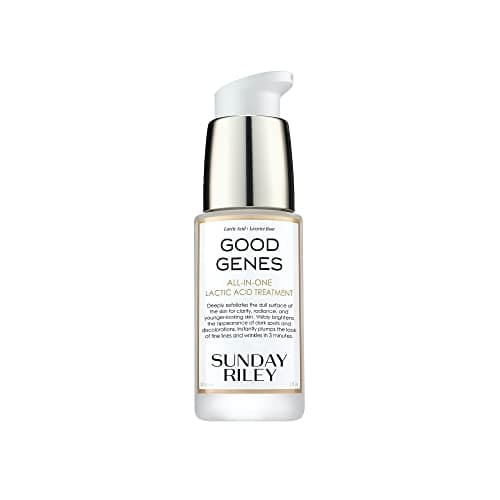
Product image from the Amazon listing.
Our verdict
Yes — the Sunday Riley Good Genes lactic acid treatment is worth it if you have dull, uneven or reactive skin and want the specific 'morning-after glow' the cult following talks about, without the sting of harsher acids. It's more expensive per ounce than The Ordinary Lactic Acid 10%, but the purified acid plus botanical base is the reason it works on sensitive skin where cheaper AHAs fail. Wear SPF the next day and it's the serum that quietly makes people ask what you're doing differently.
The short version
Good Genes is the serum that made Sunday Riley a household skincare name. It's built around purified lactic acid — the gentlest of the alpha-hydroxy acids — wrapped in a creamy botanical base with licorice (for tone), lemongrass, aloe, arnica and prickly pear extract. Used on cleansed skin at night 2-3 times a week, it exfoliates the dull outer layer without the sting of stronger acids, calms redness over weeks, and delivers the specific 'morning-after glow' its cult following talks about. At $85 an ounce it's not cheap, and it's not chemically unique (The Ordinary sells a 10% lactic serum for $10) — but it's the specific formula that turns 'I put on lactic acid' into 'my skin looks amazing.'
Pros & cons
Pros
- Purified lactic acid — smoother, gentler than most AHAs
- Creamy botanical base feels like skincare, not a peel
- Real morning-after glow within the first few uses
- Fades tone unevenness over 4-8 weeks
- Fragrance-safe formulation for most sensitive skin
- Comes in a 1oz that lasts 3-4 months at 3 nights a week
Cons
- Expensive per ounce vs pure lactic acid alternatives
- Not for use with retinoids on the same night
- Can sting on freshly exfoliated or compromised skin
Why people love it
Cleanse and pat dry
Use a gentle cleanser and pat skin fully dry (damp skin amplifies acid penetration — a bad thing here). Wait 5 minutes if you've just exfoliated.
Apply 3-4 drops at night, 2-3× per week
Warm 3-4 drops between your palms and press across the face, avoiding the eye area. Start twice a week; work up to three or four if skin tolerates it.
Follow with moisturizer and SPF the next day
Skip other actives (retinol, vitamin C, exfoliating acids) on the same night. In the morning, use a broad-spectrum SPF — lactic acid makes skin more sun-sensitive.
Who it's for
- Dull, uneven skin that products sit on top of
- People whose skin can't tolerate stronger acids
- Anyone chasing the 'skin looks lit' morning-after effect
- Sensitive-skin folks who've failed with glycolic acid
What Sunday Riley Good Genes actually is — and why purified lactic acid matters
Lactic acid is one of the alpha-hydroxy acids (AHAs), the family that also includes glycolic (smaller molecule, deeper penetration, more potent but harsher), mandelic (larger molecule, gentler) and malic. Lactic sits in the sweet spot: molecule large enough not to aggressively burn most skin, small enough to actually exfoliate the outer dead-cell layer and improve turnover. What Sunday Riley did differently was use 'purified' lactic acid — a technical grade with fewer impurities and a smoother action profile — combined with a botanical base that specifically calms the mild sting that even gentle AHAs can produce.
In practice this means Good Genes reads as skincare, not as a peel. You put it on and it feels like a moisturizing serum — no dramatic tingling, no visible flaking the next morning if you're using it correctly. The results build gradually: brighter skin within days, smoother texture within weeks, faded discoloration and softer fine lines within months. It's the specific combination — active plus base — that turns a bathroom-cabinet acid into the product Sunday Riley's cult following credits with 'why does my skin look so good today.'
Sunday Riley Good Genes vs The Ordinary vs Paula's Choice: the AHA serum landscape
The AHA serum shelf has consolidated into three price tiers with real differences. Entry: The Ordinary Lactic Acid 10% + HA at $10 — 10% purified lactic acid in a water-based serum, no fragrance, no extras. Excellent for robust skin, hard to argue with the value. Mid: Paula's Choice Skin Perfecting 8% AHA Gel at $32 — 8% glycolic acid (stronger than lactic) with green tea extract, less irritating than pure glycolic, popular for tone. Premium: Sunday Riley Good Genes at $85 — purified lactic acid in a creamy botanical base with licorice, aloe, arnica and prickly pear, designed specifically to be gentler on reactive skin while delivering fast visible glow.
The right pick depends on skin type and priorities. Tough skin, budget-conscious, want maximum concentration: The Ordinary. Tone-and-post-acne mark focused, moderate budget, want glycolic acid: Paula's Choice. Sensitive skin, chasing the cult 'lit-from-within' effect, willing to pay for a refined formulation: Good Genes. Most skincare enthusiasts eventually rotate through all three at different life stages. For beginners on a budget: start with The Ordinary and upgrade only if it doesn't suit. For anyone who's already tried cheaper lactic acids and hated the sting, Good Genes is the version worth the price.
Building a routine around Good Genes: what to layer, what to skip, and when
The safe routine skeleton: cleanser, wait 60 seconds, Good Genes on dry skin, moisturizer. That's it. Don't add serums, essences, or actives on Good Genes nights — the whole point of an acid night is a simple stack that lets the AHA do its work without interference. On off nights, use retinol, vitamin C serum, or peptides depending on your goals. Structuring a week: Monday-retinol, Tuesday-Good Genes, Wednesday-peptide moisturizer, Thursday-Good Genes, Friday-retinol, weekend-recovery. That cadence delivers all the benefits without any single-night overload.
The morning after Good Genes matters more than most routines admit. Skin is more sun-sensitive for 24 hours, so SPF isn't optional — mineral SPF like EltaMD UV Clear is the safest daily pick, and reapply during outdoor time. Skip physical exfoliants (scrubs, brushes) the day after; skin has already been exfoliated chemically. Once a routine is stable and you're getting the results you wanted, resist the urge to escalate to more frequent use — most people who ruin their skin with acids do it by pushing from 3 nights a week to 5. Good Genes rewards patience, not aggression.
See Sunday Riley Good Genes on Amazon
Check the latest price, photos and buyer reviews on Amazon.
Check Price on Amazon →Sold and shipped by AmazonFrequently asked questions
Is the Good Genes lactic acid treatment worth it in 2026?
Yes — the Sunday Riley Good Genes lactic acid treatment is still the AHA serum most worth its price if you have dull, uneven or reactive skin that stings on cheaper acids. The formula is purified lactic acid (the gentlest AHA) in a creamy, botanical base — licorice, aloe, arnica, prickly pear — that layers cleanly with everything except retinol and other acids. Most users see the 'morning-after glow' within 3-5 uses, and the 1oz bottle lasts 3-4 months at 3 nights a week, so cost-per-use lands around $0.70. If you specifically want max active concentration for the money, The Ordinary Lactic Acid 10% at $10 delivers more raw acid per drop and works fine for tougher skin. Good Genes' edge is that the base is nearly as important as the acid — it's the combination that keeps sensitive skin from reacting.
Is Sunday Riley Good Genes worth the $85 price tag?
For dull, uneven or reactive skin — yes. The purified lactic acid Sunday Riley uses is a smoother, larger-molecule form than the technical-grade lactic in most drugstore serums, and the creamy botanical base (licorice, aloe, arnica, prickly pear) is what makes it tolerable on sensitive skin where cheaper AHAs sting. A 1oz bottle lasts 3-4 months of 2-3× weekly use, so real cost-per-use is roughly $0.70. If your barrier is robust and you just want maximum lactic acid for the money, The Ordinary does that job for $10. If you've tried a cheap lactic acid, hated the sting, and given up on AHAs, Good Genes is the specific version worth the premium.
Sunday Riley Good Genes vs The Ordinary Lactic Acid 10% — which is better?
Different tools for different faces. The Ordinary Lactic Acid 10% + HA is $10 for 30ml — 10% lactic acid in a water-based serum, no fragrance, no fancy extras. It's more concentrated, cheaper per drop, and works well for tougher skin that can handle straight actives. Good Genes is $85 for 30ml — purified lactic acid at a lower concentration in a creamy botanical base with licorice, aloe, arnica and prickly pear that reduce irritation and add glow. For sensitive skin that stings from The Ordinary, Good Genes is often the difference between tolerating lactic acid and giving it up. For a robust barrier that just wants max exfoliation cheap, The Ordinary wins. Try The Ordinary Niacinamide alongside either — it stacks well with lactic and doesn't compete for the same slot.
Can I use Good Genes with retinol or vitamin C?
Not on the same night. Layering lactic acid over retinol (or vice versa) compounds irritation and can compromise the skin barrier, often leading to redness, peeling and breakouts. The safe cadence: retinol on nights 1 and 3, Good Genes on nights 2 and 4, moisturizer on nights 5-7. Or alternate weeks. Vitamin C in the morning is fine — different routine — as long as you're wearing SPF religiously. If you're already on prescription tretinoin, use Good Genes at most once a week on retinol-off nights, or skip it entirely if your barrier is still adapting.
How long until I see results from Good Genes?
Morning-after glow (from immediate exfoliation of dead surface cells) shows up after the first 3-5 uses. Reduction in tone unevenness, faded post-acne marks and smoother texture builds over 4-8 weeks of consistent 2-3× weekly use. Fine-line softening — the more ambitious claim — takes 3-6 months. Take a photo in consistent lighting when you start; the change is easier to see side by side at week 8 than in the mirror day to day.
Is Sunday Riley Good Genes safe for sensitive skin?
For most sensitive skin, yes — that's actually its differentiator versus cheaper lactic acid serums. The purified lactic acid used in Good Genes is a smoother, larger-molecule form of the acid that penetrates less aggressively than technical-grade lactic. The botanical base (aloe, arnica, prickly pear) actively calms irritation. That said, 'sensitive' means different things — patch test on the jawline for a few nights before applying full-face, start once a week rather than three times, and back off immediately if you get burning, redness or unusual breakouts. For genuinely reactive skin (rosacea, active eczema, over-exfoliated barrier), fix the barrier first with a ceramide moisturizer like Byoma Rich Cream before trying any acid.
Do I really need SPF the day after using Good Genes?
Yes, and this is non-negotiable with any AHA. Lactic acid works by exfoliating the top layer of skin — the same layer that provides some natural sun protection. Skipping SPF the next day amplifies UV damage and undoes the tone benefits Good Genes is doing for you. Wear a broad-spectrum SPF 30+ every morning you're using lactic acid — a mineral option like EltaMD UV Clear SPF 46 is the safest daily pick. If you're not consistent about SPF, don't use lactic acid at all; you'll create more tone unevenness than you fix.
As an Amazon Associate, TopCrate earns from qualifying purchases at no extra cost to you. Always patch test AHA products and follow with SPF. Product image, price, availability and ratings are shown on Amazon and are subject to change.
More reviews you might like
SKINCARE
Celimax Vita-A Retinal Shot Review: Best K-Beauty Retinal for Sensitive Skin?
SPORTS
Body Glide Original Review: The Anti-Chafe Balm That Actually Works
SKINCARE
Foreo Luna Mini 3 Review: Is the Silicone Cleansing Brush Worth It?
SKINCARE