HANDS-ON REVIEW
Voss+Agin 1.00 CTW Lab-Grown Diamond Stud Earrings Review: Is It Worth It?
A full carat of certified, lab-grown diamonds in classic four-prong studs — chemically identical to mined stones, at a price that skips the mine.
Quick answer: Yes, Voss+Agin's lab-grown diamond studs are worth it — they're the smart-money version of the most-gifted jewelry design on earth: a certified, eye-clean, full-carat pair of actual diamonds at the price mall jewelers charge for the certificate appointment. Know the honest trade (wear-value, not resale-value) and know your recipient — and for almost everyone, this is $300 that lands like $1,500.
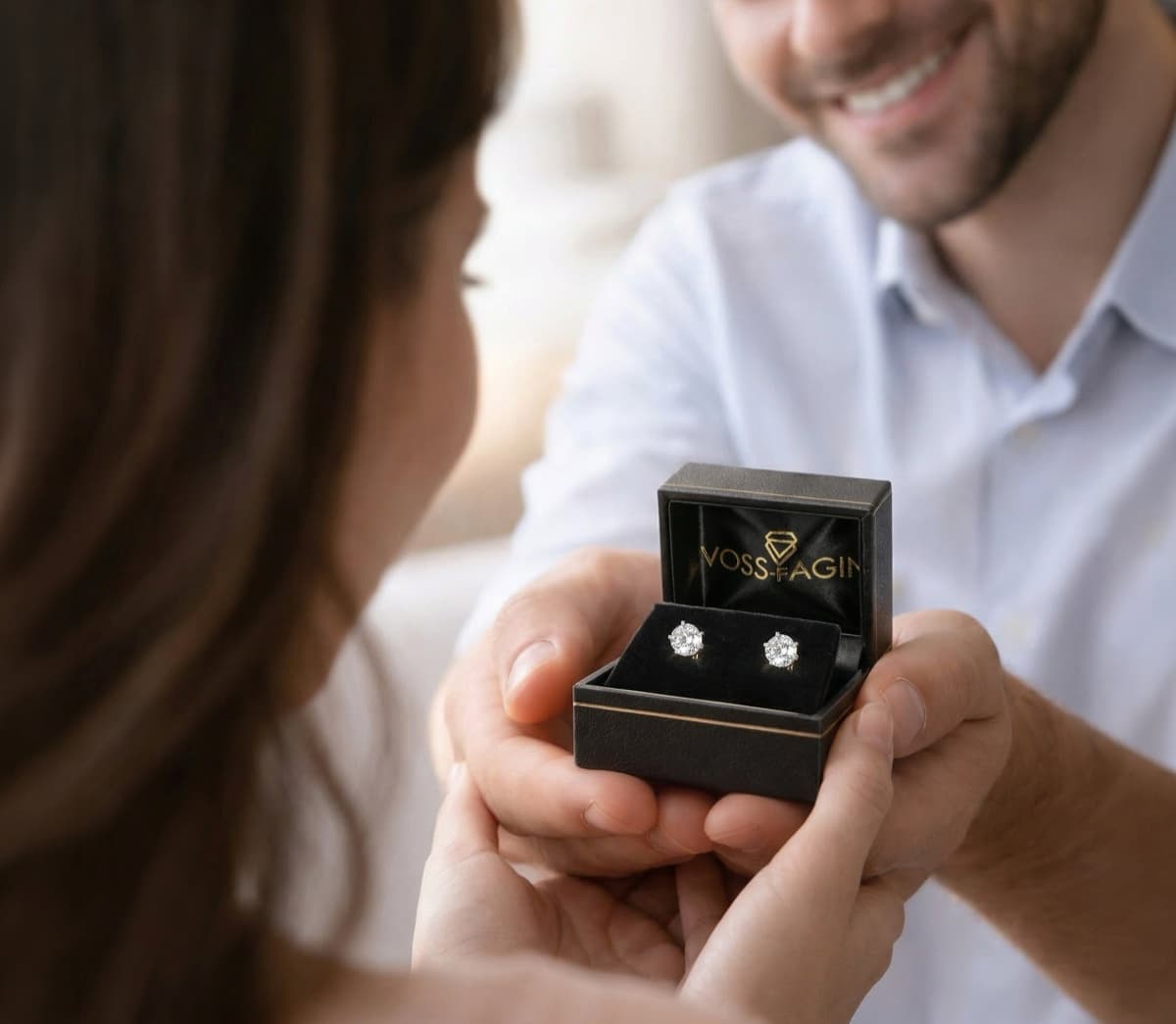
The classic gift, minus the classic markup. Photo: Voss+Agin
Our verdict
Yes, Voss+Agin's lab-grown diamond studs are worth it — they're the smart-money version of the most-gifted jewelry design on earth: a certified, eye-clean, full-carat pair of actual diamonds at the price mall jewelers charge for the certificate appointment. Know the honest trade (wear-value, not resale-value) and know your recipient — and for almost everyone, this is $300 that lands like $1,500.
The short version
Diamond studs are the little black dress of jewelry — the pair that works daily and formal, twenty and eighty — and their price has always been mostly story: mining scarcity, mall-jeweler margins, the certificate theater. Voss+Agin sells the stone without the story: 1.00 carat total weight of lab-grown diamonds — chemically, optically and physically identical to mined stones, gradable by the same G-color/VS-clarity scales, certificate included — set in classic four-prong studs for $299.99, where the equivalent mined pair starts north of $1,000. Lab-grown means grown, not simulated: this is carbon crystallized into actual diamond, distinguishable from mined only by a lab's provenance equipment and by the receipt.
Pros & cons
Pros
- Real diamonds — lab-grown is chemically identical to mined
- Full 1.00 carat total weight; certification included
- G-color / VS-clarity grade — white and eye-clean
- Classic four-prong studs: the everyday-to-formal staple
- A third the price of an equivalent mined pair
- Conflict-free by construction — no mining supply chain
Cons
- Lab-grown carries less resale/heirloom-market value than mined — buy to wear, not to trade
- One standard design — this is the classic stud, not a designer setting
- Traditionalist recipients may care about mined provenance; know your audience
How it works
Grown, not simulated
Lab diamonds crystallize from carbon under the same heat-and-pressure physics as underground stones — the result is diamond, full stop, not cubic zirconia or moissanite.
Graded like any diamond
The stones carry the same 4C grading as mined diamonds — this pair at G color (white) and VS clarity (eye-clean) — with certification documenting it.
Set in the classic stud
Four-prong solitaire settings with secure backs: the exact design that's been the default 'first real diamonds' gift for a century.
Who it's for
- Gift-givers at the anniversary/birthday/graduation tier
- First-real-diamonds buyers who'd rather not finance them
- The ethically-minded who want mine-free stones
- Anyone upgrading CZ studs to the real thing quietly
Lab-grown 101: what 'real' means here
A lab-grown diamond is not an imitation — it's carbon crystallized into the identical lattice as a mined stone, produced by recreating the heat-and-pressure (or vapor-deposition) conditions that geology used to monopolize. Hardness, brilliance, fire, thermal properties: identical, which is why the gemological institutes grade them on the same 4C scales and why jewelers need specialized provenance equipment to tell origin at all. The FTC settled the language question years ago: they are diamonds.
What separates this from the drawer of 'diamond-look' products: cubic zirconia is a different material that clouds and scratches within a few years; moissanite is its own (lovely, but distinguishable) stone with rainbow-heavy fire. Lab diamond is the only alternative that is literally the same substance — the G/VS grading on this pair means white-bodied stones with no inclusions visible to the eye, which in studs (viewed at conversation distance, worn at the ear) is precisely the grade sweet spot where money stops buying visible improvement.
The price gap, explained honestly
Why is the identical crystal two-thirds cheaper? Because the mined-diamond price was never about material cost — it's scarcity management, a marketing legacy ('two months' salary' was an ad campaign), and a five-hand supply chain each taking margin. Growing gem-grade crystal has scaled like the technology it is, and prices fell accordingly. What you give up is the part of a mined stone's value that was story all along: geological romance and the resale/heirloom market that story sustains.
That trade should be made with open eyes: mined diamonds hold secondary-market value in a way lab-grown currently doesn't, so these are jewelry to wear and love, not a store of value — true, frankly, of almost all retail jewelry once it leaves the store. The flip side is ethics by construction: no mining labor questions, no conflict-provenance chain to audit, a fraction of the extraction footprint. For a growing share of buyers — especially younger recipients — that's not a compromise, it's the point.
Are Voss+Agin studs worth $299.99?
Benchmark the exact spec: 1.00 CTW at G/VS in white-metal four-prong settings runs $1,000–1,600 mined at mainstream jewelers, and $400–650 lab-grown at the big online diamond retailers — the $299.99 offer sits under both with certification included. The classic-stud design is deliberately the most timeless (and least fashion-risk) format in jewelry; it's the piece that gets worn hundreds of days a year, which is the real metric of jewelry value.
Gift strategy notes: studs sidestep the ring-sizing trap entirely, the certificate belongs in the card (it's half the moment), and the box matters — this is a category where presentation carries. As the anchor gift of the sentimental tier, it pairs naturally with the other keep-forever purchases — a legacy book for the grandparent generation, a safety pendant for the practical-elegant recipient. For the buyer who was about to finance mined studs at 4×the price: this is the same sparkle, certified, owned outright.
Frequently asked questions
Are lab-grown diamonds real diamonds?
Yes — chemically, physically and optically identical to mined stones: same carbon lattice, same hardness, same brilliance, graded on the same 4C scales. Even jewelers need lab equipment to determine origin. They are not CZ or moissanite.
What exactly do I get?
A pair of four-prong stud earrings totaling 1.00 carat of lab-grown diamonds at G color (white) and VS clarity (eye-clean), with certification documenting the stones, in gift-ready packaging.
Why are they so much cheaper than mall-jeweler studs?
Because growing gem-grade diamond has scaled like any technology, and because the mined price was always mostly scarcity management and supply-chain margin. Identical crystal, minus the story tax.
Will anyone be able to tell?
No — not visually, not with a loupe, not with a thermal tester (lab diamonds pass, because they're diamonds). Origin is detectable only by specialized gemological provenance equipment.
Do lab-grown diamonds hold their value?
Honestly: less than mined on the resale market — buy them to wear, not to trade. (Retail mined jewelry also resells far below purchase price; the heirloom-value story is mostly story at this tier.)
Are they ethical/conflict-free?
By construction — no mine, no extraction labor chain, no conflict-provenance question. It's the one diamond category where the ethics require no auditing.
When you buy through links on this page, TopCrate may earn an affiliate commission at no extra cost to you. Lab-grown diamonds are chemically identical to mined diamonds; resale characteristics differ. Prices accurate as of publish time.
More reviews you might like
SKINCARE
Celimax Vita-A Retinal Shot Review: Best K-Beauty Retinal for Sensitive Skin?
SPORTS
Body Glide Original Review: The Anti-Chafe Balm That Actually Works
SKINCARE
Foreo Luna Mini 3 Review: Is the Silicone Cleansing Brush Worth It?
SKINCARE