HANDS-ON REVIEW
Memorygram Legacy Book Review: Is It Worth It?
A year of gentle weekly questions turns a parent's or grandparent's stories into a keepsake hardcover book — the interview you always meant to do, done.
Quick answer: Yes — Memorygram is worth $123.50 because it's the only Legacy Book service priced like a gift rather than a service, and it solves the most procrastinated project in family life by removing everything that made it stall: no interviews to schedule, no blank page, no technology to teach. One emailed question a week, answered in their own voice, becomes a hardcover their descendants will actually hold. It takes a year and it costs real money — and it's still the cheapest way ever devised to keep the storyteller in the family after the storyteller is gone. Pair it with an [iMemories](/reviews/imemories) tape rescue and [ThePhotoStick](/reviews/thephotostick) photo consolidation, and the family archive is finally complete.
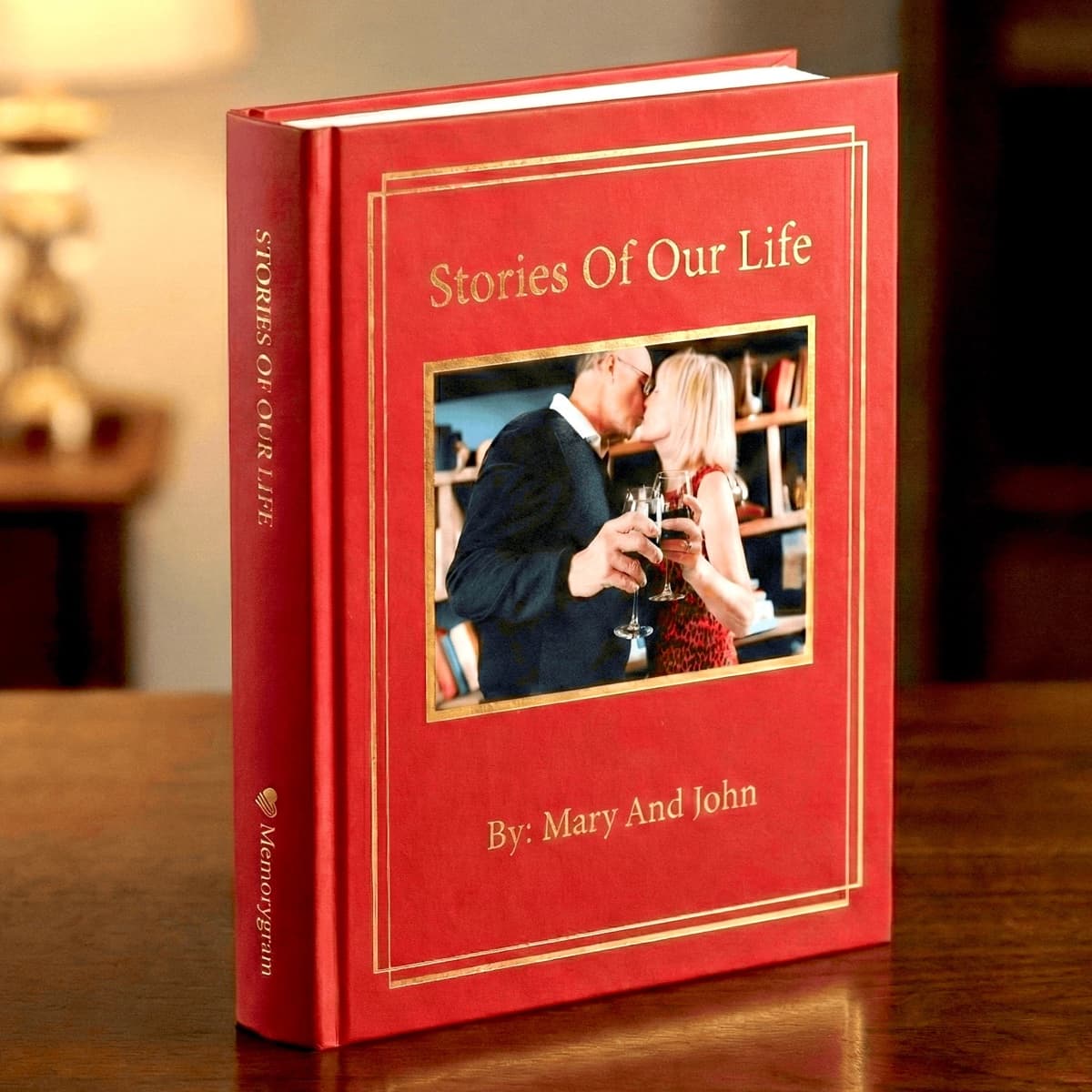
The finished Legacy Book: their stories, their photos, their name on the cover. Photo: Memorygram
Our verdict
Yes — Memorygram is worth $123.50 because it's the only Legacy Book service priced like a gift rather than a service, and it solves the most procrastinated project in family life by removing everything that made it stall: no interviews to schedule, no blank page, no technology to teach. One emailed question a week, answered in their own voice, becomes a hardcover their descendants will actually hold. It takes a year and it costs real money — and it's still the cheapest way ever devised to keep the storyteller in the family after the storyteller is gone. Pair it with an [iMemories](/reviews/imemories) tape rescue and [ThePhotoStick](/reviews/thephotostick) photo consolidation, and the family archive is finally complete.
The short version
Every family has the same regret on a delay timer: the stories only one person can tell — how they met, what the war or the crossing or the first job was really like — that nobody ever quite sits down to record. Memorygram runs the sitting-down for you: each week it sends your parent or grandparent one thoughtful question by email, they answer in their own words (and add photos) at their own pace, and over a year the answers accumulate into a professionally printed, hardcover Legacy Book with their name on the cover. No app to learn, no deadline pressure, no interviewer awkwardness — just a gentle prompt, a reply, and eventually a book their grandchildren's grandchildren will hold.
Pros & cons
Pros
- Turns a year of weekly questions into a real hardcover keepsake
- Storyteller answers by simple email reply — no app, no learning curve
- Photos weave in alongside the stories
- Questions are professionally crafted to unlock real memories
- The finished book is printed, bound and built to outlast us all
- A gift that flatters: 'your life is worth a book'
Cons
- It's a year-long project by design — not an instant gift
- The book is only as rich as the answers the storyteller gives
- Extra copies and additional storytellers cost extra
How it works
Gift it to your storyteller
Sign up a parent or grandparent — they get a weekly question by email, chosen to open real memories rather than yes/no answers.
They reply in their own words
Answers happen at their pace, in their voice, with photos attached when a story calls for one. No apps, no logins to forget.
The book arrives
After the questions wrap, the answers and photos are compiled into a professionally printed hardcover — their name on the cover, their life inside.
Who it's for
- Adult children who keep saying 'we should record grandma'
- Families staring down a milestone birthday gift
- Storytellers who'd never write a memoir but answer emails
- Anyone who's lost one parent's stories and won't repeat it
Why the weekly-question format actually works
Ask someone to 'tell their life story' and you get paralysis — the blank page defeats almost everyone, which is why the memoir a parent was always going to write never exists. One specific question a week inverts the psychology: 'What was your first car and where did it take you?' is answerable over coffee, and answering feels like reminiscing, not authoring. A year of those small answers quietly compounds into tens of thousands of words — a memoir assembled without anyone ever having to be a writer.
Email as the medium is the second quiet masterstroke. The storyteller demographic — parents in their 60s through grandparents in their 90s — reliably uses email and reliably abandons apps; a reply-to-this-message workflow means zero onboarding, zero passwords, zero 'can you help me with the thing.' The weekly cadence also gives the family a year of side effects: the questions become dinner-table conversation, and children report learning stories mid-project they'd never heard in decades.
The finished book: what a Legacy Book contains
The end product is a hardcover — cloth-feel cover, the storyteller's name and title on the front, their answers organized inside with the photos they attached along the way. It reads in their voice, verbatim, which is the point: not a sanitized biography but the way Dad actually tells the story about the fishing trip, typos of personality intact. A hundred-ish pages of first-person family history is the format that survives — books get shelved and re-read; files get lost with the laptop.
It slots into the family-archive stack as the piece nothing else captures. Digitizing the old tapes rescues what was recorded; consolidating the photos preserves what was shot; but the context — who's in the photo, what happened just off-frame, why it mattered — lives only in a living memory until something like this extracts it. Families who've done all three effectively have a complete archive: footage, images, and the narrator's track. Order extra copies at printing; the sibling who 'didn't need one' always asks later.
Is Memorygram worth $123.50?
Price the alternatives honestly: a professional personal-history service (interviewer, editor, book) starts around $2,000 and climbs steeply; a DIY effort — you, a recorder, transcription, layout software, print-on-demand — costs less cash and almost never gets finished, which is the expensive part. At $123.50 for the guided year plus the printed hardcover, Memorygram occupies the gap: professional structure and output at a self-serve price, with the crucial feature being that it actually completes.
The clear-eyed caveats: it's a year-long slow gift, so set expectations at the birthday table (families often print a 'your book has begun' card to hand over); and the output quality tracks the input — a storyteller who answers in two sentences gets a thinner book, so the family's role is cheerleading the good weeks. Against those, one fact does the deciding: the stories have a hard deadline nobody knows the date of. This is the rare purchase where 'later' is the expensive option.
Frequently asked questions
How does Memorygram actually work?
The storyteller receives one thoughtful question by email each week and simply replies — in their own words, with photos if they like. After the year of questions, everything is compiled and professionally printed as a hardcover Legacy Book.
Is it hard for a non-technical grandparent?
It's built for exactly them: no app, no login, no learning curve — if they can reply to an email, they can write this book. Family members can also help type up answers for storytellers who prefer talking.
How long until the book arrives?
It's a year-long project by design — the weekly rhythm is what produces rich, unhurried stories. Many families gift it with a card announcing the project so the giving moment isn't empty-handed.
What if they skip some weeks?
Life happens and the format forgives it — questions wait, pacing flexes, and the book compiles what was answered. Gentle family encouragement during the slow stretches is the real success factor.
Can more than one person tell their story?
Yes — additional storytellers can be added (at extra cost), which is how couples often do it: his book and hers, or a joint project with both voices answering.
Can we get extra copies for the family?
Yes — extra hardcover copies are available and cheapest ordered together at printing. A digital copy add-on also exists for the family archive. Every sibling ends up wanting one; plan accordingly.
When you buy through links on this page, TopCrate may earn an affiliate commission at no extra cost to you. Book length and content depend on the storyteller's answers; extra copies and additional storytellers are priced separately. Prices accurate as of publish time.