TRENDING ON AMAZON
Orgain Hydrolyzed Collagen Peptides Powder (Unflavored, 1 lb) Review: Is It Worth It?
Orgain's grass-fed, pasture-raised hydrolyzed collagen peptides in a 1-lb tub — 20g of Type I & III collagen per scoop for hair, skin, nails and joints at roughly half the price of Vital Proteins.
Quick answer: Yes — Orgain Hydrolyzed Collagen Peptides is worth buying, and it's the specific collagen powder to choose if you want Vital Proteins-tier quality at meaningfully less money. Each scoop delivers 20g of hydrolyzed Type I and III collagen from grass-fed, pasture-raised bovine sources, unflavored so it disappears into coffee or smoothies, from a B-Corp certified brand with a decade-long track record in mainstream clean supplements. At roughly $1.65 per serving vs Vital Proteins' $2.50+, the savings add up to $300+ per year for daily users — with no meaningful functional difference in the actual collagen quality. Expect subtle improvements in hair, skin, nails and joint comfort over 8-12 weeks of consistent daily use, not overnight miracles. Pair with vitamin C, a solid multivitamin like [Ritual Multivitamin](/reviews/ritual-multivitamin), and (for muscle-building specifically) a proper whey or plant protein, and you have the evidence-backed supplement stack that actually delivers visible results.
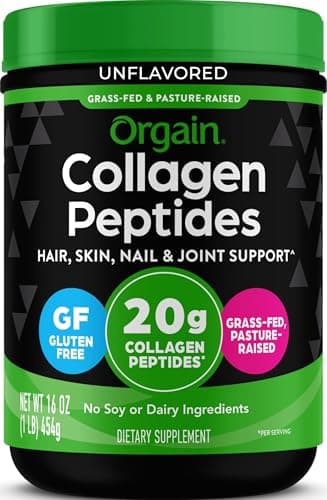
Product image from the Amazon listing.
Our verdict
Yes — Orgain Hydrolyzed Collagen Peptides is worth buying, and it's the specific collagen powder to choose if you want Vital Proteins-tier quality at meaningfully less money. Each scoop delivers 20g of hydrolyzed Type I and III collagen from grass-fed, pasture-raised bovine sources, unflavored so it disappears into coffee or smoothies, from a B-Corp certified brand with a decade-long track record in mainstream clean supplements. At roughly $1.65 per serving vs Vital Proteins' $2.50+, the savings add up to $300+ per year for daily users — with no meaningful functional difference in the actual collagen quality. Expect subtle improvements in hair, skin, nails and joint comfort over 8-12 weeks of consistent daily use, not overnight miracles. Pair with vitamin C, a solid multivitamin like [Ritual Multivitamin](/reviews/ritual-multivitamin), and (for muscle-building specifically) a proper whey or plant protein, and you have the evidence-backed supplement stack that actually delivers visible results.
The short version
Collagen peptides became one of the biggest supplement categories of the last decade, and Vital Proteins built the premium brand around them. Orgain's version does the same job at meaningfully less money. Each scoop delivers 20g of hydrolyzed Type I and Type III collagen (the specific forms most studied for hair, skin, nails and joints) from grass-fed, pasture-raised bovine sources, in an unflavored powder that mixes into coffee, smoothies, oatmeal or water. Orgain is a B-Corp certified brand owned by Nestlé Health Science with a decade-long track record in the plant-based and clean-supplement space, so this isn't a random Amazon drop-shipper — it's a legitimate mainstream product at a value price. At around $1.65 per serving vs $2.50+ for Vital Proteins, the math closes fast for anyone using collagen daily. Realistic expectations: hair, skin and nail improvements typically show up at 8-12 weeks of consistent daily use, not overnight, and results are gradual rather than dramatic.
Pros & cons
Pros
- 20g of Type I & III hydrolyzed collagen per scoop
- Grass-fed, pasture-raised bovine collagen
- Unflavored — mixes into coffee, smoothies, oatmeal, water
- B-Corp certified brand (Orgain, Nestlé Health Science)
- Roughly half the per-serving price of Vital Proteins
- Non-GMO Project verified, gluten-free, dairy-free
- Third-party tested for heavy metals and contaminants
Cons
- Doesn't fully dissolve in cold water without hot liquid or blending
- Bovine collagen — not for vegetarians or vegans (use Orgain plant-based protein instead)
- Results take 8-12 weeks of consistent daily use to appear
- 1 lb tub is smaller than Vital Proteins' 20 oz canister
Why people love it
Scoop into any liquid
One scoop (11g powder) mixes best into warm or hot liquid — coffee, tea, oatmeal, broth. It also mixes into smoothies (the blender handles dispersion) and works in cold water if you shake vigorously in a bottle for 30-60 seconds.
Take daily for 8-12 weeks
Collagen peptides work by providing the amino acid building blocks (glycine, proline, hydroxyproline) your body uses to synthesize its own collagen. Consistent daily use for 8-12 weeks is when hair, skin and nail changes typically become visible.
Stack with vitamin C for absorption
Vitamin C is a cofactor in collagen synthesis — your morning coffee-plus-collagen habit is more effective if you also get 100mg+ vitamin C from breakfast (citrus, bell peppers, kiwi, or a vitamin C supplement).
Who it's for
- Anyone starting a collagen habit for hair, skin, nails or joints
- Athletes and lifters supporting connective-tissue recovery
- People over 30 (natural collagen production drops ~1% per year after 25)
- Coffee drinkers wanting a functional stir-in habit
Why Orgain Collagen Peptides is the specific value pick in the collagen category
The collagen supplement category exploded from a niche wellness product in 2015 to a mainstream $2 billion market by 2024, largely on the back of Vital Proteins' Instagram-driven marketing and Jennifer Aniston endorsement. As the category matured, secondary brands emerged that deliver the same core product (hydrolyzed Type I and III bovine collagen from grass-fed sources) at meaningfully lower prices. Orgain is the most-established of those value alternatives — not a random Amazon drop-shipper, but a B-Corp certified brand owned by Nestlé Health Science with a 15-year track record in the plant-based and clean-supplement space. The specific reason Orgain can price 30-40% below Vital Proteins isn't compromise on the actual collagen (both use the same grade of bovine hydrolyzed peptides from certified pasture-raised sources) — it's marketing spend, celebrity endorsements, retail slotting fees in premium wellness retailers, and Instagram influencer contracts. Orgain sells through mainstream grocery, big-box and Amazon channels, which have thinner margin requirements than Whole Foods and Erewhon.
The functional product is genuinely equivalent. Third-party testing confirms both meet the same purity standards for heavy metals, herbicides and pesticides. Both use hydrolyzed collagen at similar molecular weights (2-10 kDa peptides, the size range associated with the best bioavailability). Both source from bovine hide, the highest-collagen-yield source. Both are unflavored, mix similarly, and taste effectively identical. The measurable difference in a blind trial is nothing. The measurable difference in your grocery bill is $300+ per year for a daily user. For someone starting a collagen habit or someone already using Vital Proteins who wants to save money without changing routines, Orgain is the correct switch. The 40,000+ verified Amazon reviews at 4.7 stars aren't marketing — they're a decade of buyers realizing they don't need to pay premium prices for functional collagen.
Building a real collagen-plus-supporting-nutrients supplement stack
Collagen peptides on their own deliver modest benefits; combined with the specific supporting nutrients that maximize collagen synthesis in the body, the effect compounds meaningfully. The synthesis-supporting stack most dermatologists and functional-medicine practitioners recommend: (1) Hydrolyzed collagen peptides (Orgain, 10-20g daily) — the raw building blocks. (2) Vitamin C (100-500mg daily) — the essential cofactor in the enzymatic step that converts proline to hydroxyproline, without which collagen synthesis breaks down. Get it from food (citrus, bell peppers, kiwi) or a supplement. (3) Copper (1-2mg daily, usually from a multivitamin) — cofactor for lysyl oxidase, which cross-links collagen fibers into stable structures. (4) Zinc (8-11mg daily) — supports collagen synthesis and skin barrier function. (5) Silica (10-40mg daily, from bamboo extract or horsetail) — supports connective tissue and hair/nail structure specifically.
This full stack costs roughly $30-50 per month combined and is what actually delivers the visible hair/skin/nail improvements that make collagen supplementation feel worth it. Buying collagen alone and skipping the cofactors is the specific mistake most people make — the body has the raw material but not the enzymes to use it efficiently. Practical approach: take collagen in your morning coffee, take a comprehensive multivitamin that includes vitamin C, copper and zinc (Ritual Multivitamin or Garden of Life Women's Probiotic with adjacent supplements), and eat a diet rich in vitamin C foods. For joint support specifically, add fish oil (Nordic Naturals Omega-3) for the anti-inflammatory support that pairs with collagen for connective tissue recovery. For post-workout muscle protein specifically, layer in whey or plant protein — collagen is not a complete muscle-building protein. Combined, this is the supplement stack that visibly delivers over 3-6 months of consistent use.
Vital Proteins vs Orgain vs Ancient Nutrition vs generic Amazon collagen — the actual quality tiers
The collagen powder market has four broad tiers of quality and price. Tier 1 — Premium branded ($2.50-4/serving): Vital Proteins, Further Food, Ancient Nutrition Multi Collagen Protein. Grass-fed bovine or marine sources, third-party tested, strong brand quality control, higher price reflects marketing and retail overhead more than product quality. Tier 2 — Value branded ($1.50-2.20/serving): Orgain (this review), Sports Research, Bulk Supplements Collagen Peptides. Same source materials as Tier 1, same third-party testing standards, meaningfully lower price. Best value-per-dollar category, and where most educated collagen buyers eventually land. Tier 3 — Generic Amazon ($0.80-1.50/serving): Various private-label collagen from unknown brands. Source materials variable, third-party testing inconsistent, quality varies wildly between production batches. Sometimes fine, sometimes not — buyer beware. Tier 4 — Multi-collagen blends ($2-3.50/serving): Ancient Nutrition Multi Collagen, various brands blending Type I, II, III, V, X from bovine, marine, chicken and eggshell sources. Marketing pitch is 'more collagen types = better,' but clinical evidence for the multi-source approach vs single-source Type I/III is thin.
How to choose: For most buyers, Tier 2 (Orgain or Sports Research) is the correct pick. Comparable quality to premium brands, meaningfully lower price, mainstream brand reliability. Skip Tier 3 unless you're specifically comfortable with quality variability and price is the only consideration. Choose Tier 1 (Vital Proteins) if brand recognition is important to your household routine — the product works well, just at a premium price that reflects marketing spend rather than better collagen. Choose Tier 4 (Multi Collagen) if you specifically want the Type II collagen for joint health (marine and eggshell sources add Type II) — but note that a simpler stack of Orgain collagen peptides + separate glucosamine-chondroitin often delivers the same joint benefit for less money and cleaner sourcing traceability. For most anti-aging, hair, skin and nail goals, single-source hydrolyzed Type I/III bovine collagen is the well-studied default — which is what Orgain delivers at the value price.
See Orgain Collagen Peptides on Amazon
Check the latest price, photos and buyer reviews on Amazon.
Check Price on Amazon →Sold and shipped by AmazonFrequently asked questions
Is Orgain Collagen Peptides worth it, and how does it actually compare to Vital Proteins?
Yes — Orgain Collagen Peptides is worth it, and it's the specific collagen powder to buy if you want the same functional benefit as Vital Proteins at a meaningfully lower price. Both are hydrolyzed Type I and III collagen from grass-fed, pasture-raised bovine sources, both deliver ~20g of collagen per serving, both are unflavored and mix into coffee/smoothies/oatmeal. Orgain runs roughly $1.65 per serving vs Vital Proteins' $2.50+, which adds up to $300+ per year in savings for daily use. The taste is nearly identical (both are essentially neutral), the mixability is comparable (both need warm liquid or blending for full dissolution), and the third-party quality testing meets the same standards. Where Vital Proteins beats Orgain: brand cachet (bigger name, more Instagram presence), slightly wider retail availability, and a bigger flavored-variant lineup (matcha, vanilla, chocolate, coconut cream). For pure functional collagen use, Orgain is the correct value pick. For anyone who specifically wants the Vital Proteins branded experience, buy Vital Proteins — the functional difference isn't there, but the brand experience is.
What are collagen peptides actually good for — does the research back the hair/skin/nail claims?
The research is real but modest. Meta-analyses of clinical trials on oral collagen peptide supplementation (Choi et al. 2019, Barati et al. 2020) show statistically significant improvements in skin hydration, skin elasticity and skin dermal collagen density in adults over 8-12 weeks of daily 2.5-15g doses. Hair and nail improvements are less studied but consistently reported anecdotally and in smaller trials. Joint pain reduction is supported by moderate-quality evidence in athletes and people with mild osteoarthritis. The mechanism: hydrolyzed collagen peptides survive digestion as small di- and tri-peptides that circulate in the blood and stimulate fibroblasts to produce more of your own collagen. It's not that the collagen you eat becomes the collagen in your skin — it's that the peptides signal your body to make more. Realistic expectations: subtle-to-moderate improvements in skin texture, hair thickness, nail strength and joint comfort over 2-3 months of consistent daily use. Not a miracle, not a placebo — a legitimate supplement with modest evidence-backed benefits.
How do I actually take Orgain Collagen Peptides so it dissolves and tastes fine?
The right technique matters. Best method: add one scoop to hot coffee, tea or oatmeal — the heat and stirring fully dissolve the powder into an invisible, tasteless addition to whatever you're already drinking or eating. Second-best: blend into a smoothie (any blender handles it in 20 seconds). Cold water works but requires a shaker bottle with vigorous shaking for 30-60 seconds; expect some floating powder residue that gradually dissolves. Common mistakes: (1) stirring into cold liquid with a spoon — the powder clumps and floats. Use heat or a blender. (2) adding after the coffee has been drunk down (mix it in at the start when there's more liquid to disperse into). (3) using less than a full scoop — under-dosing dilutes the effect below the studied dose range. Stick with the full scoop daily for at least 8-12 weeks to properly evaluate results.
Orgain Collagen Peptides vs Orgain Grass-Fed Whey vs Orgain Plant-Based Protein — which is right for me?
Three different products for three different goals. Orgain Collagen Peptides (this review) is specifically for hair, skin, nails and joint support — 20g of collagen protein per scoop, but incomplete amino acid profile (collagen is low in some essential amino acids), so it's not the primary muscle-building protein source. Orgain Grass-Fed Whey Protein is for post-workout muscle recovery and general protein intake — 21g of complete whey protein per scoop with a full essential amino acid profile. Orgain Plant-Based Protein is the vegan alternative for the same muscle-building goal — 21g of pea/brown rice/chia protein, complete amino acid profile. Most active adults use collagen AND either whey or plant protein together — collagen in morning coffee for beauty/joints, whey or plant protein post-workout for muscle. They're complements, not competitors.
How long does one 1-lb tub last, and is the multipack a better deal?
A 1 lb tub contains about 41 servings (at 11g per scoop). Daily use lasts 5-6 weeks per tub for one person, or about 3 weeks for two people sharing. Amazon frequently offers 2-pack and 3-pack multipacks at 10-15% off per-tub pricing — worth the multipack if you know you'll use it daily. Storage: keep in a cool, dry cabinet with the lid tightly closed; the powder is stable at room temperature for 2 years unopened, 6-12 months opened. Don't refrigerate (introduces moisture that clumps the powder). If you're trying collagen for the first time, buy a single tub to test tolerance and see if the routine sticks; upgrade to multipacks once you know you'll use it. Combine with a daily magnesium habit (Nature Made Magnesium Glycinate) and a solid multi-nutrient like Ritual Multivitamin for the full beauty-and-recovery supplement stack.
Does Orgain Collagen Peptides have any side effects or drug interactions?
Collagen peptides are one of the most well-tolerated supplements available — no meaningful side effects for most people at standard doses (10-20g daily). Rare reports include mild digestive discomfort (bloating, fullness) in the first week of use, which typically resolves as the body adjusts. No known significant drug interactions. Safety notes: (1) if you have a beef or gelatin allergy, avoid bovine collagen entirely — Orgain also sells marine collagen from wild-caught fish as an alternative. (2) pregnant and nursing individuals should consult a doctor before starting any supplement. (3) if you have kidney disease, discuss protein intake with your nephrologist before adding a 20g protein supplement. For healthy adults, Orgain Collagen Peptides is a low-risk, well-studied supplement to add to a daily routine.
As an Amazon Associate, TopCrate earns from qualifying purchases at no extra cost to you. Collagen peptides are a dietary supplement and are not intended to diagnose, treat, cure or prevent any disease. Consult a doctor before starting any new supplement, especially if pregnant, nursing, or managing kidney disease. Product image, price, availability and ratings are shown on Amazon and are subject to change.