FITNESS TRUTH
Why Isn't the Scale Moving When I'm Working Out? (The Real Explanation, and What to Track Instead)
The scale can stay flat for weeks while your body is genuinely transforming underneath. The number isn't broken — it's measuring the one thing that changes slowest, and hiding everything else.
The pattern is depressingly universal. Six weeks into a serious fitness effort — you're lifting three or four times a week, you're actually eating right, your jeans are noticeably looser, and the person in the gym mirror looks different. You step on the bathroom scale and the number is exactly where it started. Or it's up a pound. And for a very large number of people, that specific moment is when the whole thing quietly falls apart: the six weeks of work stop feeling worth it, the discipline slips, and by month three you're back where you started with an added conviction that fitness doesn't work for your body.
The problem isn't your body. The problem is that the bathroom scale measures the one thing that changes slowest during real fitness progress, adds it up wrong, and reports the sum as if it were the whole picture. This guide walks through the six honest reasons the scale isn't moving even when everything is working, the three metrics that tell you what's actually happening under the number, and the specific piece of hardware that flips the question from 'is my body changing?' to 'here's the direction of travel, charted.'
Reason 1: You're losing fat and gaining muscle at the same time (the big one)
This is the reason for roughly 70% of the stalled-scale complaints, and it's also the reason people give up on programs that were actually working. Strength training and a protein-adequate diet cause two changes at the same time: your body burns fat (lipolysis), and it builds muscle (hypertrophy). These aren't the same tissue. A pound of muscle is roughly 15-20% denser than a pound of fat, occupies less space in your body, and looks completely different in the mirror — but on the scale, a pound of muscle gained cancels a pound of fat lost, and the number holds steady. For beginners in the first three to six months, this simultaneous recomposition is at its most dramatic; a lifter can gain 3-5 pounds of muscle and lose 3-5 pounds of fat over eight weeks and see the scale move zero. Zero. Meanwhile they look meaningfully different in the mirror, their pants fit differently, and their strength numbers are climbing every week.
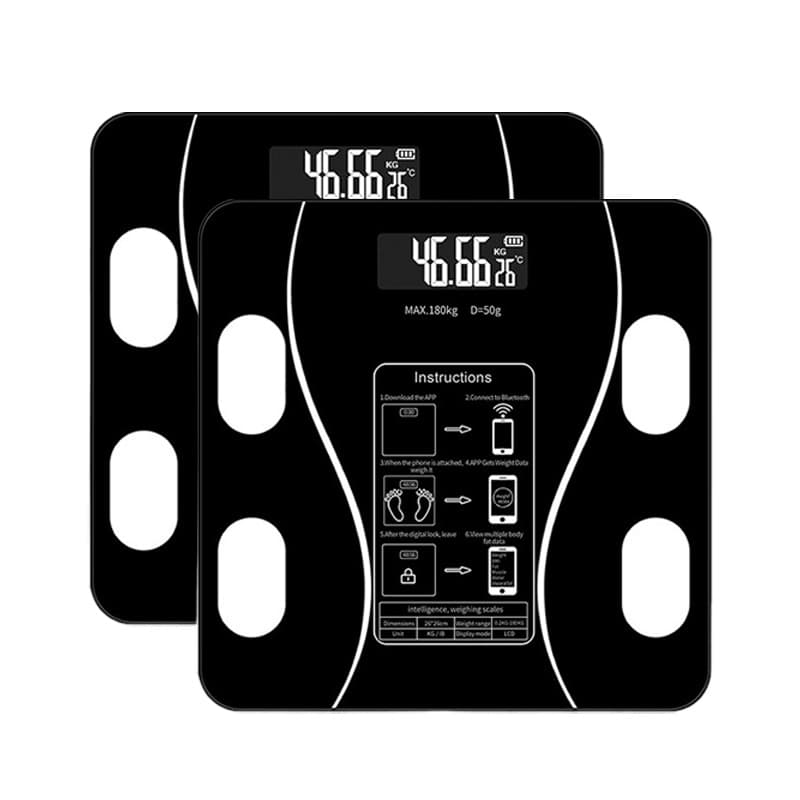
The scale isn't broken — it's answering the wrong question. It's asked to summarize a two-variable change into one number, and the summary hides the interesting story. This is exactly what a body-composition tool is designed to fix: it separates the two so you can see fat going down and muscle going up as two independent trend lines. Something like the FitScale X body composition scale estimates the split with bioelectrical impedance and syncs the trends to an app — the same weigh-in produces four graphs instead of one, and the four graphs together tell you what's actually happening in a way the single-number scale never could.
Reason 2: New muscle holds water and glycogen (temporarily)
When you start training a muscle harder than it's used to, several things happen at the cellular level that make the muscle 'weigh' more without adding proportional lean tissue. First, the muscle stores more glycogen — a form of stored carbohydrate the body uses for fast fuel — and glycogen holds water at a ratio of about 3 grams of water per gram of glycogen. A trained muscle can carry substantially more glycogen than an untrained one; the water that comes with it is real weight on the scale, even though the visible muscle hasn't grown much yet. Second, resistance training produces micro-damage the body repairs, and the repair process brings inflammation and fluid retention as a normal short-term response. Third, sodium intake, sleep, and hormonal cycles all move body water by a pound or two on any given day.
Practical translation: in the first two to four weeks of a new program, the scale often goes UP a pound or two before it goes down. That's the muscle filling with glycogen and water, and it's a sign the program is working, not that it's not. Most people who quit programs quit in exactly this window. The way to see through the water noise is either to weigh yourself every morning and look at a 7-day rolling average (which smooths out the daily swings) or to track composition rather than weight, so the water-storage effect shows up as 'more muscle' rather than as 'weight going up for no reason.'
Reason 3: Your metabolism has adapted (this is real, and it's manageable)
If you've been in a caloric deficit for a meaningful stretch — say, 8-16 weeks — your body genuinely does adapt its energy expenditure downward. This is called 'adaptive thermogenesis' or 'metabolic adaptation' and it's a well-studied real effect, not a myth: your basal metabolic rate can drop by 10-15% below what a formula would predict for your current weight, thyroid hormone (T3) drops, non-exercise activity thermogenesis (NEAT — the fidgeting, walking, standing that adds up) drops, and hunger hormones rise. The net effect is that the calorie deficit that produced weight loss for the first two months quietly turns into maintenance calories for month three, and the scale plateaus even though your food intake hasn't changed.
The fix isn't 'eat less and less forever' — that just deepens the adaptation. The two evidence-supported approaches are a diet break (raise calories to maintenance for 1-2 weeks, then drop back to a moderate deficit) or a slower, more moderate deficit from the start (aiming to lose 0.5-1% of body weight per week rather than 1-2%). Both give the metabolic machinery a chance to reset, and both preserve more muscle (which is what you actually want the scale to hold onto). If you're stalled and hungry, that's often the specific signal that adaptation is what's happening, not that willpower is failing.
Reason 4: The daily variation is bigger than you think
Your body weight varies by 2-5 pounds day-to-day based on things that have nothing to do with fat or muscle: how much salt you ate yesterday, how much water you're carrying, how much food is currently in your digestive tract (a full colon can weigh several pounds by itself), where you are in a menstrual cycle (women can gain 3-6 pounds of water in the days before a period), how much sleep you got, whether you drank alcohol, whether you did a hard workout the day before (glycogen depletion and rebound, plus inflammation). Weighing yourself once a week on 'weigh-in day' means you're comparing one snapshot of that noise to another snapshot of that noise — and the actual signal (fat lost, muscle gained) is smaller than the noise for weeks at a time.
The remedy is either to weigh daily and use the weekly average as your data point (which is what body-composition apps automatically do), or to track less frequently but pair it with a metric that has less noise. Body fat percentage from a bioimpedance scale is noisy in the absolute reading but stable in the trend across weeks. Progress photos taken in the same clothes and lighting every two weeks are almost noise-free. Waist and hip circumference measured with a tape measure are noise-free enough to use monthly. Any of these give you a signal-to-noise ratio the daily scale weight can't match on its own.
Reason 5: You're eating more than you think (the honest one)
This is the reason nobody wants to hear and the one that turns out to be true a fraction of the time nobody wants to admit. Multiple careful studies on self-reported food intake — including the famous Lichtman et al. study in the New England Journal of Medicine — have found that people who report they 'can't lose weight despite eating very little' are, on average, underreporting their intake by 30-50%. Not because they're lying; because the mental math of 'a handful of nuts, a splash of oil, a taste while cooking, the leftover fries off the kid's plate' genuinely adds up to hundreds of calories a day that nobody counts, and because portion sizes have crept up so far from what recipes assume that a 'serving' of pasta is often two or three servings.
If the scale genuinely isn't moving after six weeks of what feels like a strict diet, spend two weeks logging every single thing you eat — measured, weighed, everything — into an app like MyFitnessPal or Cronometer. Not forever. Just as a calibration exercise. The most common outcome is not 'I was eating exactly what I thought I was' but rather 'I was eating 400 more calories a day than I estimated,' and the plateau evaporates once the actual number comes into view. This isn't about willpower; it's about measurement. And it's paired with reason 3 above — if your metabolism has adapted and you're also underestimating intake by 400 calories, those two effects together explain most stalls.
Reason 6: You're actually making progress and the scale is telling you so — slowly
The last reason is the least dramatic and the most common in month-two-onward stalls. Real, sustainable fat loss for a non-obese person happens at roughly 0.5-1% of body weight per week. For a 170-pound person that's 0.85-1.7 pounds a week — half a pound, sometimes a pound, with normal weekly variance of two pounds. That means in any given week the fat loss is genuinely smaller than the day-to-day noise, and the trend only shows up on a 4-week rolling average. The scale isn't lying and it isn't stalled; it's just moving at the pace real fat loss moves, which is slower than the 'transformation' narrative sells.
This is exactly where composition tracking earns its keep. Weight going down 0.6 pounds a week is easy to miss inside the daily noise; body-fat percentage dropping 0.3 percentage points a week is a slightly more visible trend on the same underlying reality. Combine that with strength going up (a genuinely powerful signal — the same 5-rep-max on the squat producing an extra plate over four weeks is real muscle) and the waist-tape reading dropping half an inch a month, and you have four independent signals confirming that the plain scale weight is going to catch up eventually. And it will — the scale is usually the last metric to reflect a body change, not the first.
The four metrics that actually tell you what's happening (in the order they respond)
The way to escape scale-only frustration is to stop asking one metric to do a job it was never suited for and instead track a small basket of complementary metrics that respond at different speeds. In the order they respond fastest to slowest: strength numbers in the gym (respond in weeks — the 5-rep-max on your main lift going up is real muscle, before any scale metric shows it), progress photos in the same clothes and lighting (respond in 3-4 weeks — you see the change before the scale does, especially in the mirror), circumference measurements at waist, hips, and chest with a tape measure (respond in 4-6 weeks — genuinely low-noise and very motivating), body composition percentages from a bioimpedance scale (respond in 4-8 weeks as a trend, noisy day-to-day but reliable over the month), and only last, scale weight itself (responds in 6-12 weeks for beginners doing recomposition, faster for pure fat-loss efforts but always the slowest to show muscle gain).
The specific hardware that makes the composition side easy to track is a body-composition scale that pairs with an app — you step on once a day, the app charts the trends across all the metrics automatically, and the multiple lines together tell a story the single scale number never could. The FitScale X is the specific one we've reviewed for this use case: at $109.99 it undercuts the premium smart scales meaningfully while doing the same core job (full composition breakdown, app trend charts, multi-user households), and it's the piece of hardware most likely to keep you consistent through the scale-flat weeks when you'd otherwise quit. Pair it with a fitness tracker for the activity side and the picture of your progress is complete in a way single-number weight never gets to.
The one honest exception: when the scale really is trying to tell you something
All of the above is about weight that's stalled or slightly up when the effort is real and progress is happening. There's a different case where the scale is genuinely telling you something is off, and it's worth separating: weight moving in the wrong direction over 8+ weeks (a rolling average trending clearly up, not just weekly noise) while intake and training haven't changed to explain it. That's the case worth taking seriously as a signal, and it's one where a doctor's visit — thyroid panel, medications review, sleep and stress assessment — is the honest next step rather than a fifth week of trying harder.
The overlap between 'the scale is stalled because progress is happening in a way the scale can't see' and 'the scale is climbing because something is medically off' is small; usually one or the other is clearly what's happening. The tell is what else is happening. Feeling stronger, jeans looser, energy up, but scale flat = the recomposition story from earlier, and a composition scale will confirm it. Feeling tired, cold, sluggish, hungry, and the scale climbing without a matching change in intake = worth a doctor's opinion. The composition scale doesn't replace medical advice; it's how you get a clear enough picture of your body to tell the two situations apart.
Read our FitScale X body composition scale review
The affordable smart scale that shows the progress the plain scale hides — body fat, muscle, water and BMI, charted over time in a companion app so the recomposition story becomes visible when the raw scale weight won't budge.
Read our FitScale X body composition scale reviewFrequently asked questions
Why isn't the scale moving when I'm working out?
Most commonly because you're gaining muscle while losing fat at the same time — a pound of muscle gained cancels a pound of fat lost on the scale, but your body composition is genuinely changing. In the first two to four weeks of a new program, new muscle also holds extra water and glycogen (about 3 grams of water per gram of glycogen stored), which can push the scale up before it goes down. Add normal daily weight variance of 2-5 pounds from food, water, salt, and cycle timing, and the fat-loss signal often gets lost inside the noise. A body composition scale that separates fat from muscle mass shows the change the plain scale hides.
How long does it take for the scale to reflect fitness progress?
For pure fat-loss efforts, 4-6 weeks to see a clear trend past the daily noise. For beginners doing strength training and diet at the same time (body recomposition), 6-12 weeks — because gained muscle offsets lost fat on the scale even though the body is transforming. This is why single-scale-weight tracking is so demotivating for lifters: the metric that responds fastest to your work isn't the scale, it's strength numbers in the gym and progress photos, and those show change in weeks not months.
Am I gaining muscle or just gaining weight?
Four signals tell you it's muscle, not fat: strength numbers going up week-over-week (a genuinely reliable indicator of muscle building), progress photos showing visible changes in body shape, jeans and clothes fitting differently (particularly looser at the waist), and body composition from a bioimpedance scale showing fat percentage down and muscle mass up on the trend chart. If all four are moving in the right direction, the scale weight is misleading you and the muscle is real. If none of them are moving, the weight gain is probably something else worth examining.
How much weight can I actually lose in a week?
For a non-obese person, real sustainable fat loss happens at roughly 0.5-1% of body weight per week. For a 170-pound person that's 0.85-1.7 pounds. Faster losses in early weeks are usually water weight (from glycogen depletion), and 'crash' losses beyond 1% per week for extended stretches cost you muscle mass — which is exactly what you want the scale to hold onto because muscle keeps your metabolism higher. Slow and steady also holds up better against metabolic adaptation, so it's not just kinder; it's more effective long-term.
Do I need a smart scale to track progress?
You don't strictly need one, but for anyone doing strength training and diet at the same time, single-number weight is the metric most likely to make you quit even when everything is working. A body-composition scale separates fat from muscle so the recomposition story is visible, an app charts the trends past the daily noise, and multi-user support means the household shares one device. FitScale X is the specific one we've reviewed for this use case: at $109.99 it does the same core job as the premium smart scales for a fraction of the price. The alternative — for tighter budgets — is a plain scale plus a tape measure and monthly progress photos, which cover the same signals with more effort.
How accurate are bioimpedance body composition scales?
The absolute readings are estimates, not clinical measurements — this is true of every consumer bioimpedance scale, budget or premium, including the big-brand ones costing $200. The exact body-fat percentage on any given day drifts with hydration, meal timing, and recent exercise. What's reliable is the trend under consistent conditions: weigh at the same time of day (first thing in the morning is the classic choice), in similar hydration, and watch the direction of travel over weeks. The trend line is accurate and motivating even when any single day's reading is approximate. Treat it as a fitness tool, not a medical device, and it does exactly what it should.
Should I stop weighing myself if the scale isn't moving?
Only if the scale is making you quit programs that are working — in which case yes, put it away and use progress photos, gym strength numbers, and how clothes fit instead. Otherwise the fix is not to stop weighing, but to weigh smarter: weigh daily so the daily noise becomes a smoothed average, use a body-composition scale so the recomposition story is visible, and add at least one non-scale metric to the mix so you're never dependent on one number to summarize your effort. The scale is a useful data point, badly abused when it's the only one.
TopCrate is reader-supported. When you buy through links on our site we may earn an affiliate commission, at no extra cost to you. Content is for general information and isn't a substitute for professional advice.