TRENDING ON AMAZON
Fitbit Charge 6 Advanced Fitness & Health Tracker Review: Is It Worth It?
Heart rate, sleep stages, ECG, 7-day battery and built-in GPS in a band slim enough to forget — Fitbit's most-refined tracker yet, now with Google apps built in.
Quick answer: Yes — for accurate sleep tracking, reliable continuous heart-rate data and 7-day battery in a band you'll actually wear 24/7, the Fitbit Charge 6 is the most useful fitness tracker for the widest range of people in 2026. Cheaper than a full smartwatch, slimmer than an Apple Watch, and now with the Google features that close the smart-features gap. If you want a wrist computer, buy an Apple Watch; if you want health data you'll actually act on, this is the easy pick.
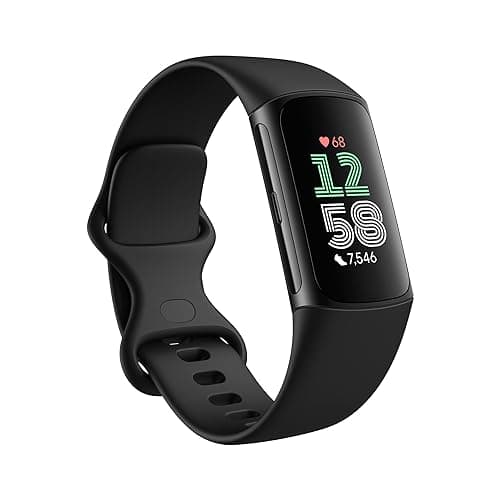
Product image from the Amazon listing.
Our verdict
Yes — for accurate sleep tracking, reliable continuous heart-rate data and 7-day battery in a band you'll actually wear 24/7, the Fitbit Charge 6 is the most useful fitness tracker for the widest range of people in 2026. Cheaper than a full smartwatch, slimmer than an Apple Watch, and now with the Google features that close the smart-features gap. If you want a wrist computer, buy an Apple Watch; if you want health data you'll actually act on, this is the easy pick.
The short version
The Fitbit Charge 6 is the right answer for most people who want serious health tracking without buying an Apple Watch. It packs continuous heart rate (now with Google's most-accurate-yet sensor), built-in GPS, sleep-stage tracking with a Sleep Score, ECG and EDA stress sensors, 40+ exercise modes, 7 days of battery life and now native Google Maps, Google Wallet and YouTube Music controls on the wrist. The slim band is so light you forget you're wearing it, which matters more than any spec — the best fitness tracker is the one you actually keep on your wrist for sleep tracking and resting heart rate trends.
Pros & cons
Pros
- Up to 7 days of battery life — vs ~1 day for most smartwatches
- Built-in GPS — track runs and rides without your phone
- Heart rate sensor is Fitbit's most accurate yet
- Sleep Score, Sleep Stages and overnight HRV tracking
- ECG and EDA (stress) sensors built into a $160 band
- Google Maps, Google Wallet, YouTube Music controls on the wrist
Cons
- Premium features need Fitbit Premium subscription ($10/mo or $80/yr)
- Touchscreen can be finicky in wet conditions
- No always-on display option to preserve battery
Why people love it
Strap on and pair
Set up via the Fitbit app on iOS or Android; sync your Google account if you want Maps/Wallet/YouTube Music integration.
Wear it 24/7
Sleep with it on for nightly Sleep Score, HRV and stress data. The slim band and 7-day battery make all-day-every-day wear realistic.
Track activity automatically
It detects most exercises automatically (walks, runs, bike rides); start a workout manually for GPS tracking, heart rate zones and recovery metrics.
Who it's for
- Anyone wanting health data without an Apple Watch
- Sleep tracking and recovery monitoring
- Runners and cyclists who want phone-free GPS
- Heart-rate-zone training and resting HR trends
Fitbit Charge 6 vs Apple Watch SE vs Garmin Vivosmart: which fitness band to buy
Apple Watch SE is the obvious comparison if you have an iPhone. It does more (apps, Siri, cellular options, deep iPhone integration) but costs significantly more, has a chunkier form factor, and demands daily charging — which directly conflicts with overnight sleep tracking. Many Apple Watch users end up charging during the morning shower and missing nightly data. If you primarily want a wrist computer with fitness as a feature, Apple Watch SE wins. If you primarily want a fitness/sleep tracker with smart features as a bonus, Charge 6 wins.
Garmin Vivosmart 5 is the closest direct competitor — also a slim band tracker with GPS and 7-day battery. Garmin's sport metrics and training-load analysis are more sophisticated for serious athletes, but the watch UI is older, the sleep tracking is less polished than Fitbit's, and the app feels engineering-grade rather than consumer-friendly. For casual to enthusiast fitness use, Charge 6 has the better software experience. For competitive endurance athletes, step up to a Garmin Forerunner. For mid-range fitness and health, Charge 6 hits the sweet spot.
What the Fitbit Charge 6 tracks that you'll actually use (and what you won't)
The features that earn their place daily: steps and resting heart rate (long-term trend lines reveal cardiovascular fitness changes you'd never notice day to day), Sleep Score and Sleep Stages (genuinely useful for understanding why you're tired), GPS-tracked workouts (no phone needed), and smartphone notifications on the wrist (less reflexive phone checking). These four are the everyday value drivers and they work well.
The features that sound great but go unused for many: ECG (most people don't have AFib symptoms; the feature is comforting peace-of-mind, not a daily tool), EDA stress sensor (interesting once or twice; rarely changes behavior), 40+ exercise modes (most people use 4-5 at most), and the Daily Readiness Score (requires Premium subscription and overlap with Sleep Score). Don't pay extra for features you won't use; the Charge 6 is worth it even if you only use the basics well.
How to set up the Fitbit Charge 6 for maximum sleep and recovery insights
Sleep tracking is where Fitbit excels and where most users underutilize the device. To get accurate data: wear it snug on your wrist (one finger between band and skin), wear it every night for at least 14 consecutive nights before judging trends (single-night data is noisy), and enable Sleep Schedule with a target bedtime/wake time. The Sleep Score combines duration, restoration (resting heart rate dip), and depth (time in stages) into a single number — useful for spotting trends, not for daily worry.
For recovery insights, watch your overnight Heart Rate Variability (HRV) trend over 4-6 weeks. HRV is a more sensitive indicator of stress, sleep quality, illness and overtraining than heart rate alone — if HRV trends down for several days while resting heart rate trends up, you're under-recovered and should ease back on training intensity. The Charge 6 surfaces HRV in the Health Metrics dashboard. Pair the trend data with your subjective energy levels; the device gives you objective signals to validate what you already feel. Most users find this loop more useful than counting steps. For the body-composition side of the same picture — whether the training is actually building muscle and dropping fat while the scale number stalls — a bioimpedance smart scale like the FitScale X charts weekly trends that pair naturally with the Fitbit's HRV and sleep data.
See Fitbit Charge 6 on Amazon
Check the latest price, photos and buyer reviews on Amazon.
Check Price on Amazon →Sold and shipped by AmazonFrequently asked questions
How does the Fitbit Charge 6 compare to an Apple Watch?
The Charge 6 is a fitness tracker first and smartwatch second; Apple Watch is the opposite. Charge 6 wins on battery (7 days vs 1-2), price (about a third of an Apple Watch), weight (much slimmer band) and Android compatibility. Apple Watch wins on app ecosystem, voice features (Siri), advanced cellular models, and tight iPhone integration. If you mainly want health tracking and sleep insights, Charge 6 is the better-targeted product. If you want a wrist computer that also tracks fitness, Apple Watch is worth the upgrade — but expect daily charging.
Do I need a Fitbit Premium subscription?
No — the core experience (heart rate, sleep score, steps, GPS workouts, ECG, EDA) is all free without subscription. Fitbit Premium ($10/month or $80/year) unlocks advanced sleep analysis (Sleep Profile with monthly archetype, deeper Sleep Score breakdown), guided workouts and meditations, more detailed health metrics dashboards, and personalized insights. Premium is worth it for users who want to dig into the data; casual users get plenty of value from the free tier.
Is the GPS on the Fitbit Charge 6 accurate enough for serious running?
Yes — the built-in GPS uses multiple satellite systems (GPS, GLONASS, Galileo, BeiDou) for solid accuracy on outdoor runs and rides. Most reviewers find it within 1-2% of distance measurements compared to dedicated Garmin running watches. The acquisition is fast (under 30 seconds in open sky) and the GPS works without needing your phone, which is the main upgrade over older Fitbit trackers. For serious marathoners chasing PRs, a Garmin Forerunner is more precise, but Charge 6's GPS is solid for any non-elite runner.
Can the Charge 6 actually take an ECG and detect heart issues?
Yes — the ECG app is FDA-cleared to detect signs of atrial fibrillation. Place a finger on the metal sides of the band for 30 seconds and it generates a single-lead ECG you can share with a doctor. Background atrial fibrillation detection runs passively using the heart-rate sensor. Important caveats: this isn't a substitute for clinical diagnosis. It can flag potential AFib for medical follow-up but cannot diagnose other heart conditions. Don't rely on it for chest pain or acute symptoms — that's an ER visit, not a wrist check.
How long does the Fitbit Charge 6 actually last on a charge?
Fitbit rates it at 7 days of battery life with typical use (always-on heart rate, sleep tracking, occasional GPS workouts, notifications). Real-world reports range from 5-7 days depending on GPS usage, brightness and notification volume. Heavy GPS use (daily 1-hour outdoor runs) drops it to about 3-4 days; light use without GPS pushes toward 7-8 days. Charging via the proprietary cable takes about 60-90 minutes from empty to full.
Does the Charge 6 work with iPhone, Android, or both?
Both. The Fitbit app is available on iOS and Android, and the Charge 6 works equally well with either. New for the Charge 6 is deeper Google integration (Maps, Wallet, YouTube Music) which works best on Android phones but functions on iPhone too. If you're an iPhone user choosing between Apple Watch and Charge 6, the Charge 6 still works flawlessly with iOS — just without the deep iPhone ecosystem integration the Apple Watch gets.
How accurate is the Fitbit Charge 6 sleep tracker and heart rate sensor?
Sleep tracking is where the Charge 6 shines — it's Fitbit's most polished implementation to date and independent reviewers consistently rate it as one of the more accurate consumer sleep trackers (typically within 15-20 minutes of clinical polysomnography for total sleep duration, and better than most competitors at flagging awake time). Sleep-stage estimates (REM, light, deep) are directional rather than laboratory-grade — trust the trends over multiple weeks, not any single night. Heart-rate accuracy is the strongest sensor Fitbit has shipped: Google's updated algorithm runs continuously in the background, keeps well within a few BPM of a chest strap during walks, runs and everyday activity, and only really diverges during very high-intensity intervals (HIIT, weightlifting with intense grip) where wrist optical sensors as a class struggle. For sleep, resting heart rate trends, HRV and cardio-zone training, the Charge 6 delivers accurate-enough data to make real decisions from.
As an Amazon Associate, TopCrate earns from qualifying purchases at no extra cost to you. Product image, price, availability and ratings are shown on Amazon and are subject to change. Health features are wellness aids, not medical devices except where specifically FDA-cleared (ECG). Consult a doctor for health concerns.