COFFEE
Which Keurig Should You Buy in 2026? K-Mini vs K-Express vs K-Duo, Compared
Keurig sells a dozen machines that all make the same cup — the real differences are counter space, a water reservoir you don't have to refill every morning, and whether you ever need a full pot. Here's the three-machine shortlist that covers almost everyone.
Every Keurig brews the same K-Cup the same way: hot water, pressure, under a minute, done. That is precisely why picking one is confusing — the product pages all lead with the same promise, and the differences that actually matter day to day are buried in the spec sheets. Those differences come down to three questions: how much counter you can give up, how often you are willing to refill a reservoir, and whether anyone in the house ever wants a full pot of coffee instead of a single cup.
We've reviewed the Keurig lineup individually, and three machines cover nearly every kitchen: the K-Mini when space is the constraint, the K-Express when you want the sane default, and the K-Duo when the honest answer is that some mornings need a carafe. Below is how the three compare, who each one is actually for, and the cost-per-cup reality nobody's product page mentions.
- 1Best overall — pods and a 12-cup carafe
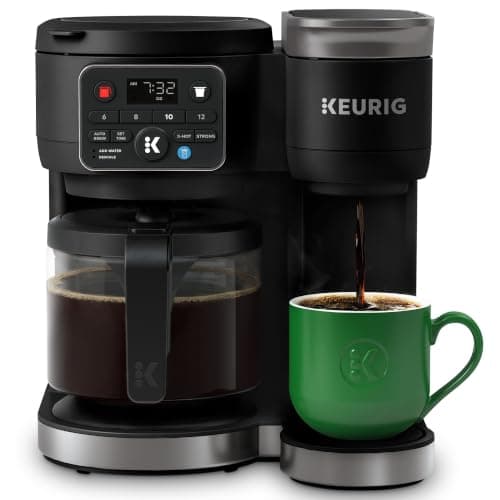
Keurig K-Duo
9.8/10TopCrate scoreThe dual-brew machine that ends the pod-versus-drip argument: a K-Cup brewer on one side, a 12-cup glass-carafe drip brewer that runs on ordinary ground coffee on the other, sharing one 72oz reservoir. One person gets a 45-second cup on a rushed Tuesday; a houseful of guests gets a real pot on Saturday. If your household ever needs both, nothing else on this list does this job.
- 2
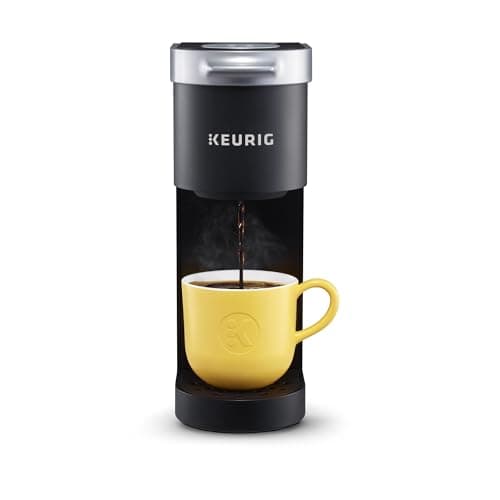 Best small Keurig — under 5 inches wide
Keurig K-Mini
9.7/10TopCrate scoreThe smallest single-cup Keurig — barely wider than the mug it fills. There's no standing reservoir: you pour in exactly one cup of water, it brews it, and the machine goes back to occupying almost no counter. That trade is the whole product, and for a dorm, an RV, an office desk or a galley kitchen it's the right one.
- 3
 Best value — the sane default
Keurig K-Express
9.6/10TopCrate scoreThe budget single-serve Keurig that gets the essentials right: three cup sizes, a Strong Brew button that actually darkens the cup, and a genuine 42oz reservoir so you're not refilling for every brew — at roughly half the price of Keurig's flagship machines. If you don't need a carafe and aren't squeezed for space, this is the default answer.
The three-question test that picks your machine
Start with the carafe question, because it eliminates the most options fastest. If anyone in your household drinks more than two cups back to back, or you host with any regularity, single-serve-only machines quietly become a bottleneck — brewing six cups one pod at a time is a fifteen-minute job and six pods of cost. The K-Duo is the answer to that life: pods for weekday speed, cheap ground coffee by the pot for volume. If a full pot has genuinely never crossed your mind, skip the carafe and the counter space it costs.
Next is the reservoir question. The K-Mini has no standing tank — you pour in one cup of water per brew. That sounds trivial until you're doing it every single morning, which is why the K-Mini is best understood as a small-space specialist rather than a primary family machine. The K-Express's 42oz tank covers four to five brews between refills, which is the practical minimum for a machine two people share daily. The K-Duo's 72oz tank feeds both sides of the machine and goes the longest between trips to the sink.
Last, counter space, measured honestly. The K-Mini's under-five-inch width is the category's party trick and it is genuinely transformative in a dorm, an RV galley or behind an office monitor. The K-Express takes a normal small-appliance footprint. The K-Duo is the widest thing Keurig makes because it is two brewers in one chassis — measure your counter before you order it, not after.
The cost-per-cup math Keurig's product pages skip
Every Keurig costs more per cup than the machine price suggests, because the pod is the product. Brand-name K-Cups run roughly $0.50-0.80 each; a cup of drip from ground coffee costs $0.15-0.25. At two cups a day, the pod habit costs $250-400 a year more than drip — which reframes the K-Duo's premium over the single-serve machines as the only version that pays for itself, since its carafe side runs on cheap ground coffee for the bulk of your volume while pods handle the single-cup moments they're actually good at.
Two ways to pull pod costs down on any of the three: a reusable My K-Cup filter (a few dollars, fills with your own ground coffee, cuts per-cup cost to drip levels at the price of thirty seconds of spooning), and buying pods in 60-plus counts rather than dozens — our Peet's K-Cups review covers the bulk-buy math on the pods we think actually taste like coffee. Whichever machine you land on, run a descale every three months — hard-water scale is the number-one Keurig killer, and our descaling guide takes fifteen minutes.
Which Keurigs to skip — and when the answer isn't a Keurig
The models between these three mostly sell features that don't survive contact with a real morning: app connectivity you'll use twice, brew-temperature menus that move the needle less than a Strong Brew button, and iced-coffee modes that amount to brewing hot over ice. The three machines above bracket the lineup's actual decision space — small, default, and dual-brew — and the in-between models are those three with accessories priced in.
And if your real complaint about coffee is that pod coffee tastes like a lighter version of what a café hands you, the honest answer is that no Keurig fixes that — the format brews clean, mild drip-style coffee by design. The espresso-adjacent route is a different machine entirely: our Nespresso vs Keurig comparison covers when the crema-topped side of the pod world is worth its higher per-pod price, and when it absolutely isn't.
Read our Keurig K-Duo review
The dual-brew Keurig that ends the pod-versus-drip argument — one K-Cup side for 45-second weekday cups, one 12-cup carafe side running cheap ground coffee for everyone-else mornings, sharing a single 72oz reservoir.
Read our Keurig K-Duo reviewFrequently asked questions
Is the Keurig K-Duo worth it over a regular Keurig?
If anyone in your household ever wants more than one cup at a time — weekend mornings, guests, a two-coffee spouse — yes, and it's not close. The K-Duo's carafe side runs on ordinary ground coffee at roughly a quarter of the per-cup cost of pods, so the machine's price premium pays itself back inside a year for most two-person households. If you genuinely never brew more than a single cup, the K-Express does the single-serve job for less money and less counter.
What is the smallest Keurig you can buy?
The K-Mini — under five inches wide, the narrowest machine Keurig makes. The trade for that footprint is a one-cup-at-a-time water system: there's no standing reservoir, so you pour in each cup's water before brewing. Perfect for dorms, RVs, offices and tiny kitchens; mildly annoying as a busy family's only machine.
Do all Keurig machines use the same pods?
The K-Mini, K-Express and K-Duo all take standard K-Cups, and all three accept the reusable My K-Cup filter for brewing your own ground coffee. The pods that don't cross over are Nespresso capsules — completely different system, covered in our Nespresso vs Keurig comparison.
Why does my Keurig brew weak coffee?
Three usual suspects, in order: cup size set too large for one pod (a 12oz brew through a pod built for 8-10oz is watery by definition — use Strong Brew or a smaller size), scale buildup restricting water flow (fix with our 15-minute descale), and stale pods. If you've fixed all three and still want darker, the K-Express and K-Duo's Strong Brew button is the real lever — it slows the brew for a noticeably fuller cup.
TopCrate is reader-supported. When you buy through links on our site we may earn an affiliate commission, at no extra cost to you. Content is for general information and isn't a substitute for professional advice.