TRENDING ON AMAZON
Peet's Coffee Major Dickason's Blend K-Cup Pods Review: Is It Worth It?
The dark-roast K-Cup that actually tastes like real Peet's coffee — Major Dickason's classic blend in the single-serve format most people brew every morning.
Quick answer: Yes, Peet's Coffee Major Dickason's K-Cups are worth buying, and they're the K-Cup a dark-roast drinker should default to in 2026 — the pods deliver Peet's flagship dark roast in single-serve format better than any competing K-Cup, work with every Keurig from the [K-Mini](/reviews/keurig-k-mini) to the [K-Duo](/reviews/keurig-k-duo), and per-pod pricing is reasonable in bulk. Perfect for dark-roast drinkers who already own a Keurig; light-roast fans and those willing to fresh-grind should look elsewhere.
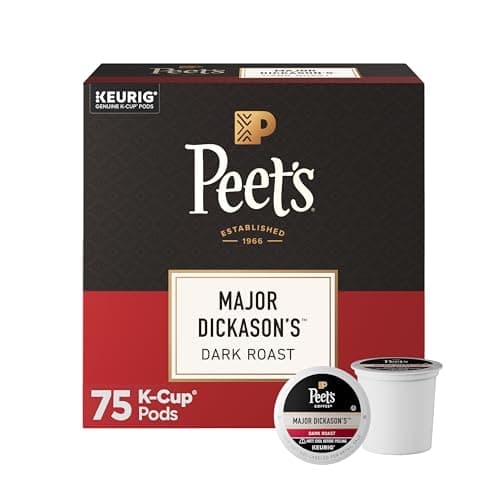
Product image from the Amazon listing.
Our verdict
Yes, Peet's Coffee Major Dickason's K-Cups are worth buying, and they're the K-Cup a dark-roast drinker should default to in 2026 — the pods deliver Peet's flagship dark roast in single-serve format better than any competing K-Cup, work with every Keurig from the [K-Mini](/reviews/keurig-k-mini) to the [K-Duo](/reviews/keurig-k-duo), and per-pod pricing is reasonable in bulk. Perfect for dark-roast drinkers who already own a Keurig; light-roast fans and those willing to fresh-grind should look elsewhere.
The short version
Peet's Coffee is the dark-roast pioneer that trained a generation of coffee drinkers to like their coffee bold, and Major Dickason's Blend is their flagship — a rich, full-bodied dark roast with the caramelized-sugar and cocoa depth that thin drip coffee simply doesn't deliver. In K-Cup form it works perfectly with any Keurig, so you get a serious morning cup without owning an espresso machine or a burr grinder.
Pros & cons
Pros
- Peet's flagship Major Dickason's dark roast in K-Cup format
- Rich, full-bodied cup — the dark-roast benchmark
- 100% Arabica beans
- Compatible with all Keurig brewers
- Recyclable K-Cup pods
- Available in bulk value packs (32+ pods)
- Consistent cup after cup
Cons
- Too intense for those who prefer light roasts
- K-Cup format never quite matches fresh-ground
- Per-cup cost higher than bagged beans
Why people love it
Pop into any Keurig
The pod fits every Keurig brewer including K-Mini, K-Duo, K-Elite and K-Slim. No dosing, no tamping — insert, close, brew.
Brew at the strongest setting
For Major Dickason's dark roast, use the smallest cup size setting your Keurig offers (usually 6–8 oz) — the less water, the more concentrated and Peet's-like the cup tastes. Bigger sizes dilute the roast.
Recycle the pod
Peet's K-Cups are made with recyclable pod materials — peel the lid, empty the grounds into compost, and drop the plastic cup in curbside recycling. Some municipalities take the whole pod.
Who it's for
- Dark-roast coffee drinkers
- Existing Keurig owners
- Anyone wanting single-serve without a burr grinder
- Offices and second-coffee-station kitchens
Peet's Major Dickason's vs Starbucks Dark Roast vs Death Wish — which dark-roast coffee wins?
Peet's Major Dickason's is the original benchmark for American dark-roast coffee — Alfred Peet developed it in 1969 and it defined the 'dark, full-bodied, complex' profile that Starbucks later mainstreamed. Compared to Starbucks Dark Roast or French Roast, Peet's is roasted deeply but stops just short of burnt — you get the rich body and caramelized sugars without the ashy, bitter finish that Starbucks Extra Bold often has. Blind tastings among dark-roast fans usually put Peet's above Starbucks and most supermarket dark roasts.
Death Wish Coffee is a different play — it's dark-roasted specifically for maximum caffeine content (roughly 2x standard coffee per cup) rather than flavor. If you want the strongest cup possible for caffeine kick, Death Wish delivers. If you want the best-tasting dark-roast K-Cup, Peet's Major Dickason's wins. For those who want dark roast and are willing to fresh-grind, buying whole-bean Major Dickason's and pairing it with a Fellow Stagg EKG pour-over kettle is the setup that most closely replicates a Peet's cafe cup at home.
K-Cups vs bagged beans vs Nespresso — what's the best morning coffee format?
K-Cups win on convenience and consistency: one pod per cup, no mess, no learning curve, and the same taste every time. Peet's K-Cups specifically bring cafe-quality dark roast into the format, which most K-Cup brands can't say. Downsides: per-cup cost is higher than bagged beans (roughly $0.60 per cup vs $0.20 for well-priced bagged coffee), and the ground-coffee-in-a-pod format never matches freshly-ground beans for aroma and complexity.
Bagged whole beans plus a burr grinder and drip machine (or pour-over) is the flavor winner — freshly ground coffee tastes noticeably better and costs less per cup, but requires 3–5 more minutes of morning effort. Nespresso is a third option: it uses espresso-style extraction with aluminum pods and produces a stronger, more crema-topped cup than any K-Cup can, but the machines are more expensive and the drink profile (short espresso rather than 8 oz drip) suits a different morning routine. The pragmatic setup for many households: bagged beans on weekend mornings when there's time, K-Cups Monday–Friday when you just need to get out the door. Pair with a good insulated mug like the Ember Mug or YETI Rambler and you've got the setup that actually gets used every day.
Building a home coffee setup with Peet's — from beginner Keurig to serious pour-over
The tiered path most home coffee drinkers walk: (1) Keurig + Peet's K-Cups. Zero learning curve, zero morning effort, cafe-quality dark roast in a pod. A Keurig K-Mini plus a 32-pod Peet's variety pack gets you set up under $100 total. (2) Whole bean Peet's + drip coffee maker. Buy bagged Major Dickason's whole beans, add a good burr grinder ($150–200 for a solid one), and use a decent drip machine. Big flavor jump over K-Cups, adds ~5 minutes to morning routine. (3) Whole bean Peet's + pour-over. A pour-over setup with a Fellow Stagg EKG kettle, a V60 or Kalita Wave, and a burr grinder produces cafe-quality cups but requires 8–10 minutes and a technique. Reserved for weekend mornings.
The 80/20 pick for most households: Keurig + Peet's K-Cups on weekdays for convenience, whole-bean Peet's on weekend mornings when you have time to grind and brew properly. Same brand, same coffee style, two effort levels. Pair with the right vessel for the drink — a YETI Rambler for keeping the coffee hot at the desk, an Ember Mug if you sip slowly and want it warm all morning, or a simple Owala FreeSip if you're taking it in a bag. Coffee gear is easy to overspend on; the biggest quality jump is always the beans themselves.
See Peet's K-Cups on Amazon
Check the latest price, photos and buyer reviews on Amazon.
Check Price on Amazon →Sold and shipped by AmazonFrequently asked questions
Peet's K-Cups review: are they actually worth buying in 2026?
Yes — Peet's Coffee Major Dickason's Blend K-Cups earn their bestseller status in 2026 and remain the dark-roast K-Cup default. What real long-term use consistently shows: (1) The flavor is meaningfully better than Starbucks or Green Mountain dark-roast K-Cups — deeper body, more caramelized-sugar and cocoa notes, and none of the burnt-ash finish Starbucks pods often deliver. (2) Every Keurig brewer (K-Mini, K-Slim, K-Duo, K-Elite, K-Cafe) brews them cleanly, and the smaller cup-size settings (6-8 oz) concentrate the flavor most like a real Peet's cafe cup. (3) Bulk 32-count and 60-count packs bring per-cup pricing down to around $0.60 — higher than bagged beans but competitive with any premium K-Cup. (4) The pods are recyclable if you peel the foil, dump grounds, and drop the plastic in curbside recycling. Honest downsides: any K-Cup is a compromise vs freshly-ground beans, per-pod cost is higher than bagged coffee, and light-roast fans should look at Peet's Café Domingo or a whole-bean setup instead. For dark-roast drinkers who own a Keurig and want cafe-quality single-serve without the effort, Peet's Major Dickason's is the K-Cup to buy.
Do Peet's K-Cups actually taste like real Peet's coffee?
Better than you'd expect, but not identical to a freshly-ground drip pot. The K-Cup format uses pre-ground coffee that starts oxidizing the moment the pod is sealed, and the small volume of water in a Keurig limits extraction. That said, Major Dickason's dark roast holds up in a K-Cup better than lighter roasts do — the rich flavor profile survives the format's limitations. Brew on the smallest cup size setting for the most Peet's-like intensity. For the closest-to-cafe result at home, freshly-ground beans through a Peet's aeropress or drip beat any K-Cup — but for morning convenience, these are the closest single-serve option.
Peet's K-Cups vs Starbucks K-Cups vs Green Mountain — which is best?
For dark-roast drinkers, Peet's Major Dickason's easily beats Starbucks K-Cups (which taste over-roasted and often burnt) and Green Mountain (which trends toward medium-lighter mainstream flavor). Peet's is the closest K-Cup approximation to serious dark-roast cafe coffee. For medium roasts, Green Mountain Nantucket Blend or Peet's Café Domingo are strong picks. For light roasts, most K-Cups struggle — the format doesn't do subtle floral or fruity roasts justice, and you're better off grinding fresh.
How much caffeine is in a Peet's K-Cup?
A standard 8-oz brewed Peet's K-Cup delivers roughly 120–140 mg of caffeine, similar to most Keurig-brewed coffee. Peet's also makes 'Extra Bold' K-Cup packs that use more coffee per pod for a stronger cup. Dark roasts don't actually have more caffeine than lighter roasts — the difference is flavor, not caffeine content. If you want more caffeine, brew a smaller cup size (concentrating the same pod's caffeine into less water) or use an extra-bold pod.
Are Peet's K-Cups recyclable?
Yes — Peet's K-Cups are made with recyclable plastic pod bodies. To recycle correctly: let the pod cool, peel off the foil lid, dump the grounds (compost them if you can), and drop the plastic cup into curbside recycling. The foil lid usually is not curbside recyclable but some drop-off programs accept it. For a lower-waste alternative entirely, a reusable K-Cup filter (fill with your own ground beans) works with any Keurig and eliminates single-use pods.
Which Keurig brewer works best with Peet's K-Cups?
All Keurig models brew Peet's K-Cups, but the pairing matters. The Keurig K-Mini is the compact single-cup pick — smallest footprint, brews on demand, ideal for one-person kitchens and dorms. The Keurig K-Duo adds a carafe side for households where one person wants K-Cups and another wants a full pot. Any Keurig with an adjustable cup-size selector lets you brew smaller cups for a stronger Peet's flavor, which is the recommended approach for dark roast.
How should you store Peet's K-Cup pods to keep them fresh?
K-Cups are individually sealed with foil lids, so they're already reasonably well-protected. To maximize freshness: store the pods in a cool, dry place out of direct sunlight, keep the box or bag closed to reduce oxidation, and use them within about 6 months of purchase. Refrigeration or freezing doesn't help sealed K-Cups (and can cause condensation issues once opened). If a pod's foil lid has been punctured or bent, use it soon — the oxidation clock has started.
As an Amazon Associate, TopCrate earns from qualifying purchases at no extra cost to you. Product image, price, availability and ratings are shown on Amazon and are subject to change.