COFFEE
Nespresso vs Keurig (2026): The Honest Difference Before You Buy Either
They look like the same idea — a pod, a button, a cup — but they brew genuinely different drinks at genuinely different running costs. The right pick depends on whether your reference point is the office drip pot or the café counter.
Nespresso and Keurig get cross-shopped constantly because they promise the same morning: drop in a pod, press a button, drink coffee, throw nothing away but the pod. Under the hood they are not the same machine wearing different logos — they brew by different methods, produce different drinks, and cost meaningfully different amounts per cup. Buying the wrong one is how a $150 machine ends up on the counter making coffee its owner quietly doesn't like.
The one-sentence version: Keurig makes fast, clean, mild drip-style coffee as cheaply as pods get; Nespresso's Vertuo line makes smaller, stronger, crema-topped cups that taste closer to what a café hands you, at roughly double the pod price. Everything below is the detail behind that sentence — and which specific machines from each side are actually worth buying.
They don't brew the same drink
A Keurig is a single-cup drip machine: hot water passes once through the grounds in the pod, producing the same style of cup a countertop drip brewer makes — clean, light-bodied, familiar. That's not a criticism; it's the taste most American coffee drinkers grew up calling coffee, and Keurig delivers it in under a minute with zero technique. If your reference point is the office pot or diner refills, a Keurig makes exactly the drink you want.
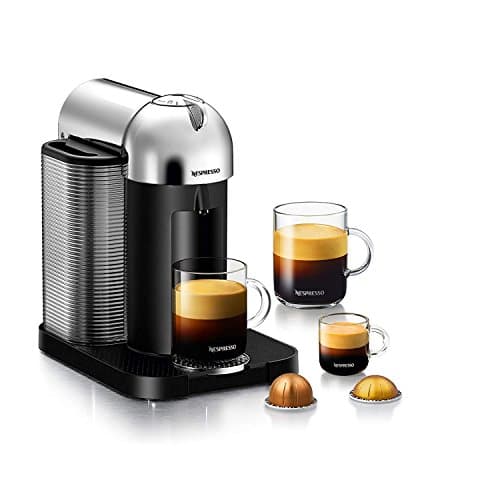
The Nespresso Vertuo spins its capsule at high speed while brewing — Nespresso calls it centrifusion — reading a barcode on each pod's rim to set the water, speed and time for that specific capsule. The result is a denser, stronger cup topped with real crema, in sizes from a true espresso shot up to a full mug. It reads as café-style coffee in a way no Keurig cup does. The flip side: the system is closed, so you're buying Vertuo capsules — no reusable-filter escape hatch, and no using the K-Cups your pantry may already hold.
The running-cost gap is the real decision
Machines from both brands land in the same $100-200 window, so the sticker prices are a distraction. The pods are the decision: K-Cups run roughly $0.50-0.80 and can drop to drip-coffee prices with a reusable My K-Cup filter, while Vertuo capsules run about $1.20-1.55 with no reusable option. At two cups a day, the Nespresso habit costs roughly $300-500 a year more — real money that buys a genuinely better-tasting cup, which is precisely the trade you should decide on purpose rather than discover on your credit card statement.
There's also a volume ceiling to respect: neither system loves the more-than-two-cups household. On the Keurig side that problem has a purpose-built answer — the Keurig K-Duo pairs its pod brewer with a 12-cup carafe running cheap ground coffee, which is why it tops our which-Keurig comparison. Nespresso has no carafe answer at all; a crowd means brewing pods back to back at capsule prices.
Which machine from each side, and who should buy which
On the Nespresso side, the full-size Vertuo is the one to buy — five cup sizes from espresso shot to full mug and the format's whole range. The smaller Vertuo Pop trims size and price but gives up cup-size flexibility, which is the feature you bought Nespresso for. On the Keurig side the shortlist is the K-Express as the value default, the K-Mini for tight spaces, and the K-Duo when a carafe matters — our Keurig buying guide picks between them in detail.
So: buy Keurig if you want familiar drip-style coffee, the lowest per-cup cost in pod land, and the option of a real pot. Buy Nespresso if espresso-style intensity and crema are what you actually crave and you'd otherwise be spending $6 at a café anyway — against that habit, even $1.50 capsules are a bargain. And whichever side you pick, pods stay freshest sealed and machines stay fast when descaled — our Keurig descaling guide applies its fifteen-minute routine to Nespresso machines almost unchanged.
Read our Nespresso Vertuo review
Café-style coffee and espresso in 30 seconds — the pod machine that makes a real crema-topped mug, not a tiny cup, and the one we'd buy from Nespresso's entire lineup.
Read our Nespresso Vertuo reviewFrequently asked questions
Is Nespresso cheaper than Keurig?
No — it's the reverse, and by a wide margin over time. Machines cost about the same, but Vertuo capsules run roughly $1.20-1.55 each against $0.50-0.80 for K-Cups, and Keurig has a reusable-filter option that drops per-cup cost to drip levels while Nespresso's system is closed. At two cups a day, expect Nespresso to cost roughly $300-500 more per year. You're paying that premium for a stronger, crema-topped, café-style cup — worth it to some coffee drinkers, invisible to others.
Can you use K-Cups in a Nespresso machine (or Nespresso pods in a Keurig)?
No, in both directions. K-Cups and Vertuo capsules are physically different formats, and Vertuo machines read a barcode on each capsule's rim to set the brew — a pod without the right barcode doesn't brew at all. Committing to a machine means committing to its pod ecosystem, which is why the per-pod price difference deserves more weight than the machine price.
Which makes stronger coffee, Nespresso or Keurig?
Nespresso, and it's not subtle. Vertuo's spinning extraction produces a denser cup with real crema that reads closer to café coffee, and the lineup brews true espresso-shot sizes no Keurig can. Keurig's Strong Brew button (on the K-Express and K-Duo) darkens its cup usefully, but the ceiling is still bold drip — if espresso intensity is the goal, Keurig is the wrong aisle.
TopCrate is reader-supported. When you buy through links on our site we may earn an affiliate commission, at no extra cost to you. Content is for general information and isn't a substitute for professional advice.