HOME SAFETY
How to Put Out a Grease Fire (Safely) — And the Three Things That Make It Worse
Water throws burning oil across the room, flour makes a fireball, and 'blow it out' spreads the flames — here's what fire services actually recommend, and the small tools that let anyone in the house do it.
Cooking is the number-one cause of home fires in the US — the National Fire Protection Association pegs unattended cooking as the leading factor, and grease fires (a Class K fire, in fire-service language) are the specific version that ends worst. Oil in a hot pan reaches its flash point around 550-600°F for most cooking oils, and once it ignites, the wrong response in the first ten seconds is what turns a stovetop scare into a kitchen rebuild.
The good news is that the right response is short, memorable, and doesn't require a heavy red canister. This guide covers what to do the instant a grease fire starts, what to absolutely never do (the water/flour/blow-it-out trio that hurts people every year), the small kitchen-safe tools that let anyone in the house handle it, and when the correct move is to leave the room and dial 911 instead.
First: what a grease fire actually is, and why water is the wrong tool
A grease fire is a cooking-oil or animal-fat fire — fuel that's already hot enough to ignite its own vapors. Fire services classify it as Class K (for kitchen), a category separate from wood/paper fires (Class A), flammable-liquid fires (Class B), and electrical fires (Class C), because oil behaves differently: it floats, it's much hotter than water, and it will re-ignite from residual heat even after you knock the flames down.
Which is exactly why water is the classic disaster. A cup of water dropped on a pan of burning oil doesn't cool it — it sinks under the oil, flashes instantly to steam (a 1,700-fold volume expansion), and shoots the burning oil upward and outward as a rolling fireball. Fire researchers demonstrate it every year with soda cans of water and 400°F pans; the fireball reaches the ceiling. The rule is absolute: no water on a grease fire, ever. That also rules out wet dish towels, wet oven mitts, and the sink sprayer.
The five-second grease-fire playbook
If the pan itself is on fire and you're going to handle it, work in this order. One: kill the heat. Turn the burner off — gas or electric — before you do anything else, because the pan can't cool while you're still feeding it energy. Two: cover the flames to smother them. A metal lid slid across the top of the pan from the side (not dropped straight down, which can splash oil) starves the fire of oxygen; a metal baking sheet works too. Leave the cover in place for at least 15-20 minutes — lifting it early lets oxygen back in and the fire re-lights from the still-scorching oil.
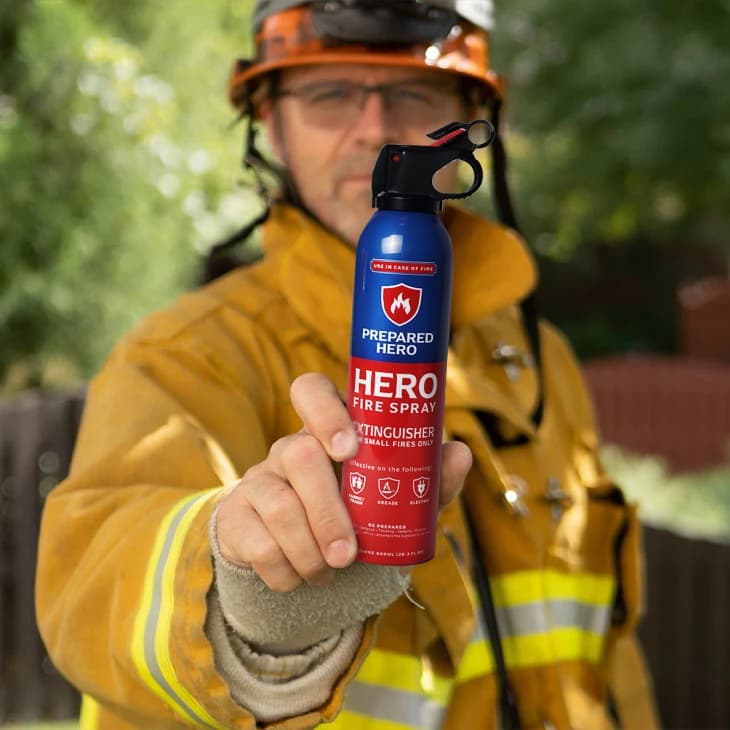
Three: if the pan won't cover cleanly — deep fryer, tall pot, a fire that's already spread beyond the pan — use a Class K/ABF-rated fire extinguisher or a purpose-built kitchen fire product. A Cobra fire blanket is the kitchen-safe version of the metal lid at a much larger scale: a fiberglass sheet you pull off the wall by two tabs and drop over the fire from above, smothering it in one motion. A pressurized aerosol like the Hero Fire Spray is the point-and-shoot alternative — hold the button and the foam coats the oil, cooling and cutting off oxygen at the same time. Both weigh almost nothing, need no annual servicing, and — critically — anyone in the house can operate them in the three seconds that matter.
The three things that make a grease fire dramatically worse
Water is the biggest one, but it has company. Flour — the sourdough-kitchen folk remedy — is not the safe substitute people think. Fine flour dispersed into a hot flame behaves like sawdust in a mill: the airborne particles ignite explosively, and the demonstration videos are genuinely horrifying. Salt and baking soda are the only pantry powders that reliably help small pan fires (both smother without combusting, and baking soda additionally releases carbon dioxide when heated). Sugar, baking powder, cornstarch, and — again — flour will make things worse.
The second is trying to move the burning pan. Carrying a flaming skillet to the sink or the back door means splashing burning oil across your arms, the floor, and every flammable surface between the stove and the door — and the reflex to drop it when it burns you turns the fire into a spreading pool. Cover it in place. The third is blowing on the flames or fanning them with a towel: air makes fire bigger, not smaller, and a synthetic dish towel waved over an open flame is a wick.
Stock the kitchen so the response is possible
The pep talk above only works if the tools are within one step of the stove — which most kitchens don't manage. The NFPA recommends a portable extinguisher on every floor of a home, and specifically calls for a Class K (kitchen-rated) or multi-purpose ABF extinguisher near cooking. That's the professional answer, but a 5-pound red canister is heavy, needs annual pressure checks, and the powder discharge means throwing out the pan, cleaning the kitchen for hours, and re-painting the wall behind the stove.
The consumer-friendly kit that people actually keep in reach is a lightweight aerosol suppressor plus a fire blanket. Mount the Hero Fire Spray on a hook next to the range hood and the Cobra fire blanket inside a cabinet door within arm's reach of the stove; keep a metal lid or baking sheet with the pans, not stashed in the drawer under the dishwasher. If you cook with oil more than once a week, this is a $70 setup that turns a genuinely dangerous emergency into a fifteen-second inconvenience. Also, while you're doing safety housekeeping, our carbon monoxide detector placement guide covers the other silent kitchen risk — CO from gas ranges and blocked flues — with the same practical eye.
When to stop fighting and leave — the honest version
The fire triangle from your school days still applies: fuel, heat, oxygen. In a kitchen, you can usually take away two of those (turn off the burner, cover the pan) fast enough. But there's a point where any residential setup is overmatched, and continuing to fight the fire is the mistake that puts people in the hospital instead of just replacing a skillet. The rules of thumb the fire service teaches: if the flames are already higher than your head, if they've spread beyond the pan to the cabinets, hood, or curtains, or if the smoke is so thick you can't see the stove — leave the room, close the door behind you (starves it of oxygen and slows the spread), get everyone out, and call 911 from outside.
Never re-enter to grab something. And after any grease fire — even one you handled in ten seconds — turn on the range hood and open a window for a while, check that the burner is genuinely off (not just knocked down), and look at the wall and cabinet above the stove for scorching that means heat traveled where you didn't see it. If a wall is warm to the touch or the hood duct sounds like it's still popping, call the fire department to confirm nothing is smoldering inside the wall or the ductwork. That single call is much cheaper than the alternative.
Read our Hero Fire Spray review
The aerosol kitchen fire extinguisher you operate like spray paint — light enough to keep on a hook next to the stove and simple enough for anyone in the house to use in the three seconds that matter.
Read our Hero Fire Spray reviewFrequently asked questions
How do you put out a grease fire safely?
Turn the burner off first, then smother the pan — slide a metal lid or baking sheet across the top from the side (not straight down), or drop a fire blanket over it. Leave the cover in place for 15-20 minutes so it doesn't re-ignite. For a fire too big to cover cleanly, use a Class K/ABF extinguisher or a purpose-built kitchen fire spray. Never use water, and never try to carry the burning pan.
Why can't you use water on a grease fire?
Water is heavier and cooler than the burning oil, so it sinks under it, flashes to steam (expanding about 1,700 times its volume in an instant), and shoots the burning oil upward as a fireball that easily reaches the ceiling. Fire researchers demonstrate this every year with the same result: severe burns, spread flames, and often a house fire. No water on a grease fire — including wet towels or the sink sprayer.
Does baking soda actually put out a grease fire?
Yes, for small pan fires. Baking soda smothers the flame and releases carbon dioxide as it heats, which helps displace oxygen. It takes a lot of it — pour, don't sprinkle — and it only works on early, contained fires. Salt works similarly. Never use flour, sugar, baking powder, or cornstarch: fine powders like flour can flash-ignite when dispersed into a flame.
What's a Class K fire extinguisher — do I need one at home?
Class K extinguishers are designed for cooking-oil and fat fires, which behave differently from wood or electrical fires. They use a wet-chemical agent that cools the oil and forms a soap-like foam that prevents re-ignition. The NFPA recommends a Class K or multi-purpose ABF extinguisher within reach of any home cooking area. Many consumers instead keep a lightweight aerosol kitchen-fire suppressor plus a fire blanket, which are much easier to actually use in a panic.
Should I move a burning pan to the sink or outside?
No — this is one of the most common ways people get hurt. Carrying a flaming skillet splashes burning oil across your arms, the floor, and everything between you and the door, and the pain reflex when it burns you drops the pan and spreads the fire. Turn the heat off and cover the pan in place. If the fire is beyond a pan you can cover, evacuate and call 911.
How do I use a fire blanket on a grease fire?
Pull the blanket down by the two tabs at the bottom, wrap your hands inside the top edges so the fabric shields your fingers, and lay it gently onto the fire from above and toward you — not thrown from a distance, which can waft flames sideways. Once the fire is covered, turn the burner off (if you haven't already), leave the blanket in place for at least 15 minutes, and don't touch the pan until it's fully cool. Fiberglass blankets like the Cobra fire blanket are the standard consumer option and are reusable if the fabric isn't damaged.
When should I stop fighting a kitchen fire and call 911?
If flames are higher than your head, have spread beyond the pan to cabinets, hood, or curtains, or the smoke is thick enough that you can't safely see or breathe — stop. Get everyone out, close the door behind you to slow the fire's oxygen supply, and call 911 from outside. Never re-enter a burning kitchen to grab possessions or pets. Any kitchen fire that involves the hood, cabinetry, or wall behind the stove is worth a fire-department confirmation even if you knocked it down, because heat and embers can travel into ductwork and wall cavities you can't see.
TopCrate is reader-supported. When you buy through links on our site we may earn an affiliate commission, at no extra cost to you. Content is for general information and isn't a substitute for professional advice.