COMPARISON
Hero Fire Spray vs First Alert: Aerosol Can vs Classic Extinguisher — Which One Belongs in Your Kitchen? (2026)
Hero Fire Spray and First Alert are the two most-searched kitchen fire-suppression names in 2026, and they take opposite sides of a real design trade-off. Prepared Hero's $29.99 aerosol can is light enough for anyone in the household to grab and point like spray paint; First Alert's $20-$30 Tundra AF400 aerosol and $20-$30 KITCHEN5 KFE2S5 metal extinguisher are the household-safety-aisle standards. Here's how each option actually works, what fire classes they're rated for, and which belongs where in a prepared home.
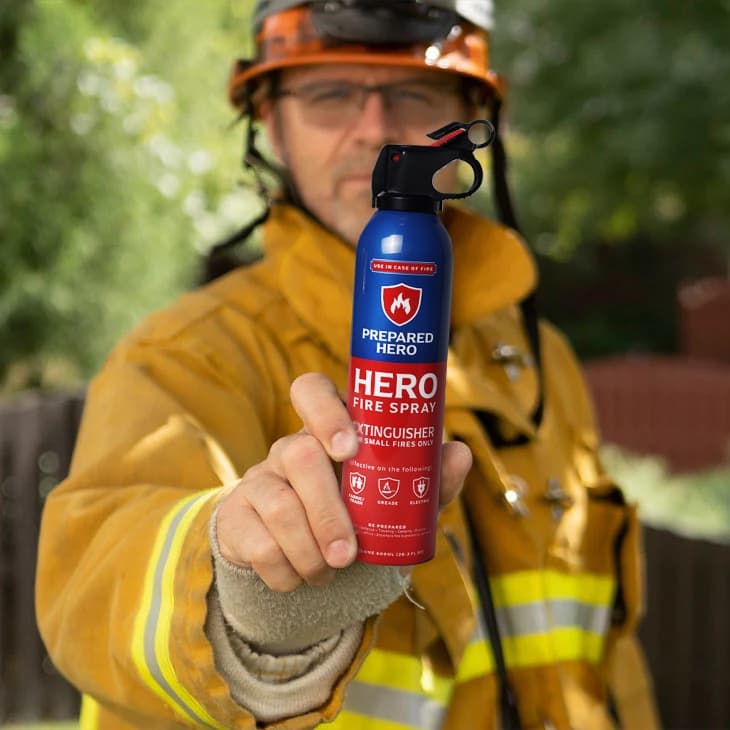
Prepared Hero Fire Spray and First Alert are the two names a US household typing "kitchen fire extinguisher" into Bing in 2026 is most likely to compare, and the honest framing up top is that First Alert isn't a single product the way Hero Fire Spray is. First Alert is the household-safety brand (owned by Resideo Technologies, the Honeywell-spin-off that also makes most of the smoke alarms in US homes), and in the kitchen-fire category it sells two directly comparable products: the First Alert Tundra AF400 aerosol fire extinguishing spray (14 oz, Home Depot's shelf price ~$14-$19) and the First Alert KITCHEN5 KFE2S5 traditional metal fire extinguisher (UL rated 5-B:C, Amazon's shelf price ~$20-$27). Prepared Hero Fire Spray is the Prepared Hero brand's $29.99 aerosol-can fire suppressor, sold direct through its own funnel and through TopCrate's affiliate link, from the same brand that makes the famous Prepared Hero Fire Blanket.
So the honest comparison isn't "Hero vs First Alert" at the brand level — it's three products in two categories: aerosol fire sprays (Hero Fire Spray vs First Alert Tundra AF400) and traditional extinguishers (First Alert KITCHEN5 KFE2S5 as the household staple with no direct Hero equivalent in the sealed-canister form factor). The three products complement each other more than they compete. A prepared household typically ends up with multiple cans and multiple classes, placed by use case: a quick-reach aerosol by the stove, another in the car, a sealed-canister UL-rated extinguisher by the garage workbench. The question this guide answers is which product belongs in which spot, and when you should buy one over the other at the specific-purchase moment.
A disclosure from us: TopCrate is a paid affiliate for Prepared Hero and earns a commission when readers buy Hero Fire Spray through our links. It doesn't change the verdict on this page, and it doesn't push Hero Fire Spray into use cases First Alert's products handle better — the fit rules below keep First Alert's traditional extinguisher in play for garage, workshop and larger-fuel-load use cases it is genuinely better at, and keep the First Alert Tundra AF400 as a legitimate alternative aerosol if you want a UL-tested industry-standard can at a lower price. Fire safety is the one home-safety category where getting the honest answer right is more important than any affiliate relationship. Our full Hero Fire Spray review and Prepared Hero Fire Blanket review cover the Hero-brand suppression kit in depth; this comparison names what First Alert's products do better and worse.
Hero Fire Spray vs First Alert at a glance
Prepared Hero Fire Spray: $29.99 standard price direct from Prepared Hero through our affiliate funnel; aerosol can roughly the size of a tall air-freshener; sprays a foam suppressant that smothers small fires by cutting off oxygen on contact; targeted at the stovetop and kitchen use case (grease, electrical, fabric and pan fires in the small-contained-fire category); light enough to mount beside the stove, in the car, in an RV, on a boat; no pin to pull, no gauge to read, no annual servicing; single-use discharge per can; wipes clean afterward (no corrosive dry-chemical powder); the brand's broader kit includes the Prepared Hero Fire Blanket, Flame Shield, Proof Bag and Dual Threat Detector in the same family.
First Alert Tundra AF400 (aerosol fire extinguishing spray): ~$14-$19 Home Depot shelf price, ~$15 Walmart shelf price for a 14 oz single can; aerosol can similar in form factor to a tall shaving-cream can; sprays a dry-chemical biodegradable suppressant; UL-listed for Class A (fabrics, wood, paper), Class B (grease, flammable liquids) and Class K (cooking oils, deep-fryer fires); light enough to mount in the kitchen or car; no pin, no gauge, no annual service; single-use discharge per can; wipes-clean cleanup; First Alert's broader fire-safety lineup covers the full home-safety category (smoke alarms, CO detectors, metal extinguishers).
First Alert KITCHEN5 KFE2S5 (traditional metal extinguisher): ~$20-$27 Amazon shelf price, ~$20-$23 Walmart shelf price; sealed-canister UL-rated 5-B:C fire extinguisher roughly the size of a 2-liter soda bottle; sprays a dry-chemical suppressant from a pressurized canister with a pin-and-trigger operation; includes a mounting bracket, pressure gauge, waterproof instructional label; the industry standard for sealed-canister household extinguishers; requires annual pressure check and periodic manufacturer-recommended service; corrosive dry-chemical cleanup is the main downside versus the aerosol options.
The practical difference: Hero Fire Spray and First Alert Tundra AF400 are directly comparable aerosol fire sprays — both are the "grab-and-point-like-spray-paint" category, both work the same way, both are single-use per can. The price gap is roughly $10-$15 per can with First Alert typically cheaper on retail shelves. The First Alert KITCHEN5 KFE2S5 is a different category entirely: a traditional UL-rated extinguisher with a sealed canister, a longer discharge time, a bigger fuel-load capacity, and the dry-chemical cleanup trade-off. Hero doesn't currently sell a sealed-canister extinguisher that competes with the KFE2S5 directly, so the comparison here is Hero Fire Spray (aerosol) vs First Alert Tundra AF400 (aerosol) on one side, and the KITCHEN5 KFE2S5 (traditional) as a complementary purchase on the other.
What a fire class rating actually tells you
The letters you see on an extinguisher label (A, B, C, K) tell you which fuel types that extinguisher is rated to put out, which is the single most important fact to know before you buy. Class A is ordinary combustibles (wood, paper, fabric, trash); Class B is flammable liquids (grease, gasoline, cooking oil in a shallow spill); Class C is energized electrical fires (anything with a live circuit — a toaster, a laptop, a wall outlet); Class K is a subset of Class B specifically for commercial kitchen cooking-oil fires (deep fryers, saturated-fat fires that reignite as soon as you back off). A standard household kitchen fire is usually a Class B or Class K cooking-oil flare on a stovetop; a toaster or appliance fire is Class A plus Class C if the circuit is live.
First Alert's KITCHEN5 KFE2S5 is UL-rated 5-B:C, which means it's tested and certified for grease (Class B) and electrical (Class C) fires in a household kitchen — the two most common kitchen fire sources — but not formally rated for Class A (ordinary combustibles) or Class K (commercial deep-fryer fires). That's not a weakness; it's a focus. For a household kitchen, a B:C rating covers the vast majority of fires that actually happen. First Alert's Tundra AF400 aerosol is rated for Class A, Class B and Class K, which is actually broader than the KITCHEN5 rating because the AF400 is targeted at the full kitchen-and-household-fire category rather than just the stovetop.
Prepared Hero Fire Spray does not currently carry a published UL fire-class rating in its marketing materials. The brand positions it for "grease, electrical, fabric and pan fires" (which maps conceptually to Class A, B and C), and the mechanism (foam suppressant that smothers oxygen) is the same mechanism First Alert and other foam-aerosol brands use for the same fire classes. The honest framing on the UL question: a UL-tested product has gone through an independent third-party certification process that confirms it does what the label says under standard testing conditions; a product without a published UL rating hasn't gone through that specific certification, which doesn't necessarily mean it doesn't work, but it does mean the independent-verification floor isn't established on paper the same way. First Alert's Tundra AF400 and KITCHEN5 both carry explicit UL ratings; Hero Fire Spray relies on the brand's reputation and buyer reviews instead.
What this means for a buying decision: for a buyer whose primary requirement is "this product has an independent third-party fire-class certification," First Alert's UL ratings are a legitimate differentiator and the Tundra AF400 at $14-$19 is the honest pick. For a buyer whose primary requirement is "this product is easy enough for anyone in the household to grab and use in three seconds," both aerosol options qualify, and Hero's $29.99 price buys the Prepared Hero brand ecosystem (the fire blanket, the detector, the kit-of-household-safety products from the same brand) that First Alert's individual-product lineup doesn't bundle the same way.
Aerosol spray mechanism: foam vs biodegradable dry chemical
Both Hero Fire Spray and First Alert Tundra AF400 are aerosol fire extinguishing products that spray a suppressant from a pressurized can — the "point and spray like paint" operation that is their main selling point over traditional extinguishers. The suppression chemistry differs: Hero Fire Spray uses a foam suppressant that physically smothers the fire by blanketing the fuel surface and cutting off oxygen access; First Alert Tundra AF400 uses a biodegradable dry-chemical suppressant that interrupts the combustion reaction chemically plus adds a smothering effect at the fuel surface. Both approaches work on the same fire classes; both have been used in the commercial-aerosol-fire-suppressor category for decades.
The cleanup difference: Hero Fire Spray's foam wipes clean with a damp cloth once the fire is out and cold, with no corrosive residue on the stovetop, countertop or adjacent surfaces. First Alert Tundra AF400's biodegradable dry chemical also wipes clean (First Alert specifically engineered the AF400 as a cleaner-cleanup alternative to traditional dry-chemical powder), with similar performance to the Hero foam on a stovetop. Both are meaningfully cleaner than a traditional dry-chemical fire extinguisher's cleanup (which coats every appliance and surface in a corrosive powder that can cost more to clean up than the fire did). This is a direct tie between Hero Fire Spray and the First Alert Tundra AF400 on cleanup; both are the right answer when the alternative is a traditional dry-chemical powder discharge in the kitchen.
Discharge time and quantity: both aerosol products have a limited discharge time per can — typically 20-40 seconds of continuous spray before the can is empty — which is why both are single-use products rather than reusable. That's the honest trade-off against a traditional extinguisher like the KITCHEN5 KFE2S5, which carries a bigger fuel-load capacity in a sealed canister and can discharge longer; the trade-off against the KITCHEN5 is weight (the aerosol is a few hundred grams vs the KITCHEN5's ~2.5 pounds), form factor (aerosol fits in a drawer; the KITCHEN5 needs a wall-mount bracket) and ease of use (the aerosol doesn't require pulling a pin or holding a specific stance). For a quick-reach kitchen-stove situation, the aerosol wins on ease; for a bigger-fuel-load garage or workbench situation, the KITCHEN5 wins on capacity.
The sealed-canister extinguisher case for the First Alert KITCHEN5
The First Alert KITCHEN5 KFE2S5 isn't the aerosol product's competitor; it's its complement. The KITCHEN5 is a UL-rated 5-B:C traditional dry-chemical fire extinguisher the size of a 2-liter soda bottle, with a pin-and-trigger operation, a pressure gauge on the top, a mounting bracket for a wall or cabinet install, and a weatherproof instructional label on the body. The sealed-canister design holds a bigger fuel-load capacity than any aerosol can, which means the KITCHEN5 can keep spraying longer and handle a bigger fire than the aerosol products can.
Where the KITCHEN5 earns its spot in a prepared household: a garage with a workbench and stored flammable liquids (paint thinner, gasoline for the mower, propane tank refills), where the realistic fire scenario is bigger than a stovetop grease flare and the aerosol's 20-40 second discharge isn't enough; a workshop with a welding or grinding setup, where sparks can ignite oily rags; a utility room with the furnace and water heater; a boat with the galley stove and engine compartment; an RV with the propane fridge and generator. In any of these settings, the sealed-canister UL-rated extinguisher is the honest pick, and the aerosol is a complement rather than a replacement.
The KITCHEN5's trade-offs are the ones that make the aerosol attractive in the kitchen: dry-chemical cleanup is corrosive (the powder coats every appliance and can require commercial cleaning after a discharge); the weight (~2.5 pounds) is harder for kids, older adults or anyone caught off guard in a panic to operate smoothly; the pin-and-trigger operation requires one practice run before you really know how to use it; the annual pressure check and the manufacturer-recommended service interval are maintenance obligations the aerosol doesn't have. For the stovetop grease flare specifically, the aerosol is the right tool because the three seconds of panic-execution time favors simplicity; for the garage welding bench, the KITCHEN5 is the right tool because the three minutes of controlled suppression time favors capacity.
Where to put each one in a prepared household
Kitchen (beside the stove, in a drawer or on a wall-mount at eye level): an aerosol fire spray — Hero Fire Spray or First Alert Tundra AF400 — is the right tool because the realistic kitchen fire is a stovetop grease flare that needs to be hit in the first three seconds. The sealed-canister KITCHEN5 is slower to deploy and overkill for most stovetop fires. The honest pick between Hero and First Alert in the kitchen is a judgment call: Hero Fire Spray at $29.99 with the Prepared Hero brand ecosystem (the fire blanket, the detector, the kit mentality) vs First Alert Tundra AF400 at $14-$19 with the UL rating and the brand ubiquity. For a household already building a Prepared Hero kit, Hero Fire Spray is the honest pick for the kit's internal consistency; for a household optimizing per-can cost or wanting the UL label, Tundra AF400 is the honest pick.
Car, boat, RV, dorm (one can per vehicle or small space): aerosol again, same reasons as the kitchen — the car-engine or appliance fire needs a quick-reach tool, the space doesn't support a mounting bracket, and the realistic fire is small-and-contained. Pick either Hero Fire Spray or Tundra AF400 by the same cost-vs-ecosystem logic as the kitchen; both work. The honest buy-multiple move at either brand's single-unit price is to put one in each vehicle rather than one at the house and one in the car, because the car's garage-fire scenario and the kitchen's stovetop-fire scenario don't overlap and each needs its own can.
Garage, workshop, utility room, boat engine compartment: First Alert KITCHEN5 KFE2S5 is the honest pick. The realistic fire is bigger (stored flammables, oily rags, welding sparks, fuel vapor), the sealed canister's larger fuel load is justified, the wall-mount bracket gives the extinguisher a specific location where everyone in the household knows it is, and the UL 5-B:C rating is the independent certification that this extinguisher is tested for the Class B and Class C fires the space is at risk for. The dry-chemical cleanup is the cost you accept for the capacity; if the fire is bad enough to need the full discharge, cleanup is the smallest of your problems.
The prepared-household kit: at least one aerosol in the kitchen, one aerosol per vehicle, and one sealed-canister UL-rated extinguisher in the garage or workshop. The total spend is in the $70-$130 range depending on how you mix Hero, First Alert and multi-pack bundles — a modest cost against the median US home-fire property-damage number. Working smoke alarms (which First Alert, as the household name that invented the first consumer-grade home smoke alarm in 1960, dominates the market for) are the non-negotiable prerequisite to any of this; no fire-suppression tool matters if nobody knows the fire has started.
What neither aerosol does
Both Hero Fire Spray and First Alert Tundra AF400 are designed for small, contained fires in the first thirty seconds after ignition. Neither replaces the smoke alarm (your first warning), the sprinkler system (if you have one), or 911 (the first call once a fire is beyond immediate suppression). Both brands say so plainly in their own materials: the correct response to any fire that's growing, larger than the source, between you and the exit, or filling the room with smoke is to evacuate everyone and call 911 immediately — the aerosol can is for the moment in the first three seconds when the fire is still small, not for the moment three minutes later when it's climbing the cabinets.
Neither aerosol replaces the sealed-canister extinguisher for bigger-fuel-load fires. The aerosol's 20-40 second discharge is engineered for a stovetop grease flare, a wastebasket fire, a small appliance fire, or a fabric ignition. The welding-table fire in a garage, the gasoline-vapor flash in an outbuilding, or the furnace room fire needs the KITCHEN5's bigger fuel load and the UL 5-B:C rating. Running the aerosol dry on a fire that was always going to be bigger than its discharge capacity is worse than reaching for the sealed-canister tool from the start.
Neither Hero Fire Spray nor First Alert's products are a replacement for a comprehensive fire-safety plan. The plan is working smoke alarms on every level and in every bedroom (replaced every 10 years, batteries checked twice a year); a working CO detector in sleeping areas (the Prepared Hero Dual Threat Detector our review covers is one option, First Alert's lineup covers this category too); an evacuation route with two exits from every room and a meeting point outside; a known 911-call-first rule for any growing fire. The extinguishers and sprays are the thing you grab if the fire is still small enough; the plan is what gets everyone out if it isn't.
Buying honestly and avoiding counterfeits
Prepared Hero's brand ubiquity in the Fire Blanket category attracts counterfeit and lookalike products, and the Fire Spray product carries similar risk — generic unbranded aerosol cans sold on third-party marketplaces, cans with Prepared Hero logos but no actual brand affiliation, cans whose fire-suppression contents may not match the label. Suppression quality is invisible until the worst moment, so the single most important hygiene move on Hero Fire Spray is to buy through official channels: Prepared Hero's own site, the TopCrate affiliate link, or a verified major retailer that stocks the brand directly. Don't buy Prepared Hero products from an unknown Amazon third-party seller or a social-media listing at a suspicious discount; the small savings aren't worth the risk of a can that doesn't work when the fire is in front of you.
First Alert's counterfeit risk is lower because the brand is sold almost exclusively through major retailers (Home Depot, Lowe's, Walmart, Amazon's First-Alert-direct storefront) and the UL rating on the Tundra AF400 and KITCHEN5 requires a specific certification mark that counterfeiters have a hard time faking convincingly. Still, the honest hygiene move on First Alert is the same: buy from a major retailer rather than an unknown third-party seller, and verify the UL mark on the can or canister before use. If a First Alert product's packaging looks even slightly off (misspellings, blurry logos, unusual batch numbers), return it and reorder from a different seller.
On ongoing-service responsibility: aerosol cans (both Hero Fire Spray and Tundra AF400) carry a shelf-life date and should be replaced on that schedule, immediately after any use, and whenever the pressure feels substantially lower than new. Sealed-canister extinguishers (First Alert KITCHEN5) carry an annual pressure-check obligation (check that the gauge is in the green zone every year) and a manufacturer-recommended service interval that typically runs 6-12 years depending on the model. A fire extinguisher that's expired, under-pressured or past its service date is a fire extinguisher that doesn't work when you need it; the single most expensive mistake in the fire-safety category is a non-maintained tool.
The honest decision rule
For the kitchen (or car, boat, RV, dorm): pick an aerosol — Hero Fire Spray at $29.99 if you want the Prepared Hero brand ecosystem (fire blanket, detector, kit mentality) and are already building that kit; First Alert Tundra AF400 at $14-$19 if you want the UL rating, the lower per-can price, and the retail-shelf availability of a mass-market brand. Both aerosols work the same way, both wipe clean, both are single-use per can; the differences are brand ecosystem and price rather than suppression effectiveness. Keep more than one aerosol — one per fire-prone zone (kitchen, car, dorm room) — because each can is single-use and fire risk doesn't move around with you.
For the garage, workshop, utility room or boat engine compartment: First Alert KITCHEN5 KFE2S5 at $20-$27 is the honest pick. The sealed-canister UL 5-B:C rating is the independent third-party certification that matches the bigger-fuel-load fire risk these spaces carry, the capacity is enough for a fire that's beyond what an aerosol can handle, and the wall-mount bracket gives everyone in the household a known location for the tool. The dry-chemical cleanup trade-off is accepted in exchange for the capacity; a bigger fire in a bigger space needs a bigger tool.
The prepared-household kit, in one line: one aerosol in the kitchen, one aerosol per vehicle, and one First Alert KITCHEN5 KFE2S5 in the garage, plus working smoke alarms everywhere and a Prepared Hero Fire Blanket beside the stove (our review covers it) for the covering-the-pan-fire use case the aerosol doesn't replace. Our full Hero Fire Spray review covers the Hero aerosol's daily-use experience in depth; the aerosol earned our pick for the specific kitchen-grab-and-point use case it's built for, and the First Alert KITCHEN5 is the honest complement for the heavier spaces the aerosol can't cover.
Read our full Hero Fire Spray review
Our verdict on Prepared Hero's $29.99 aerosol fire extinguisher — what it actually does and doesn't put out, where it belongs in the kitchen, and the honest kit pairing with the brand's fire blanket for the stovetop-cover use case the aerosol doesn't replace.
Read our full Hero Fire Spray review →Frequently asked questions
Hero Fire Spray vs First Alert Tundra AF400 — which aerosol should I buy?
Both work the same way (point-and-spray aerosol foam/suppressant for small kitchen fires), both wipe clean, both are single-use per can. The honest differences: Hero Fire Spray at $29.99 buys the Prepared Hero brand ecosystem (fire blanket, flame shield, detector in the same family) and the TopCrate-affiliated direct funnel; First Alert Tundra AF400 at $14-$19 Home Depot shelf price buys a UL-tested fire-class rating (Class A, B and K) and the retail-shelf availability of a Resideo-brand mass-market product. For a buyer building a Prepared Hero kit, Hero is internally consistent; for a buyer optimizing per-can cost or wanting the UL label specifically, Tundra AF400 is the honest alternative. There's no suppression-effectiveness tiebreaker between them; the choice is brand ecosystem vs price-and-UL-rating.
Do I need a traditional extinguisher if I have an aerosol?
In the kitchen specifically, no — the aerosol covers the realistic stovetop-fire use case, is easier to deploy, and wipes clean afterward. In the garage, workshop or anywhere with a bigger fuel load (stored flammables, oily rags, welding or grinding sparks, a boat engine compartment), yes — a First Alert KITCHEN5 KFE2S5 at $20-$27 or a comparable UL-rated sealed-canister extinguisher is the honest pick, because the sealed canister's bigger fuel-load capacity matches the bigger realistic fire risk and the UL 5-B:C rating gives you the independent certification for Class B (flammable liquids) and Class C (electrical) fires. A prepared household typically has both: aerosol in the kitchen and vehicles, sealed-canister in the garage and workshop.
Does Hero Fire Spray have a UL rating?
Prepared Hero does not publish a UL fire-class rating on Hero Fire Spray in its current marketing materials. The brand positions the can for grease, electrical, fabric and pan fires (which maps conceptually to Class A, B and C), and the mechanism is the same foam-smothering mechanism used in the aerosol fire-spray category generally. First Alert's Tundra AF400 does carry a published UL listing for Class A, Class B and Class K. If the independent third-party fire-class certification is your single most important criterion, First Alert's UL-tested aerosol is the honest pick at the lower price point; if the Prepared Hero brand ecosystem and the TopCrate-affiliated direct funnel matter more, Hero Fire Spray is the honest pick with the understanding that the certification floor is the brand's reputation rather than a UL mark.
How many cans should I buy?
At least one per fire-prone zone, because each aerosol can is single-use and fire risk is distributed across the home. The baseline kit for a US household is: one aerosol beside the stove, one aerosol in each vehicle (car, RV, boat), and one First Alert KITCHEN5 KFE2S5 mounted in the garage or workshop. For a bigger house with a basement workshop or outbuildings, add one sealed-canister extinguisher per such space. The total spend lands in the $70-$130 range depending on how you mix brands and whether you use multi-pack discounts, which is modest against the median US home-fire property-damage figure.
Does an aerosol expire?
Yes. Both Hero Fire Spray and First Alert Tundra AF400 are aerosol cans with a shelf-life date printed on the can — typically 3-6 years from manufacture, depending on the brand and model. Note the date when you install the can and replace it on schedule, immediately after any use (both are single-use discharge), and whenever the can feels substantially lighter or less-pressured than a new one. A traditional sealed-canister extinguisher like the First Alert KITCHEN5 KFE2S5 has a longer service life (typically 6-12 years) but requires annual pressure-gauge checks and the manufacturer-recommended service interval; an expired or under-pressured extinguisher of any type doesn't work when you need it, which is the single most expensive mistake in the whole category.
Can either tool replace smoke alarms and 911?
No, and both brands say so plainly. The fire-safety plan for a prepared US household is: working smoke alarms on every level and in every bedroom (replaced every 10 years, batteries checked twice yearly) as the first warning; a working CO detector in sleeping areas (the Prepared Hero Dual Threat Detector or a First Alert equivalent); an evacuation route with two exits from every room and a meeting point outside; a 911-call-first rule for any growing fire. The aerosol or extinguisher is only the tool you grab if the fire is still small and contained in the first thirty seconds. For any fire that's growing, larger than the source, between you and the exit, or filling the room with smoke, the correct answer is to evacuate everyone and call 911; the suppression tool is a complement to the plan, never a replacement for it.
TopCrate is reader-supported. When you buy through links on our site we may earn an affiliate commission, at no extra cost to you. Content is for general information and isn't a substitute for professional advice.