TRENDING ON AMAZON
Physician's Choice 60 Billion CFU Probiotic with Prebiotics Review: Is It Worth It?
The 60-billion-CFU daily probiotic with 10 clinically studied strains and organic prebiotics — over 1 million users, dermatologist- and gastroenterologist-recommended.
Quick answer: Yes — Physician's Choice 60 Billion CFU Probiotic is worth it, and it's the smart-money pick in the crowded probiotic supplement category. 60 billion CFU across 10 clinically studied bacterial strains plus organic prebiotic fiber, delayed-release capsules that survive stomach acid, and shelf-stable at room temperature — all in a once-daily capsule at Amazon-competitive pricing. Not the fanciest probiotic (Seed DS-01 has more advanced formulation), not the most targeted (Align beats it for IBS-specific research), but the pragmatic daily-maintenance choice that gets recommended more than any other Amazon supplement in its category. Give it 4-6 weeks of consistent use for full benefits. Immunocompromised patients, pregnant/nursing women and anyone on prescription medication should confirm with their doctor first.
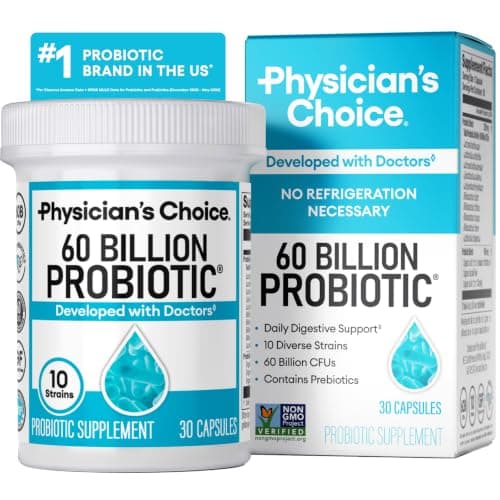
Product image from the Amazon listing.
Our verdict
Yes — Physician's Choice 60 Billion CFU Probiotic is worth it, and it's the smart-money pick in the crowded probiotic supplement category. 60 billion CFU across 10 clinically studied bacterial strains plus organic prebiotic fiber, delayed-release capsules that survive stomach acid, and shelf-stable at room temperature — all in a once-daily capsule at Amazon-competitive pricing. Not the fanciest probiotic (Seed DS-01 has more advanced formulation), not the most targeted (Align beats it for IBS-specific research), but the pragmatic daily-maintenance choice that gets recommended more than any other Amazon supplement in its category. Give it 4-6 weeks of consistent use for full benefits. Immunocompromised patients, pregnant/nursing women and anyone on prescription medication should confirm with their doctor first.
The short version
Physician's Choice 60 Billion Probiotic is the Amazon best-selling probiotic in the U.S., and it holds that position for straightforward reasons — the formulation actually matches what most people need for daily gut and digestive support. Each once-daily delayed-release capsule delivers 60 billion CFU across 10 clinically studied bacterial strains (Lactobacillus acidophilus, plantarum, casei, paracasei, salivarius, bulgaricus, rhamnosus, Bifidobacterium lactis, bifidum and longum), plus organic prebiotic fiber that feeds the bacteria once they arrive in your gut. The delayed-release capsule shell is engineered to survive stomach acid so more of the live cultures actually make it to the intestine, and each bottle is third-party tested and shelf-stable at room temperature. It's not the fanciest probiotic on the market, and it doesn't have the specific strain designations elite formulations advertise — but for daily gut support, post-antibiotic recovery and general bloating/regularity issues, it's the smart-money pick that gets recommended more than any other Amazon supplement in its category.
Pros & cons
Pros
- 60 billion CFU per capsule — genuinely therapeutic dose
- 10 clinically studied bacterial strains
- Includes organic prebiotic fiber (chicory root, fructooligosaccharides)
- Delayed-release capsule survives stomach acid
- Shelf-stable — no refrigeration required
- Third-party tested for potency and purity
- One capsule per day (not 2-3 like many competitors)
Cons
- First 1-2 weeks can cause mild gas or bloating during adaptation
- Strain codes not published on label (species-level only)
- Not the cheapest probiotic per CFU
- Pregnancy/nursing users should confirm with their doctor first
Why people love it
One capsule daily with or without food
Take one delayed-release capsule any time of day. The engineered capsule shell survives stomach acid so live cultures reach your intestine rather than being destroyed on the way down.
10 strains work in the gut lining
Different Lactobacillus and Bifidobacterium species colonize different parts of the small and large intestine, competing with unhelpful bacteria and producing short-chain fatty acids that support gut lining integrity.
Prebiotic fiber feeds the colony
The included organic prebiotic (chicory root inulin, fructooligosaccharides) is fermentable fiber that feeds the good bacteria once they arrive — improving colonization vs a plain-probiotic pill.
Who it's for
- Anyone recovering from a course of antibiotics
- People with bloating, gas or irregular digestion
- IBS-D and IBS-C sufferers (with doctor guidance)
- General gut-health maintenance for adults 18+
Why probiotic strains and doses matter (and how Physician's Choice compares to the competition)
The probiotic supplement market is confusing on purpose. Every brand advertises a different CFU count, a different strain list, and different marketing claims — and consumers reasonably wonder if any of it is meaningful. Here's the honest state of the science in 2026. First: dose matters, but only up to a point. Clinical studies generally support probiotic doses in the 10-100 billion CFU range for gut-health benefits. Below 10 billion, effects are usually modest; above 100 billion, additional benefits taper off. Physician's Choice's 60 billion CFU sits squarely in the therapeutic sweet spot. Second: strain diversity matters more than raw CFU. Multi-strain probiotics (like Physician's Choice's 10-strain blend) tend to outperform single-strain products for general gut support because different bacterial species colonize different intestinal regions and produce different beneficial metabolites. Third: prebiotic inclusion helps because probiotics need food (fermentable fiber) to establish colonies.
Where Physician's Choice loses points versus premium options like Seed DS-01: strain codes. Elite formulations publish the specific alphanumeric strain designation (e.g., Lactobacillus rhamnosus GG, Bifidobacterium infantis 35624) that ties each strain to specific published clinical trials. Physician's Choice publishes species-level names (Lactobacillus rhamnosus) but not the specific strain codes, so you can't verify which underlying research applies to their specific formulation. For scientific rigor, this matters. For practical everyday use, it matters less — the 10-strain 60-billion CFU multi-species formulation delivers the same broad gut-support benefits that clinical studies of multi-strain probiotics consistently show. If you want to know exactly which studies validate your specific probiotic, get Seed or Culturelle. If you want a reasonable, effective daily probiotic at Amazon-competitive prices, Physician's Choice is the pragmatic pick that gets recommended more than any other for good reason.
How to integrate Physician's Choice into a real gut-health routine
Probiotics work best as one part of a broader gut-support routine rather than a standalone fix. The core habits that compound with probiotic supplementation: fiber intake (aim for 25-35 g/day — most Americans get 15-20 g), varied plant foods (30+ different plant species per week has emerging research support for microbiome diversity), fermented foods (yogurt, kefir, sauerkraut, kimchi, kombucha 2-3 servings per week), reduced ultra-processed food intake, and enough sleep (poor sleep degrades gut microbiome in measurable ways). Physician's Choice added to a routine that includes these habits produces noticeably better results than the pill alone.
For post-antibiotic recovery specifically — the highest-evidence probiotic use case — take Physician's Choice 2 hours apart from your antibiotic dose during the course (yes, during, not after), and continue for 2-4 weeks after finishing the antibiotic to help rebuild the microbiome the antibiotic depleted. For IBS and chronic bloating, allow 4-6 weeks of consistent daily use before evaluating; if no benefit, try switching to a Bifidobacterium-focused probiotic or consulting a gastroenterologist. For general daily gut maintenance, take one capsule per day indefinitely — there's no harm in continuous use and the benefits compound over months. Pair with a good multivitamin like Ritual and a magnesium supplement like Nature Made Magnesium for a complete daily-supplement stack that covers the basics without going overboard.
Who should skip Physician's Choice (and when a different probiotic is smarter)
Probiotics aren't universally beneficial, and Physician's Choice specifically isn't right for everyone. First: skip probiotics entirely if you're immunocompromised (chemotherapy, active organ transplant recovery, HIV with low CD4 count) or critically ill in a hospital setting — rare but serious probiotic-related bloodstream infections have been reported in these populations. Consult your specialist first. Second: skip a multi-strain broad-spectrum probiotic like Physician's Choice if your specific issue is well-studied for a single strain. Example: pediatric acute diarrhea has strong evidence specifically for Saccharomyces boulardii or Lactobacillus rhamnosus GG (Culturelle) — a targeted single-strain product outperforms broad-spectrum in that specific context. Similarly for IBS symptoms specifically, Bifidobacterium infantis 35624 (Align) has more targeted evidence than multi-strain products.
Third: consider a higher-end formulation if you have money to spend and want the strongest research backing. Seed DS-01 is the current premium pick — 24 strains, advanced enteric-coated capsule technology, published strain codes tied to specific clinical trials, at around $50/month vs Physician's Choice's ~$25/month. For most healthy adults with normal gut concerns (occasional bloating, post-antibiotic recovery, general maintenance), Physician's Choice at 60 billion CFU across 10 strains delivers 85% of what Seed does at half the price. Start with Physician's Choice, evaluate after 4-6 weeks, and consider upgrading only if you specifically need more. Don't overthink it — daily probiotic use is what actually matters, and any of these products taken consistently will outperform the fanciest probiotic you buy once and abandon.
See Physician's Choice 60B Probiotic on Amazon
Check the latest price, photos and buyer reviews on Amazon.
Check Price on Amazon →Sold and shipped by AmazonFrequently asked questions
Do probiotics actually work, and what should I expect from Physician's Choice specifically?
Yes for most gut-related issues, with a realistic timeline. Peer-reviewed research supports probiotic use for antibiotic-associated diarrhea, irritable bowel syndrome (both IBS-D and IBS-C), some inflammatory bowel conditions, and general gut microbiome diversity. Physician's Choice's specific multi-strain 60 billion CFU formulation is in the therapeutic dose range for these conditions. What to expect: first 1-2 weeks may include mild gas, bloating or changes in bowel movements as your gut microbiome adjusts. Weeks 2-4: most users report reduced bloating, more regular bowel movements, and less digestive discomfort. Weeks 4+: sustained benefits at maintenance dose. If you notice no change at all after 6 weeks, this specific formulation may not match your gut needs — try a different strain profile (e.g., focused on Bifidobacterium infantis for IBS) or consult a gastroenterologist.
Physician's Choice vs Culturelle vs Align vs Seed: which probiotic is best?
Different formulations targeting different needs. Physician's Choice 60 Billion is the broad-spectrum daily maintenance pick — 10 strains, high CFU, prebiotic, best value per CFU. Culturelle uses only Lactobacillus rhamnosus GG at 10 billion CFU — a specific strain with strong evidence for pediatric use and antibiotic-associated diarrhea, but narrower in scope. Align uses Bifidobacterium 35624 at 1 billion CFU — well-studied specifically for IBS symptoms, at a much smaller dose. Seed DS-01 uses a proprietary 24-strain blend with more advanced encapsulation for around $50/month — clinically robust but 3-4× the price. For general daily gut support at a reasonable cost, Physician's Choice is the smart-money pick. If your specific issue is IBS (Align), post-antibiotic recovery (Culturelle), or you want the most advanced formulation regardless of cost (Seed), those are the specialized alternatives.
Should I take probiotics with or without food, and at what time of day?
Physician's Choice specifically is fine with or without food thanks to its delayed-release capsule design — the capsule protects the bacteria from stomach acid regardless of what else you eat. General recommendation for probiotics: with breakfast or with a light meal is often the easiest to remember and creates a consistent daily habit. Some sources recommend taking on an empty stomach 30 minutes before eating, but the peer-reviewed evidence for that timing is weak. The most important factor is consistency — take it at the same time every day for at least 4-6 weeks to see the full effect. Don't skip days; probiotic colonization requires continuous supply.
How long does it take to see results from Physician's Choice probiotics?
Realistic timeline: week 1-2, some users notice initial bloating or gas as the gut microbiome adjusts (this is normal adaptation, not a bad sign). Weeks 2-4: most users notice more regular bowel movements, reduced bloating after meals, and less digestive discomfort overall. Weeks 4-8: sustained benefits, better recovery from occasional dietary indiscretions, and often improvements in ancillary areas some users report (skin, mood, immune function — the gut-brain and gut-skin axes are real research areas). If you're taking probiotics specifically for antibiotic recovery, benefits are faster — usually noticeable within 1-2 weeks. For IBS or chronic bloating, allow at least 4-6 weeks. If nothing has changed after 8 weeks of consistent daily use, this formulation isn't right for you — try a different strain profile.
Is Physician's Choice 60 Billion CFU safe for daily long-term use?
Yes for healthy adults. Multi-strain probiotics at 60 billion CFU are within the range studied in long-term clinical use and generally considered safe for daily indefinite use. Rare side effects include mild gas or bloating during the first 1-2 weeks of adjustment. Populations that should consult a doctor first: immunocompromised patients (chemotherapy, HIV, organ transplant recipients), critically ill hospitalized patients, and people with central venous catheters — very rare cases of probiotic-related infections have been reported in these groups. Pregnant and nursing women should also confirm with their doctor, though probiotics are generally considered safe during pregnancy and many OB-GYNs specifically recommend them. If you have a serious immune condition, don't start probiotics without medical guidance.
Does Physician's Choice probiotics need to be refrigerated?
No — that's one of its practical advantages. The formulation is engineered to be shelf-stable at room temperature (up to 77°F / 25°C for extended periods). This matters for travel (no need to pack a cooler) and for households without extra fridge space. Some older probiotic products required refrigeration to maintain live culture viability, but modern manufacturing (freeze-drying combined with delayed-release capsules) allows shelf stability. Keep the bottle in a cool, dry place away from direct sunlight; a bathroom cabinet works fine. Very hot cars in summer or extended heat above 85°F should be avoided — bring it inside from Amazon delivery boxes in extreme summer heat.
Can I combine Physician's Choice with other supplements or medications?
Generally yes with most supplements, and specific caution with a few medications. Compatible: multivitamins (like Ritual), fish oil, magnesium, vitamin D, most other supplements. Take probiotics at least 2 hours apart from oral antibiotics (during a course) to avoid the antibiotic killing the probiotic bacteria — many doctors specifically recommend continuing probiotics DURING antibiotic courses at the 2-hour separation to reduce antibiotic-associated diarrhea. Caution: some immunosuppressants and certain antifungals may interact with probiotics — check with your prescribing doctor. If you're on any prescription medication and starting probiotics, mention it at your next appointment to confirm no interactions.
As an Amazon Associate, TopCrate earns from qualifying purchases at no extra cost to you. Physician's Choice is a dietary supplement, not a medication or treatment for disease. Consult a healthcare provider before starting new supplements, especially if you have a medical condition, take medications, are pregnant, or are immunocompromised. Product image, price, availability and ratings are shown on Amazon and are subject to change.