TRENDING ON AMAZON
Medicube Zero Pore Pad 2.0 Review: Is It Worth It?
The viral Korean toner pad that combines 4.5% AHA lactic acid, 0.45% BHA salicylic acid, and dual-textured cotton — chemical exfoliation for pore minimization and oil control that TikTok can't stop talking about.
Quick answer: Yes, Medicube Zero Pore Pad 2.0 is worth it for combination-to-oily skin with visible pores, blackhead concerns, or afternoon-shine issues. The dual-texture design (embossed for physical exfoliation, smooth for serum delivery) is a genuinely smart formulation, the AHA + BHA + PHA combination is dermatologist-approved and effective, and independent testing supports the pore-and-oil reduction claims. Use 2-3 times per week (not daily), pair with sunscreen the next morning, and pair with hydrating products on off-nights. Not for very dry, very sensitive, or active-acne skin — but for the specific target user, it's the K-beauty exfoliating pad that outperforms simpler single-acid alternatives.
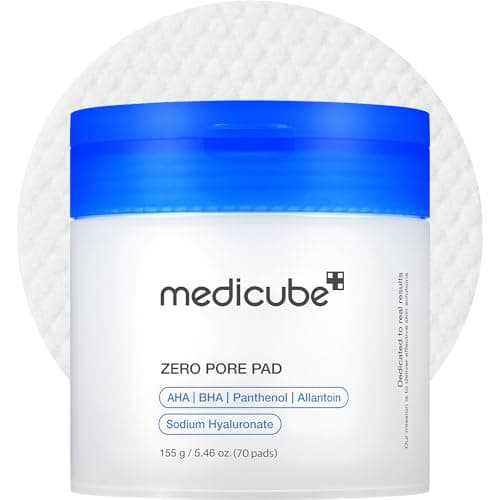
Product image from the Amazon listing.
Our verdict
Yes, Medicube Zero Pore Pad 2.0 is worth it for combination-to-oily skin with visible pores, blackhead concerns, or afternoon-shine issues. The dual-texture design (embossed for physical exfoliation, smooth for serum delivery) is a genuinely smart formulation, the AHA + BHA + PHA combination is dermatologist-approved and effective, and independent testing supports the pore-and-oil reduction claims. Use 2-3 times per week (not daily), pair with sunscreen the next morning, and pair with hydrating products on off-nights. Not for very dry, very sensitive, or active-acne skin — but for the specific target user, it's the K-beauty exfoliating pad that outperforms simpler single-acid alternatives.
The short version
Medicube's Zero Pore Pad 2.0 is the K-beauty toner pad that broke out of the beauty-forum niche and hit mainstream Amazon best-seller status. Each pad is dual-textured — an embossed side that physically sloughs off dead skin, and a smooth side that delivers a serum-loaded chemical exfoliant (4.5% AHA lactic acid, 0.45% BHA salicylic acid, plus niacinamide and Centella Asiatica). The specific claim is 47.1% reduction in oil and 87.3% decrease in visible pore appearance from independent testing. In practice, most users report noticeably smoother skin, fewer blackheads and reduced oiliness within 2-3 weeks of consistent use (2-3 nights per week). It's marketed as a nighttime treatment, not a daily toner — using every night causes irritation for most people. One jar of 70 pads lasts about 2-3 months at the recommended frequency, making it a moderate-cost, high-effectiveness addition to a K-beauty or acne routine.
Pros & cons
Pros
- Combines AHA lactic acid + BHA salicylic acid + PHA gluconolactone
- Dual-textured pad: physical + chemical exfoliation together
- Independent testing shows real reductions in oil and pore appearance
- Pre-soaked pads make application effortless (no measuring)
- Includes niacinamide and Centella for soothing effect
- 70 pads per jar lasts 2-3 months of recommended use
Cons
- Not for daily use — irritating if overused
- AHA/BHA combination not for very sensitive skin
- Jar packaging means active ingredients degrade after 6 months of opening
Why people love it
Cleanse and dry your skin
Apply as the second step in your PM routine, after cleansing. Skin must be dry — applying to wet skin dilutes the acid concentration and reduces effectiveness.
Swipe with the embossed side first
The textured side gently exfoliates dead skin and lifts sebum from pore openings. Move in outward strokes from the center of the face, avoiding the eye area and lips.
Finish with the smooth side
Flip the pad and use the smooth side to press the remaining serum into your skin. Let it absorb 30-60 seconds before your next skincare step (serum, moisturizer). Follow with sunscreen the next morning — chemical exfoliants increase sun sensitivity.
Who it's for
- Anyone with visible pores or oily T-zone
- Blackhead-prone skin
- People building a K-beauty routine
- Combination and oily skin types
Why K-beauty exfoliating pads became the format that finally worked for pore care
Chemical exfoliation has been a skincare staple for decades, but the delivery format matters enormously for real-world results. The two traditional formats — leave-on liquid toners (like Paula's Choice 2% BHA Liquid) and rinse-off masks (like Alpha-H Liquid Gold) — each have friction points. Liquid toners require cotton pads or a specific application technique and dosage that most users get wrong. Rinse-off masks require rinsing time that not everyone has nightly. Both leave users guessing whether they're using the 'right amount' of active. Pre-soaked exfoliating pads, pioneered by K-beauty brands like Cosrx and Medicube, solved the dosage-and-application problem: each pad delivers a pre-measured, consistent dose of the actives with no guesswork, no separate cotton pad, and no rinsing.
Medicube's specific innovation with the Zero Pore Pad 2.0 was the dual-texture design. Traditional toner pads (Cosrx One Step Original, Neogen Bio-Peel Gauze) have a single texture — usually smooth cotton. Medicube pairs an embossed physical-exfoliation side with a smooth serum-delivery side, giving users both mechanical and chemical exfoliation in a single product without the harsher effect of scrubs. The embossed side lifts sebum from pore openings and gently sloughs dead skin. The smooth side presses the AHA/BHA serum into the skin for chemical exfoliation. Together they deliver a cumulative pore-and-oil control effect that either format alone doesn't quite match. Combined with niacinamide and Centella Asiatica for anti-inflammatory support, this is why the product outperforms simpler options for the specific problem it targets.
Building a K-beauty pore-care and oil-control routine around Medicube
A complete K-beauty routine around Medicube Zero Pore Pad looks like this. AM (every day): gentle cleanser (Anua Heartleaf, or CeraVe Foaming), vitamin C serum for sun-protection support, hydrating essence (COSRX Snail Mucin), moisturizer, SPF 30-50. PM on Medicube nights (2-3x per week): double cleanse (oil cleanser to remove sunscreen and makeup, then foaming cleanser), fully pat dry, apply Medicube pad using the technique described above, wait 60 seconds, apply a hydrating serum (hyaluronic acid or Snail Mucin), apply a barrier-supporting moisturizer. PM on off-nights (4-5x per week): double cleanse, hydrating toner or essence, hydrating serum, moisturizer. Once per week: overnight sleeping mask or richer moisturizer to compensate for the exfoliating nights. The result over 4-8 weeks is meaningfully clearer, less oily, more even skin with fewer blackheads and smaller-appearing pores.
The routine works best combined with lifestyle basics that support the same goals. Wash pillowcases weekly (dirty pillowcases contribute to blackhead formation more than most people realize) — a satin pillowcase like the Kitsch satin pillowcase both reduces friction on chemically-exfoliated skin and stays cleaner longer than cotton. Don't touch your face during the day (touching transfers oil and bacteria to pores). Stay hydrated (dry skin ironically over-produces oil to compensate, worsening the oil-and-pore cycle). Consider dietary factors if oiliness is severe — high-glycemic diets and dairy can worsen sebum production in some people. Combined with the Medicube routine, these lifestyle habits compound the results into genuine skin transformation over 3-6 months.
When Medicube Zero Pore Pads aren't the right choice (and what to use instead)
Medicube Zero Pore Pads are specifically designed for combination-to-oily skin with visible pores, blackheads, and afternoon shine. They're not the universal K-beauty exfoliant that everyone should own — several skin types and concerns are better served by other products. For very dry skin with no pore-and-oil concerns: skip Medicube entirely, use a hydrating essence like COSRX Snail Mucin daily instead. Chemical exfoliation for dry skin should be limited to a mild PHA product (Zero Pore Pad Mild version, or a gentler AHA like polyhydroxy acid or gluconolactone). For sensitive skin, rosacea or eczema: Medicube's active concentration is likely to irritate — use the Mild version, or skip chemical exfoliation entirely and focus on barrier repair with ceramide-rich moisturizers and no actives.
For active acne (not just blackheads): Medicube's mechanism targets oil and pore congestion, but it doesn't kill acne bacteria. For active whiteheads and inflammatory acne, add benzoyl peroxide 2.5% as a spot treatment (or use a benzoyl peroxide cleanser like CeraVe Acne Foaming Cream Cleanser). Never use Medicube pads and benzoyl peroxide on the same night. For hormonal acne (jawline and chin breakouts that flare with menstrual cycles): topical products only partially address hormonal drivers — see a dermatologist for potential systemic care (oral contraceptives, spironolactone, isotretinoin). For deep cystic acne: this requires professional care, not over-the-counter products. Medicube pads sit in a specific and useful niche — pore appearance and mild-to-moderate oil control — and understanding when they're right (and when they're not) is what separates a skincare regimen that works from one that irritates skin without benefit. For the target audience, they earn their spot in the routine.
See Medicube Zero Pore Pad on Amazon
Check the latest price, photos and buyer reviews on Amazon.
Check Price on Amazon →Sold and shipped by AmazonFrequently asked questions
Do Medicube Zero Pore Pads actually work?
Yes — for the specific target users (oily to combination skin, visible pores, blackhead-prone), the pads deliver measurable results within 2-3 weeks of consistent use. The combination of chemical exfoliation (AHA + BHA), physical exfoliation (embossed pad texture), and soothing actives (niacinamide + Centella) is a well-formulated approach to pore care that outperforms simpler single-acid products. Medicube publishes independent lab-test results claiming 47.1% reduction in sebum and 87.3% decrease in visible pore waste — these are clinical-condition numbers, so real-world results are typically less dramatic but still noticeable. Users report smoother texture, less oily-shine by afternoon, and gradual improvement in blackhead density around the nose and chin. What they don't do: shrink pores permanently (no product can — pore size is genetic), treat active acne (that requires benzoyl peroxide or prescription care), or work on dry-skin users who don't have the specific issues they target.
Medicube Zero Pore Pad vs Naturium Multi-Peptide vs COSRX Snail 96: which K-beauty product should I buy?
Different products for different concerns. Medicube Zero Pore Pad is the pore-and-oil control specialist — best for combination-to-oily skin with visible pores and blackheads. Naturium Multi-Peptide is peptide-focused firming for anti-aging concerns — best for people primarily worried about fine lines and skin firmness, not oil control. COSRX Snail Mucin Essence is hydrating and gentle — best for dry, sensitive, or damaged-barrier skin, and often used alongside stronger exfoliants like Medicube on off-nights. The three complement each other in a full K-beauty routine: Medicube 2-3 nights per week for exfoliation, COSRX Snail Mucin on off-nights for hydration, Naturium as a longer-term firming layer. If you can only buy one: Medicube for oil/pore control, COSRX for hydration issues, Naturium for anti-aging. For active acne beyond blackheads, add a spot treatment with 2.5% benzoyl peroxide, since the Medicube pads target oil and pore congestion rather than active acne infection.
How often should I use Medicube Zero Pore Pads? Can I use them every night?
No — 2-3 times per week is the recommended frequency for most skin types, and this is important. The pads combine chemical exfoliation (AHA + BHA) with physical exfoliation (embossed texture), which is a fairly strong exfoliating action. Daily use causes barrier damage, redness, sensitization and paradoxically worsens the skin issues you're trying to fix. Start with 2 times per week for the first 2 weeks. If skin tolerates well (no redness or stinging), increase to 3 times per week. If irritation appears, reduce to once per week or switch to the milder Zero Pore Pad Mild version. The maximum for very tolerant skin is 3-4 times per week. On off-nights, use gentler products: a hydrating essence (COSRX Snail Mucin, Anua Heartleaf Toner), moisturizer, and no additional exfoliation. Never use on the same night as retinol or benzoyl peroxide — that combination is a fast track to over-exfoliation.
What's the difference between the original Zero Pore Pad and the Mild version?
The original Zero Pore Pad 2.0 uses 4.5% AHA lactic acid + 0.45% BHA salicylic acid — the classic exfoliating combo that most users can tolerate 2-3 times weekly with good results. The Zero Pore Pad Mild replaces the AHA/BHA with 3% PHA (polyhydroxy acid gluconolactone), which is a much gentler exfoliant that's tolerable daily even for sensitive skin. PHA delivers about 50-70% of the exfoliating effect of AHA/BHA with dramatically less irritation. Pick the original if you have combination-to-oily skin without known sensitivity — better results, must limit frequency. Pick the Mild if you have sensitive skin, are new to chemical exfoliation, or want a daily-safe option. Some users own both: the Mild for daily use, the original for 1-2 nights per week when they want stronger exfoliation. Both come in the same 70-pad jar packaging.
Can I use Medicube Zero Pore Pads with retinol or vitamin C?
Not on the same night — this is the important guardrail. Chemical exfoliants (AHA/BHA), retinol, and vitamin C are all active ingredients that can individually irritate skin. Layering multiple on the same night is a fast path to over-exfoliation, redness, peeling and barrier damage. The correct approach is to alternate nights: Medicube pads on Monday/Wednesday/Friday, retinol on Tuesday/Thursday, hydrating night (moisturizer only, no actives) on the weekend. For vitamin C, most people use it in the morning routine (helps sun protection), not evening — so vitamin C serum in the AM and Medicube pads at PM is fine on the same day. If your skin is very tolerant, you might add a peptide serum on Medicube nights, but keep everything gentle. Never combine Medicube pads with benzoyl peroxide or exfoliating scrubs on the same night. Always follow Medicube pads with a good moisturizer to compensate for the barrier-disrupting effect of the acids, and always wear SPF 30+ the next morning — AHA in particular makes skin significantly more sun-sensitive for up to a week after use.
How long does one jar last and what does it cost per month?
A jar contains 70 pads. At the recommended 2-3 times per week usage, one jar lasts 5-8 months. On Amazon, expect $28-35 for a single jar. That's roughly $4-6 per month for the pad use — comparable to premium serums and mid-range K-beauty products. Subscribe-and-save adds a modest discount. Keep the jar sealed when not in use — the pre-soaked pads dry out if left open. After opening, the actives remain stable for about 12 months; if you're only using 2-3 times per week, use each jar within a year rather than stockpiling. For a two-jar rotation (one at the sink, one in the cabinet), one purchase per 6-12 months keeps you covered.
As an Amazon Associate, TopCrate earns from qualifying purchases at no extra cost to you. Contains chemical exfoliants (AHA/BHA); increases sun sensitivity — use SPF 30+ daily. Patch-test if you have sensitive skin. Not intended to treat active acne — see a dermatologist for persistent breakouts. Product image, price, availability and ratings are shown on Amazon and are subject to change.
More reviews you might like
SKINCARE
Celimax Vita-A Retinal Shot Review: Best K-Beauty Retinal for Sensitive Skin?
SPORTS
Body Glide Original Review: The Anti-Chafe Balm That Actually Works
SKINCARE
Foreo Luna Mini 3 Review: Is the Silicone Cleansing Brush Worth It?
SKINCARE