TRENDING ON AMAZON
McCafe Premium Roast Coffee K-Cup Pods (100% Arabica Medium Roast) Review: Is It Worth It?
The McDonald's coffee you actually like — in K-Cup form. 100% Arabica medium roast with the same clean, smooth flavor as a Mickey D's morning cup, priced as one of Keurig's best value-per-pod picks.
Quick answer: Yes — McCafe Premium Roast K-Cups are worth it, and they're the best-value K-Cup for daily use in 2026. 100% Arabica medium roast, smoother than most drugstore K-Cups, tastes genuinely like McDonald's coffee (which is well-liked for a reason), works with every Keurig machine, and at about 40 cents per pod in the 96-count pack, it's roughly half the price of Starbucks K-Cups. For anyone who drinks their Keurig daily and wants reliable value without dropping to bitter generic K-Cup territory, McCafe is the smart-money pick. Dark-roast lovers should look at [Peet's Major Dickason's Blend](/reviews/peets-coffee-k-cups) instead; flavored-coffee households should look at Green Mountain variety packs. For everyone else at the mainstream daily-driver level, McCafe is the specific K-Cup to subscribe to.
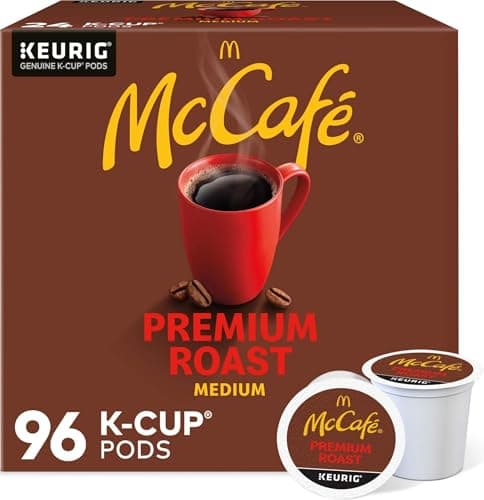
Product image from the Amazon listing.
Our verdict
Yes — McCafe Premium Roast K-Cups are worth it, and they're the best-value K-Cup for daily use in 2026. 100% Arabica medium roast, smoother than most drugstore K-Cups, tastes genuinely like McDonald's coffee (which is well-liked for a reason), works with every Keurig machine, and at about 40 cents per pod in the 96-count pack, it's roughly half the price of Starbucks K-Cups. For anyone who drinks their Keurig daily and wants reliable value without dropping to bitter generic K-Cup territory, McCafe is the smart-money pick. Dark-roast lovers should look at [Peet's Major Dickason's Blend](/reviews/peets-coffee-k-cups) instead; flavored-coffee households should look at Green Mountain variety packs. For everyone else at the mainstream daily-driver level, McCafe is the specific K-Cup to subscribe to.
The short version
McCafe Premium Roast K-Cups are McDonald's coffee brand licensed into K-Cup format, and they've become one of the best-selling K-Cup varieties on Amazon for a simple reason — they taste exactly like the coffee you actually order at McDonald's (which, whatever your feelings about the chain, is a well-liked medium roast). 100% Arabica beans, medium roast profile, subtle chocolate and toasted-nut notes, and a smoother-than-average finish for a mainstream K-Cup. The 96-count value pack works out to around 40 cents per pod (about half the price of Starbucks K-Cups), and it's compatible with every Keurig machine — 1.0, 2.0, K-Mini, K-Duo, K-Slim, K-Elite. The recyclable pod design is a small sustainability plus. It's not craft-roaster quality (that's Peet's or a fresh-ground pour-over), but for daily home use it delivers noticeably better flavor than generic drugstore K-Cups at a lower price than the premium brands. The specific pick for households that use their Keurig daily and want reliable value.
Pros & cons
Pros
- 100% Arabica medium roast — smoother than most drugstore K-Cups
- Tastes genuinely like McDonald's coffee
- Works with every Keurig machine (1.0, 2.0, K-Mini, K-Duo)
- Recyclable pod design (peel-and-recycle)
- 96-count value pack runs about 40 cents per pod
- Widely available on Amazon, grocery stores and Walmart
Cons
- Not craft-roaster quality — for that, grind fresh beans
- Medium roast only in the standard SKU — dark-roast lovers need a different pick
- Decaf availability limited to smaller box sizes
Why people love it
Load a McCafe pod
Standard K-Cup format — drops into any Keurig brewer. No adapter, no special holder, no fuss.
Pick your cup size
McCafe pods brew well at 6 oz, 8 oz or 10 oz depending on your Keurig — 8 oz is the sweet spot most people find balanced. Larger sizes will make it slightly weaker.
Recycle the pod when done
McCafe pods are recyclable — peel the foil top, dump the grounds, and toss the plastic cup in the recycling.
Who it's for
- Households using their Keurig daily
- Anyone who orders McDonald's coffee out
- Value-conscious K-Cup buyers
- Offices, dorms and shared kitchens with a Keurig
Why McCafe K-Cups became one of the best-selling Keurig pods on Amazon
McCafe launched its K-Cup line in 2011 through a partnership between McDonald's and Kraft (later Keurig), aiming to bring McDonald's popular medium-roast coffee to home Keurig users. What made it work was flavor consistency: the K-Cups use the same coffee blend McDonald's serves in restaurants, so anyone who liked McDonald's coffee could reproduce it at home with a $0.40 pod versus a $2-3 restaurant cup. This flavor-consistency-plus-value proposition drove McCafe to become one of the top-3 selling K-Cup brands on Amazon within a few years, and it has held that position through 2026 across 80,000+ verified Amazon reviews with an average 4.7-star rating.
The specific coffee profile McCafe engineered — 100% Arabica, medium roast, subtle chocolate and nut notes, smooth finish — was designed to appeal to the broadest range of coffee drinkers. It's neither too dark (which would alienate people who find Starbucks bitter) nor too light (which would confuse people accustomed to darker mainstream American coffee). This 'universal appeal' is precisely why McCafe works for shared households, offices and multi-generational kitchens — everyone can drink it comfortably. Compared to specialty roaster K-Cups (which cater to specific taste preferences), McCafe is the option that gets used by everyone. And at 40 cents per pod (96-count pack from Amazon), it's meaningfully cheaper than Starbucks (60-80 cents) and Peet's (60-80 cents) while delivering better flavor than generic drugstore K-Cups. The sweet spot in the K-Cup value equation.
Building a home coffee setup around McCafe and your Keurig
Home coffee setups scale in three tiers, and McCafe fits at the mainstream everyday level. Tier 1 — Basic Keurig + McCafe K-Cups (~$100-150 total): Buy a compact Keurig K-Mini or 2-cup K-Duo, stock McCafe Premium Roast K-Cups on Subscribe & Save (~5-10% additional discount off the 40-cent per-pod pricing). Zero learning curve, café-quality mainstream coffee, ready in 90 seconds. This is the specific setup 80% of Keurig households run. Tier 2 — Keurig + Multiple K-Cup varieties (~$150-300 total): Same Keurig hardware, but stock 3-4 varieties for different moods — McCafe medium roast for daily, Peet's Major Dickason's for weekends and afternoon coffee, Starbucks blonde roast for lighter days, decaf for evenings. Total variety cost stays reasonable because you don't drink 100% of any single variety. Best for households where different people prefer different coffees.
Tier 3 — Keurig + Whole Bean Weekend Setup (~$300-500 total): Weekday Keurig with McCafe K-Cups for convenience, weekend pour-over or French press with whole-bean Peet's Major Dickason's, a Fellow Stagg EKG electric kettle, and a burr grinder (Baratza Encore, $150). Best for coffee enthusiasts who want café-quality on weekends but don't want to grind and brew every weekday morning. The Tier 1 approach with McCafe K-Cups is the best-value default for most households; Tier 2 and 3 are worthwhile upgrades depending on how much you care about coffee. Pair with a good insulated mug like a YETI Rambler or an Ember Mug if you sip slowly and want the coffee to stay hot; a fast Owala FreeSip is the better pick if you're taking coffee to a commute or gym.
McCafe K-Cups vs the whole K-Cup ecosystem — where the value ceiling sits
The K-Cup market has ~1,000 varieties across every major coffee brand, and understanding where McCafe sits helps you decide whether to stick with it or explore. At the bottom of the K-Cup quality-per-dollar curve: generic Amazon Basics K-Cups, Kirkland Signature K-Cups, and drugstore-brand K-Cups (~25-35 cents per pod, noticeably harsher flavor). Mid-tier value: McCafe, Green Mountain Nantucket Blend, Folgers K-Cups (~35-50 cents, smooth mainstream flavor). Upper mid-tier: Peet's Major Dickason's Blend, Starbucks Pike Place, Community Coffee (~55-75 cents, meaningfully better body and flavor than mainstream). Top-tier: Death Wish, Illy, Kicking Horse ($1+ per pod, specialty roaster quality).
McCafe's specific value position: highest-flavor K-Cup available under 50 cents per pod. Everyone below McCafe compromises on taste to save 5-15 cents; everyone above pays 25-50 cents more per pod for real quality improvements. If you drink 2-3 K-Cups per day, McCafe costs about $30-40/month, versus $50-70/month for premium brands or $18-25/month for generics. The math strongly favors McCafe as the daily driver — the flavor upgrade over generics is dramatic, and the price savings over premium brands add up to $200-400/year that funds occasional Peet's, Starbucks or specialty pods for variety. For most Keurig households, McCafe on Subscribe & Save as the daily default plus a rotating variety pack of premiums for weekends and afternoons is the optimal value-plus-quality K-Cup setup. Combined with proper water quality (filtered tap or spring water — hard tap water damages Keurig internals over time), correct cup sizing (6-8 oz maximizes flavor concentration; 10-12 oz dilutes it), and periodic descaling every 3-6 months, this setup delivers reliable good coffee for years at genuinely reasonable per-cup cost.
See McCafe K-Cups on Amazon
Check the latest price, photos and buyer reviews on Amazon.
Check Price on Amazon →Sold and shipped by AmazonFrequently asked questions
Are McCafe K-Cups worth it, or are Starbucks K-Cups better?
Worth it for the value — and for many drinkers, flavor-competitive with Starbucks too. Starbucks K-Cups deliver Starbucks' signature darker roasts (Pike Place, Breakfast Blend, French Roast) at premium K-Cup pricing — roughly 60-80 cents per pod. McCafe delivers a smoother medium roast (their whole flagship coffee style) at about 40 cents per pod. For anyone who orders their Starbucks 'blonde roast' or complains that Starbucks is over-roasted and bitter, McCafe is meaningfully better-tasting and cheaper. For anyone who specifically loves the dark, smoky Starbucks flavor profile, Starbucks K-Cups win on brand fit. The value math is clear — McCafe is half the per-pod cost — but the flavor decision depends on whether you prefer medium or dark roast. Buy a small pack of each and A/B them for a week; most households in the medium-roast camp end up switching to McCafe.
McCafe K-Cups vs Peet's Coffee K-Cups vs Green Mountain: which K-Cup is best?
Three different coffee philosophies. McCafe = McDonald's smooth medium roast. Best for: mainstream coffee drinkers who want familiar, easy-drinking coffee, and anyone value-conscious. Around 40 cents per pod. Peet's Coffee K-Cups = West Coast premium dark roasts (Major Dickason's, French Roast, House Blend). Best for: dark-roast lovers, coffee drinkers upgrading from mainstream brands who want more body and boldness. Around 60-80 cents per pod. Green Mountain = the original Keurig-owned brand, wide flavor variety (Nantucket Blend, Breakfast Blend, French Vanilla, hazelnut). Best for: households who want lots of flavor options, casual drinkers who like flavored coffees. Around 50-70 cents per pod. Simple rule: if you drink black coffee and want value + smooth medium roast → McCafe. If you drink black coffee and want premium quality + darker roast → Peet's. If you like flavored coffees or want variety → Green Mountain. Many households keep 2-3 varieties on the counter for different moods.
Do McCafe K-Cups actually taste like McDonald's coffee?
Yes — this is confirmed by countless side-by-side comparisons and it's the main reason the K-Cups sell so well. McDonald's spent years perfecting a medium-roast blend engineered for mass appeal (smooth, not bitter, works well with cream and sugar or black) and licensed the same coffee to be produced in K-Cup format. If you like the coffee at McDonald's, you'll like these K-Cups. The main difference: at McDonald's the coffee is brewed in commercial drip machines with very hot water and served in a paper cup that keeps it piping hot. Home Keurig brewing produces a slightly different mouthfeel and cooler serving temperature, but the flavor profile is very close. For anyone who buys McDonald's coffee daily on their commute, switching to home brewing with McCafe K-Cups saves substantial money over time — a daily McDonald's coffee costs $2-3, McCafe at home costs $0.40.
How do McCafe K-Cups compare to freshly ground coffee — is it worth grinding beans instead?
Freshly ground coffee is meaningfully better in flavor than any K-Cup, including McCafe — this is unavoidable coffee chemistry. Ground coffee loses aromatic compounds within minutes of grinding; even sealed in a nitrogen-flushed K-Cup, the coffee is 3-12 months post-grind by the time you brew it. For serious coffee drinkers, the flavor gap is noticeable. Fresh-ground pour-over with a burr grinder and a Fellow Stagg EKG kettle produces coffee that K-Cups can't match. That said, fresh grinding adds 5-10 minutes to your morning routine and requires proper equipment ($100+ burr grinder, kettle, filters). K-Cups deliver 70-80% of the flavor at 5% of the effort. The right answer for most households is 'K-Cups on weekday mornings, fresh-ground on weekends.' McCafe is the best-value K-Cup pick for the weekday brewing; whole-bean Peet's or a specialty roaster is the pick for weekend ceremony brewing.
Are McCafe K-Cups recyclable, and how much waste do they create?
Yes — McCafe pods are recyclable in the current design (peel-and-recycle). Process: after brewing, wait until the pod cools (5 minutes), peel back the aluminum foil top, dump the coffee grounds into compost or trash, and toss the empty plastic cup into your standard curbside recycling. It takes 15 seconds per pod. Compared to older non-recyclable K-Cups (which contributed significantly to landfill waste — the K-Cup category came under environmental criticism precisely because of this), current McCafe pods are a real improvement. If waste reduction is a top priority, reusable K-Cup filters (My K-Cup by Keurig) are the best option — refill with any ground coffee, produce zero disposable waste. But if you want the convenience of pre-packaged pods with the smallest possible environmental footprint, the recyclable McCafe pods are a solid choice.
McCafe K-Cups vs generic Amazon Basics K-Cups: is McCafe worth the extra money?
Yes, meaningfully. Generic/Amazon Basics K-Cups run about 25-30 cents per pod — cheaper than McCafe's 40 cents. But generics use lower-grade Robusta beans or lower-quality Arabica, faster roasts that emphasize bitterness, and shorter shelf-life packaging. The taste difference is real — generic K-Cups taste noticeably bitter, harsh, and thin compared to McCafe. For a household drinking 2-3 cups daily, the McCafe premium works out to about $10-15/month extra vs generics, and the flavor upgrade is worth it for most drinkers. Skip the generics unless budget is genuinely tight; McCafe is the sweet spot for value + quality in the K-Cup category. Newer brands like Peet's, Starbucks and specialty roasters are the tier above; McCafe is the smart-money mainstream pick.
As an Amazon Associate, TopCrate earns from qualifying purchases at no extra cost to you. Product image, price, availability and ratings are shown on Amazon and are subject to change.