TRENDING ON AMAZON
Eureka NES215A Blaze 3-in-1 Swivel Handheld & Stick Vacuum Review: Is It Worth It?
The corded stick vacuum that quietly became Amazon's best-selling budget vacuum — a 4-pound 3-in-1 (stick + handheld + crevice) with a swivel head and an 18-foot cord for under $30, and specifically the pick for anyone with mostly hardwood floors.
Quick answer: Yes — Eureka NES215A Blaze reviews at 56,000+ five-star ratings are genuinely earned, and it's the specific budget stick vacuum most apartment dwellers, small-house owners and hardwood-floor households should buy. Corded 4-lb 3-in-1 design with 18-foot cord and swivel steering, meaningfully strong suction on hardwood and low-pile carpet, and $28-30 pricing that's dramatically cheaper than cordless competitors. Not the pick for wall-to-wall medium-to-high pile carpet (needs a motorized brush roll — use Shark Navigator or Dyson V12), heavy-shedding pet households with carpet (needs stronger extraction), or large multi-story homes (18-foot cord is limiting). For the specific target user — hardwood-primary small-to-medium spaces, quick-grab daily maintenance, budget-conscious — the Blaze is the correct pick and Amazon's best-selling budget vacuum for legitimate reasons. Pair with a [Bissell Little Green spot cleaner](/reviews/bissell-little-green) for spills and a robot vacuum like [Shark Robot](/reviews/shark-robot-vacuum) or [Roborock Q Revo](/reviews/roborock-q-revo) for scheduled deep-cleaning if you have carpet, and you've built a complete home-cleaning setup for under $400 total.
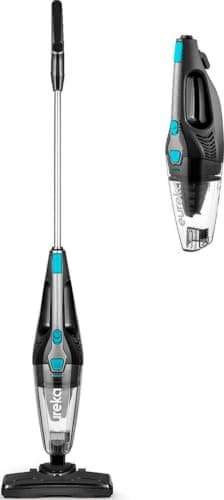
Product image from the Amazon listing.
Our verdict
Yes — Eureka NES215A Blaze reviews at 56,000+ five-star ratings are genuinely earned, and it's the specific budget stick vacuum most apartment dwellers, small-house owners and hardwood-floor households should buy. Corded 4-lb 3-in-1 design with 18-foot cord and swivel steering, meaningfully strong suction on hardwood and low-pile carpet, and $28-30 pricing that's dramatically cheaper than cordless competitors. Not the pick for wall-to-wall medium-to-high pile carpet (needs a motorized brush roll — use Shark Navigator or Dyson V12), heavy-shedding pet households with carpet (needs stronger extraction), or large multi-story homes (18-foot cord is limiting). For the specific target user — hardwood-primary small-to-medium spaces, quick-grab daily maintenance, budget-conscious — the Blaze is the correct pick and Amazon's best-selling budget vacuum for legitimate reasons. Pair with a [Bissell Little Green spot cleaner](/reviews/bissell-little-green) for spills and a robot vacuum like [Shark Robot](/reviews/shark-robot-vacuum) or [Roborock Q Revo](/reviews/roborock-q-revo) for scheduled deep-cleaning if you have carpet, and you've built a complete home-cleaning setup for under $400 total.
The short version
Eureka's NES215A Blaze is what happens when a mainstream vacuum brand builds a stick vacuum specifically for the 'I don't need a Dyson, I need something that works on my hardwood and doesn't cost $500' user. It's a 4-pound corded 3-in-1 with a swivel steering head, an 18-foot power cord (versus the 15-25 minute battery of cordless competitors), an onboard crevice tool, a floor nozzle designed specifically for hard surfaces, and conversion to a handheld for stairs, upholstery and above-floor cleaning. Performance is genuinely competitive on hardwood, tile, laminate and low-pile carpet — the suction is strong enough to pick up dust, crumbs, pet hair and dry debris effectively on smooth surfaces. Where it falls short: no motorized brush roll means it struggles with medium-to-high pile carpet (the airflow-only design can't dig into carpet piling to lift embedded dirt). At $28-30 on Amazon with 56,000+ five-star reviews and 40,000+ total reviews averaging 4.2 stars, it's the specific budget vacuum most Amazon reviewers point to for renters, apartment dwellers, dorm rooms, RVs, boats, garages, workshops and anyone whose primary floor surface is hardwood or tile.
Pros & cons
Pros
- Under $30 — dramatically cheaper than cordless competitors
- 4-pound lightweight design — easy to carry upstairs and above-head
- 3-in-1 converts between stick, handheld and crevice modes
- 18-foot cord = unlimited runtime with no battery to charge
- Swivel steering head navigates around furniture legs
- 56,000+ five-star Amazon reviews — most-loved budget vacuum
Cons
- No motorized brush roll — poor on medium-to-high pile carpet
- Corded — need power outlet access (18-foot cord helps)
- Small dust cup requires frequent emptying
Why people love it
Plug in and lay out the cord
The 18-foot cord extends most of a room from one outlet — plug into a corner outlet and you can vacuum an entire small-to-medium room without unplugging and moving to another outlet.
Airflow-only suction lifts debris from smooth surfaces
A 240W (2 amp) motor generates strong enough airflow to lift dust, crumbs, hair and dry debris from hardwood, tile, laminate and low-pile carpet. No brush roll means nothing to tangle with pet hair or long human hair — a real advantage over motorized-brush vacuums.
Convert to handheld for above-floor cleaning
Detach the stick portion and the base becomes a handheld vacuum for stairs, upholstery, car interiors, mattress edges and countertops. The included crevice tool handles tight spaces (between couch cushions, along baseboards, into corners).
Who it's for
- Renters and apartment dwellers with hardwood floors
- Dorm rooms, RVs, boats and vacation rentals
- Anyone wanting a quick-grab vacuum for daily crumb cleanup
- Workshops, garages and secondary use as a backup vacuum
Why the Eureka NES215A Blaze quietly became Amazon's best-selling budget vacuum
The vacuum category on Amazon in 2026 is dominated by expensive cordless stick vacuums (Dyson V15 at $700+, Shark Stratos at $500+) and mid-range corded uprights (Bissell CleanView at $80-120). What the Eureka Blaze proved is that there's a huge underserved market for a specific type of buyer: someone with a small-to-medium living space (apartment, condo, small house, dorm room) with primarily hardwood or tile floors, who wants a lightweight quick-grab vacuum for daily maintenance between deep-cleaning sessions, and who genuinely doesn't need or want to spend $150+ on a stick vacuum. The Blaze at $28-30 hits this user profile precisely, and Amazon's algorithms recognized the fit — the product accumulated over 56,000 five-star reviews and became the specific budget vacuum recommendation across most Amazon-adjacent content in the category.
The engineering choices that make it work at this price point: (1) Airflow-only design with no motorized brush roll — cheaper to manufacture (no brush-roll motor, no belt, no bearings) and genuinely works well on hard surfaces. (2) Lightweight plastic body at 4 lbs — cheaper to manufacture than metal alternatives and easier to carry upstairs or use above-head for ceiling fans and window sills. (3) Corded design at 18 feet — eliminates the battery cost (batteries add $80-150 to the manufacturing cost of cordless vacuums) and eliminates the battery degradation problem (cordless vacuums lose 30-50% battery capacity after 3-5 years). (4) 3-in-1 stick/handheld/crevice conversion delivers the multi-function value users expect from more expensive vacuums. Combined, these choices produce a vacuum that costs Eureka roughly $15-18 to manufacture, sells at $28-30, and delivers genuinely competitive performance on hard surfaces. It's a specific example of how understanding the target user precisely enables a product that dominates its category. Not for everyone — but exactly right for a huge market.
Building a complete cleaning routine around the Eureka Blaze (and when to upgrade)
The Eureka Blaze works best as one component of a multi-vacuum household approach, not as a single-vacuum solution. The most cost-effective cleaning setup for most apartment and small-house owners: (1) Eureka Blaze (~$30) as the primary daily-maintenance vacuum for hardwood, tile, low-pile carpet and above-floor cleaning. (2) A dedicated carpet vacuum if you have significant medium-to-high pile carpet — either a corded upright like a Shark Navigator Lift-Away ($200-250) or a robot vacuum like the Shark robot vacuum or Roborock Q Revo for scheduled automatic cleaning. (3) A Bissell Little Green portable carpet cleaner or similar spot cleaner for wet spills, pet accidents and upholstery stains — meaningfully different function than a vacuum. (4) A Bissell PowerFresh steam mop for periodic deep-cleaning and sanitizing of hard floors. Total setup: $250-500 across four specialized cleaning tools, each meaningfully better at its specific job than a single 'do everything' vacuum would be at $500-700.
When to upgrade past the Eureka Blaze as your primary vacuum: (1) You've moved to a larger home with more square footage than the 18-foot cord conveniently covers. (2) You've added significant medium-to-high pile carpet to your home. (3) You've acquired a heavy-shedding pet (long-haired dogs, multiple cats) whose hair needs stronger vacuum performance than the Blaze delivers on carpet. (4) You're tired of the corded limitation and want cordless freedom for whole-house cleaning. (5) You're aging or have physical limitations that make the 4-lb Blaze uncomfortable to use extensively (some users prefer heavier vacuums with better vibration dampening). If none of these apply, the Blaze continues to be the smart-money default. Pair with a proper microfiber mop or a Homeika cordless stick vacuum if you want a cordless alternative that handles carpet better while still keeping budget under $200 total.
Honest limitations: what the Eureka Blaze can't do (and what to use instead)
Being honest about what the vacuum can't do is as valuable as hyping what it can. Situations where the Blaze isn't the right primary vacuum: (1) Wall-to-wall medium-to-high pile carpet — the airflow-only design cannot lift embedded dirt from deep carpet piling. Use a Shark Navigator Lift-Away, Dyson V15 Detect, or Bissell Cleanview instead. (2) Large multi-story homes (2500+ sq ft) — the 18-foot cord means constant unplugging and moving between outlets, which becomes tedious over a large space. Use a cordless vacuum with 30-60 minute battery life instead. (3) Heavy-shedding pet households — pet hair on carpet needs a motorized brush roll to extract. Use a Shark Pet Pro Cordless, Dyson V12 Detect Slim, or a robot vacuum programmed for daily runs. (4) Users with mobility issues who need self-standing storage (the Blaze needs to lean against a wall) or extra-lightweight design (some prefer robot vacuums to avoid pushing any vacuum). Use a robot vacuum instead.
(5) Users who specifically want quieter operation (the Blaze runs at approximately 75-78 dB, which is loud) — quieter vacuums exist in the premium tier (Dyson V15 at 60-65 dB) but not at the Blaze's price point. (6) Users with severe dust allergies who need HEPA-grade filtration — the Blaze has a basic filter that doesn't meet HEPA standards. Upgrade to a HEPA-certified vacuum like the Miele Compact C1 (~$400) instead. (7) Users needing bagged vacuums for allergy or hygiene reasons — the Blaze is bagless. Choose a bagged Miele or Riccar instead. For everyone else — apartment dwellers with hardwood, small-house owners with mostly hard flooring, students, RV/boat owners, backup-vacuum shoppers — the Eureka Blaze at $28-30 is the smart-money default that delivers genuine value at its price point. It's not innovation or luxury; it's competent budget engineering. For the target user, sometimes that's exactly the right product.
See Eureka Blaze NES215A on Amazon
Check the latest price, photos and buyer reviews on Amazon.
Check Price on Amazon →Sold and shipped by AmazonFrequently asked questions
Eureka NES215A Blaze reviews — is 56,000+ five-star ratings really deserved?
Yes, and specifically because the vacuum is priced and marketed correctly. Eureka NES215A Blaze reviews at 56,000+ five-star ratings (out of 40,000+ total reviews averaging 4.2 stars) cluster around a consistent user profile: renters and apartment dwellers with primarily hardwood or tile floors, students with dorm rooms or small apartments, RV and boat owners needing a compact backup vacuum, and anyone specifically wanting a lightweight quick-grab vacuum for daily crumb-and-dust maintenance between deep-cleaning sessions with a bigger vacuum. For that specific user, the Blaze at $28-30 delivers meaningfully better performance than $80-150 budget cordless competitors on hardwood, and roughly comparable performance on low-pile carpet. Where negative reviews cluster: users with medium-to-high pile carpet or shag rugs (the airflow-only design without a motorized brush roll can't lift embedded dirt from deep carpet piling), users who wanted a cordless vacuum (the Blaze is corded), and users with very large homes (the 18-foot cord is limiting for whole-house cleaning). Set the right expectations — hardwood/tile primary, corded is fine, small-to-medium spaces — and reviews match the experience.
Eureka Blaze vs Dyson V15 vs Shark Rocket: which stick vacuum should I actually buy?
Different price points solving different problems. Eureka Blaze (this page, $28-30): corded, 4 lbs, airflow-only, best for hardwood-primary small spaces. The specific value: cheapest working stick vacuum on Amazon. Shark robot vacuum or Shark Rocket (~$150-200 for the corded stick, more for robot): motorized brush roll, better carpet performance, longer warranty, similar 3-in-1 conversion, still corded on the Rocket. Dyson V15 Detect ($700+) or Dyson V12 ($450+): cordless (30-60 minute battery), laser dust detection, powerful motorized brush roll, high-quality build, dramatic price premium. Rule of thumb: if you have primarily hardwood/tile floors and want the cheapest working vacuum, Eureka Blaze. If you have mixed carpet-and-hardwood and want better carpet performance in a corded stick, Shark Rocket. If you want cordless freedom for a whole large house with mixed flooring, Dyson V12 or V15. For most apartment and small-house owners, Eureka Blaze delivers 80% of Dyson performance on hardwood at 5-8% of the price.
Does the Eureka Blaze work on carpet, or is it hardwood-only?
Works OK on low-pile carpet (thin apartment carpet, indoor-outdoor carpet, some Berber), struggles significantly on medium-to-high pile carpet or shag rugs. The reason is design: the Blaze uses airflow-only suction with no motorized brush roll, so it can lift surface debris (crumbs, hair, dust) from any flooring type — but it can't dig into carpet piling to lift embedded dirt the way a motorized brush roll does. For an apartment with a mix of hardwood plus thin low-pile carpet, the Blaze handles both adequately. For a house with wall-to-wall medium-to-high pile carpet, you need a vacuum with a motorized brush roll (Shark Navigator, Dyson V12, or even a corded upright like the Hoover WindTunnel). The Blaze pairs well with a dedicated carpet-cleaning vacuum for households with both surface types — use the Blaze for daily hardwood maintenance and the bigger vacuum for weekly carpet deep-cleans.
How does the corded design compare to cordless stick vacuums?
Trade-offs in both directions. Corded advantages: unlimited runtime (no battery to charge or replace, no 15-minute battery life limits), consistent full-power suction throughout the cleaning session (cordless models often reduce power on 'eco' modes to extend battery life), no battery degradation over years of use (Dyson batteries typically need replacement every 3-5 years at $80-150 each). Cordless advantages: complete freedom of movement (no cord tangling, no needing to plug/unplug between rooms), better for whole-house cleaning without stopping, generally lighter to carry upstairs. For the specific target user of the Blaze (apartment dwellers, small-house owners, primarily hardwood), the corded design is genuinely fine — the 18-foot cord reaches most of an apartment room from one outlet, and the unlimited runtime means you never run out of battery mid-clean. For anyone needing to vacuum a large multi-story home without stopping to switch outlets or having to plan around battery life, cordless is worth the price premium. For anyone whose vacuum use is 'grab it for 10 minutes to clean up a spill,' the corded Blaze wins on both simplicity and price.
Is the Eureka Blaze good for pet hair?
Good for pet hair on hardwood, tile, laminate and hard surfaces. Poor for pet hair on carpet. The specific reason: on hard surfaces, the airflow-only design lifts pet hair effectively without the tangling issues that plague motorized-brush vacuums (long pet hair wraps around motorized brushes and requires manual cleaning every few sessions). On carpet, the airflow alone can't extract pet hair embedded in the piling — you'd want a motorized brush vacuum for that. For a pet-owning household with mostly hardwood floors, the Blaze is actually a strong pick specifically because it doesn't tangle with pet hair. For pet-owning households with wall-to-wall carpet, use a Shark Navigator Lift-Away or Dyson V12 Detect Slim (both designed specifically for pet hair on carpet) as the primary vacuum, and keep the Blaze as a backup for hardwood areas and stairs where pet hair accumulates. The Blaze's onboard crevice tool and handheld conversion are genuinely useful for cleaning couch cushions, mattress edges and stairs where pet hair collects.
How long does the Eureka Blaze last, and what fails first?
Realistic lifespan: 2-4 years of daily use, 4-6 years of every-other-day use. The failure points in order of likelihood: (1) Motor bearings wear after 2-4 years of heavy daily use — this is the most common eventual failure point and is not repairable (motor replacement costs more than a new vacuum). (2) Cord damage from being wound too tightly or repeatedly stepped on — winding the cord loosely and avoiding sharp bends extends life. (3) Filter clogs from not being cleaned regularly — clean the washable filter monthly with cold water and let it air-dry 24 hours before reinstalling; failure to clean the filter reduces suction and causes overheating. (4) Dust cup latch mechanisms wearing out — usually cosmetic failure that doesn't affect function but can cause dust to leak. At $28-30 replacement cost, the Blaze is essentially a consumable product — expect to replace every 2-4 years rather than repair. Compare to premium vacuums ($400-700) that typically last 7-10 years but cost 15-20× more upfront; per-year cost is roughly comparable, but the Blaze has zero upfront risk if it doesn't work for your needs. Warranty coverage is limited (typically 1-year manufacturer defect only).
As an Amazon Associate, TopCrate earns from qualifying purchases at no extra cost to you. Product image, price, availability and ratings are shown on Amazon and are subject to change.