TRENDING ON AMAZON
Bissell PowerFresh 1940A Steam Mop Review: Is It Worth It?
The $99 upright steam mop that kills 99.9% of germs on sealed hard floors with just water — 3 steam settings, a swivel head that reaches under cabinets, and washable microfiber pads that outlast a hundred rolls of paper towel.
Quick answer: Yes — the Bissell PowerFresh 1940A is worth $99 and is the specific steam mop most households should buy. Three steam settings (the critical feature) let you safely mop sealed hardwood on low, laminate on medium and grouted tile on high — all from the same tool. Kills 99.9% of germs with just water (no chemicals), the swivel head reaches under cabinets, and the washable microfiber pads outlast hundreds of Swiffer refills. Break-even on chemical-free savings vs a Swiffer WetJet happens in year one. Not the right tool for unsealed hardwood, waxed floors or heavy-debris pickup (sweep or vacuum first) — but for weekly deep-clean mopping on any hard floor, it's the reference pick. Independent reviewers from Consumer Reports to Bob Vila agree, and 50,000+ Amazon reviewers confirm.
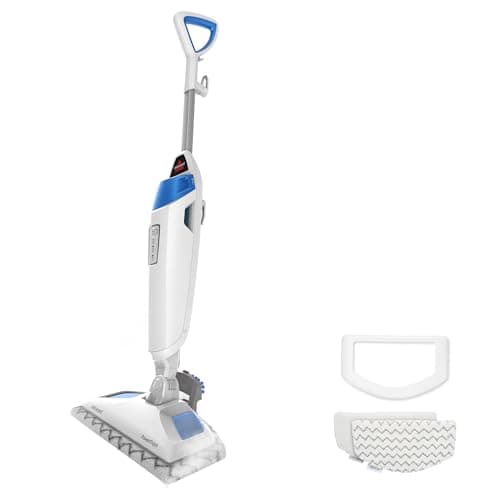
Product image from the Amazon listing.
Our verdict
Yes — the Bissell PowerFresh 1940A is worth $99 and is the specific steam mop most households should buy. Three steam settings (the critical feature) let you safely mop sealed hardwood on low, laminate on medium and grouted tile on high — all from the same tool. Kills 99.9% of germs with just water (no chemicals), the swivel head reaches under cabinets, and the washable microfiber pads outlast hundreds of Swiffer refills. Break-even on chemical-free savings vs a Swiffer WetJet happens in year one. Not the right tool for unsealed hardwood, waxed floors or heavy-debris pickup (sweep or vacuum first) — but for weekly deep-clean mopping on any hard floor, it's the reference pick. Independent reviewers from Consumer Reports to Bob Vila agree, and 50,000+ Amazon reviewers confirm.
The short version
The Bissell PowerFresh 1940A has quietly become the default steam mop recommendation across independent reviews (Good Housekeeping, Consumer Reports, Bob Vila) for one specific reason: three steam settings. Cheap steam mops give you one blast level, which is fine on tile and disaster on hardwood — too much moisture warps sealed wood. The PowerFresh's SmartSet Digital Steam Control lets you dial down for delicate oak, mid for laminate, and full-blast for grouted tile, all on the same mop. Add the swivel triangular head that reaches under cabinets, the two included microfiber pads (soft for daily cleaning, scrubby for stuck-on grime), and the ability to add optional 'spring breeze' scent discs to the water tank, and it's the steam mop most households actually should own. It's not a wet-dry vacuum, doesn't replace a broom, and doesn't work on unsealed floors — but for the specific job of chemical-free daily mopping on tile, hardwood, laminate and vinyl, at $99, it's the smart-money pick.
Pros & cons
Pros
- Three steam settings — critical for hardwood vs tile
- Kills 99.9% of germs on sealed hard floors without chemicals
- Swivel triangular head reaches under cabinets and around toilets
- Washable microfiber pads (2 included — soft and scrubby)
- Fragrance discs for optional Spring Breeze scent
- Ready to steam in 30 seconds
- Compact — stores vertically in a broom closet
Cons
- Needs distilled water in hard-water areas to prevent mineral buildup
- Corded — 25-foot cord tethers you
- Not for unsealed hardwood, waxed or oiled floors
- Pad-changing is easy but hands get warm
Why people love it
Fill and heat
Fill the tank with clean water (distilled is best in hard-water areas), plug in, and the SmartSet control heats water to over 200°F in about 30 seconds — no waiting for a boiler-style heat-up.
Pick your steam setting
Three digital settings: low for delicate hardwood and laminate, medium for daily mopping on sealed hard floors, high for grouted tile and heavy-soil messes. Adjust on the fly with the dial.
Push, don't scrub
Slowly push the mop head across the floor at a natural walking pace — the steam sanitizes and loosens grime, the microfiber pad wipes it away. Refill tank as needed (about 15 minutes per full tank).
Who it's for
- Households with sealed hardwood, tile, laminate or vinyl floors
- Anyone tired of the sticky residue of Swiffer WetJet
- Pet owners cleaning up daily paw marks and tracked-in dirt
- People with mixed flooring (hardwood + tile + laminate) needing one mop
- Chemical-sensitive households wanting to clean without cleaners
Is the Bissell PowerFresh worth $99, or should you just buy a Swiffer WetJet?
The comparison people actually make. A Swiffer WetJet costs $25-30, uses disposable pads and disposable cleaning solution refills, and works fine for daily quick cleanups. The math over time isn't kind, though: Swiffer WetJet solution refills cost $6-8 for 25oz (roughly a month of daily light use), and Swiffer pads cost $15 for 24 (a couple months of light use). A household using the WetJet weekly spends $80-120 per year on refills. Over 5 years, that's $400-600 on consumables, plus the WetJet itself dying every 2-3 years from battery or motor failure. The PowerFresh at $99 uses no chemicals (just water) and washable pads, so the ongoing cost is effectively zero — just water and occasional dishwasher-safe pad washes. Break-even happens in year one on chemical savings alone.
The other consideration is what actually cleans. The WetJet sprays a cold cleaning solution and drags a pad over it — the pad picks up loose debris but the solution leaves a sticky residue that pet paws and bare feet track around later. The PowerFresh's steam sanitizes at 200°F+ (well above kill temperature for common bacteria and germs) without chemical residue, so the floor dries clean rather than sticky. For hardwood floors specifically, the WetJet's continuous moisture spray is aggressive on sealed wood; the PowerFresh's low steam setting is gentler. For daily quick 'wipe up the coffee spill' cleaning, the WetJet is faster. For weekly deep-clean mopping on any floor type, especially hardwood, the PowerFresh is the smarter tool. Many households own both — WetJet for spot cleanups, PowerFresh for weekly deep clean.
Bissell PowerFresh vs Shark Steam Pocket vs Bissell PowerFresh Pet vs Steamfast: choosing between steam mops
The steam mop market has four legitimate contenders and each fills a slight niche. Bissell PowerFresh 1940A (~$99) is the reference model — three steam settings, swivel head, fragrance-disc slot, and consistent independent-review praise. It's the pick for households with mixed flooring including hardwood. Shark Steam Pocket Mop (~$70) is the value competitor — one steam setting, more limited but effective for tile-and-vinyl-only households where you don't need to dial steam down for hardwood. Bissell PowerFresh Pet (~$120) is the same core mop with an added scrubby-brush attachment and pet-formula fragrance disc — worth the upcharge for heavy pet-mess households, redundant otherwise. Steamfast SF-140 (~$60) is the budget option — heavier steam output, no variable settings, more of a scrub-tile-and-grout tool than a general daily mop.
For most households, the standard PowerFresh 1940A is the right choice: variable steam handles hardwood safely, price is reasonable, and Bissell's parts availability means replacement pads and gaskets are easy to find years later. Get the Pet version only if you have multiple pets and daily paw-mud cleanup. Get the Shark only if you have exclusively tile/vinyl floors and want to save $30. Get the Steamfast only if your primary use case is grout scrubbing rather than general mopping. Skip cheaper unknown-brand steam mops on Amazon — the pump and heating element are the failure points, and no-name brands don't stock replacement parts. A $99 PowerFresh from a known brand outperforms and outlasts a $40 no-name unit.
How to actually mop a house with the Bissell PowerFresh (the technique that separates fast, clean floors from slow, streaky ones)
The single biggest mistake first-time steam-mop users make is treating it like a wet mop and scrubbing back and forth. Steam mops work by push-and-glide: the microfiber pad drags across the floor at a slow walking pace while the steam sanitizes and loosens grime, and the pad wipes it clean in a single forward motion. Scrubbing back and forth pushes debris around rather than picking it up. Correct technique: prep the floor by sweeping or vacuuming first (steam mops don't pick up debris, and mopping over crumbs leaves streaks), fill the tank with distilled water, pick the right steam setting (low for hardwood, medium for laminate and vinyl, high for grouted tile), and mop in slow overlapping strokes moving away from the door toward your exit point.
Room-by-room, plan the order: bedrooms and guest rooms first (least dirty), then living areas, then kitchen and bathrooms (dirtiest). This keeps the pad reasonably clean through the whole cycle. Change to a fresh pad when you finish the bathroom or kitchen — dragging that pad back through living areas contaminates them. On heavy-grime spots (stovetop drips, pet accidents), let the mop sit stationary on high steam for 10-15 seconds before wiping, then push through. On grout, use the scrubby side of the microfiber pad and slower strokes. Empty and refill the tank when it runs low mid-job (about 15 minutes per full tank). Total time to steam-mop a 2,000 sq ft house: 45-60 minutes including refills. For daily light spot cleaning between weekly steam-mopping, keep a bottle of Bona (hardwood) or 50/50 water-and-vinegar (tile) spray on hand for quick 'wipe up the coffee spill' cleanups without hauling out the full mop. Pair with the Ninja Air Fryer for the third leg of the modern kitchen: cook clean, mop clean, and stay off harsh chemicals for both.
See Bissell PowerFresh Steam Mop on Amazon
Check the latest price, photos and buyer reviews on Amazon.
Check Price on Amazon →Sold and shipped by AmazonFrequently asked questions
Is the Bissell PowerFresh actually safe on hardwood floors?
Yes — on sealed hardwood floors, using the low steam setting and a soft microfiber pad. This is the specific reason the PowerFresh keeps beating cheaper steam mops in independent tests: three steam settings let you dial down moisture for delicate flooring. Sealed hardwood (polyurethane or wax-sealed) can handle occasional low-steam mopping without warping or damage. What it's not safe on: unsealed hardwood (raw or oiled wood — steam soaks in and warps), waxed floors (steam melts the wax finish), engineered hardwood with damaged seals (moisture seeps into the wood layers), or any floor with visible cracks or gaps between planks (moisture pools underneath). Test in an inconspicuous corner first, use the low setting for hardwood, and don't leave the mop stationary on any wood surface — keep it moving. For heavy-daily hardwood mopping, the Bona wood floor spray mop system is a lower-moisture alternative worth considering.
Bissell PowerFresh vs Shark Steam Mop: which is better?
The PowerFresh wins in independent testing for one specific reason: variable steam control. Shark's basic Steam Pocket Mop has one steam setting; the PowerFresh has three. On hardwood and delicate laminate, the ability to dial down steam is the difference between clean floors and warped ones — and hardwood is the majority of American homes. Shark's advantages: usually cheaper ($60-80 vs $90-100 for PowerFresh), often easier to find in stock, and the pocket-style pad system is arguably easier to change than the PowerFresh's Velcro pads. Both use similar 1,200-1,500 watt heaters and reach roughly the same steam temperature. For pure tile or vinyl floors, Shark is a fine cheaper alternative. For mixed flooring (especially with hardwood), the PowerFresh's variable steam is worth the modest price bump.
Do I need to add cleaning solution to the Bissell PowerFresh water tank?
No — that's the whole point. The PowerFresh uses steam alone to sanitize and clean, no chemicals needed. Adding cleaning solutions or vinegar to the tank is explicitly against Bissell's recommendation and can void the warranty — cleaning agents in the tank can leave residue on the heating element, clog the steam nozzle, or damage internal parts. The only additions Bissell approves are their own Spring Breeze fragrance discs, which sit in a separate scent chamber outside the water path. If you need extra cleaning power for greasy or heavy-soil stains, pre-treat the specific spot with a floor-appropriate cleaner (dilute white vinegar for tile, Bona for hardwood), wait 5 minutes, then steam-mop as usual. The steam is enough for 95% of daily cleaning tasks.
How often should I use the Bissell PowerFresh, and can I use it too much?
Once or twice a week is optimal for most floors. Daily steam mopping is fine for tile and vinyl but excessive for sealed hardwood — even low-setting steam adds moisture, and daily exposure over years accelerates wood-floor wear. Practical schedule: high-traffic zones (kitchen, entryway) once a week with the PowerFresh, plus dry sweep/vacuum daily to remove grit. Low-traffic zones (bedrooms, guest rooms) every 2-3 weeks. Full house deep clean once a month. For pet households or homes with kids, bump kitchen and entryway to twice a week. Signs you're over-mopping hardwood: dull finish, gray discoloration, or squeaking planks — these indicate accumulated moisture damage. Reduce frequency if you see any of these. For daily-mopping zones like kitchens, pair the PowerFresh with a good robot vacuum like the Roborock for daily dry pickup, and steam-mop weekly for deep clean.
Bissell PowerFresh vs a wet-dry vacuum like the Bissell CrossWave: which should I buy?
They solve different problems. The PowerFresh steam mop uses hot steam to sanitize and loosen grime on already-swept floors — great for daily maintenance mopping, kills germs without chemicals, but doesn't pick up debris. You need to sweep or vacuum first before using the PowerFresh. The Bissell CrossWave Cordless Max is a wet-dry vacuum that scrubs AND vacuums simultaneously — it lifts wet spills, sucks up loose debris, and scrubs the floor in one pass. Costs more (~$400 vs $99 for PowerFresh) but replaces two steps. For most households, the PowerFresh is the better first buy — cheaper, targeted at the specific job of steam-sanitizing, and works alongside your existing vacuum. Upgrade to the CrossWave if you want one-tool floor cleaning and are willing to pay for the convenience.
How do I clean and maintain the Bissell PowerFresh so it lasts?
Two main maintenance tasks. First: empty the water tank after every use. Leaving water in the tank causes bacterial growth (the tank isn't cold-sanitized) and mineral buildup from tap water evaporating. Empty, rinse, and let air-dry before storing. Second: wash microfiber pads regularly. After 2-3 uses, throw the pad in the washing machine on warm with mild detergent (no fabric softener — it clogs the microfiber). Air-dry or tumble-dry low; high heat degrades the microfiber over time. For hard-water areas, use distilled water in the tank exclusively — tap water mineral buildup will clog the steam nozzle within 6-12 months, at which point the mop stops producing steam. If the mop's steam output diminishes, run a descaling cycle (fill with 1:1 distilled water and white vinegar, steam-mop over an old towel for 5 minutes, then rinse the tank thoroughly with clean water). Done properly, the PowerFresh lasts 5-8 years of weekly use.
As an Amazon Associate, TopCrate earns from qualifying purchases at no extra cost to you. Steam mops are not safe on unsealed hardwood, waxed floors or damaged flooring — test in an inconspicuous area first and follow your flooring manufacturer's care guidelines. Product image, price, availability and ratings are shown on Amazon and are subject to change.