SLEEP HEALTH
Why Do I Wake Up With a Stiff Neck? The Six Real Causes — and the Fix That Solves Most of Them
It isn't 'you slept wrong.' It's your pillow height vs. your sleep position, an eight-hour slack in blood flow, and — on 60% of American beds — a pillow past its structural expiration date. Here's what's actually happening at 3 a.m., and the ranked list of fixes.
You open your eyes, try to turn your head toward the alarm, and stop halfway. The right side of your neck is locked, the trapezius on top of your shoulder feels like it's been wrung out, and rotating to check your blind spot on the drive to work is going to be a project. If this pattern shows up two or three mornings a week — or every single morning — it isn't 'you slept wrong,' and it isn't bad luck. Waking up with a stiff neck is almost always a mechanical problem you can trace to one of six specific causes, most of which involve what your head was resting on for the last eight hours.
What happens to the neck overnight is quiet but real: blood flow drops in the small muscles that hold the head steady, the cervical discs between your vertebrae rehydrate and expand, and any tension you carry — clenched jaw, hunched shoulders, arm tucked under a pillow — gets locked in for the duration of the sleep cycle. Add a pillow that's too tall, too flat, or worn out, and the neck spends eight hours in a slightly bent position that a healthy neck would never voluntarily hold for eight minutes. The fixes below are ranked by what actually solves it in the highest percentage of households, starting with the one that fixes about half of morning-neck cases on its own.
First: what a neck actually needs from a pillow (the geometry nobody explains)
The cervical spine has a natural forward curve — a shallow C — and its job at night is simple: stay in that curve, regardless of whether you're on your back, your side, or (unfortunately) your stomach. When the curve is preserved, the small stabilizer muscles along the spine can relax; when it isn't, those muscles fire all night to try to hold your head in a position it shouldn't be in, and by morning they're spent. That's the ache. It isn't inflammation or an injury — it's eight hours of low-grade contraction in muscles that were supposed to be resting.
The pillow's whole job is filling the gap between the mattress and the base of your skull so the curve stays intact. On your back, that's about 3–4 inches of loft (the height of the pillow under the neck). On your side, it's 4–6 inches (higher, because your shoulder is between the mattress and your ear). On your stomach — the position that will keep coming up in this piece for bad reasons — the correct pillow loft is zero, and even zero doesn't fix the neck-rotation problem. Whether a pillow supports the curve depends on its loft, its firmness, and whether it holds shape all night. Getting any one of those three wrong is the mechanical cause of most morning stiffness.
Cause #1: your pillow height is wrong for your sleep position (the biggest single factor)
A pillow that's too tall pushes your head forward — chin toward chest — and stretches the muscles along the back of the neck for hours. A pillow that's too flat lets your head drop back or, worse, sideways on a side-sleeping night, kinking the neck laterally. Either extreme produces the exact same 6 a.m. locked-neck feeling, which is why 'get a firmer pillow' or 'get a softer pillow' advice from a friend so rarely helps: the problem isn't firmness, it's loft height matched to your position. Back sleepers on a tall down pillow, side sleepers on a flat memory-foam slab, and stomach sleepers on anything at all are the three most common versions of this mistake.
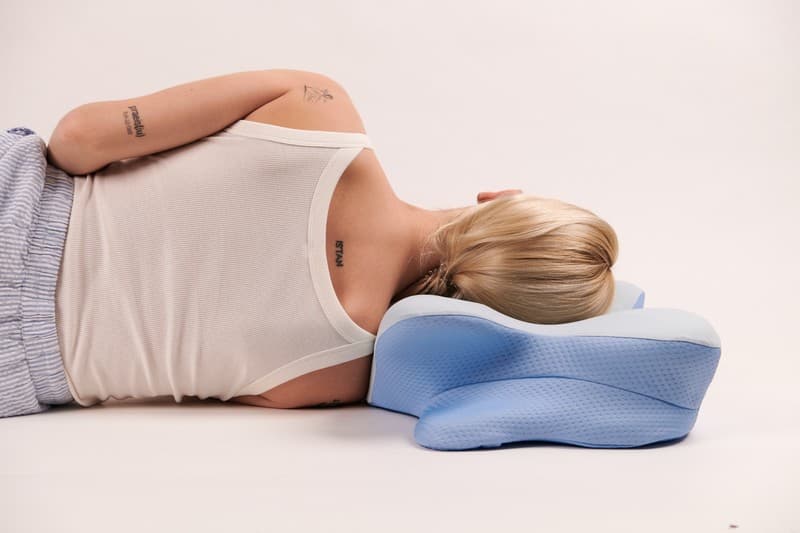
The clean fix is a shaped pillow that provides the correct loft for each position simultaneously — a lower center dimple for the head on the back, a raised front ridge to fill the neck's curve, and taller side wings for side sleeping when you roll. The Derila is the mainstream example: a butterfly-contoured memory-foam pillow with those three zones built into one shape, so back and side sleepers both wake up with the curve intact without swapping pillows in the middle of the night. A contoured memory foam pillow is not a marketing gimmick for this problem — the shape is doing the work a flat rectangle physically cannot do, no matter how expensive the fill is. If your neck stiffness is worse on nights you slept mostly on your back, or on nights you rolled from back to side more than usual, cause #1 is very likely what's happening, and a shaped pillow is the direct fix.
Cause #2: you slept on your stomach (the position that never gets a pass)
Stomach sleeping keeps the neck rotated 80–90° to one side for the entire night. There is no pillow geometry that solves this — the mechanical problem is the rotation itself, not the loft under the head. The stabilizer muscles along one side of the neck are stretched to their end range for eight hours while the muscles on the other side are fully bunched, and the small facet joints of the upper cervical spine are held at the edge of their travel. You wake up with the pain concentrated on one side (whichever way you turned your head), and the ache often runs down into the shoulder blade on that same side.
Sleep researchers essentially agree that back and side are neutral positions and stomach is not. The realistic path off stomach sleeping is a body pillow to hug — the arms and knees wrap around it, which physically stops the roll back onto the belly during light sleep — combined with a slightly taller pillow that discourages the head from dropping flat. Reading our body pillow piece walks through the sizing decision and why a full-body-length model outperforms a half-length one for stomach-sleepers trying to switch. Give it a two- to three-week runway: the first three nights on your side feel wrong, the fourth night is neutral, and by the third week your neck will tell you it's the switch that worked.
Cause #3: your pillow is spent (and you probably don't realize it)
Pillow fill has a shelf life. A cheap polyester-filled pillow collapses in 6–18 months of nightly use; a decent memory-foam or latex pillow lasts 3–5 years; a top-tier one might make 7. The failure mode isn't 'the pillow explodes' — it's a slow, invisible collapse where the fill compresses under your head and stays that way. From above the pillow looks the same; underneath the pillowcase it's a shallow bowl. The fold test tells you immediately: fold the pillow in half, and if it doesn't spring back open on its own within about a second, the fill is done. A spent pillow can't hold loft, which means your neck bends more overnight than the pillow's original design allowed for, and every symptom of cause #1 reappears even though the pillow you bought years ago used to work.
The pattern most households don't catch: the pillow started fine, gradually declined, and the mornings-with-stiffness slowly got more frequent. There was never a specific bad night — the fill just got tired over hundreds of washes and thousands of head-hours. Replacing a spent pillow with something structurally serious — memory foam that keeps shape, or a shredded-foam pillow with adjustable fill — is often the single change that fixes chronic stiffness in someone whose sleep position and mattress are otherwise fine. If you own the same pillow you had four presidential elections ago, this is probably part of your problem.
Cause #4: overnight dehydration and disc rehydration make everything worse
The intervertebral discs in your spine are ~80% water, and they rehydrate at night — you're literally 1–2 cm taller when you wake up than when you went to bed for that reason. That process is normal and healthy, but it also means the discs and surrounding tissues are more turgid in the morning, more sensitive to any joint that spent the night out of position. On top of that, most people are mildly dehydrated by morning simply because 6–8 hours have passed without fluid intake, and dehydrated muscles are stiffer and more prone to spasm than well-hydrated ones. A stiff neck at 6 a.m. can genuinely feel worse than the same amount of muscular fatigue would at 3 p.m.
The intervention is boring and effective: a full glass of water within five minutes of waking up, and gentle range-of-motion movement (slow head turns, chin tucks, shoulder rolls) for two or three minutes before you do anything else. This doesn't fix a mechanical cause — if your pillow is wrong, water won't save you — but it dramatically reduces the amplitude of the morning stiffness even on a well-supported neck. Skipping it is why 'my neck is always worst first thing and eases by lunch' is such a common description: the stiffness peak is amplified by the overnight dehydration and eases as normal activity restores fluid and blood flow to the tissues.
Cause #5: nighttime jaw clenching (bruxism) transmits directly into the neck
The muscles that clamp your jaw shut — the masseter and the temporalis — are anatomically continuous with the muscles that stabilize the front of the neck and the base of the skull. When you grind or clench your jaw at night (a much more common condition than people realize; dentists estimate roughly one in three adults do it), that low-grade contraction transmits straight through to the suboccipital muscles at the back of the head and the sternocleidomastoid along the front of the neck. You wake up with a stiff neck, an ache behind the ears, and often a mild tension headache — a package that gets blamed on the pillow but is actually being generated by the jaw.
The telltale sign is jaw soreness first thing in the morning, sore back teeth on chewing, or a dentist who's mentioned wear on your molars. The fix is a night guard fitted by a dentist (drugstore boil-and-bite versions work for confirmation but wear out fast), plus jaw-relaxation exercises before bed. Stress-driven bruxism responds to the same things that help general nighttime tension — a colder bedroom, magnesium supplementation, and the wind-down techniques covered in how to fall asleep with a racing mind. If cause #5 is the actual driver, a new pillow won't fix it and a night guard will.
Cause #6: your mattress cover is slick and your head slides off center all night
This one is smaller in impact than the others but it stacks on top of them. Modern mattress covers are often cool-touch fabric or slick quilted polyester — the same surfaces that make a fitted sheet pop off — and a slick surface lets a shaped pillow slide sideways by a few inches during a restless night. Your head follows, and by morning you've drifted onto the flat wing of the pillow instead of the contoured center. The fix is a pillowcase with some friction (cotton percale or bamboo rather than sateen or silk) plus, on a truly restless bed, a pillow with a wider footprint that has room to drift without leaving the support zone. This won't fix a wrong-loft or spent pillow, but it eliminates the specific 'the pillow was fine when I went to sleep' version of the problem.
If you already run silk or satin pillowcases for hair reasons and don't want to give them up, a wider or heavier pillow (memory foam is denser than down and moves less) offsets the slippage. Between mattress cover choice, pillowcase texture, and pillow weight there's usually a combination that keeps the pillow put — the fix is finding which of the three is the loose link in your specific bed.
The morning-of fixes (versus the overnight prevention)
Once you wake up with a stiff neck, the sequence that helps most is: 15–20 minutes of cold pack on the sore area if the pain is sharp and localized (reduces the acute muscle spasm), a hot shower directed at the neck and shoulders if it's more of a dull all-over ache (relaxes the muscles and restores blood flow), gentle range-of-motion movement — slow chin tucks, head turns to each side, shoulder rolls, no forcing — and an over-the-counter anti-inflammatory if you tolerate them. Skip aggressive stretching, sudden neck cracks, and 'sleeping it off' by going back to bed on the same pillow. None of these fix the cause; they manage the symptom while you address whichever of causes #1–5 is actually running your mornings.
The overnight prevention is where the real change happens. If you're a side or back sleeper on a flat, spent pillow: switch to a shaped memory-foam pillow like the Derila — the neck ridge holds the cervical curve you need, the head cradle keeps you centered, and dense foam doesn't collapse the way polyester fill does. If you're a stomach sleeper working toward the side: pair the shaped pillow with a full body pillow. If jaw clenching is real: get a fitted night guard. The best pillow for neck pain piece walks through the specific shapes and heights to look at for each situation, and the wedge pillow is worth reading if reflux or sleep apnea is compounding the problem.
When morning neck pain isn't about how you slept
A minority of morning-stiffness cases have nothing to do with the pillow. Red flags that warrant a doctor visit rather than a new pillow: pain that shoots down one arm past the elbow, numbness or tingling in the hand or fingers, weakness in the grip, headache with fever and a stiff neck (that's a medical urgency, not a sleep issue), or a stiff neck that's been getting worse for weeks despite pillow changes and doesn't ease by mid-morning. Herniated cervical discs, radiculopathy, and inflammatory conditions like early rheumatoid arthritis all show up in ways that look like morning stiffness at first, and they need imaging or lab work, not a pillow swap.
The reassuring version: garden-variety morning neck stiffness that eases within a couple of hours, has no radiating pain, and improves when you change pillows or sleep positions is almost always mechanical. The six-cause list above covers the overwhelming majority of it, and the interventions — a shaped pillow, a night guard if you clench, better hydration, off the stomach if you sleep there — genuinely fix the pattern within one to three weeks in most households. If you've worked through those and the pain is still with you, that's the point where a physical therapist or an orthopedist starts to add value beyond what a pillow choice can do.
See the Derila review
A butterfly-contoured memory-foam pillow with a head cradle, a raised neck ridge, and taller side wings — one shape that holds correct loft for back and side sleepers without collapsing the way polyester fill does. The direct mechanical fix for causes #1 and #3 above.
See the Derila reviewFrequently asked questions
Why do I wake up with a stiff neck every morning?
Almost always one of six mechanical causes: (1) your pillow is the wrong height for your sleep position — too tall pushes the chin forward, too flat lets the head drop; (2) you sleep on your stomach, which rotates the neck 80–90° for hours; (3) your pillow has quietly lost loft and no longer supports the cervical curve; (4) overnight dehydration and normal disc rehydration amplify any position problem; (5) you clench your jaw at night, which transmits tension straight into the neck; or (6) the pillow slides on a slick mattress cover and you drift off the support zone. A shaped contoured memory foam pillow fixes the loft and geometry issues that drive cases #1 and #3, which together account for over half of persistent morning stiffness.
What's the best sleep position to avoid a stiff neck?
Back sleeping is the neutral gold standard for the neck — the head and neck stay in line with the spine, and a shaped pillow with a 3–4-inch neck ridge holds the natural cervical curve overnight. Side sleeping is a close second when the pillow height matches the width of your shoulder (typically 4–6 inches of loft, higher for broad-shouldered sleepers). Stomach sleeping is the only position with no good pillow answer, because the problem is the neck rotation itself, not the loft under the head — and it consistently produces one-sided morning pain. If you're a stomach sleeper trying to switch, a body pillow to hug is the most effective retraining aid.
Can the wrong pillow really cause morning neck pain?
Yes — and it's the single most common cause in adults without an underlying medical issue. The pillow's job is filling the gap between the mattress and the base of your skull so your cervical spine stays in its natural forward curve for the whole night. A pillow that's too tall bends the neck forward; too flat lets it drop; too soft collapses under head weight and lets both happen. The stabilizer muscles then fire for eight hours trying to hold the head in a position it shouldn't be in, and by morning they're exhausted. A shaped memory-foam pillow like the Derila is designed specifically to fix this, with a head cradle to center the skull, a neck ridge to fill the curve, and wings that provide correct loft for side sleeping.
How do I get rid of morning neck stiffness fast?
For sharp, localized pain: 15–20 minutes of a cold pack on the sore muscle reduces the acute spasm. For a dull all-over ache: a hot shower directed at the neck and upper shoulders eases it faster than a heating pad because the moving water combines heat with light massage. Follow either with slow, controlled range-of-motion (chin tucks, gentle head turns, shoulder rolls — no forcing, no cracking), a full glass of water, and light movement rather than going back to bed. Over-the-counter anti-inflammatories help if you tolerate them. These are symptom management; the underlying fix is whichever of the six causes is running your nights.
Does drinking water before bed actually help with neck stiffness?
It helps modestly. Overnight dehydration amplifies morning muscle stiffness — your muscles are literally less pliable when you're mildly dehydrated, and 6–8 sleeping hours are a long stretch without fluid. A glass of water in the evening (not right before bed — you'll wake up to use the bathroom) plus a full glass within five minutes of getting up shortens the stiffness peak on any given morning. It won't fix a wrong-loft or spent pillow, though, so treat it as a stack-on-top intervention rather than a solution. The main event is the geometry: the correct pillow for your sleep position and one that hasn't collapsed.
How often should I replace my pillow if I keep waking up with neck pain?
Sooner than the label suggests, and much sooner than most people actually do. A budget polyester-fill pillow collapses within 6–18 months of nightly use. A quality memory-foam or latex pillow lasts 3–5 years; a top-tier one might reach 7. Use the fold test: fold the pillow in half, and if it doesn't spring back open on its own within about a second, the fill is spent. A pillow that fails the fold test can't hold the loft your neck needs, even if it still looks fine from above. If you own the same pillow you had five-plus years ago and mornings are consistently rough, replacing it — ideally with a shape-holding contoured memory foam pillow — is the highest-leverage fix in the whole category.
When should I see a doctor about morning neck pain?
Get evaluated if the pain shoots down one arm past the elbow, if you have numbness, tingling, or weakness in a hand or fingers, if it comes with a headache and fever (that's a medical urgency), if it's been progressively worsening for weeks despite pillow changes, or if it doesn't ease at all as the morning goes on. Those patterns point at nerve involvement, disc issues, or inflammatory conditions that need imaging or blood work rather than a pillow swap. Ordinary mechanical stiffness — the kind that improves when you change pillows or sleep positions and eases by mid-morning — is almost never a medical problem, but the red flags above are worth taking seriously the first time they appear.
TopCrate is reader-supported. When you buy through links on our site we may earn an affiliate commission, at no extra cost to you. Content is for general information and isn't a substitute for professional advice.