SLEEP 101
Best Pillow for Neck Pain: How to Pick the Right One for How You Sleep
Why pillow height matters more than pillow price, the right loft for every sleep position, and the honest truth about what a new pillow can and can't fix.
Your pillow decides what angle your neck spends eight hours at every single night — and if you keep waking up stiff, sore, or turning your whole torso to check your blind spot, it's a prime suspect. The frustrating part is that most people shop for pillows by squeezing them in a store aisle, which tells you almost nothing. What actually matters is measurable: whether the pillow holds your head in line with your spine in the position you actually sleep in.
This guide covers how the wrong pillow aggravates neck pain, the right pillow height for side, back, and stomach sleepers, how the major pillow types compare, and why an adjustable-fill pillow is the safest bet if you're not sure. One thing to be clear about up front: a pillow is a comfort and support product, not a medical treatment. It can stop making things worse and help you sleep more comfortably — but persistent or worsening neck pain is a conversation for a doctor, not a checkout page.
Why the Wrong Pillow Makes Neck Pain Worse
Your cervical spine — the seven vertebrae in your neck — wants to stay in a neutral line with the rest of your spine while you sleep. A pillow's entire job is to fill the gap between your head and the mattress so that line stays straight. Too tall, and your head gets propped up at an angle all night; too flat, and it sags below your shoulders. Either way, the muscles and ligaments in your neck spend hours gently strained in one direction, and you wake up feeling it.
The test is simple: in your normal sleep position, your ear, shoulder, and hip should form a roughly straight line. Lying on your side, your nose should point straight ahead, not tilted toward the ceiling or the mattress. If a housemate can eyeball you (or you can prop up a phone camera), a ten-second check tells you more than any product page. A pillow that passes this test in your sleep position is doing its job; one that fails it is quietly undoing your night, no matter what it cost.
Pillow Height by Sleep Position: The Loft Cheat Sheet
Loft — pillow height under the weight of your head — is the single most important spec, and the right number depends almost entirely on how you sleep. Side sleepers need the most: roughly 4 to 6 inches, because the pillow has to fill the full gap from ear to mattress created by your shoulder. Broad shoulders push you toward the high end; a taller pillow that would look absurd on a back sleeper is exactly right here.
Back sleepers want a medium loft, roughly 3 to 5 inches — enough to support the natural forward curve of the neck without shoving the chin toward the chest. Stomach sleepers need the least: a thin pillow under 3 inches, or none at all, because any real height forces the head up and back while it's already turned to the side. Stomach sleeping is honestly the roughest position for a neck — if that's you and your neck complains regularly, a body pillow can help you migrate toward side sleeping over a few weeks.
Pillow Types Compared: Contour Memory Foam, Adjustable, Latex, Feather
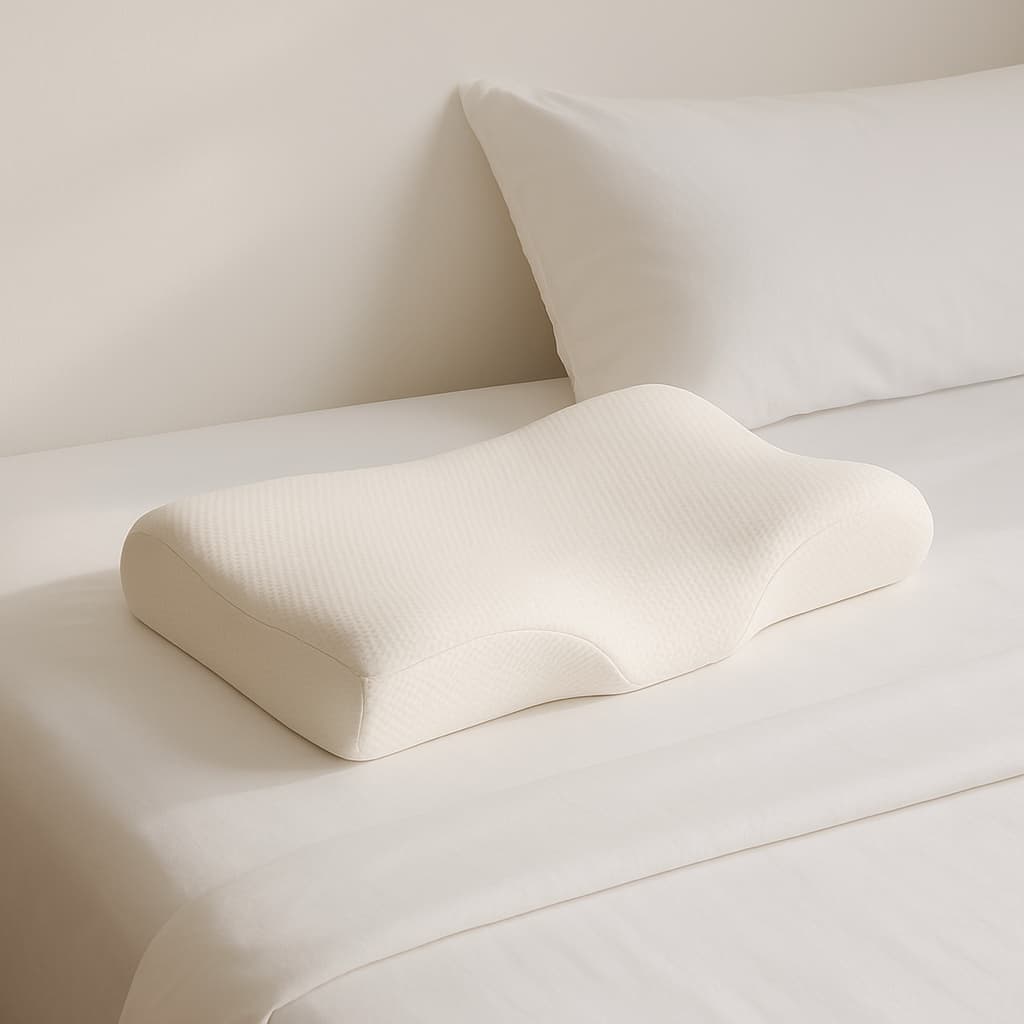
Cervical or contour memory foam pillows are molded with a wave shape — a raised ridge under the neck and a dip for the head. When the height happens to match your frame, they're excellent at holding a neutral line. The catch is that the height is fixed: if the ridge is a half-inch off for your shoulders, you can't fix it, and there's usually an adjustment period of a few nights even when it fits.
Latex pillows are springy rather than sinky, hold their loft for years, and sleep cooler than most memory foam — and what research exists on pillows and neck comfort tends to favor supportive, shape-holding designs like contoured latex over soft, collapsing ones. Feather and down pillows are the opposite story: luxuriously soft, but they flatten under a head's weight within hours, which means your loft at 3 a.m. is not your loft at bedtime. For a neck that's already unhappy, that inconsistency is the problem, not the softness.
The common thread: material matters less than whether the pillow holds the right height for your position all night. A perfectly fitted cheap pillow beats an ill-fitting expensive one every time.
Why Adjustable Fill Is the Safe Default
Here's the uncomfortable truth about buying any fixed-height pillow online: you don't actually know your ideal loft. It depends on your shoulder width, your mattress firmness (a soft mattress swallows your shoulder and lowers the gap), and your sleep position — and nobody measures those before checkout. Adjustable-fill pillows solve this by letting you open a zipper and add or remove shredded foam until the height is right for you, in your bed, in your position.
The Coop pillow is the textbook example of the type: a zippered shell full of shredded memory foam, plus a bag of extra fill, so side sleepers can pack it tall and back sleepers can thin it out. Sleepgram gets to the same destination a different way, with removable inner inserts you mix and match instead of loose fill — less fine-grained, but tidier to adjust. Either approach turns pillow height from a gamble into a dial, which is exactly what you want when your neck is the thing at stake. If you want specific picks by budget and position, our best pillows guide ranks the ones we'd actually put on the bed.
When to Replace Your Pillow — and When to See a Doctor
Pillows wear out faster than people think. Most have a useful life of roughly 18 to 36 months: budget polyester fill sits at the short end, memory foam in the middle, and latex at the long end. The fold test is a decent quick check — fold the pillow in half, and if it stays folded or creeps back slowly instead of springing open, the fill is done supporting anything. Lumps, permanent flat spots, and a neck that feels worse at dawn than at midnight are the other tells.
And the honest part: some neck pain is not a pillow problem. If your pain comes with numbness or tingling in your arms or hands, pain radiating down into a shoulder or arm, grip weakness, or it started after a fall or accident — or it simply persists for weeks despite a properly fitted pillow — see a doctor. Those are signs of something a pillow was never going to fix, and the right move is a diagnosis, not another round of bedding roulette.
See our Best Pillows of 2026 guide
Our tested picks by sleep position and budget — including the adjustable pillows we'd hand a sore neck first.
See our Best Pillows of 2026 guideFrequently asked questions
What pillow do chiropractors recommend for neck pain?
There's no single pillow the profession endorses. Most clinicians recommend whatever keeps your neck in a neutral line for your sleep position — commonly a cervical contour pillow or an adjustable-fill pillow you can tune to your frame. Fit matters far more than brand, and a pillow supports a sore neck rather than treating it.
Is memory foam or feather better for neck pain?
Memory foam, for most people. It holds a consistent height all night, while feather and down flatten under your head within hours, so your neck's angle drifts as you sleep. Latex is the other strong option — springier than memory foam and very durable. Feather pillows are lovely for comfort, but consistency is what a sore neck needs.
How high should my pillow be for neck pain?
It depends on position: side sleepers generally need 4 to 6 inches of loft to fill the shoulder gap, back sleepers do best around 3 to 5 inches, and stomach sleepers should stay under 3 inches or skip the pillow entirely. The goal in every case is keeping your ear, shoulder, and hip in a straight line.
Can a pillow really cause neck pain?
It can absolutely aggravate it. A pillow that's too tall or too flat holds your neck at a strained angle for hours every night, which is why the pain is often worst in the morning and eases as the day goes on. But persistent pain has many possible causes, so if a properly fitted pillow doesn't help within a few weeks, get it checked by a doctor.
How often should you replace a pillow?
Every 18 to 36 months for most pillows — sooner for cheap polyester fill, longer for latex. If it fails the fold test (fold it in half; it should spring back open), has permanent flat spots, or your neck feels worse in the morning than it did at bedtime, it's due.
Do cervical pillows actually work?
They can help you sleep more comfortably when the contour height matches your body and sleep position — the ridge supports the neck's natural curve. But the height is fixed, so a bad match can't be tuned, and expect a few nights of adjustment. They're a support product, not a treatment for an underlying neck condition.
TopCrate is reader-supported. When you buy through links on our site we may earn an affiliate commission, at no extra cost to you. Content is for general information and isn't a substitute for professional advice.