CLEANING 101
How to Wash White Clothes: Keep Whites White Without Wrecking Them
The sorting rule that saves entire loads, the truth about hot water, and an honest ranking of oxygen bleach, chlorine bleach, bluing, and plain sunshine.
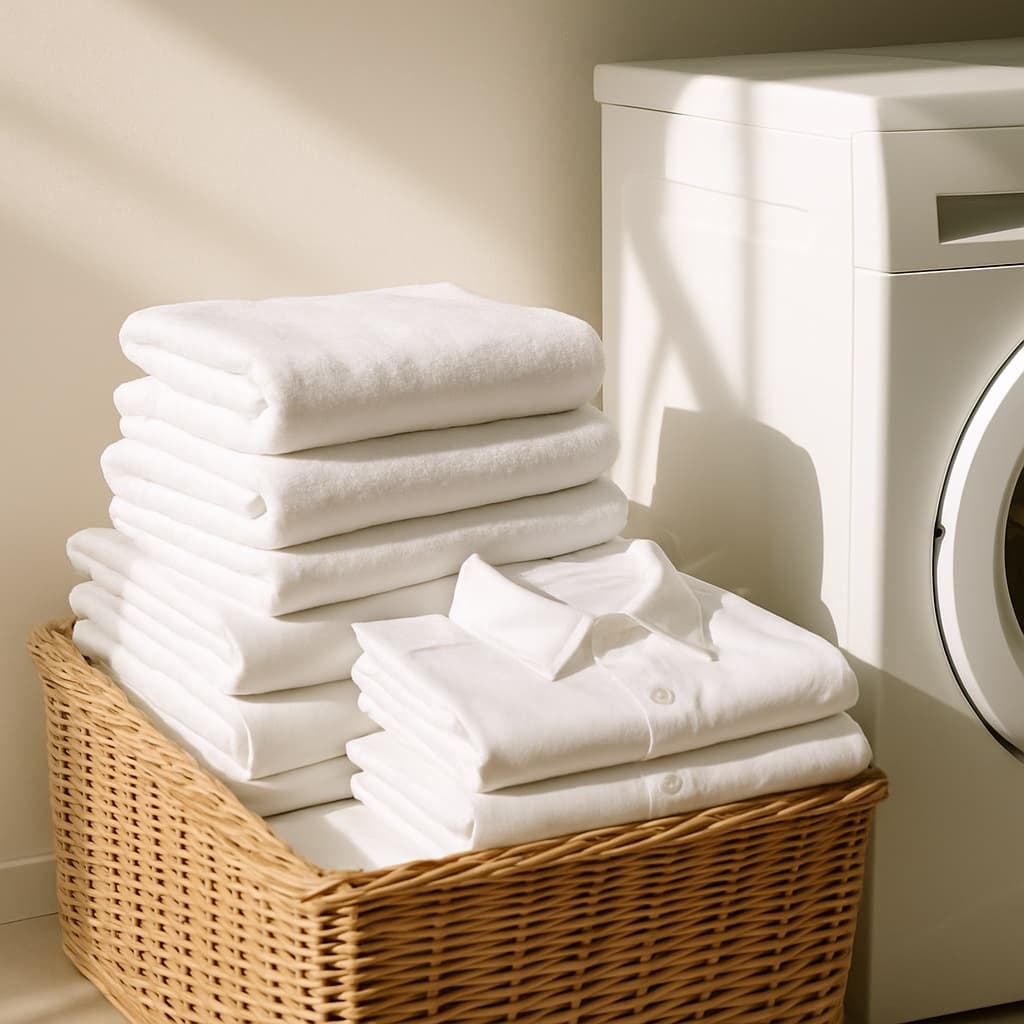
White laundry is binary: it's either crisp or it's telling on you. And dingy whites are rarely one dramatic accident — they're built one lazy load at a time, from a stray colored sock, water that's too cold, detergent doses that are too big, and body oils that never fully rinse out. The good news is that every one of those mistakes has a cheap, specific fix.
This guide covers the whole system: how to sort without mercy, what water temperature actually does, how much detergent whites really need, an honest comparison of the four big whiteners — oxygen bleach, chlorine bleach, bluing, and free sunshine — plus why whites go gray in the first place and the rinse trick that reverses it.
Sort Ruthlessly: Whites Wash Alone
The economics of the one red sock are brutal. Sorting a load costs thirty seconds; not sorting can cost the load. A single new red or navy item shedding dye in hot water can tint every white thing in the drum, and once that dye sets in the dryer, you're shopping, not laundering. Whites mean whites-only — not whites plus one pair of jeans, not whites plus a striped shirt that's 'basically white.'
The sneakier problem is low-grade transfer. Even without a pink catastrophe, washing whites with light colors deposits a trace of dye every single load, and that slow accumulation is a big part of why old white T-shirts look gray. Sort white items with colored logos or trim into the lights pile, and within the whites pile, split heavy cottons like towels from lighter shirts and delicates — they want different temperatures anyway.
Water Temperature: Hot, With Caveats
For cotton whites — towels, sheets, socks, underwear, T-shirts — hot water is the honest answer. Heat dissolves body oils and detergent far better than cold, and body oil is the main ingredient in yellowing. Use the hottest setting the care tag allows, and you'll get cleaner rinsing and brighter fabric from the exact same detergent.
The caveats matter, though. The care tag outranks this article: synthetics, elastane blends, and delicates usually want warm or cold, and hot water will shrink or shorten the life of garments that aren't built for it. And heat sets protein stains — blood and sweat should be pretreated or rinsed in cold water first, because a hot wash can cook those stains into permanence. Check that stains are actually gone before the dryer, too; dryer heat sets whatever the wash missed.
Detergent Dosing: Enough, but Not Extra
Detergent caps are optimistic by design. For a high-efficiency machine, roughly two tablespoons of a standard detergent handles a normal load — the top line on the cap is for marketing, not laundry. Every scoop beyond what the water can rinse away stays behind as a film on the fabric, and that film is a dirt magnet: it dulls whites, stiffens towels, and traps odor.
Underdosing has its own failure mode, especially in hard water: without enough detergent to keep loosened soil suspended, it redeposits onto the fabric, and whites come out grayer than they went in. If your water is hard, the fix isn't doubling the soap — it's adding a water-softening booster like borax or washing soda alongside a normal dose. Enzyme-based detergents earn their keep on whites, since enzymes digest the body-oil and protein soils that cause yellowing.
Oxygen Bleach vs. Chlorine Bleach: Know the Difference
Oxygen bleach — sodium percarbonate, the active ingredient in products like OxiClean — is the safe default. In water it releases hydrogen peroxide, which bleaches stains without the scorched-earth chemistry of chlorine. It's gentle enough for nearly every washable fabric except wool and silk, and it works on colors too. Its one demand is patience: oxygen bleach performs best as a warm-to-hot soak measured in hours, not as a scoop tossed into a 30-minute cycle.
Chlorine bleach is the nuclear option: genuinely powerful on white cotton and linen, and genuinely destructive to everything else. Never use it on wool, silk, spandex, or leather — it dissolves protein fibers and wrecks stretch, which is why bleached underwear waistbands give out. Always add it through the dispenser so it dilutes before touching fabric, and know that overuse yellows whites, defeating the whole point. Two hard safety rules: never mix chlorine bleach with vinegar (the combination releases toxic chlorine gas) and never mix it with ammonia (which produces chloramine gas). One product per load, full stop.
Bluing and Sunshine: The Old-School Whiteners
Laundry bluing is the great-grandmother trick that still works: a trace of blue pigment (Prussian blue, in the classic Mrs. Stewart's formula) added to the wash cancels out yellow tones optically, the same way violet shampoo neutralizes brassy hair. It doesn't remove anything — it color-corrects. The technique is all in the dilution: a few drops stirred into a quart of water before it goes anywhere near the machine. Pour it on straight and you'll own blue-spotted laundry. Skip it in any load with bleach, which reacts badly with the pigment.
Sunshine is the only whitener that's completely free. UV light breaks down the compounds that make fabric look yellow, which is why line-dried whites come off the line noticeably brighter — a mild, slow-motion bleaching with a fresh-air smell as a bonus. Drape whites in direct sun and let physics work. It's colorfast whites only, though: the same UV that brightens whites fades colors.
Why Whites Go Gray — and How to Reverse It
Grayed and yellowed whites are almost always a residue story: detergent film, fabric softener, hard-water minerals, and body oils layering up wash after wash until the fabric itself is coated. Overloading accelerates it — a stuffed drum can't circulate enough water to rinse properly, so soil and soap stay in the fibers. For whites that have already gone dingy, a session of laundry stripping pulls that accumulated buildup back out in one satisfying, murky soak. And clean your washing machine monthly, because a scummy drum re-deposits residue onto every load it runs.
For ongoing maintenance, the vinegar rinse is the cheapest fix in laundry: add half a cup of distilled white vinegar to the rinse cycle (the fabric softener compartment works) and it dissolves the alkaline detergent residue that dulls whites and stiffens towels. The smell vanishes as it dries. Just remember the standing rule — vinegar never shares a load with chlorine bleach. Get the routine right and whites stop being a restoration project and start just being white.
Read our Bissell CrossWave review
We tested Bissell's vacuum-mop hybrid to see if one machine can keep a lint-dusted, detergent-dripped laundry room floor as clean as the whites coming out of the dryer.
Read our Bissell CrossWave reviewFrequently asked questions
Should white clothes be washed in hot or cold water?
Hot, for cotton whites like towels, sheets, socks, and T-shirts — heat dissolves the body oils that cause yellowing and rinses detergent cleaner. Follow the care tag for synthetics and delicates, and pretreat protein stains like blood or sweat in cold water first, since heat sets them.
Is oxygen bleach or chlorine bleach better for whites?
Oxygen bleach (sodium percarbonate, as in OxiClean) is the better default: safe for nearly all washables except wool and silk, and most effective as a warm soak of several hours. Chlorine bleach is stronger but only belongs on white cotton and linen — never on wool, silk, or spandex — and overusing it yellows fabric.
Why do my white clothes turn yellow even though I use bleach?
Often because of the bleach. Chlorine bleach overuse damages fibers and leaves a yellow cast, and it doesn't remove the underlying cause — body oils and detergent residue built up in the fabric. A long oxygen bleach soak or a laundry stripping session removes the buildup instead of just bleaching over it.
Can I use vinegar and bleach together on white laundry?
Never. Mixing chlorine bleach with vinegar releases toxic chlorine gas. Use a vinegar rinse and bleach in entirely separate loads, and make sure the machine has rinsed through before switching between them.
How do hotels keep their whites so white?
No secret ingredient — just discipline: strictly sorted whites-only loads, genuinely hot water, precisely measured detergent, oxygen-based brighteners or peroxide in the wash, and fabric replaced before it gets dingy. You can copy everything but the last part.
How often should you wash white clothes?
After every one to two wears, even if they look clean. Invisible body oils and sweat oxidize in the fabric over time, and that slow chemistry is what turns collars and underarms yellow. Whites that sit dirty in a hamper yellow faster than whites washed promptly.
TopCrate is reader-supported. When you buy through links on our site we may earn an affiliate commission, at no extra cost to you. Content is for general information and isn't a substitute for professional advice.