FAMILY LEGACY
How to Record Your Grandparents' Stories Before It's Too Late (Without Making It Awkward)
The interview you've been meaning to do for eight years — why it keeps not happening, and the three formats that actually get it done: the phone recording, the shared question thread, and the one-year hardcover.
Somewhere on your phone is a note from three or five years ago that says 'record grandma's stories.' It has never been checked off, and the reason isn't that you don't care — the reason is that recording a life story is a genuinely hard project to start. It requires scheduling with a person who doesn't schedule, an interview format you've never run, questions you don't know how to ask, and a technology stack (recorder, transcription, storage, eventual output) that nobody has explained. So it stays on the note. And then, at some point, the person you meant to record isn't available to record any more, and the note becomes a much heavier thing.
This guide is the version of the project that actually gets finished. We'll walk through why the interview-with-a-notepad plan almost always fails, the three formats that reliably work (in ascending order of finished polish), the specific question categories that unlock real memories rather than one-word answers, and — critically — how to make the whole thing feel like a conversation your grandparent enjoys instead of a homework assignment they dread. The goal isn't a documentary. The goal is that in ten years there is something to point to when a grandchild asks who their great-grandmother was.
Why the 'I'll sit down with them and take notes' plan never happens
The default mental image — you, a notepad, an afternoon at grandma's kitchen table — has three specific failure modes, and hitting any one of them kills the project. The first is scheduling: it requires you to both be free at the same time, in the same place, with enough energy for an emotionally heavy conversation. That's rare. The second is the blank-page problem in reverse — you sit down with no plan, ask 'so, tell me about your life,' and get the same three sanitized anecdotes the whole family already knows. Real memories don't come out on demand; they come out sideways, prompted by specific narrow questions. The third is memory-of-your-own: you'll remember maybe 20% of what you heard, and your notes will lose the phrasing that made the stories yours.
The realistic path around all three is to stop trying to run a single big interview and instead build a system that captures small pieces over time. That means a format the storyteller can engage with in their own environment, on their own schedule, prompted by questions someone else designed, with an automatic archive that doesn't depend on your notes. The three formats below all satisfy those constraints — they just differ in how much finished polish comes out the other end.
Format #1: the phone-voice-memo interview series (free, works today)
The lowest-friction start is a voice memo on your phone during your next in-person visit. Open the recorder before you take your coat off, set it on the table between you, and don't hide that it's running — the awkwardness disappears within about five minutes, and the storyteller usually forgets it's there. Ask one narrow question ('what car did dad drive when you first got married?') and let the answer sprawl. Fifteen to twenty minutes is the sweet spot: long enough to reach a real story, short enough that neither of you gets tired. Do it every visit. After a year you'll have twenty short recordings, and their voice is preserved in a way no transcription can match.
The catch is that voice memos are fragile. They live on one phone, they get accidentally deleted, and they're a nightmare to find if you don't label them the moment they're recorded. Rename each file the second you stop the recording ('grandma_first_car_2026-09.m4a'), and back the whole folder up to a cloud drive that same day. If the recordings pile up faster than you can handle them, our how to convert VHS to digital guide covers the wider family-archive workflow — the audio pieces slot into the same folder structure. This format is free and finishes zero polished output on its own, but it captures the raw material that everything else depends on.
Format #2: the shared question thread (email, one prompt at a time)
The second format solves the 'we don't live in the same city' problem. Send your grandparent one specific question by email every week or two — 'what did you do the first summer after high school?', 'what was the first house you and grandpa lived in like?', 'what's a family recipe you wish someone would learn?' — and ask them to reply whenever they feel like it, in whatever length they want. No deadline, no format expectations. Some weeks you'll get three sentences. Some weeks you'll get a two-page email. Both are wins.
Email works because it's a technology every grandparent already uses and none of them abandon (unlike apps, which they will not download). It lets them write when the memory catches them — often days after the question arrives, in the middle of doing dishes — instead of forcing an on-the-spot answer. And it produces a searchable, backed-up, dated archive automatically. Copy each reply into a running Google Doc labeled by question, and after a year you have a rough manuscript. The one honest limitation: the storyteller has to be a comfortable enough writer to enjoy the medium. If typing a paragraph is a chore for them, format #3 is the fix.
Format #3: the guided-question service that produces a hardcover book
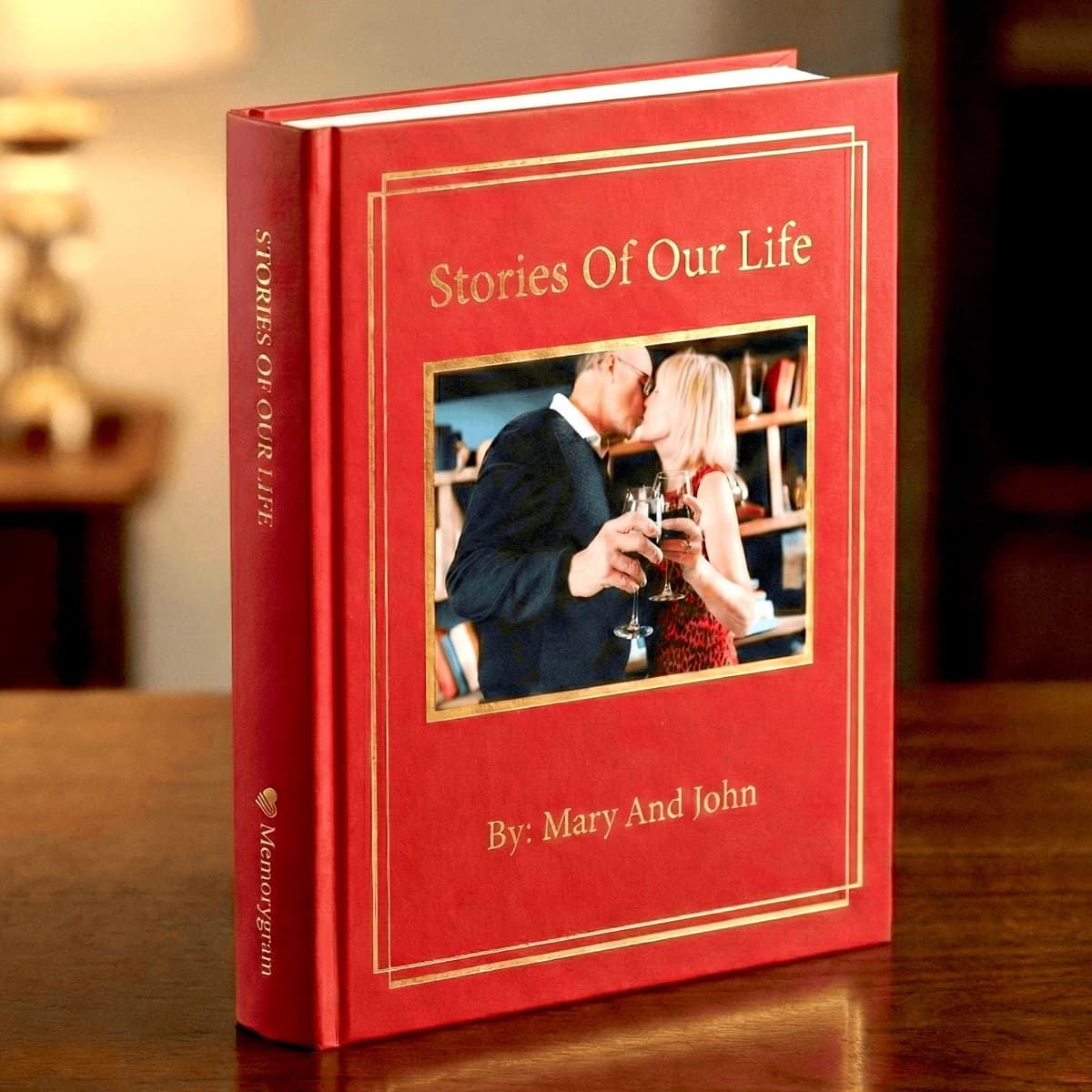
The most complete version of the project outsources the parts you're bad at (question design, weekly prompting, layout, printing) and keeps the parts only you can do (getting your grandparent to sign up, and reading the book when it arrives). Services like Memorygram send one thoughtful question by email every week for a year, the storyteller replies with their answer and any photos they want to include, and the accumulated year of replies is compiled into a professionally printed hardcover with their name on the cover — a real, physical book that sits on a shelf and gets pulled down and re-read.
The clever thing about the weekly-question format is that it inverts the psychology of memoir-writing. Asking someone to 'tell their life story' produces paralysis; asking 'what was your first job and what did it pay?' produces a coffee-length answer, and fifty-two of those quietly compound into a book. Because the medium is email — reply to a message — there is nothing to install, no password to remember, no app to teach. The trade is money and time: it's a paid service (around $125 for the guided year plus the printed book) and it takes a year to complete. For a milestone birthday, a Mother's or Father's Day gift, or the parent whose stories you specifically don't want to lose, it's the format that reliably produces a finished object. Pair it with the phone recordings from format #1 and you have both the voice and the book — the two things you can't get later.
The questions that unlock real answers (and the ones that get nowhere)
The single biggest determinant of quality is question design. Broad questions ('what was your childhood like?') produce broad answers ('it was fine'); narrow, sensory, specific questions ('describe the kitchen in the first apartment you and dad shared') produce stories, because the specifics reactivate the actual memory. Aim for questions that ask about first things (first car, first job, first apartment, first paycheck), sensory details (what a place smelled like, what a season sounded like), objects (a piece of jewelry, a tool, a photograph), and people who aren't the storyteller (a grandparent's own grandparent, a neighbor, a coworker they liked). Questions about opinions and hot-take politics rarely produce good archive material and often produce family friction — save them for a different conversation.
A pattern that consistently works: pick a decade and drill into it before moving on. 'The 1960s' as a prompt is too big; 'the summer of 1962' is a memory. If a service like Memorygram is running the prompts for you, resist the urge to write your own — the professionally designed question set is one of the things you're paying for, and it's built specifically to avoid the yes/no traps that DIY questions fall into. If you're running it yourself, our how to fall asleep with a racing mind piece is unrelated to the project, but the writing-things-down-so-you-stop-carrying-them principle it covers is worth reading — the same 'get it out of your head before it fades' logic applies here, at a much longer timescale.
The archive problem: where to keep it so a great-grandchild can find it
A recording nobody can find isn't preserved. The single most-lost-forever category of family history is the box of cassettes in someone's attic and the audio files on a phone that got replaced without a backup. Whatever format you use, plan the archive on day one: a labeled cloud folder (Google Drive, Dropbox, iCloud — pick one and stick to it) shared with at least two other family members, so no single device failure loses the collection. Photos and scanned documents live in the same folder tree, filed by decade or by person. If you're consolidating a lifetime of old images from various shoeboxes, our ThePhotoStick review covers the fastest way to sweep them off aging computers into one place — the audio interviews then live alongside them as the narration track.
The finished hardcover from a service like Memorygram is the archive layer that survives when everything digital is forgotten. Books get shelved and re-read; files get lost with the laptop. If you can only afford one long-term artifact from the project, the printed book is the one that outlasts. Order two or three copies at printing while it's cheapest — the sibling who 'didn't need one' always asks later, and grandchildren will each want a copy of their own when they're old enough to read it.
How to make it feel like a conversation, not an obligation
The tone of the project matters more than the technology. If your grandparent senses this is a homework assignment or, worse, a countdown, they'll shut down. Frame it as flattery — 'your life is worth a book' — and treat the process as a series of small excuses to talk more. Send a follow-up note when a particular answer moved you. Ask about the person the story mentioned. Print out one favorite answer and mail it back to them, so they see what it looks like on paper. These are the small warming gestures that turn a chore into something they look forward to.
And accept the imperfect. Some weeks the answer will be short, some prompts will be skipped, some memories will be misremembered — that's fine. The book you end up with will be a real portrait of a real person, told in their voice, with the wrinkles and typos of personality intact. That's the point. A too-polished, ghostwritten version wouldn't sound like them, and the version that sounds like them is the one their grandchildren will actually want. Start this week. The person whose stories you meant to record has a hard deadline nobody knows the date of, and 'later' is the expensive option.
Read our Memorygram review
A year of gentle weekly questions turns a parent's or grandparent's stories into a professionally printed hardcover Legacy Book — the interview you always meant to do, done.
Read our Memorygram reviewFrequently asked questions
What's the best way to record my grandparents' stories?
Combine two formats: phone voice memos during in-person visits (to preserve their actual voice) plus a weekly-question service like Memorygram (to produce a hardcover book from their written answers over a year). Voice recordings capture the sound; the book captures the archive. Neither format on its own delivers both, so run them in parallel if you can.
How do I get my grandparent to open up in an interview?
Ask narrow, sensory, specific questions instead of broad ones. 'Describe the kitchen in your first apartment' produces a real story; 'what was your childhood like?' produces 'it was fine.' Focus on first things (first car, first job), objects (a piece of jewelry, a tool), and other people (a coworker they liked, a neighbor). Keep sessions to 15-20 minutes so nobody gets tired, and let the recording keep running once they start telling a story — the best stuff usually comes after the first pause.
Is Memorygram or StoryWorth the right kind of service?
Both belong to the same category — an emailed question per week for a year that produces a hardcover book at the end. Memorygram is a strong pick if the storyteller is comfortable answering by email reply (no app, no login), the question set is professionally designed to open real memories, and you want a keepsake hardcover with their name on the cover. Services like Remento add audio recording via an app, which suits storytellers who prefer talking to typing. Pick based on which medium your specific person will actually use.
How much does it cost to make a family legacy book?
Roughly three tiers. DIY (voice recorder + Google Doc + Blurb or Lulu print) is under $100 all-in, but takes many weekend hours of work and often stalls before finishing. Guided-question services like Memorygram run around $125 for the year of prompts plus a printed hardcover, and they finish because the structure carries the project. Professional personal-history services (interviewer, editor, book designer) start around $2,000 and climb steeply. For most families, the middle tier is the sweet spot: professional structure and output at a self-serve price.
How long should each interview session be?
Fifteen to twenty minutes is the sweet spot. That's long enough to reach at least one full story and short enough that neither of you gets tired or bored, which is where the answers get lazy. If a story is still unfolding at the 20-minute mark, let it finish, then stop. Multiple short sessions over months produce far better material than one exhausting all-afternoon interview.
What if my grandparent isn't comfortable with technology?
Match the format to their existing habits, not the other way around. If they already use email — and most grandparents in their 60s through 90s do — a service that works by email reply requires no learning. If they're not comfortable typing, do phone voice memos in person and let a family member type up the answers, or pick a service with an audio-recording option they can use by phone call. Never try to introduce a new app; adoption is close to zero and the project stalls.
How do I make sure the recordings don't get lost?
Set up the archive on day one: a labeled cloud folder (Google Drive, iCloud, Dropbox) shared with at least two other family members so no single device failure loses the collection. Rename each recording the moment you finish it ('grandma_first_car_2026-09.m4a'). Back up to the cloud that same day. And treat the printed hardcover as your durable artifact — files get lost with laptops, but books get shelved and re-read.
TopCrate is reader-supported. When you buy through links on our site we may earn an affiliate commission, at no extra cost to you. Content is for general information and isn't a substitute for professional advice.