LIGHTING
How to Light a Dark Hallway at Night (Six Fixes, Ranked by Effort, No Wiring Required)
The hallway-at-3am problem has cheap fixes and expensive fixes — here's which ones actually stay useful past week two, and the one that disappears into the wall so completely you forget it's there.
Every house has one — a hallway that turns pitch black at 2am, the stretch between the bedroom and the bathroom (or the top of the stairs, or the landing outside a kid's room) that you navigate by muscle memory and the occasional stubbed toe. Fixing it by hard-wiring a proper ceiling fixture is a $400 electrician visit that most people never book, so the hallway stays dark, and the toe stays stubbed. But the DIY category has quietly matured: there are now half a dozen no-wiring lighting fixes that actually work, at price points from $8 to $80, and the choice between them is more about form factor and behavior than about brightness.
This guide covers six no-wiring options in rough order of effort: plug-in night lights (the classic, with its specific downside), stick-on motion-activated LED bars (the renter's favorite), rechargeable puck lights (for the stretch with no outlet at all), battery-operated wall sconces (for the wall between the hallway walls), outlet-cover night lights (the one that disappears), and permanent-look solar or wired-in options if you're willing to go one step further. And a quick tour of what actually determines whether the light stays useful in month six — because the honest failure mode of most hallway lighting isn't that it doesn't work, it's that you stop maintaining it and the batteries die.
The design problem: what a hallway light actually needs to do (and what most fail at)
A hallway light at night has three jobs that are subtly different from the jobs a room light has. First, it needs to point at the floor, not at the ceiling — you're not lighting a room, you're lighting a path so you don't step on the cat or trip on a rug edge. A light that fires upward or spreads sideways illuminates the whole hallway (which sounds good) but actually makes it harder to see the floor because your eyes constrict to the brightest thing in view, which is the light itself, not the ground you need to see. Second, it needs to turn on and off automatically — you're going to walk through it at 3am half-asleep, and asking your 3am self to reliably switch a light on and off is the wrong system design. Third, it needs to be bright enough to see by but not bright enough to fully wake you up, because you want to go back to sleep after the trip to the bathroom.
That combination — downward-pointing, automatic on/off, dim enough not to trigger full wakefulness — is what most 'hallway lighting' solutions miss. A regular plug-in nightlight fires sideways (blinding at eye level, useless at floor level). Battery-powered LED strips are usually way too bright, marketed as 'ambient' and set up to light the whole hallway. Motion-activated stick-on bars often have no dusk sensor and fire during the day too, which drains the battery uselessly. The best fixes are the ones that get all three right without asking you to manage them.
Fix 1 — The classic plug-in night light (works, but with real downsides)
The $5 pharmacy plug-in nightlight is the default and it's not bad — a small LED that plugs into a wall outlet and glows dimly at floor level. It has a dusk sensor built in on the modern versions (so it's actually automatic on/off), draws negligible power (under 1 watt of LEDs), and works out of the box with zero installation. The old objection that the bulb burns out doesn't apply to modern LED units, which last essentially the life of the product.
Two real downsides that nobody mentions until they've lived with one for a year. First: it permanently occupies one socket of a two-socket outlet, which becomes annoying every time you need to charge a phone in that hallway or plug in the vacuum. In a hallway with only one or two outlets total, losing one to a nightlight is a real cost. Second: it protrudes out from the wall by about an inch, right where you're most likely to bump it with a hip, a mop handle, or a vacuum cleaner. Enough bumps and it eventually breaks or falls out of the socket. Fine as a starter option, or in a hallway with plenty of outlets and no traffic near the outlet, but not the endgame.
Fix 2 — Stick-on motion-activated LED bars (best for hallways with no outlets)
For a hallway with genuinely no outlets — the classic stair landing, or a long corridor between rooms — battery-powered stick-on LED bars are the workhorse solution. A 12-inch aluminum LED bar with a built-in motion sensor and dusk sensor costs $15-25 for a single unit or $40-60 for a three-pack, sticks to the wall or under a shelf edge with 3M command tape, and runs on 3 AAA batteries for 4-8 months of typical use. When motion is detected in low light, the LED lights for 15-30 seconds and turns off; no motion during the day, no drain. It's a genuinely good product category in 2026 — the sensors are reliable, the LEDs are bright enough to see the floor, and the battery life is reasonable.
The honest tradeoff is the maintenance. Every 6-9 months you're taking the unit down, replacing the batteries, and re-sticking it. The 3M adhesive occasionally fails and needs re-applying with fresh tape. For a household with 2-3 hallway lights this is a real chore, and about a third of the households that install them end up letting the batteries die and never replace them — at which point the light is a decorative aluminum bar. If you'll actually keep up with the maintenance, they're excellent. If you know you won't, one of the fixes below is a better long-term choice.
Fix 3 — Rechargeable puck lights with remote or motion sensor
The puck-light category has quietly gotten good. Small round wireless LED pucks (3-4 inches diameter, 1 inch tall) with USB-rechargeable batteries, either remote-controlled or motion-activated, cost $20-35 for a set of three and stick to any flat surface. Runtime on a charge is 6-10 hours of on-time, which for a motion-activated light triggering a few times a night stretches to 2-3 months between charges. The main advantage over battery-powered LED bars: you're not buying batteries every 6 months, and the recharging habit is easier to maintain than 'find the right size batteries and swap them out.'
Placement wise, pucks are more flexible than bars because they're smaller — they fit under a stair tread, on top of a baseboard, or on the side of a doorframe without looking like a piece of hardware. The tradeoff: less light per unit than a proper bar (a puck is maybe 20 lumens vs a bar's 50-80), so you need more of them to cover the same hallway. In a hallway with two-three natural placement points, the puck approach works well. In a long corridor that needs continuous light, bars win.
Fix 4 — Battery-operated wall sconces (the design-forward option)
For a hallway you actually want to look nice — a guest-facing entrance corridor, a bedroom hallway that gets visitors — battery-operated wall sconces have quietly filled the gap between 'utility LED' and 'hardwired fixture.' Real ceramic or metal shades, a screw-in LED bulb, a battery pack hidden inside the base, and either a wall switch or a remote — the whole thing looks like a hardwired sconce but installs with 3M tape or a single anchor screw. Prices run $40-90 per sconce, batteries last 3-6 months on typical use, and the LED bulbs are dimmable via remote on most units.
This is the fix for the specific situation where the hallway is a design element, not just a utility corridor — the front hall of a home you show off, or a hallway you photograph for real estate. For a purely functional hallway that just needs to be lit at night, sconces are overkill and expensive. And the battery-swap chore is the same as with LED bars, plus the sconce is heavier to detach, which many households find annoying enough to eventually stop doing.
Fix 5 — Outlet-cover night lights (the fix that disappears)
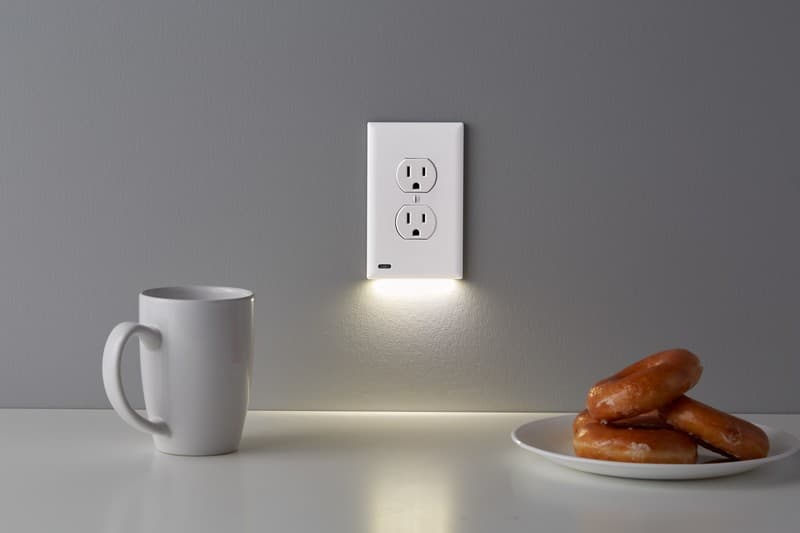
The most elegant no-wiring hallway light in 2026 is a category most people don't know exists: the outlet-cover night light replaces the plastic cover plate on an existing outlet with a smarter cover plate that has built-in downward-facing LEDs and its own light sensor. Small conductive prongs on the back contact the outlet's side screw terminals to draw a trickle of power from the outlet itself — no batteries, no wiring, no electrician. Both sockets stay completely usable. During the day it looks exactly like a normal outlet cover; at night the built-in LEDs turn on automatically and wash the floor with soft light. Installation is a one-screwdriver, one-minute job (turn off the switch, unscrew the old cover, snap on the new one, screw it back on).
The GuideLight outlet cover night light is the specific product in this category most reviewed and most sold — the SnapPower design that essentially invented the format. It solves all three of the design problems from earlier: it points downward (path illumination, not room illumination), it's automatic (built-in dusk sensor), and it's dim enough to see by without waking you up. Nothing to charge, no batteries to swap, no protruding hardware to knock. The tradeoff is that it requires an existing outlet in the hallway — no outlet, no GuideLight — but for the hallway or bathroom that has one, this is the fix that most closely disappears into the architecture. It's also a permanent-looking upgrade that renters can install without asking permission (it swaps back in seconds) and homeowners can leave in place for years.
Fix 6 — When to go further: solar, wired-in, or a real fixture
For very long hallways, exterior corridors, or outdoor paths (garden walkways, side-of-house corridors that get pitch black), solar-powered path lights are the honest next tier — a small solar panel charges a battery during the day, motion or dusk sensors trigger the LEDs at night, and there's no maintenance for the life of the product. Not appropriate for interior hallways (no sun to charge from), but very appropriate for the outside version of the same problem.
And the honest 'if you're willing to spend' answer: a real hardwired hallway light fixture with a wall switch — or, better, a motion-activated hardwired fixture — is the ceiling of this whole category. A licensed electrician can add one for $300-500 in most homes, and if the hallway is really important (a family with small children who wander at night, an aging parent living with you, a home you'll be in for a decade), the wired fixture is the right answer. Everything above is 'good enough' relative to the fixture, and the specific value of the no-wiring options is that they buy you 90% of the fix for 5% of the cost. If you'd rather just fix it permanently, call an electrician.
Getting the layout right — where to place hallway lights for the best coverage
Whatever fixture you choose, the placement rules are the same. Light every 6-8 feet along a hallway is the target — closer if the hallway has turns or floor obstacles, farther if it's straight and clear. Mount lights low (18-24 inches off the floor) rather than high — a light at eye level blinds you, a light at ankle level illuminates the floor. Stairs get one light per landing, not per step; the sensor lights the whole run when you step onto the first tread. Bathrooms benefit from a light between the bed and the bathroom door, not just inside the bathroom — the trip in the dark is when you fall, not when you're already at the toilet.
One layout mistake that people make constantly: putting all the lights on the same side of the hallway. This creates dark shadows on the opposite wall's baseboards, which is exactly where you catch a hip or a shin. Alternate sides — first light on the left, next on the right — so the coverage fills in from both directions. Small change, meaningful reduction in the shin-bruise rate. And for the specific safety story — kitchen-adjacent hallways benefit from being lit for the same reason our how to put out a grease fire guide covers: middle-of-the-night navigation past hazards is when the small preventive investment pays off. For sleep-cycle protection while you're at it, how to fix a sleep schedule covers the light-exposure end of the same problem — bright-light nighttime interruptions matter for how quickly you get back to sleep.
Read our GuideLight review
The outlet-cover night light that replaces your outlet's cover plate — no batteries ever, both sockets stay usable, automatic dusk-to-dawn LEDs washing the floor with soft light, and a one-minute screwdriver install. The specific fix for hallways and bathrooms that already have an outlet.
Read our GuideLight reviewFrequently asked questions
What's the best way to light a hallway at night without wiring?
It depends on whether the hallway has an outlet. If it does — hallway with a wall outlet you can use — outlet-cover night lights are the elegant answer: they replace the outlet's cover plate, draw a trickle of power from the outlet's screw terminals (no batteries, no wiring), keep both sockets fully usable, and turn on automatically at dusk with a built-in sensor. The GuideLight is the specific product in this category. If there's no outlet — stair landing, long interior corridor, closet hallway — battery-powered motion-activated LED bars or rechargeable puck lights are the workhorse alternatives, though both require battery swaps or recharging every few months. For a very long or exterior corridor, solar-powered path lights are the maintenance-free option.
How bright should a hallway night light be?
Dim enough not to fully wake you up, bright enough to see the floor and any obstacles. In lumens, that's roughly 5-30 lumens per fixture for a downward-pointing floor light — much dimmer than a room lamp (300-800 lumens) but noticeably brighter than a phone screen's flashlight setting. Most purpose-built night lights (outlet-cover units, motion-activated LED bars) target this range by default. The specific mistake to avoid: motion-sensor LED bars marketed as 'ambient' or 'closet lighting' at 100+ lumens — these are too bright for hallway navigation and will make you noticeably more awake by the time you get to the bathroom, which defeats the point of a night light. Warm color temperature (2700-3000K) is also more sleep-friendly than cool white (5000K), which is why most quality night lights ship warm.
How long do outlet-cover night lights last?
Effectively the life of the outlet — since they draw power from the outlet's screw terminals rather than a battery, there's nothing to replace. The LED itself is rated for tens of thousands of hours (10-15+ years of nightly use), and the light sensor and switching electronics are similarly long-lived. This is the category's specific advantage over battery-powered options, which typically need battery swaps every 3-9 months. The GuideLight has been on the market for over a decade with reports of first-generation units still running. Installation is a one-screwdriver job that takes about a minute per outlet.
Are outlet-cover night lights safe? Do they draw a lot of power?
Yes safe and no not much power. The unit's prongs contact the outlet's side screw terminals (the same terminals your outlet's own wiring already contacts) rather than plugging into the socket, which is a standard low-current tap that draws well under a watt of power — the annual electricity cost is a few cents per unit. The install is one screw and doesn't require touching any live wiring; you turn off the wall switch, remove the existing cover, snap on the new one so the prongs seat against the outlet's side screws, and screw it back in. If you're comfortable changing a battery, you're comfortable installing an outlet-cover night light. Both sockets remain fully usable for chargers and other devices.
How do I light a stair landing that has no outlet nearby?
Two good options depending on how much maintenance you're willing to do. First: a motion-activated LED bar stuck to the wall of the landing at 18-24 inches off the floor with 3M command tape. Runs on 3 AAA batteries for 4-8 months of typical use, triggers on motion, turns off in daylight. Second: rechargeable puck lights on the landing wall — 3 AAA-battery equivalent runtime but recharged via USB every 2-3 months. Both work well for stair landings, both require ongoing battery attention. Whichever you pick, mount low (illuminate the treads, not the ceiling) and add one light per landing, not per step — the motion sensor lights the whole run when you step onto the first tread. If the landing does have an outlet, an outlet-cover night light like GuideLight is the maintenance-free upgrade.
Will a hallway night light bother my sleep?
A well-designed one won't — the whole design category is calibrated for this exact worry. Downward-pointing (illuminates the floor, not the walls or your closed door), low lumen output (5-30 lumens is the right range), warm color temperature (2700-3000K), and automatic dusk-to-dawn operation with no need for you to interact means the light is only doing its job when you need it and out of your bedroom's sight line otherwise. The specific mistake that does disturb sleep: overly bright 'ambient' motion-sensor LED bars aimed at the ceiling, which can spill light into the bedroom under the door. Aim your fixture at the floor, and the sleep concern goes away.
How many night lights do I actually need in a hallway?
One every 6-8 feet of hallway is the target for consistent floor illumination. A short hallway (10-12 feet, bedroom to bathroom) needs one well-placed unit; a medium hallway (15-25 feet) needs 2-3; a long hallway or one with turns needs one at each end plus one at each turn or landing. Alternate sides of the hallway rather than putting them all on one side (opposite walls create better overlap and fewer shadow zones). And for stairs specifically, one light per landing is enough — the motion sensor illuminates the entire run when triggered.
TopCrate is reader-supported. When you buy through links on our site we may earn an affiliate commission, at no extra cost to you. Content is for general information and isn't a substitute for professional advice.