COOLING 101
How to Cool a Room Without AC: What Actually Works, in the Order It Works
Block the sun before it gets in, flush the heat out after dark, point the fan the right way — and the honest truth about ice bowls, damp sheets, and when to just buy the AC.
A room doesn't get hot by accident — heat pours in through sunlit windows all day, gets topped up by your oven and electronics, and then has nowhere to go at night. Every guide on how to cool down a room leads with fans, but fans are step three. The rooms that stay livable in a heat wave belong to people who work with the physics: stop heat getting in, throw it out when the outside air turns cool, and only then worry about airflow.
This guide covers the fixes in order of impact — window coverings, night-flush ventilation, fan placement that actually lowers the temperature, evaporative cooling and where it genuinely works, the indoor heat sources you can switch off, tricks for sleeping cool, and the point at which the honest answer is an air conditioner.
Block the Sun First: Window Coverings Are the Biggest Lever
Sunlight through glass is the single biggest reason your room is hotter than the hallway — a sunny window is quietly running a space heater all afternoon. So the highest-impact move costs nothing: close the curtains or blinds on every sun-facing window before the sun hits it, not after the room is already baking. Heat you keep out is free; heat you have to remove is expensive.
If you're buying coverings, buy them for this job. The Department of Energy's numbers put cellular (honeycomb) shades at up to a 60 percent reduction in unwanted solar heat through windows when tightly fitted, and blackout curtains in a light color do serious work too — the trapped-air layer between fabric and glass is the mechanism, so a snug fit matters more than the brand. Outside-the-glass options like awnings or exterior shades work even better for the same reason bouncing heat off the house beats absorbing it.
Night-Flush Ventilation: Trade Hot Air for Cool Air After Dark
Daytime discipline only pays off if you dump the day's heat overnight. The rule is simple: keep windows shut while it's hotter outside than inside, then open everything the moment outdoor air drops below indoor air — usually late evening through early morning. Your walls, floors, and furniture have been soaking up heat all day, and hours of cool air moving through is what actually discharges them.
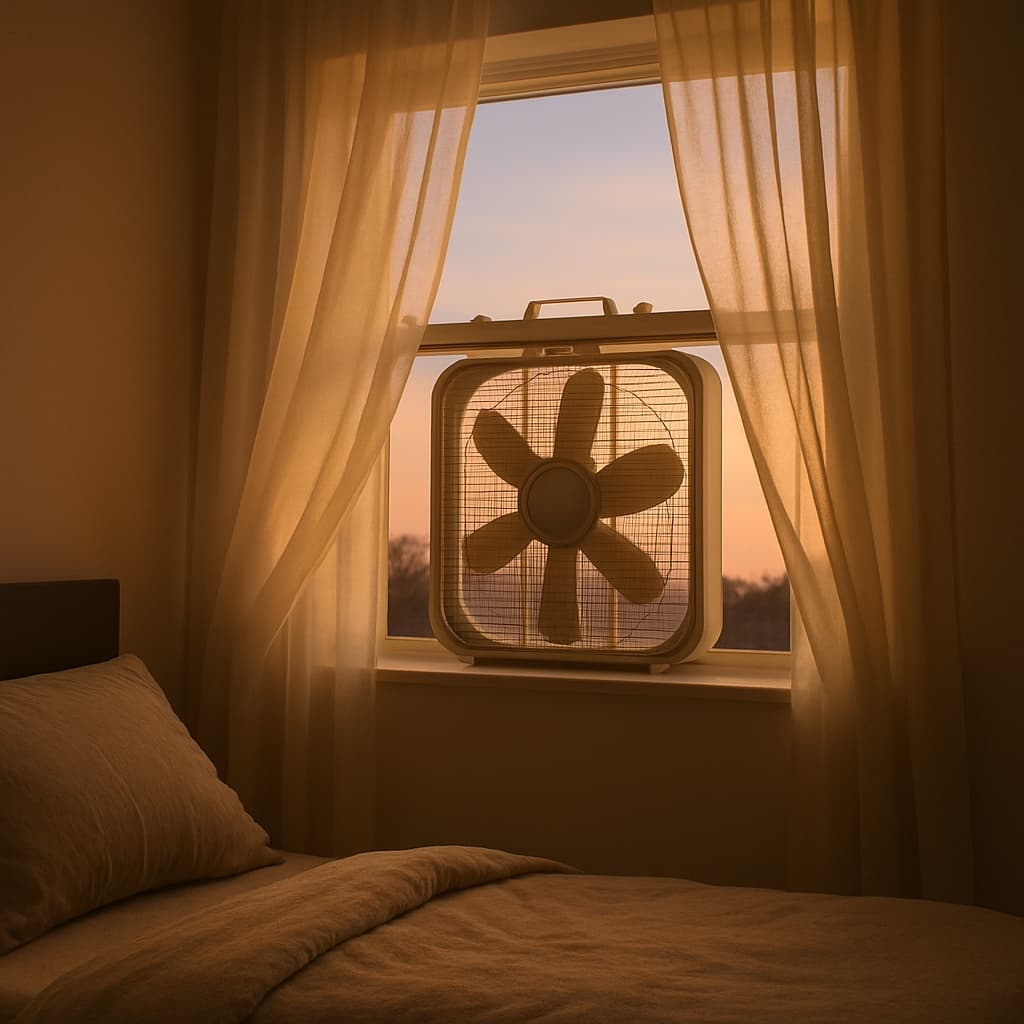
Speed it up with cross-flow: put a box fan in one window blowing out — exhausting hot air — and open a window on the opposite side of the room or house as the intake, ideally on the cooler, shadier side. That one-two creates a steady current that can swap the room's air far faster than passive open windows. At dawn, close the windows and drop the coverings, sealing the cool in. It feels counterintuitive to shut windows on a warm morning; it's the whole trick.
Fan Technique: Point It Out the Window, Not at the Couch
Here's the part most people get backwards: a fan doesn't cool air, it moves it, and the motor even adds a little heat. A fan running in a closed hot room is just stirring the soup. If the goal is lowering the room's temperature, the winning setup is the fan blowing out of a hot window — physically ejecting hot air so cooler air gets pulled in from elsewhere — which beats pointing it at yourself for the room as a whole.
Pointing it at yourself still has a job: body cooling. Moving air strips away the warm layer hugging your skin and speeds up sweat evaporation, which is why a fan feels great while doing nothing for the thermometer. Use both modes deliberately — exhaust fans to change the room's temperature during the night flush, personal airflow to change how you feel during the day.
Evaporative Cooling: Damp Sheets, Swamp Coolers, and Where They Really Work
Evaporating water absorbs a remarkable amount of heat, and you can exploit that with zero equipment: hang a damp sheet in front of a box fan and the air coming through arrives noticeably cooler. That rig is a crude evaporative cooler, and the same physics powers everything from desert swamp coolers to the mist fans at theme parks.
It's also what a personal unit like the ChillWell does in a tidier package — a small water tank, a wet cartridge, and a fan blowing air through it at your desk or bedside. The honest framing: these cool the person in front of them, not the room, and they shine in dry climates where evaporation is fast. In humid air, evaporation stalls and an evaporative unit is mostly a fan that adds moisture — so if you're in Houston rather than Phoenix, set your expectations (and see the dehumidifier point below, because you have the opposite problem).
Stop Making Heat Indoors — and Wring Out the Humidity
Everything drawing watts in your room is a heater with a second job. The oven is the biggest offender — a summer roast dumps heat into the kitchen for hours, so shift to the grill, the microwave, no-cook meals, or a countertop appliance that seals its heat in a drawer. Old incandescent and halogen bulbs turn about 90 percent of their energy into heat, so swap anything still glowing warm for LEDs. And a gaming PC or big TV pumps out hundreds of watts — running one in a closed bedroom on a hot day is a self-inflicted wound. Run the dryer and dishwasher at night or not at all.
Then deal with humidity, because mugginess is half of what 'hot' feels like: sweat can't evaporate into saturated air, so a humid 84 feels worse than a dry 90. A dehumidifier does emit some heat, but in a damp climate the trade is usually worth it — drier air lets your body's own cooling work again and makes every fan in the house more effective. If a closed-up room feels like a towel that never dried, humidity is your real enemy.
Cool the Sleeper, Not the Room — and When AC Is the Real Answer
Nights are where heat does its damage, and you don't need a cool room to sleep — you need a cool bed. Switch to breathable cotton or linen sheets and lose the polyester, which traps heat like a rain jacket. A cool shower before bed drops your skin temperature, a hard-frozen water bottle wrapped in a towel makes a reverse hot-water-bottle at your feet, and a fan crossing the bed keeps sweat evaporating all night. Cooling one body is a much smaller job than cooling a room — aim the effort there. And if a brutal week has already wrecked your nights, our guide on how to fix your sleep schedule covers the recovery.
Finally, the honest ceiling on all of this: passive tricks lower a room a few degrees and make heat livable, but they have limits. The CDC warns that once indoor temperatures reach the high 90s, fans no longer prevent heat-related illness — and for infants, older adults, and anyone with a heart or respiratory condition, that threshold is lower. At that point the answer is real refrigerant: a window AC unit is the cheapest effective option for a single room, a portable AC trades some efficiency for renter-friendliness, and either one beats toughing out a dangerous heat wave on principle.
Read our ChillWell 2.0 review
Our full test of the personal evaporative cooler — where it genuinely helps and where it doesn't.
Read our ChillWell 2.0 reviewFrequently asked questions
Does putting ice in front of a fan work?
Barely, briefly. A bowl of ice in front of a fan cools the small stream of air passing directly over it for as long as the ice lasts — a modest personal cool patch, not a room solution — and the melt adds a little humidity. Fine for an hour at a desk; not a strategy.
Does a fan cool down a room?
No — fans move air, they don't cool it, and the motor adds slight heat. A fan cools you by speeding up sweat evaporation, or cools the room only when it's exhausting hot air out a window while cooler outside air comes in elsewhere.
Should a fan face in or out of the window?
To lower the room's temperature, face it out of a hot window so it ejects hot air, and open an intake window on the opposite side — ideally the shady side. Face a fan inward only when the outside air is clearly cooler than the room.
What is the fastest way to cool down a room?
If it's cooler outside than inside: box fan blowing out one window, opposite window open, coverings ready to drop at dawn. If it's hotter outside: seal the room, block every sunlit window, kill heat-producing electronics, and use a fan for personal airflow until the evening flush.
Do evaporative coolers work in humid climates?
Poorly. Evaporative cooling depends on water evaporating into the air, which stalls when the air is already moist. In dry climates a personal unit meaningfully cools the person in front of it; in humid climates it's mostly a fan adding moisture — a dehumidifier helps more there.
When should I give up and buy an AC?
When passive fixes can't keep the room out of dangerous territory. The CDC cautions that fans stop preventing heat illness once indoor temps hit the high 90s — sooner for infants, older adults, and people with health conditions. A window unit for one room is the cheapest effective fix.
TopCrate is reader-supported. When you buy through links on our site we may earn an affiliate commission, at no extra cost to you. Content is for general information and isn't a substitute for professional advice.