COOLING 101
Evaporative Cooler vs. Air Conditioner: The Humidity Rule That Decides Everything
One machine removes heat and humidity, the other trades heat for humidity — which means your local weather report, not the price tag, should make this decision for you.
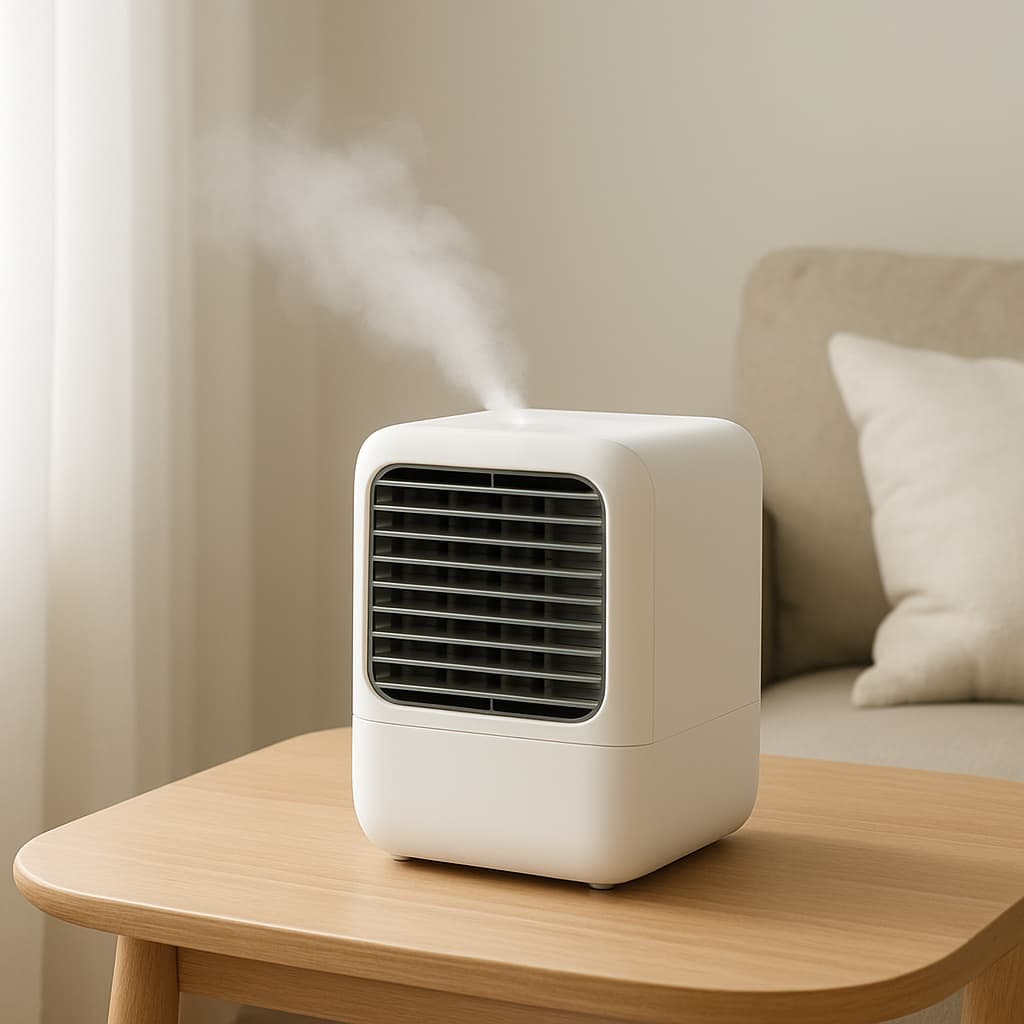
The evaporative cooler vs. air conditioner debate has a strange property: both sides are right, just not in the same zip code. In Phoenix, a swamp cooler can drop the air 20-plus degrees for a quarter of the electricity an AC would burn. In Houston, that same machine is a very elaborate way to make your apartment feel like a greenhouse. The deciding factor isn't the brand or the BTUs — it's the humidity outside your window.
This guide covers how each machine actually works, the humidity threshold that settles the argument, an honest cost comparison, the difference between whole-house swamp coolers and personal units like the ChillWell, the maintenance each one demands, and a simple decision framework for your exact situation — including the hybrid setup that quietly saves money.
How an Air Conditioner Works: A Refrigerant Heat Pump
An air conditioner doesn't create cold — it relocates heat. A refrigerant loops between two coils: indoors it evaporates, absorbing heat from your room air; outdoors a compressor squeezes it so it condenses and dumps that heat outside. Your room gets cooler because its heat is now someone else's sidewalk problem. The compressor doing all that squeezing is also why AC is the expensive half of this comparison — it's the single hungriest appliance in most summer electric bills.
The underrated part: as warm room air passes over the cold indoor coil, moisture condenses out of it and drips down a drain line. An air conditioner removes heat and humidity at the same time, which is why it works in any climate on Earth. Miami, Denver, a sealed server room — the physics doesn't care. That universality is what you're paying for.
How an Evaporative Cooler (Swamp Cooler) Works
An evaporative cooler is your body's sweating trick, mechanized. A fan pulls hot, dry air through pads soaked in water; the water evaporates into that air, and evaporation absorbs a large amount of heat — that heat comes straight out of the air, which exits the machine cooler and moister than it went in. No refrigerant, no compressor, just a fan and a small pump. In genuinely dry air, the drop across the pads can reach 15 to 40 degrees, per the Department of Energy.
Notice the trade, though: the machine cools the air by loading it with water vapor. It removes heat by adding humidity — the exact opposite of what an AC does. That single fact explains everything else in this article, including why the same machine is brilliant in Tucson and useless in Tampa.
The Humidity Rule That Decides Everything
Evaporation only happens fast when the air has room for more moisture. Dry air soaks up water eagerly and gives up lots of heat in exchange; air that's already damp barely accepts any, so barely any cooling happens. Physicists call the floor on this the wet-bulb temperature — the coolest an evaporative process can possibly get the air — and in humid weather that floor sits uncomfortably close to the actual temperature. The rule of thumb: below about 30% relative humidity, an evaporative cooler is excellent; from 30% to 50%, it still earns its keep; above 50%, buy an air conditioner and don't look back.
Be concrete about what failure looks like: at around 50% humidity, a swamp cooler that would deliver a 25-degree drop in the desert manages roughly 10. Push into a truly muggy climate and it's worse than nothing — you get a weak temperature drop plus a machine actively pumping more moisture into air that's already saturated, leaving the room stickier and less comfortable than when you started. A swamp cooler in Houston isn't a budget AC; it's a humidifier with ambitions.
Evaporative Cooler vs. AC Cost: The Honest Numbers
Here's where the swamp cooler earns its cult following. Per the Department of Energy, evaporative coolers cost about half as much to install as central air conditioning and use about one-quarter as much energy. That tracks with the hardware: an AC runs a compressor, the piston-squeezing heart of a refrigeration cycle, while an evaporative cooler runs a fan and a pump you could power with a generous smile. Portable and personal evaporative units push the gap further — a small one sips electricity like a desk fan.
The honest other half: an air conditioner is more effective everywhere, and it's the only one of the two that works at all in humid climates. You're not choosing between a cheap way and an expensive way to get the same result — you're choosing between a cheap machine that's climate-dependent and a costlier machine that's climate-proof. In dry country, that dependency never bites and the savings are real. Everywhere else, the AC premium is just the price of cooling that works in August.
Whole-House Swamp Coolers vs. Personal Evaporative Coolers
These share physics but not a job description. A whole-house evaporative cooler is a rooftop or window-mounted unit plumbed into a water line, moving enough air to cool an entire home in a dry climate — a genuine AC alternative in the right region. A personal evaporative cooler like the ChillWell is a kettle-sized tank-and-fan unit that cools the person sitting in front of it, not the room. That's not a flaw so much as a spec, but plenty of marketing blurs it, so let's not: a personal unit will not lower your living room's temperature.
Framed honestly, the personal unit still has a real niche: a desk, a bedside table, a dorm room, a garage workbench — anywhere in dry heat where one human needs a cool breeze aimed at them and whole-room cooling is unavailable or overkill. Fill the tank, point it at your face, enjoy. Just apply the same humidity rule at any size: in damp climates a personal evaporative cooler is a fan with extra steps, and a plain fan is cheaper.
Maintenance, the Open-Window Quirk, and Which One to Buy
Maintenance runs opposite directions. An AC mostly wants filter swaps and an occasional coil cleaning. An evaporative cooler is a small water feature, and standing water demands respect: tanks need refilling, pads need regular cleaning and seasonal replacement, and the whole system needs drying out between uses or it will grow mold and mildew — a musty smell from the vents is your cue that you've skipped a step. There's also the ventilation quirk that surprises everyone: an AC wants a sealed room to keep conditioned air in, while an evaporative cooler needs airflow — a cracked window or open door — so the humid air it exhales can leave. Seal a swamp cooler in a closed room and it marinates in its own humidity until the cooling stops.
So, the framework. Phoenix bedroom, with summer humidity often in the teens: evaporative cooling is the bargain of the century — a whole-house unit or a capable portable will beat an AC on cost all season. Houston apartment, where humidity rarely leaves the 60s: air conditioning, full stop, and put the swamp-cooler money toward the electric bill. Office desk in dry heat: a personal unit pointed at you is the cheapest comfort per watt in the building. And the hybrid play worth stealing in any dry climate: set the AC thermostat a few degrees higher than usual and park a personal evaporative cooler at your desk or bedside — the AC handles the house at a lazier, cheaper setpoint while the little unit keeps you personally cool for pennies. More tricks like that live in our guide on how to cool a room without ac.
Read our ChillWell 2.0 review
We tested the best-known personal evaporative cooler — here's what it actually does for a desk or bedside in dry heat, and what it doesn't.
Read our ChillWell 2.0 reviewFrequently asked questions
Do swamp coolers work in humid climates?
No — and they can make things worse. Evaporative coolers work by evaporating water into the air, which requires dry air with room to absorb moisture. Above roughly 50% relative humidity the temperature drop shrinks to a few degrees while the machine keeps adding moisture, leaving the room muggier than before. In humid climates, an air conditioner is the only real option.
What's the difference between an evaporative cooler and an air conditioner?
An air conditioner uses a refrigerant and compressor to pump heat outdoors, removing both heat and humidity from the room — it works in any climate. An evaporative cooler blows air through wet pads so evaporation absorbs the heat, which cools the air but adds humidity — it only works well in dry climates.
Is an evaporative cooler cheaper to run than an AC?
Dramatically. The Department of Energy puts evaporative coolers at about half the installation cost of central air and about one-quarter of the energy use, because they run a fan and water pump instead of a power-hungry compressor. The catch is they only deliver that value in dry climates.
Do you need to open a window when using an evaporative cooler?
Yes. An evaporative cooler continuously adds moisture to the air, so it needs a cracked window or open door to push that humid air out and pull fresh dry air in. Run one in a sealed room and indoor humidity climbs until evaporation — and cooling — grinds to a halt. Air conditioners are the opposite: they want the room sealed tight.
Can a portable evaporative cooler cool a whole room?
Personal-sized units like the ChillWell can't — they cool the person directly in front of them, which makes them great for a desk, bedside, or dorm in dry heat and useless as room AC. Cooling an entire room or house evaporatively takes a whole-house swamp cooler moving far more air, and even then only in a dry climate.
How much cooler does an evaporative cooler make the air?
It depends almost entirely on humidity. In hot, dry air the Department of Energy says evaporative coolers can drop supply air 15 to 40 degrees Fahrenheit. At around 50% humidity that shrinks to roughly 10 degrees, and in truly humid air the drop is barely noticeable.
TopCrate is reader-supported. When you buy through links on our site we may earn an affiliate commission, at no extra cost to you. Content is for general information and isn't a substitute for professional advice.