COFFEE 101
Cold Brew Ratio: Concentrate vs. Ready-to-Drink, Gram Charts for Every Jar Size, and Dilution Math
The one distinction that explains every conflicting cold brew recipe online, exact coffee-to-water charts from a quart jar to a gallon jug, and how to fix a weak batch.
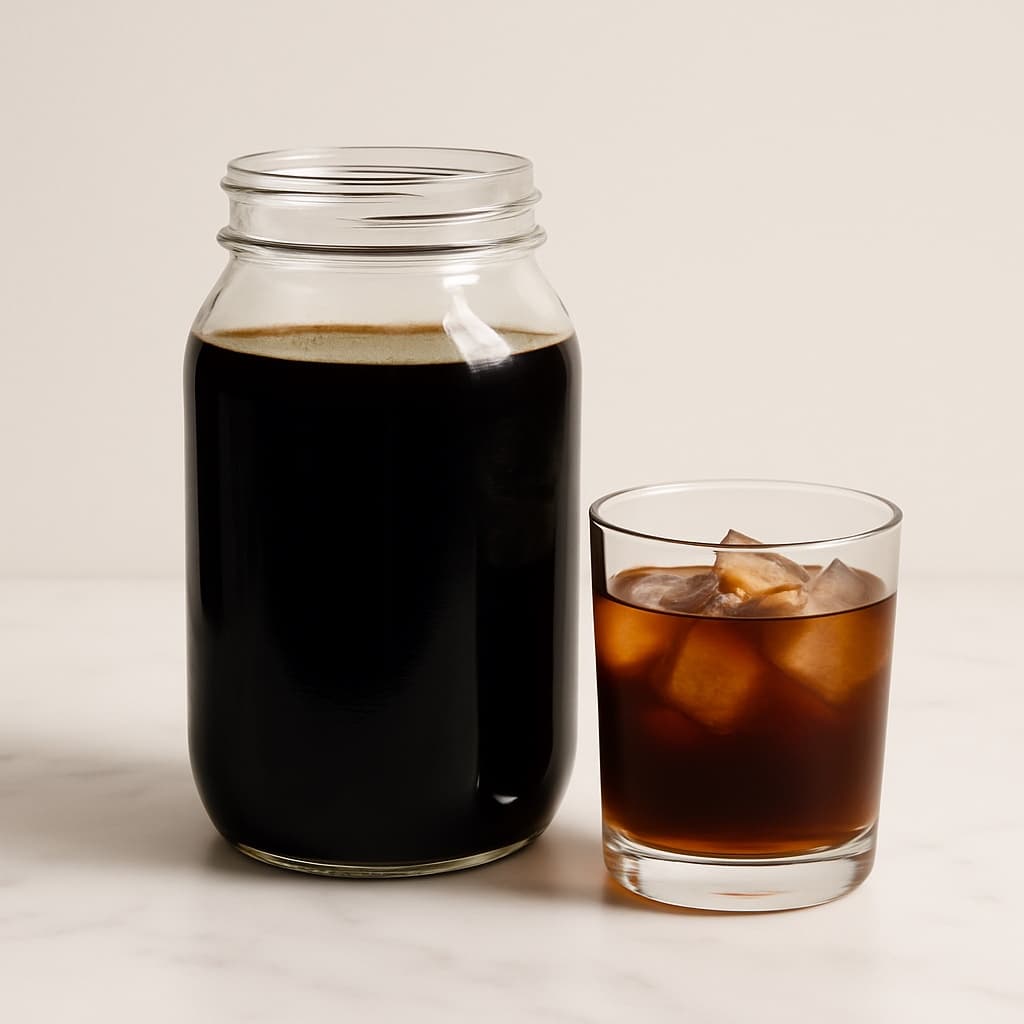
Search for a cold brew ratio and you'll find recipes confidently claiming 1:4, 1:8, even 1:15 — and they're not actually disagreeing. They're describing two different drinks. Some recipes make a concentrate you dilute before drinking; others make ready-to-drink cold brew you pour straight over ice. Use a concentrate ratio for a straight pour and you've brewed rocket fuel; use a ready-to-drink ratio and then dilute it and you've made expensive brown water.
This guide settles it: both ratios and when to use each, gram charts sized to a quart mason jar, a 2-quart pitcher, and a gallon jug, why the grind must be coarse, an honest counter-versus-fridge steeping comparison, the dilution math, and the mistakes that account for nearly every bad batch. Consider it the cold chapter of how to make coffee — nothing left vague.
Concentrate vs. ready-to-drink: the distinction every recipe skips
Concentrate is brewed strong — 1 part coffee to 4 or 5 parts water — and is not meant to be drunk straight. You cut it roughly 1:1 with water, milk, or a glass full of ice, the way cafes and the bottled stuff in the grocery cooler work. Ready-to-drink is brewed at 1:8, comes out of the jar at drinking strength, and goes straight over ice with no math.
Which to make is a lifestyle question, not a taste one. Concentrate wins if fridge space is tight, if you drink cold brew with milk (which does the diluting for you), or if you want one batch to stretch across more servings. Ready-to-drink wins if you want zero morning arithmetic — open, pour, done. Decide before you measure, because every number that follows depends on it.
The cold brew ratios, by weight
For ready-to-drink: 1:8 — one gram of coffee for every 8 grams of water. Water weighs 1 gram per milliliter, so a liter of water takes 125 grams of coffee. For concentrate: 1:5 is the sweet spot, with 1:4 as the extra-strong version worth making if you mostly drink it with milk. Weight is the honest way to measure here, because ground coffee lies by volume — a scoop of coarse grounds weighs noticeably less than the same scoop ground fine, and cold brew uses a lot of coffee, so scoop error compounds fast.
No scale? Use the rough conversion of 5 grams per level tablespoon, or 80 grams per cup of grounds — the charts below include both. And if you also brew hot immersion coffee, the french press coffee ratio runs the same weigh-first logic at 1:15; cold water just extracts so slowly that cold brew needs two to three times the dose to get there.
Cold brew ratio chart: quart jar, 2-quart pitcher, gallon jug
Ready-to-drink at 1:8, with water held a bit under each container's capacity so the grounds actually fit: quart mason jar — 3 cups (720 g) water and 90 g coffee, about 1 cup plus 2 tablespoons of grounds. Two-quart pitcher — 6 cups (1,440 g) water and 180 g coffee, about 2 1/4 cups of grounds. Gallon jug — 12 cups (2,880 g) water and 360 g coffee, about 4 1/2 cups of grounds.
Concentrate at 1:5: quart jar — 2 1/2 cups (600 g) water and 120 g coffee (1 1/2 cups of grounds). Two-quart pitcher — 5 cups (1,200 g) water and 240 g coffee (3 cups of grounds). Gallon jug — 10 cups (2,400 g) water and 480 g coffee (6 cups of grounds). One expectation to set: spent grounds hold onto roughly twice their weight in water, so a quart-jar concentrate batch yields about a cup and a half of finished concentrate — which becomes around three tall glasses once diluted. If that sounds like a lot of coffee going in, it is; concentrated strength is bought with beans, not steep time.
Coarse grind and the 12-to-24-hour steep
Grind coarse — the texture of raw sugar or coarse sea salt. Over a steep measured in hours instead of minutes, fine grounds over-extract into harsh, silty territory, and worse, they're nearly impossible to filter: that's where cold brew sludge comes from. If you buy pre-ground, ask for a coarse french press grind; the standard drip grind will work in a pinch but pours a murkier glass.
The steep window is 12 to 24 hours, and where you park the jar matters more than most recipes admit. On the counter at room temperature, extraction runs faster — 12 to 16 hours is plenty. In the fridge it runs slower — plan on 18 to 24 hours — and many people find the cup slightly cleaner for it. Honestly, both make excellent cold brew; pick the location that matches when you'll remember to strain it. Stir once at the start so no dry raft of grounds floats on top, cover it, and walk away.
When time's up, strain through a fine-mesh sieve lined with a paper filter, cheesecloth, or a nut milk bag, and resist squeezing the grounds — pressing hard pushes fine sediment and bitterness into an otherwise clean batch.
Dilution math and storage
Concentrate dilutes 1:1 — equal parts concentrate and water or milk, poured over ice. That lands a 1:5 concentrate at roughly drip strength, a touch bolder than 1:8 ready-to-drink, and melting ice closes the gap. The ice itself counts as dilution, so over a very full glass you can shift the mix toward more concentrate; with milk, 1:1 makes something close to an iced latte without the espresso machine.
Store cold brew airtight in the fridge and drink it within about a week — it doesn't spoil dramatically, it just flattens as oxidation dulls the flavor, and concentrate holds on a few days longer than ready-to-drink. Never leave the grounds steeping in the jar for storage; strain on schedule. And when the pitcher runs dry on a Wednesday, brewing a pod on the strong setting over a cup packed with ice in a Keurig K-Duo is the sixty-second stopgap — not cold brew, but genuinely cold coffee while the next batch steeps.
Strength adjustments and common cold brew mistakes
Adjust strength with the ratio, not the clock. Too weak? Next batch, move from 1:8 toward 1:6, or steep on the counter instead of the fridge. Too strong is barely a problem — add water, which is the whole charm of brewing concentrate: you can always dilute strong coffee, but no amount of anything fixes weak.
The classic mistakes: grinding fine, which makes sludge (the number one complaint). Understeeping — eight fridge hours produces exactly the watery cold brew people then blame on the method. Trying to rescue a weak ratio with a multi-day steep, which adds woody dullness instead of strength. And worrying too much about oversteeping: the bitterness warnings are overblown, because cold brew is forgiving — a few hours past 24 drifts flat and woody rather than harsh, there's just nothing to gain. Weakness from too little coffee or too little time is the real failure mode, and both are fixed with a scale and a timer.
Read our Keurig K-Duo review
For the days the cold brew pitcher runs dry and you need iced coffee in sixty seconds.
Read our Keurig K-Duo reviewFrequently asked questions
What is the best ratio for cold brew?
By weight: 1:8 (one gram of coffee per 8 grams of water) for ready-to-drink cold brew you pour straight over ice, or 1:5 for a concentrate you dilute 1:1 before drinking. Use 1:4 for an extra-strong concentrate destined for milk.
How much coffee do I need for a quart of cold brew?
For ready-to-drink: 90 grams of coarse-ground coffee (about 1 cup plus 2 tablespoons) with 3 cups of water in a quart mason jar. For concentrate: 120 grams (about 1 1/2 cups of grounds) with 2 1/2 cups of water.
How long should cold brew steep?
12 to 24 hours: 12 to 16 on the counter at room temperature, 18 to 24 in the fridge, where extraction runs slower. Going past 24 hours won't ruin it, but it adds dull, woody flavor rather than strength.
Do you have to dilute cold brew concentrate?
Yes — concentrate brewed at 1:4 or 1:5 is meant to be cut roughly 1:1 with water, milk, or a glass full of ice. Ready-to-drink cold brew made at 1:8 needs no dilution at all.
Why is my cold brew weak?
Almost always too little coffee — usually from scooping by volume instead of weighing — or too short a steep, especially in the fridge. Fix it by weighing the dose and steeping at least 12 hours at room temperature or 18 in the fridge, not by steeping for days.
Is cold brew stronger than regular coffee?
Concentrate is much stronger — that's why you dilute it. Properly diluted, a glass lands near or slightly above drip strength in caffeine, but cold brew's smooth, low-acid taste makes it dangerously easy to drink more of.
TopCrate is reader-supported. When you buy through links on our site we may earn an affiliate commission, at no extra cost to you. Content is for general information and isn't a substitute for professional advice.