COFFEE 101
French Press Coffee Ratio: The 1:15 Rule, an Exact Cups Chart, and How to Adjust Strength
The starting ratio that fixes most bad french press coffee, exact grams and tablespoons for every press size, and the honest case for a cheap kitchen scale.
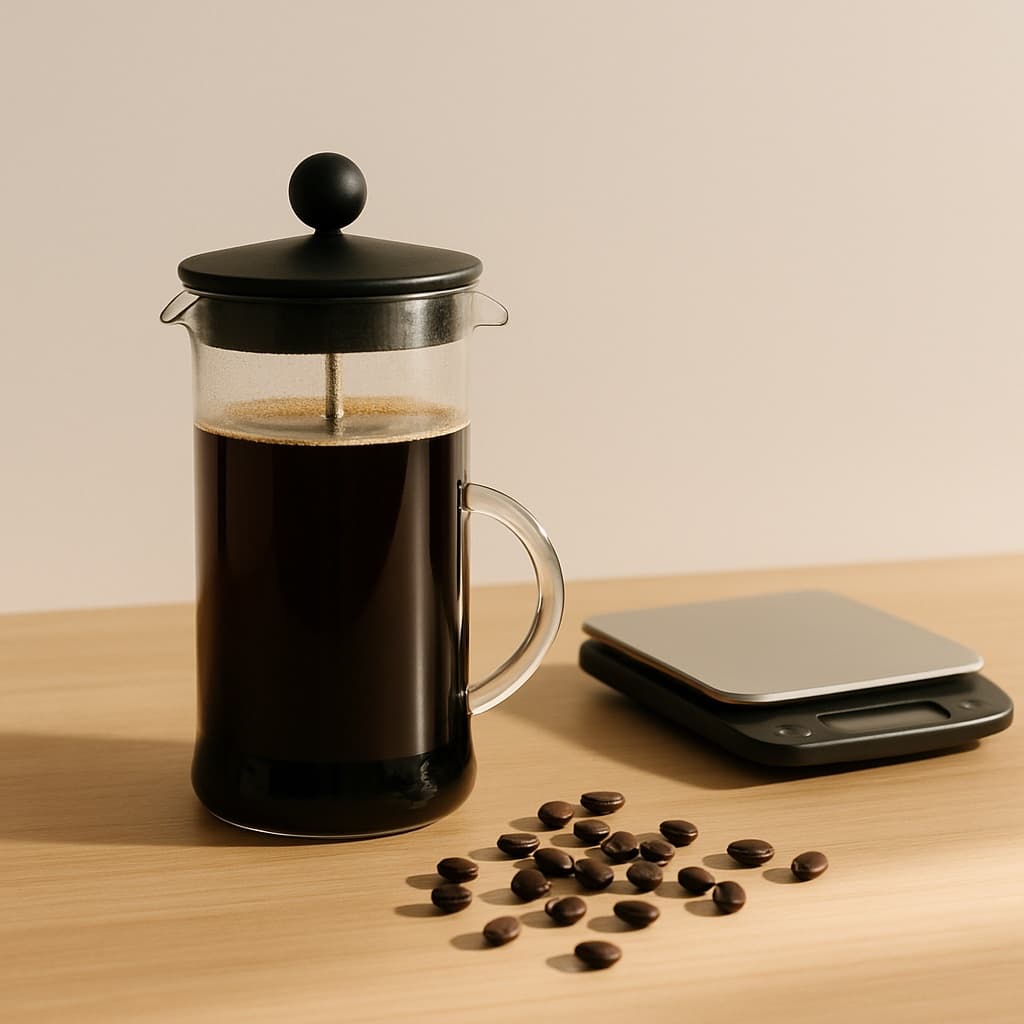
Most bad french press coffee isn't a bean problem or a technique problem — it's a ratio problem. Too little coffee makes brown water; too much makes bitter soup; and eyeballing it makes a different cup every morning. The fix is one number: 1:15. One gram of coffee for every 15 grams of water, and suddenly the press you've been fighting with makes coffee worth the four minutes.
This guide gives you the exact numbers — grams and tablespoons for one cup through a full large press — plus why the grind needs to be coarse, the simple 4-minute technique, how to dial strength up or down, and the coffee to water ratio for every other brew method while we're at it. Consider it the ratio chapter of how to make coffee, with nothing left vague.
The french press coffee ratio: start at 1:15
The ratio is 1:15 by weight — 1 gram of ground coffee for every 15 grams of water. Water conveniently weighs 1 gram per milliliter, so 300 ml of water is 300 grams, which calls for 20 grams of coffee. That's it. That's the whole formula.
Why 1:15 and not something else? French press is an immersion brew: the grounds sit in the water the entire time instead of having water pass through them, which extracts a heavier, fuller-bodied cup. At 1:15 that body reads as rich rather than muddy. It sits comfortably inside the range coffee professionals use for immersion brewing, and it leaves you room to adjust in both directions once you know what your baseline tastes like.
French press ratio chart: grams and tablespoons by cup
These numbers assume a real cup — an 8-ounce mug, about 240 grams of water — and a level tablespoon of ground coffee at roughly 5 grams. For 1 cup: 240 g water, 16 g coffee, about 3 tablespoons. For 2 cups: 480 g water, 32 g coffee, about 6 tablespoons. For 4 cups: 960 g water, 64 g coffee, about 12 tablespoons. For 8 cups: 1,900 g water, 125 g coffee, about 24 tablespoons — which is two full batches in most large presses.
Now the fine print nobody tells you: press manufacturers measure capacity in 4-ounce cups. A "3-cup" Bodum holds 12 ounces of water — one decent mug. An "8-cup" press holds 34 ounces — about four real mugs, and filling it takes roughly 66 grams of coffee at 1:15. If your coffee has been weak since the day you bought your press, there's a good chance you've been dosing for imaginary cups.
Coarse grind, 4 minutes, slow plunge: the technique
Grind coarse — think breadcrumbs or coarse sea salt, not powder. A french press filters with a metal mesh, and fine particles slip straight through it into your cup as sludge. Fine grounds also over-extract during the long steep, which is where harsh bitterness comes from. Coarse grind is not a style preference; it's what makes the whole method work.
The routine: heat water to around 200 degrees Fahrenheit — off the boil, then a 30-second wait. Add your coffee, pour in all the water, and give it one gentle stir so nothing sits dry on top. Lid on, plunger up, and wait 4 minutes. Then press the plunger down slowly — 15 to 20 seconds, no racing — and pour every cup immediately. Coffee left sitting on the grounds keeps extracting and turns bitter while your back is turned, so decant the extra into a mug or carafe.
Stronger or weaker: adjust the ratio, not the clock
Want a bolder cup? Move to 1:12 — that's 20 grams of coffee per 240 grams of water instead of 16. Want it milder? Stretch to 1:17, about 14 grams per cup. Change the amount of coffee, not the steep time: extra minutes in the press don't make coffee stronger, they make it more bitter, because time changes what gets extracted, not just how much.
Here's the honest part: a cheap kitchen scale fixes more bad coffee than any expensive beans ever will. Tablespoons are a rough translation — a scoop of coarse-ground light roast and a scoop of fine-ground dark roast can differ by a couple of grams, which compounds fast across a full press. Scoops will get you in the neighborhood, and the chart above is built for them. But if you make coffee every day and it's inconsistent, the scale is the ten-dollar upgrade that ends the mystery.
Coffee to water ratio for other brew methods
The same logic travels. Drip machines and pour-over run best around 1:16 to 1:17 — slightly leaner than french press because water flowing through grounds extracts more efficiently than water sitting on them. The often-cited golden ratio for coffee overall lands near 1:18, roughly 55 grams of coffee per liter of water, which is the industry's benchmark for a balanced cup.
Cold brew flips the table: 1:4 to 1:5 for a concentrate you dilute over ice, since cold water extracts slowly and needs the headstart. Espresso runs around 1:2 — 18 grams of coffee in, about 36 grams of liquid out. And pod machines take the question away entirely: a Nespresso Vertuo reads a barcode and doses the water itself, and a Keurig K-Duo brews to whatever cup size you press. Less control, zero math.
Common french press mistakes (and the fixes)
Sludgy, gritty cup: your grind is too fine. Coarsen it, and if you buy pre-ground, ask for a coarse french press grind rather than the all-purpose default. Bitter cup: you're steeping past 4 minutes, using water at a rolling boil, or — the sneaky one — leaving brewed coffee sitting on the grounds after plunging. Weak cup: you're under-dosing, usually thanks to the 4-ounce manufacturer cup trap above.
One more that hides in plain sight: a dirty press. Old coffee oils cling to the mesh and beaker and go rancid, flavoring every future brew. Pull the filter assembly apart every week or so and wash it properly. Get the ratio right, the grind coarse, the timer honest, and the press clean, and this forty-year-old brewing method will quietly outperform machines costing twenty times as much.
Read our Keurig K-Duo review
For the days you want one-button coffee instead.
Read our Keurig K-Duo reviewFrequently asked questions
What is the coffee to water ratio for a french press?
Use 1:15 — 1 gram of coffee per 15 grams of water. That's 16 grams (about 3 level tablespoons) of coarse-ground coffee per 8-ounce cup of water. Go 1:12 for bolder, 1:17 for milder.
How many tablespoons of coffee for 2 cups of french press?
About 6 level tablespoons (32 grams) of coarse-ground coffee for two 8-ounce cups (480 grams of water) at the 1:15 ratio.
What is the golden ratio for coffee?
Roughly 1:18 — about 55 grams of coffee per liter of water — which is the industry benchmark for a balanced cup. French press runs a touch richer at 1:15 because immersion brewing rewards a slightly heavier dose.
How long should french press coffee steep?
4 minutes, then plunge slowly and pour immediately. Steeping longer makes coffee more bitter, not stronger — if you want a stronger cup, add more coffee instead.
Why is my french press coffee muddy or full of grounds?
Your grind is too fine. The metal mesh filter lets fine particles through, so use a coarse grind — about the texture of coarse sea salt — and press the plunger down slowly.
Do I need a scale for french press coffee?
No, but it helps more than anything else you can buy. Tablespoons work with the chart above (about 5 grams per level tablespoon), but scoop weights vary by grind and roast — a cheap kitchen scale makes every cup consistent.
TopCrate is reader-supported. When you buy through links on our site we may earn an affiliate commission, at no extra cost to you. Content is for general information and isn't a substitute for professional advice.