SLEEP 101
Body Pillow Guide: What It Actually Does, Which Shape to Buy, and How to Sleep With One
What a body pillow really does for side sleepers, how the shapes and fills compare, and the right way to actually sleep with one.
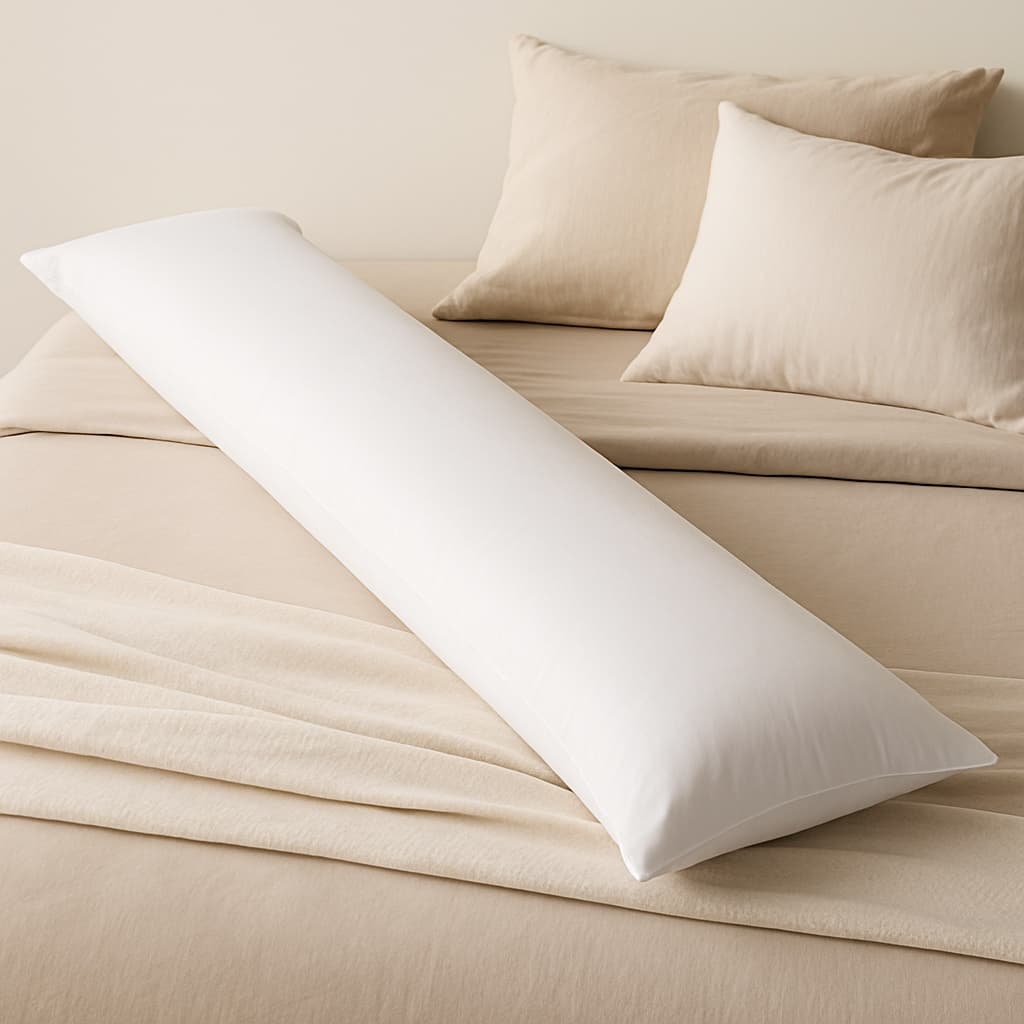
A body pillow looks like an indulgence — a five-foot cushion whose main job is being hugged. It's actually one of the most mechanically sensible sleep purchases you can make. For side sleepers, it does two simple things at once: it gives your top arm something to rest on, and it holds your knees apart so your hips and spine stay stacked instead of twisting toward the mattress. That's the whole trick, and it's why so many people who try one won't sleep without it.
This guide covers what a body pillow actually does and who genuinely benefits, how the four shapes compare (straight, C, U, and J), the real differences between shredded memory foam, down alternative, and microbead fills, what size to buy, how to keep one clean, and — the part most people get wrong — how to actually sleep with it.
What a body pillow actually does
When you sleep on your side without support, two things tend to happen. Your top knee drops forward across your body, which rotates your pelvis and puts a gentle twist through your lower back for hours at a time. And your top arm collapses across your chest or gets tucked at an odd angle, dragging your shoulder forward. Neither is dramatic, but hold any position for seven hours and small misalignments add up to stiff mornings.
A body pillow fixes both with zero effort. Slid between your knees and hugged against your chest, it keeps your top leg level with your bottom leg — so your hips stay stacked and your spine stays neutral — while giving your top arm a place to rest. To be clear about what it is: a body pillow is a comfort and positioning tool, not a medical device. If you have persistent back, hip, or joint pain, that's a conversation for your doctor. But if you're a side sleeper who wakes up achy for no obvious reason, position is the cheapest variable to test.
Who actually benefits from a body pillow
Side sleepers with morning hip or lower-back stiffness are the core audience — the knee-separation effect is designed for exactly this. Restless and combination sleepers are the second group: a body pillow gives your limbs a consistent anchor, and many fidgety sleepers find they toss less when there's something to hold onto. It's also the standard tool for stomach sleepers trying to switch to their side, because hugging a pillow recreates the front-of-body contact that makes stomach sleeping feel secure.
Two more groups worth naming. People recovering from surgery often need to stay off one side or keep a limb supported through the night, and a body pillow is a simple way to hold a position — though your surgeon's positioning instructions always come first. And pregnant sleepers benefit enormously, though they're usually better served by a dedicated pregnancy pillow with shaped bump and back support, which we cover in a separate guide.
Body pillow shapes compared: straight, C-shape, U-shape, and J-shape
The straight body pillow — sometimes called an I-shape — is the default for good reason. It's the least expensive, the easiest to find covers for, the lightest to reposition, and it does the two core jobs (knees and hug) perfectly well. Its one drawback: when you roll to your other side, the pillow doesn't come with you. You have to drag it over or learn to sleep facing one way.
The C-shape curves around you, so one end supports your head or tucks behind your back while the curve runs along your front for hugging and knee separation. It's a step up in coverage without taking over the bed. The U-shape surrounds you on both sides — meaning back support and front support simultaneously, and no repositioning when you switch sides. That convenience costs you roughly half the bed, which is why U-shapes are beloved by solo sleepers and negotiated over by couples. The J-shape is the quiet middle ground: a straight pillow with a hook at one end that cradles your head, giving you a bit of the C's coverage at closer to the straight pillow's footprint.
Fill materials: shredded memory foam vs. down alternative vs. microbead
Shredded memory foam is the supportive option. It's moldable — you can scrunch it thicker under your knee and thinner at your chest — and it holds its shape under weight all night. The trade-offs are heft (repositioning a foam body pillow is a two-hand job) and warmth, since foam retains more body heat than fluffier fills. Down alternative is the huggable option: soft, light, squishy, usually the cheapest, and most likely to be fully machine washable. It compresses more under weight, so very firm-support seekers may find it flattens where they need it most, and it will lose loft over a year or two of nightly hugging.
Microbead pillows are filled with tiny polystyrene beads that give them a cool, flexible, beanbag-like drape. They conform well and stay relatively cool, but they offer the least lift of the three, and a seam failure means beads everywhere. Our honest take: down alternative for cuddlers and budget buyers, shredded memory foam for people who want real knee-and-hip support, microbead only if you've tried one and love the feel.
Sizing and care: what fits your bed and your washing machine
The standard body pillow size is 20 by 54 inches, and it suits most adults of average height — long enough to run from chest to ankles. Taller sleepers should look for the 20-by-60 or even 72-inch versions so the pillow still reaches below the knee. If you share a full or queen bed, measure before buying a U-shape; a straight 20x54 is the polite choice for shared sleep.
Check washability before you buy, because it varies by fill. Most down-alternative body pillows can go straight into a large-capacity washer. Shredded memory foam usually cannot — water breaks down foam — so those are spot-clean-only, and the removable cover does the real hygiene work. Whatever the fill, use a removable, washable cover and launder it as often as your sheets. If you've already upgraded your regular pillowcase to silk from a brand like Blissy, you know how much the fabric against your skin changes how a pillow feels — the same logic applies to the cover you'll be hugging all night.
How to actually sleep with a body pillow
Lie on your side and pull the pillow in so it runs the length of your body. The bottom section goes between your knees — and ideally between your ankles too, which is why length matters — so your top leg rests level instead of dropping forward. Hug the top section with your top arm, letting it support the arm's weight and keep your shoulder from rolling in. Your hips should feel stacked, one directly over the other. That's the whole technique; give it three or four nights to stop feeling novel.
Two refinements. If you tend to roll onto your back and don't want to, tuck a second pillow — or the back arm of a C- or U-shape — snugly behind you; the light resistance is usually enough. And keep your regular head pillow, because a straight body pillow supports everything from the shoulders down but does nothing for your neck. Pairing a body pillow with the best pillow for neck pain you can find — something adjustable like Sleepgram, where you can tune the loft to your shoulder width — is what gets you full-body alignment, not one or the other.
See our Best Pillows of 2026 guide
A body pillow fixes everything below your shoulders — our tested picks handle the head and neck.
See our Best Pillows of 2026 guideFrequently asked questions
Are body pillows good for you?
They're good at one specific thing: keeping side sleepers aligned. Placed between the knees and hugged, a body pillow keeps your hips stacked and your spine neutral, which many people find reduces morning stiffness. It's a comfort and positioning tool, not a medical treatment — persistent pain is a question for your doctor.
How do you sleep with a body pillow?
Lie on your side, run the pillow along the front of your body, put the lower section between your knees and ankles, and hug the upper section with your top arm. Your hips should stay stacked one over the other. Keep your normal head pillow for your neck.
What size is a standard body pillow?
20 by 54 inches is the standard, and it works for most adults. Taller sleepers should look at 60- or 72-inch versions so the pillow still reaches past their knees.
Which body pillow shape is best?
For most people, a straight 20x54 pillow — it's cheapest, easiest to wash and cover, and does the core job. Choose a U-shape if you switch sides a lot and sleep solo, a C-shape for extra head-or-back coverage with a smaller footprint, and a J-shape as the compromise.
Can you wash a body pillow?
It depends on the fill. Most down-alternative pillows are fully machine washable in a large-capacity washer. Shredded memory foam is typically spot-clean only, so buy one with a removable cover and wash the cover as often as your sheets.
Do you still need a regular pillow with a body pillow?
Yes, with a straight or J-shape — a body pillow supports from the shoulders down, and your head still needs proper loft. Some C- and U-shaped designs include a head section, but many people still prefer their own head pillow on top.
TopCrate is reader-supported. When you buy through links on our site we may earn an affiliate commission, at no extra cost to you. Content is for general information and isn't a substitute for professional advice.