COMPARISON
Aerless vs Packing Cubes: Compression Bags or Organizer Cubes — Which One Actually Saves You from Checked-Bag Fees? (2026)
Aerless and traditional packing cubes both promise a tidier suitcase, but they solve opposite problems. Cubes organize a load; compression bags shrink it. Here's how Aerless's valve-compression bags stack up against Eagle Creek's Pack-It cubes on price, mechanism, guarantee, wrinkles and the real-world question — do you actually save enough space to skip a checked bag?
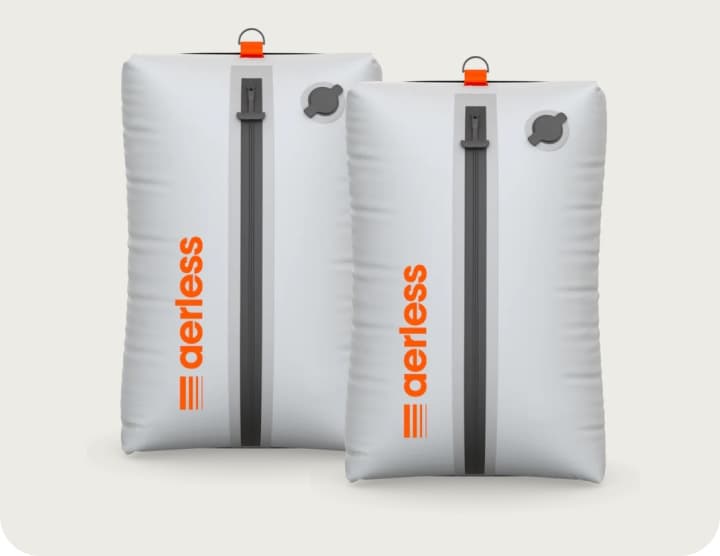
Aerless and packing cubes are the two travel-organization systems most people end up choosing between when they realize their suitcase is losing the war with a week of clothes. What they aren't is the same product. Aerless is a set of compression packing bags with a built-in one-way valve — you load clothes in, close the zip seal, kneel or press on the bag to force air out, and the valve locks it flat — sold by Aerless LLC (registered in New Jersey) starting at around $69 for the entry kit. Packing cubes are zip-top organizer pouches without any air-removal mechanism, made by dozens of brands but anchored by Eagle Creek's Pack-It Reveal set at $59 and its Pack-It Isolate Compression Cube set at around $50.
So the answer to "Aerless vs packing cubes" isn't the same for everyone. If your problem is finding the socks under the sweaters, cubes are the direct fix — they segment the suitcase into categorized compartments, and you unpack and repack faster because everything has a place. If your problem is that a week of winter clothes won't fit in a carry-on, cubes don't help meaningfully, because organizer cubes barely compress. Aerless is the tool that actually shrinks the pile. This guide covers how each system works, where the mechanism differences show up in real trips, the price and guarantee comparison, and — for anyone who's tried both — the setup most seasoned travelers land on.
One quick clarification before we get into it: within the packing-cubes category there's a subcategory called "compression cubes" (Eagle Creek's Pack-It Isolate Compression Cube is the mainstream example) that does add a mechanical compression zipper. Those cinch smaller than an organizer cube but still don't come close to the volume savings of a valve-compression bag like Aerless. Where that middle-ground fits, we cover it below. Our full Aerless review covers the compression bags in depth on their own.
Aerless vs packing cubes at a glance
What each one is: Aerless is a compression packing bag — a durable zip-top pouch with a built-in one-way valve that lets you press trapped air out and locks the flattened pile in place. Packing cubes are mesh-topped or fabric zip pouches that partition a suitcase into visible compartments. The Eagle Creek Pack-It Reveal cube set is the reference organizer version at $59 for a 3-cube set; the Eagle Creek Pack-It Isolate Compression Cube set adds a second "compression zipper" that cinches the cube smaller after loading, at around $50 for a 2-cube set.
Mechanism: Aerless removes air. Packing cubes don't. That's the whole difference in one sentence. An organizer cube holds the same volume of clothes it started with, just corralled into a rectangle. A compression-zipper cube like the Pack-It Isolate can trim maybe 15-20% off the loose pile through mechanical squeeze. A valve-compression bag like Aerless pulls the air out entirely, which is where the brand's "up to 60% more packing space" claim comes from — because a folded sweater is mostly air trapped between fibers, and removing it collapses the pile to a fraction of its original volume.
Price: A single-tier Aerless kit starts at about $69 on the brand's promotional funnel, with a 2-pack around $89 (free shipping on the 2-pack tier) and a 4-pack around $129. Eagle Creek's Pack-It Reveal cube set is $59 (3 cubes: 1 L, 3 L, 7 L); the Pack-It Isolate Compression Cube set is around $50 (2 cubes, S/M with the compression zipper); the Pack-It Isolate Carry-On Packing Cube Set (a 4-cube organizer, no compression) is $104. On per-piece cost, cubes and Aerless bags sit in a similar band; Aerless bundles get cheaper per bag at the 4-pack tier.
What each one is best at: cubes are best at organization — knowing where the socks are, unpacking at a hotel in ninety seconds, keeping dirty laundry away from clean without wrapping anything in a plastic bag. Aerless is best at volume reduction — turning a checked-bag trip into a carry-on trip, especially for bulky items like sweaters and jackets that laugh at what a cube's zipper can do. Neither reduces weight; the scale still applies to whatever you pack, no matter how tightly.
Guarantee: Aerless advertises a 100-day money-back guarantee from delivery, plus a brand-stated lifetime warranty on the bags themselves. Items must be unused and in original packaging, a handling fee applies, and the return label is valid for 20 days from issue; Trustpilot reviews flag that some buyers report paying return shipping (around $15.85 in one report). Eagle Creek offers its All Ways Guaranteed lifetime warranty on Pack-It cubes and covers manufacturing defects on the bags themselves; return policies for the retail cube purchase itself vary by store (REI's one-year satisfaction guarantee is the most generous mainstream option).
What Aerless actually is (and what it isn't)
Aerless is a set of compression packing bags built around a single mechanical trick: a one-way valve that lets air out when you press on the bag, and lets none back in during transit. Load clothes into the bag, zip the top closed to make an airtight seal, kneel or lean on the bag with your body weight, and the valve exhales the trapped air with a soft hiss before locking shut. What you're left with is a flat, dense brick of fabric that drops into your suitcase at a fraction of the original volume.
The physics is the reason the claim tracks. A folded sweater is a thin sheet of wool holding a large volume of trapped air between its fibers — wonderful for warmth, terrible for luggage. By volume, a typical packed clothing pile is more air than fabric, which is exactly why compression bags routinely halve a clothing stack that clever folding barely dents. Bulky knits, fleece and puffer jackets compress the most; dense denim and dress shirts compress the least because they held less trapped air to start with. Our full Aerless review walks the physics in more depth and covers where the compression tops out on different fabric types.
The important design point is that Aerless doesn't need a vacuum cleaner. Old-school vacuum bags did — useless in a hotel room, a hostel or a rented cabin — which is why the format never caught on for travel. Aerless uses body weight instead: press, valve exhales, valve locks. That's the entire difference between "space-saver bag for storage" and "travel-grade compression that works anywhere." There's also a separate Aerless Vacuum Kit and Vacuum Pump on the brand's site if you want faster compression at home, but neither is required for the bags to work.
Aerless LLC ships from an Edison, New Jersey warehouse and lists a second corporate address on East 45th Street in Manhattan. The brand carries a Trustpilot score of about 4.4 out of 5 across roughly 370 reviews at time of writing, which is a strong signal for a category (compression bags) where most brands sit closer to 3. The bags are not a subscription — one purchase, ships once, no recurring charges.
What packing cubes actually are (and where compression cubes fit)
Packing cubes are zip-top organizer pouches, typically fabric with a mesh top window that lets you see what's inside. The core job is segmentation: shirts in one cube, socks and underwear in another, undergarments in a third, dopp kit and cables in a fourth. Unpack the cubes into a hotel drawer and your suitcase is empty in ninety seconds; repack them into the case and you're back on the road in the same amount of time. They don't compress anything meaningful — the cube holds the same volume of clothes it started with, just corralled into a rectangle you can stack neatly.
Eagle Creek's Pack-It Reveal set at $59 (a 3-cube set: 1 L extra-small, 3 L small, 7 L medium) is the mainstream reference organizer set. The Pack-It Isolate Packing Cube set at $59 (a 3-cube set, non-compression) is Eagle Creek's slightly newer take on the same job, made from recycled ocean plastic. Neither of those adds a compression zipper — they're pure organizers.
Compression cubes are a middle-ground subcategory. The Eagle Creek Pack-It Isolate Compression Cube set at around $50 (S/M, 2 cubes) has a second "compression zipper" that cinches the cube down after loading — mechanical compression, no valve, no vacuum. In practice, that trims the loaded cube's volume by maybe 15-20% at the outside — enough to notice, but nowhere near what a valve-compression bag delivers on the same load. If you want organization plus some volume reduction in the same product, the compression cube is the pick. If your primary problem is volume rather than organization, it's the wrong tool.
Neither cube category needs a device or a technique. Fold, load, zip, done. Cubes are the lower-friction tool by a wide margin — no press, no valve, no possibility of over-compressing the case. Their weakness is exactly that: they don't attack the trapped-air problem at all.
The trade-offs, side by side
Volume savings: Aerless is dramatically ahead. The brand's "up to 60% more packing space" claim is on the aggressive end of what most travelers see in practice — real-world savings vary by fabric, and denim/dress-shirt-heavy loads see less than sweater-heavy loads — but even a conservative 30-40% reduction on bulky items is enough to turn a checked-bag winter trip into a carry-on trip. Organizer cubes save 0%. Compression cubes save maybe 15-20%. None of the three save weight; the airline scale doesn't care how densely packed your bag is.
Organization: cubes win, and it isn't close. The whole point of a cube is finding your clothes without excavating the suitcase, and no compression bag matches that. Aerless bags hold a compressed pile that has to be unpacked to see what's in it, and repacking (especially for a multi-city trip) means pressing all the air out again. If your trip involves living out of the suitcase across four hotels, cubes are the friendlier tool for the daily-access layer.
Wrinkles: cubes are gentler on formal clothes, and Aerless is honest about the trade-off. Aerless's own product page and independent reviewers both note that dress shirts and linen come out of a compression bag needing a hang or a hotel steam. Knits, tees, fleece, denim and sweaters come out basically fine. Cubes don't compress hard enough to add wrinkles on anything — the trade-off is exactly the volume-savings side.
Weight limits: worth calling out because the volume-saved illusion can bite. Aerless lets you pack more clothes into the same suitcase, which means the case gets heavier for the same volume. A carry-on stuffed with compressed winter clothes can still bust an airline weight limit — a 22-pound European carry-on limit fills fast when you pack denser. Cubes don't change how much you can pack, so they don't change the weight math.
Setup time and reusability: both are reusable across trip after trip. Cubes take zero technique to use; Aerless takes a minute of body-weight pressing per bag. Aerless's brand-stated lifetime warranty and Eagle Creek's All Ways Guaranteed lifetime warranty both mean either category should last you many trips before you replace anything, though the compression bags' valves are the moving part most likely to eventually give out on a heavily-used bag.
Aerless vs Eagle Creek Pack-It Isolate Compression Cube (the middle ground)
The specific match-up worth calling out is Aerless vs Eagle Creek's Pack-It Isolate Compression Cube — the two tools closest in intent. Both are trying to save you space; the mechanisms are different, and so is what you actually get out of them.
The Isolate Compression Cube is a cube with a second zipper that cinches the loaded volume smaller. Mechanically, you're pressing the cube's sides toward each other rather than removing air — you get some volume reduction (15-20% on the outside), the cube still functions as an organizer, and you don't need any technique beyond zipping. It's a great match for a business traveler who wants to fit a week of button-downs into a carry-on with room for shoes and a laptop bag.
Aerless removes air, which is a fundamentally different (and stronger) mechanism. On a sweater-heavy or fleece-heavy load, the volume reduction is dramatic in a way a compression cube can't reach — the physics limit is different when you're taking air out of the pile rather than squeezing the container. It's the right tool for cold-weather travel, ski trips, and the specific case where you want to skip the checked bag on a route that charges $75-100 for one.
The honest recommendation: for a business trip with dress shirts, cubes (or compression cubes) win on wrinkle-friendliness and daily-access speed. For a cold-weather trip with sweaters and outerwear, Aerless wins on volume and outweighs the wrinkle trade-off because the fabrics don't crease much anyway.
The setup most seasoned travelers actually run
If you talk to people who travel a lot, the pattern that emerges isn't Aerless vs cubes. It's Aerless plus cubes, layered. Cubes handle the daily-access layer — socks, underwear, shirts you'll wear this week — because they're what makes living out of a suitcase workable. Aerless handles the bulk layer — sweaters, jackets, spare shoes wrapped in a shoe bag, and the dirty-laundry return trip. That combined setup solves both problems: the suitcase stays organized on arrival, and the volume that would have forced a checked bag on the way there fits into a carry-on.
The specific splits people describe: one small and one medium cube for the daily-access clothes, one Aerless bag for a sweater-and-jacket bulk layer, and one Aerless bag reserved empty for the return trip. Dirty laundry compresses further than clean because it's usually already crumpled — the return trip is often the compression bag's strongest use case. You get home with a suitcase you can still close.
For a shorter trip or a warm-weather trip where nothing bulky is going in the bag, cubes alone are enough — Aerless's volume advantage doesn't matter when the pile fits without help. For a winter trip, a family trip, or a route with expensive checked-bag fees, Aerless earns its slot on its own even without cubes.
How to make sure you get the right one for your trip
Ask what problem you're actually solving. If the answer is "finding my clothes in a chaotic suitcase," pick cubes and buy the Eagle Creek Pack-It Reveal set or its Isolate cousin. If the answer is "my clothes don't fit," pick Aerless. If the answer is "both," run both, layered as above.
Ask what you're packing. Dense, wrinkle-prone dress clothes (button-downs, linen suits) argue for cubes; a compression cube if you want some space savings without the wrinkling. Bulky low-wrinkle clothes (sweaters, fleece, puffer jackets, base layers, workout gear) argue strongly for Aerless — the volume savings on those fabrics is where the compression math actually pays off.
Ask what your airline weighs. Weight-limited airlines (most European low-cost carriers, some domestic basic-economy fares) can penalize you for the exact behavior Aerless enables — packing more into the same suitcase. If your carry-on limit is 22 pounds, Aerless doesn't help you skip the checked bag if the added weight bumps you into the checked-bag charge anyway. Volume-limited airlines and routes are where Aerless's math wins.
Buy from the brand. Aerless bags come from aerless.com or the getaerless.com promotional funnel; the TopCrate affiliate link routes you to the latter. Eagle Creek's Pack-It cubes come from eaglecreek.com, REI, or the brand's Amazon storefront. Marketplace listings for either category from unknown sellers are outside the brand's own warranty.
Our verdict
Aerless and packing cubes solve different problems. Cubes organize a load — no volume savings, no wrinkles, no technique to learn, and daily-access speed that no compression bag matches. Aerless compresses a load — dramatic volume savings on bulky items, some wrinkling on formalwear, a minute per bag of body-weight pressing, and the specific ability to turn a checked-bag winter trip into a carry-on trip.
For a shorter trip with wrinkle-prone clothes, packing cubes are the right pick — start with Eagle Creek's Pack-It Reveal set, or step up to the Isolate Compression Cube for some mechanical squeeze on top of the organization. For a cold-weather trip or any flight with checked-bag fees you want to skip, Aerless is what actually delivers the space math — and if you already fly regularly, the layered cubes-plus-Aerless setup covers both jobs so you don't have to pick a side. Our full Aerless review covers the compression bags in depth for anyone leaning that way.
Read our full Aerless review
Why Aerless's valve-compression bags earn their slot for cold-weather trips and carry-on-only travelers — and where a good set of packing cubes covers the other half of the job.
Read our full Aerless review →Frequently asked questions
What's the difference between Aerless and packing cubes?
Aerless is a compression bag — a zip-top pouch with a built-in one-way valve that removes trapped air from your clothing pile, shrinking bulky items dramatically. Packing cubes are organizer pouches that partition a suitcase into compartments without changing the volume of what's inside. Cubes solve organization; Aerless solves volume. They're different tools for different problems, and many seasoned travelers run both.
Do compression cubes count as packing cubes?
Yes — compression cubes are a subcategory of packing cubes with a second zipper that cinches the cube smaller after loading. Eagle Creek's Pack-It Isolate Compression Cube is the mainstream example, at around $50 for a 2-cube S/M set. The mechanical compression trims maybe 15-20% off the loaded volume, which is meaningful but nowhere near what a valve-compression bag like Aerless delivers on bulky loads.
Does Aerless actually save 60% more packing space?
Aerless markets that as an upper bound ("up to 60% more"), and it's realistic on bulky low-density loads — sweaters, fleece, puffer jackets, workout gear — because those fabrics are mostly trapped air by volume. Real-world savings vary: dense denim and dress shirts see less (maybe 15-25% off the loose pile), and mixed loads land somewhere in between. Even at a conservative 30-40% average, it's enough to turn a checked-bag winter trip into a carry-on trip.
Does Aerless wrinkle clothes more than packing cubes?
Yes on formal clothes; no on casual clothes. Wrinkle-prone fabrics (dress shirts, linen, tailored jackets) come out of a compression bag needing a hang or a hotel steam — Aerless is honest about that trade-off. Wrinkle-resistant fabrics (knits, tees, fleece, sweaters, denim) come out basically fine. Packing cubes don't compress hard enough to add wrinkles on any fabric, which is part of why they're the friendlier tool for a business-travel wardrobe.
Is Aerless heavier than packing cubes?
The bags themselves aren't meaningfully heavier — both categories add maybe a few ounces of empty weight to a suitcase. What matters more is that Aerless lets you pack more clothes into the same suitcase, so the case gets heavier for the same volume. If your airline has a strict carry-on weight limit (22 lb on many European carriers, 40 lb on some basic-economy US fares), the extra weight can bump you into a checked-bag charge even if the volume math works. Cubes don't change how much you can pack, so they don't change the weight math.
Which has a better guarantee, Aerless or Eagle Creek?
Aerless offers a 100-day money-back guarantee from delivery plus a brand-stated lifetime warranty on the bags themselves; items must be unused and in original packaging, and buyers report paying return shipping. Eagle Creek's All Ways Guaranteed lifetime warranty covers manufacturing defects on the cubes indefinitely, and the retailer you buy from adds its own return policy on top (REI's one-year satisfaction guarantee is the most generous mainstream option). Both are strong for their categories; Eagle Creek's retail-plus-brand layered warranty is friendlier for buyers who return through a store.
Can I use Aerless bags and packing cubes together?
Yes — and this is the setup most seasoned travelers land on. Cubes handle the daily-access layer (socks, underwear, shirts for this week) because unpacking a hotel drawer in ninety seconds is what makes living out of a suitcase workable. An Aerless bag handles the bulk layer (sweaters, outerwear) so the volume that would have forced a checked bag on the way there fits into a carry-on. A second empty Aerless bag reserved for the return trip compresses your dirty laundry further than clean clothes because it's usually already crumpled.
TopCrate is reader-supported. When you buy through links on our site we may earn an affiliate commission, at no extra cost to you. Content is for general information and isn't a substitute for professional advice.